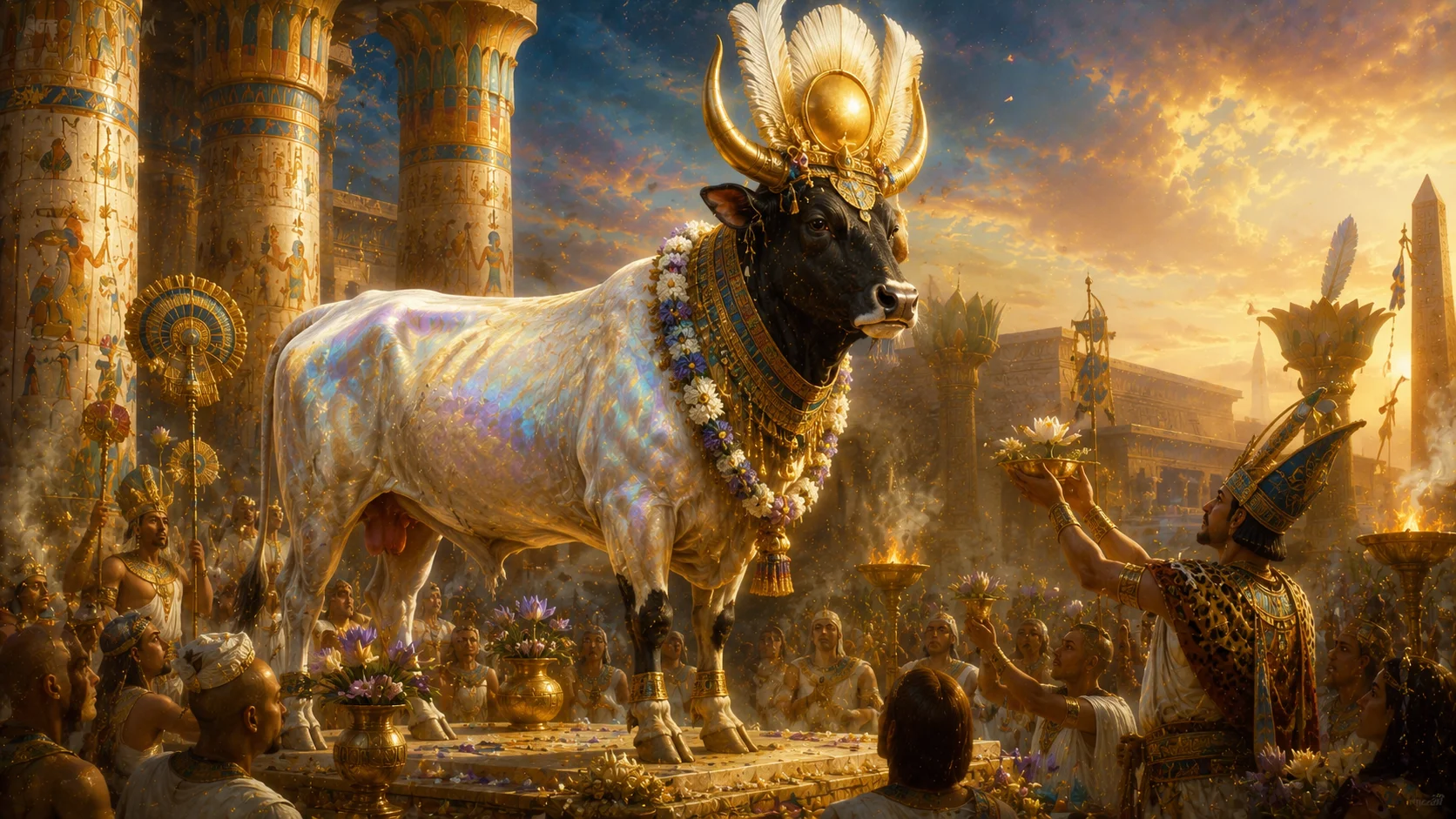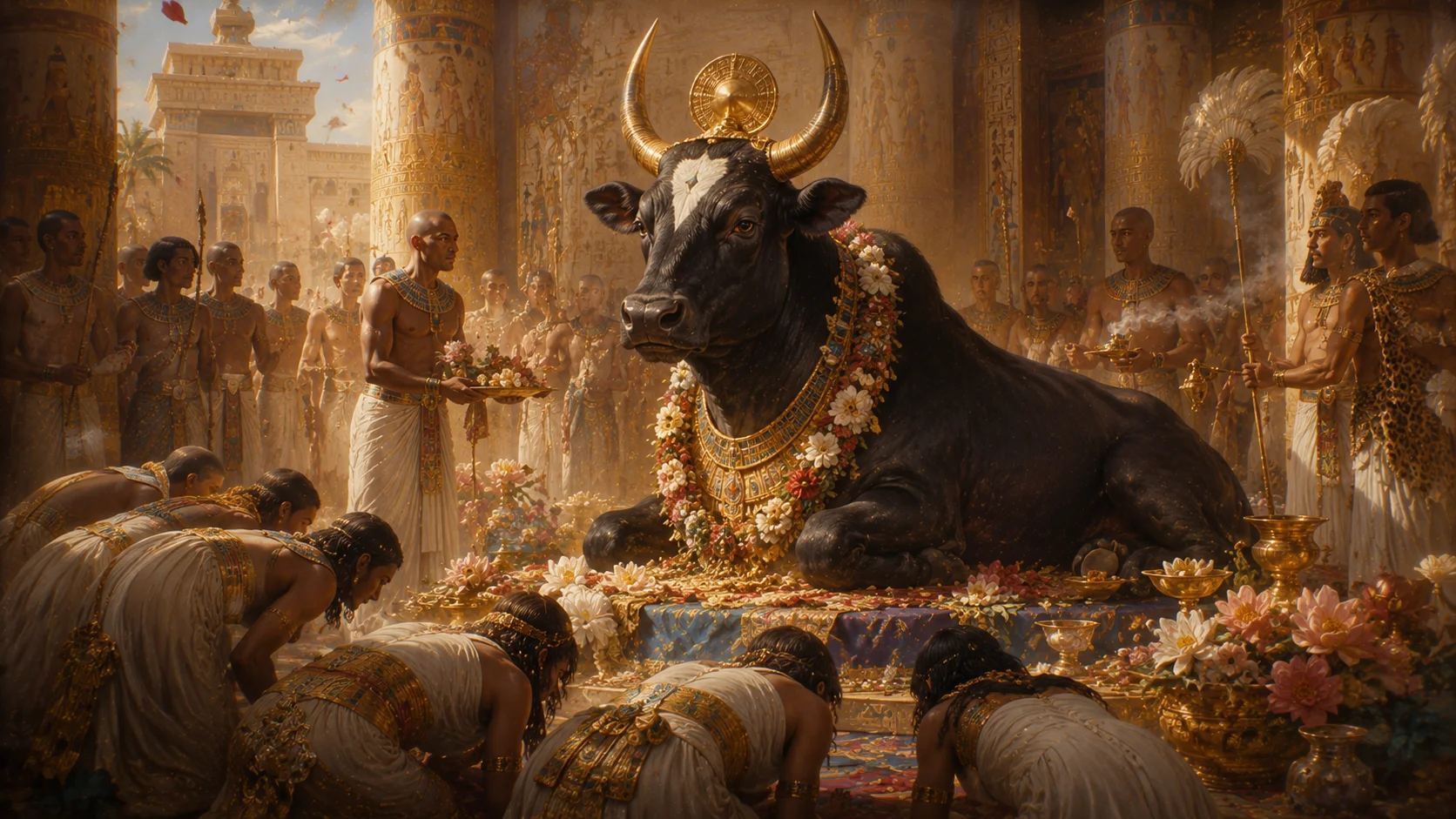
The Apis bull was the most sacred animal of ancient Egypt — a living bull worshipped as the earthly incarnation of a god (associated with Ptah and Osiris), chosen by sacred markings, pampered in a temple at Memphis, consulted as an oracle, and given a magnificent royal burial. The divine bull made flesh, the Apis is the most famous of all Egypt's sacred animals.
The Living God
The Apis (Egyptian Hapi-ankh) was a real, living bull kept at Memphis and worshipped as a sacred incarnation of the divine. The Apis was regarded as the living manifestation (the ba, or earthly form) of the great creator-god Ptah of Memphis, and was associated with fertility, strength, and the power of the king. A single bull at a time was the Apis, and at its death a new Apis was sought and installed — so the divine bull was continuously incarnate in a succession of living animals across the centuries.
The Chosen Bull
An Apis bull could not be just any bull: it had to be identified by specific sacred markings — a black bull with particular white markings (a white triangle or diamond on the forehead, a vulture- or eagle-shape on the back, a scarab-mark under the tongue, and other signs). When an Apis died, the priests searched throughout Egypt for the calf bearing these divine marks, and when it was found, it was installed with great ceremony as the new Apis. The chosen bull was then kept in luxury in its temple at Memphis, pampered and venerated, attended by priests, and given a harem of cows. It was, in effect, a god living in a stall, worshipped by all who came to it.
The Oracle and the Funeral
The Apis served as a powerful oracle: its movements and behaviour were interpreted as divine messages, and people came to consult it about the future, reading omens in the bull's actions (which stall it entered, whether it ate from an offered hand, and so on). When the Apis bull finally died, it was treated with extraordinary honour: its death was mourned throughout Egypt, and its body was elaborately mummified and given a magnificent funeral, buried in a massive stone sarcophagus in the great underground galleries of the Serapeum at Saqqara, alongside the mummified bodies of previous Apis bulls. In death, the Apis was identified with Osiris (as “Osiris-Apis,” which gave rise to the later god Serapis), uniting the living bull of Ptah with the lord of the dead.
The Sacred Bull of Memphis
The Apis endures as the most famous and sacred of all Egypt's sacred animals — the living bull worshipped as the incarnation of Ptah and, in death, of Osiris, chosen by divine markings, consulted as an oracle, and given royal burial in the Serapeum. It embodies the Egyptian practice of venerating the divine made present in a living animal, and the deep belief that a god could be incarnate in a chosen beast; and it stands as the divine bull of Memphis — a god living among men in the form of a magnificent bull, pampered, worshipped, consulted, and finally entombed with the honours of a king.
A living god in the form of a bull, chosen by sacred markings and pampered in his temple — the most sacred animal of Egypt, consulted as an oracle and entombed at last with the honours of a king.
Older Than the Pyramids
Before Egypt built in stone, it was already running the bull. The Running of the Apis — a ritual whose exact choreography is lost to us, in which the sacred bull was made to run a course — is recorded on the Palermo Stone, the great annal-slab that preserves the reign-by-reign memory of Egypt’s earliest kings. The rite appears there in the First Dynasty, around 3000 BCE. Attested from that point down into the Roman period, the Apis has one of the longest documented histories of any cult on earth — and it means the bull was already three centuries old as an institution when the first pyramid was raised at Saqqara, on the very plateau where, three thousand years later, the last of his successors would be buried.
The Egyptian name was simply Hep (written Hp), and the living animal was Hep-ankh, “Apis the living”; “Apis” is the Greek mouth’s version of it. He should not be confused with Hapy, the fat-bellied god of the Nile flood, whose name looks similar in transliteration and means something else entirely. One of the bull’s standing titles was the herald of Ptah, and the word matters: a herald does not replace the king he speaks for. The Apis was never a second god competing with the creator of Memphis. He was Ptah’s voice, made audible in a body that could walk into a room.
The Cow Struck by Light
A god has to be born of something. The classical writers who visited Egypt were told that the Apis was not conceived in the ordinary way at all: Herodotus reports that a flash of light descends from the sky onto the cow, and from that she brings forth the Apis. Plutarch, writing centuries later, specifies that the light comes from the moon. Whether Egyptian priests actually taught this or whether it is what they told inquisitive Greeks, the story does a precise theological job: it removes the bull’s father from the equation and makes the sky itself the sire.
The cow, however, was very real, and Egypt did not forget her. She became the Mother of Apis, holy for the rest of her life by virtue of what she had carried, and in the later periods she was buried in her own catacomb at Saqqara, in a gallery cut for the purpose near her sons’. It is one of the quietly moving facts of the cult. A religion capable of building seventy-tonne stone boxes for a bull also built a tomb for his mother, and thought it obvious that it should.
Seventy Days on a Bed of Alabaster
You can still stand where the Apis was embalmed. At Mit Rahina, in the ruin-field of ancient Memphis, several enormous travertine tables lie in the open air — slabs of banded alabaster the size of small boats, some carved with lions along the flanks, grooved and channelled to carry fluid away. These are the beds of the Apis embalming house, and they are sized for a bull.
The work done on them took seventy days, the same span given to a dead king, and it was governed by a written liturgy: a surviving ritual papyrus sets out the treatment of the bull’s body organ by organ and bandage by bandage, with the words to be spoken over each stage. Only a handful of such step-by-step embalming manuals survive from the whole of Egypt — and one of them was written for an animal. When the seventy days were done, the bull was drawn to Saqqara on a sledge, up the desert edge, and lowered into the rock.
The bull that keeps the calendar
Every burial was marked with a stone. Hundreds of votive and commemorative stelae were set up in the Serapeum, and the official ones are almost bureaucratically precise: this Apis was born on such a day of such a regnal year, installed at Memphis on such a day, died on such a day, was buried on such a day, and lived so many years, months and days. The priests were recording a god’s biography. What they actually left behind is one of the sharpest chronological instruments Egyptology possesses. Because the bulls’ lives overlapped reigns, their dates lock kings into sequence and pin the length of reigns that would otherwise float — particularly through the Saite and Persian centuries. Classical writers claimed that an Apis was not permitted to outlive twenty-five years and was drowned when he reached it; the Egyptians’ own careful tally of years, months and days is a better witness than the rumour, and it is the tally that historians use.
The other stelae are the human ones: small, cheap, roughly cut, set up along the processional way by people who came to ask the bull for something. They are the residue of ordinary devotion — the Serapeum was a pilgrimage destination, not merely a royal mausoleum.
Living Inside the Temple
The Memphite Serapeum precinct in the Ptolemaic period had permanent residents who were not priests. They were called katochoi, “the held” or “the detained” — people who had entered the sanctuary in response to a dream or a divine summons and simply did not leave. The papers of one of them survive in quantity: a Greek-speaking man named Ptolemaios, son of Glaukias, who lived in seclusion there in the second century BCE, wrote down his dreams, quarrelled with the temple staff, petitioned officials, and busied himself with the affairs of two twin sisters who served in the cult and were being cheated of their rations.
This is what makes the Apis unlike most ancient religion, which reaches us as monument and silence. Here the paperwork survived. We know the temperature of the place: a foreign recluse in a bull god’s courtyard, filing complaints about somebody’s bread allowance and recording what he saw in his sleep. Along the same avenue, the Ptolemies installed a semicircle of statues of Greek poets and philosophers — a reading room in stone, set down in front of the tomb of an Egyptian bull. Two civilisations sharing a driveway.
Cambyses and the Wound That Never Happened
The most famous story about the Apis is that a foreign king murdered him. Herodotus tells it with relish: Cambyses II of Persia, having conquered Egypt, returns to Memphis to find the whole city celebrating, assumes the festivities mock his military failures, demands to see this god, and stabs the bull in the thigh with his dagger, laughing at a deity made of flesh and blood. The bull dies. Cambyses goes mad. It is a perfect imperial morality tale — the conqueror who insults a god and is unmade by it.
The Serapeum says otherwise. An Apis did die during Cambyses’ occupation, and the record of that death is not a wound and a scandal but a state funeral: the burial was carried out with full honours in a commissioned sarcophagus, and Cambyses himself appears on the accompanying stela kneeling in reverence before the bull. Whatever the Persian king was, he was politically literate enough to bury Egypt’s god correctly and to be seen doing it.
So we have two sources and they do not agree, and the disagreement is more interesting than either. Herodotus was not lying; he was repeating what Egyptians told him a generation or two after the conquest. What survives in the galleries is the official version carved at the time. What survives in Herodotus is the version people were still telling each other afterwards — the story a defeated country tells about the man who defeated it. The stab in the thigh is not history. It is a nation’s memory of humiliation, given a shape it could carry.
What Mariette Found in the Sand
The Serapeum was lost for well over a thousand years. It was recovered in 1851 by Auguste Mariette, who had been sent to Egypt to buy Coptic manuscripts, spent the money digging instead, and was working from a single sentence in the geographer Strabo, who had described a temple of Serapis in a place so sand-blown that the sphinxes of its avenue stood buried up to their heads. Mariette found a sphinx head protruding from a dune, followed the line, and uncovered the avenue — and then the doorway, and then the galleries.
Inside are hundreds of metres of tunnel with side-chambers cut off them. The later vaults hold twenty-four colossal granite sarcophagi, each box cut from a single block and weighing on the order of seventy tonnes, each lid another thirty on top of that — hauled underground, through corridors barely wider than themselves, and manoeuvred into niches. Nearly all of them were found open and empty. Robbers had reached them long before, and the bulls were gone.
But one chamber, in the older section, had never been opened. Mariette broke into a room sealed since the Nineteenth Dynasty and found the burial intact — and, in the dust of the floor, the footprints of the last workman to walk out of it, more than three thousand years earlier. That single detail is why the Serapeum occupies the place it does in the imagination. Everything else in the complex is enormous. The footprints are the human size of it.
The prince who organised the dead
The earlier galleries owe their existence to Khaemwaset, a son of Ramses II and High Priest of Ptah at Memphis, who reorganised the Apis burials into a single connected series of chambers instead of scattered individual tombs. He was also, by inclination, something close to Egypt’s first archaeologist: he went about restoring Old Kingdom monuments already a thousand years old in his own day and recording whose they had been. Egypt remembered him. Centuries later he reappears as the hero of a cycle of Demotic tales — “Setne Khamwas,” the prince-magician who steals a book of spells from a tomb and is punished for it. The man who curated the tombs of the bulls became a ghost story.
The Other Bulls
Apis was the most famous, not the only one. By the Late Period Egypt maintained at least three great living bulls at once, each belonging to a different city and a different god, and the differences between them are instructive.
- Mnevis (Egyptian Mer-wer) belonged to Heliopolis and to the sun — the living bull of Ra-Atum, black like the Apis and distinguished by his own markings. His standing was such that even Akhenaten, who dismantled the temples of the other gods, provided in the boundary decrees of his new city for a tomb for the Mnevis bull. Whatever the heresy was, the sun’s bull was inside it.
- Buchis (Egyptian Bakha) belonged to Armant in the south and to Montu, the falcon-headed war god. His burials were made in a gallery of their own, with a separate catacomb for his mothers, exactly as at Saqqara. The late Roman writer Macrobius passes on the claim that the Buchis bull changed colour every hour and that his hair grew backwards — the kind of marvel that accretes to a sacred animal seen at a distance by people who never saw it.
What the three share is the underlying idea, and it is a strange one: divinity was not thought to be trapped in statues. It could be lodged in something warm that ate and slept and would eventually die, and Egypt built the institutional machinery — search parties, marks of recognition, installation rites, a stall, a harem, an embalming house, a catacomb — to handle the consequences.
From Osiris-Apis to Serapis
A dead Apis became Osiris-Apis, Wsir-Hep, which Greek speakers heard as Osorapis. Out of that name and that idea, in the first generation of Greek rule, came Serapis.
The new god was a deliberate act of policy. Promoted under Ptolemy I, Serapis kept the Egyptian theology of the dead bull-god but was given a body Greeks could pray to: a mature bearded man in the manner of Zeus, with a corn-measure on his head to mark abundance and the underworld dog at his feet. He drew in Hades, Dionysus and Asklepios, healed the sick, and travelled. Serapis went where Egypt itself never had — his temples stood across the Mediterranean and as far as the frontiers of the Roman world — and his great sanctuary in Alexandria became one of the most celebrated buildings in antiquity until it was destroyed by a Christian mob in 391 CE.
It is worth being clear about what happened here. The bull did not become Serapis. Serapis was built from the bull, out of the one aspect of him — the Apis who had died and become Osiris — that could be lifted out of Memphis and shipped. The living animal in the stall at Memphis stayed where he was, and stayed a bull, and the Egyptians who venerated him went on doing so alongside the new god who had been distilled from his death.
How to Recognise Him
He is easy to identify once you know the signs. In bronze and in relief the Apis is a striding bull, black or dark, with a sun disc set between his horns and a rearing uraeus — the royal cobra — in front of it. What the craftsmen were doing was carving the recognition-marks themselves onto the image: the very signs by which priests identified a living calf as the god were cut into his shoulders and flanks in metal, so that a votive figure the size of a hand makes exactly the same claim as a search party in the Delta. Small bronze Apis figures were made in quantity as votives and fill museum cases today; they were the affordable end of devotion, the thing you left behind when you could not commission a stela.
The other image to know is funerary and unmistakable once seen: the bull carrying a mummy on his back, striding forward with the wrapped body laid across him. It appears on coffins and papyri of the later periods and it is a statement about transport — the Apis, who runs, carries the dead to where they are going. On coins struck at Alexandria under Roman rule the bull is still there, centuries after the pharaohs, still walking.
Why a God Would Choose to Be a Bull
Every religion eventually runs into the same problem: a god you can see is a god who can be lost. Statues are safe because they do not breathe. The moment you locate the divine in something with a pulse, you have accepted that the divine will one day be found dead in a stall, and you have to have an answer ready.
Egypt’s answer was to separate the god from the container completely. The Apis did not die, because the Apis was never the animal — the animal was only where the Apis currently was. When the body failed, the god was not diminished by so much as an hour; he simply had to be found again, and the marks by which to find him were known. The search that followed each death was not a period of mourning for an absence. It was a manhunt for a presence that had already relocated and was, at that moment, standing in a field somewhere in the Delta, unaware, being nudged by its mother. This is the same logic by which several living traditions still recognise a returning teacher in a newly born child — not a borrowing in either direction, but the same solution reached by people facing the same difficulty.
And beneath the theology sits something older and less refined, which is why the bull and not some other creature. A bull is the largest dangerous thing a farming people ever have to stand next to. It is fertility and violence in one body, the animal that makes the herd and the animal that can kill you on a whim, and it is the plainest available image of a power that is essential and not safe. Egyptian kings understood this perfectly: they called themselves Ka-nakht, “strong bull,” and wore a bull’s tail fastened to the back of the royal kilt. The pharaoh dressed as the animal. The god simply moved in.
Sources & traditions
- EncyclopediaWikipedia — Apis (deity)
- TraditionEgyptian texts, inscriptions and later retellings
Myths change from area to area and from time to time. This chronicle follows the most widely told versions; tellings in other villages, regions and eras may differ.