Apophis (Apep) was the great serpent of chaos in ancient Egyptian myth — the colossal snake of darkness, dissolution and non-existence who attacked the sun-god Ra every night as he sailed through the underworld, seeking to swallow the sun and plunge the world into eternal darkness. The eternal enemy of the sun and of all order, he is chaos itself, fought and defeated anew every single night.
The Serpent of Chaos
Apophis (Egyptian Apep; Greek Apophis) was the embodiment of chaos, darkness, dissolution and non-existence — the great cosmic enemy, the force opposed to all order, light and creation (the opposite of Ma'at). He was depicted as a colossal serpent, a monstrous snake of immense size, the personification of the chaos that preceded creation and that forever threatened to swallow the ordered world back into the dark formless void. He was not a god to be worshipped but a force of pure destruction to be fought, feared and warded off — the eternal adversary of the sun and of existence itself.
The Nightly Attack on the Sun
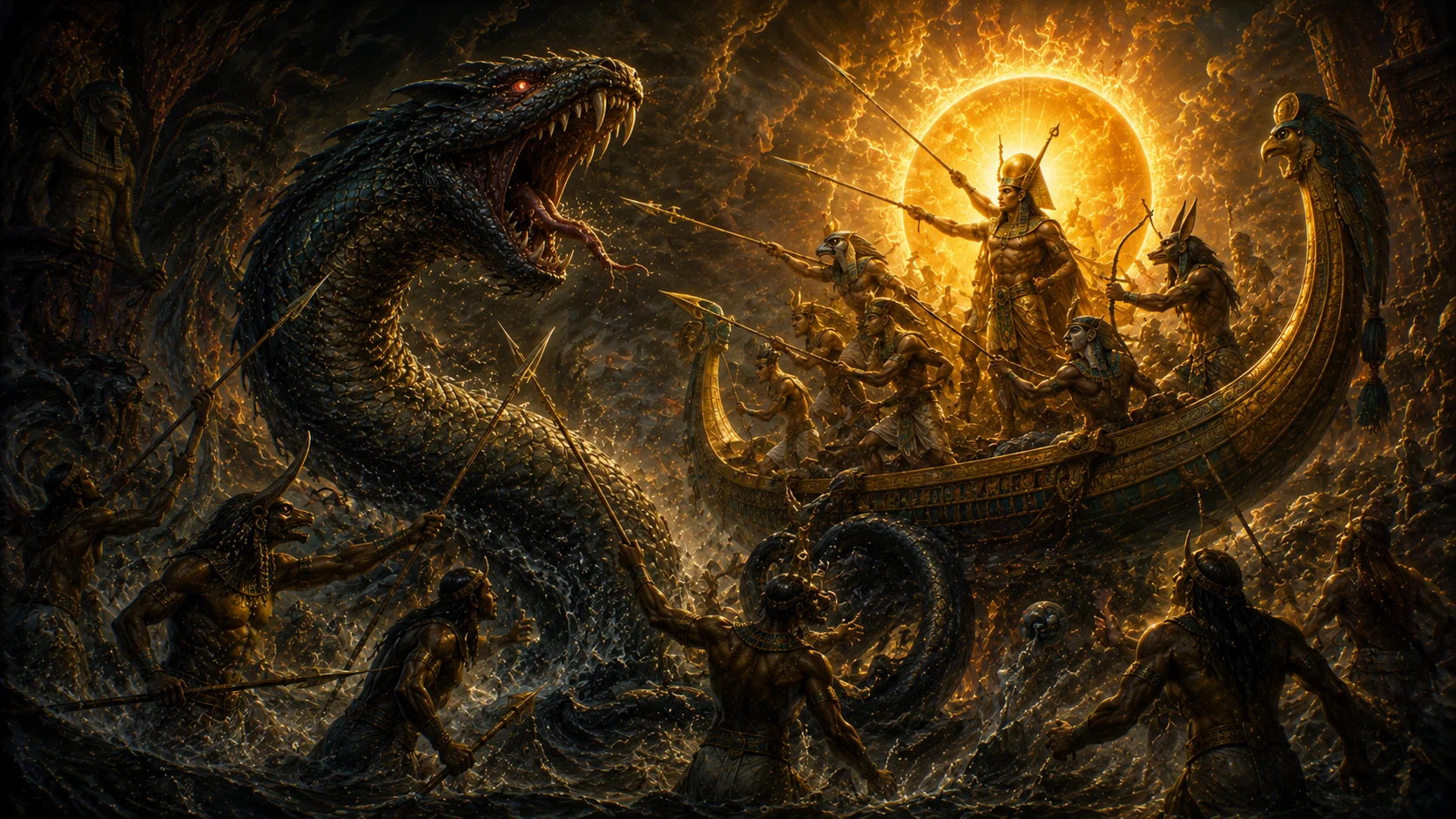
Apophis's defining role was his eternal nightly battle against the sun-god Ra. Each night, as Ra sailed his solar barque through the twelve dark hours of the underworld (the Duat), Apophis lay in wait to attack the barque and devour the sun — for if the serpent of chaos could swallow the sun, the sun would not rise, and the world would be plunged into eternal darkness and dissolution, creation undone. Every night, Apophis assailed the solar barque, trying to stop the sun's journey; and every night, Ra and his defenders — including the protective serpent Mehen, the god Set (who stood at the prow and speared the serpent), and others — fought and defeated Apophis, cutting, binding and driving back the great snake so that the sun could complete its journey and rise again at dawn. This nightly battle was the central cosmic drama of the Egyptian universe: the eternal struggle of order against chaos, light against darkness, existence against non-existence, fought and won anew every single night.
The Eternal Enemy
Apophis could never be permanently destroyed — he was wounded, cut to pieces, burned and bound each night, but he always returned, for chaos is eternal and the struggle never ends. The Egyptians took the threat of Apophis seriously enough to perform rituals to aid Ra in the battle: priests recited spells and performed rites (the “Books of Overthrowing Apophis”) to curse, weaken and destroy the serpent, making wax or other images of Apophis and ritually destroying them to help defeat the chaos-snake and ensure the sun would rise. Solar eclipses, storms, and the darkness of a sunless day were attributed to Apophis temporarily gaining the upper hand. He was the ever-present threat at the heart of the cosmos, the chaos that must be fought without end.
The Chaos That Must Be Fought Forever
Apophis endures as one of the most powerful and important figures in all of Egyptian myth — the great serpent of chaos, the eternal enemy of the sun and of all order, who attacks the sun-god every night and is defeated and yet always returns. He embodies the Egyptian vision of the cosmos as an eternal struggle between order (Ma'at) and chaos (isfet), light and darkness, existence and non-existence; and he stands as chaos itself made into a monster — the colossal serpent that must be fought and defeated anew every single night so that the sun may rise, the world endure, and creation continue against the ever-present threat of dissolution into the dark.
The colossal serpent of chaos who attacks the sun every night, seeking to swallow it and plunge the world into eternal darkness — defeated each night, yet always returning, the eternal enemy that must be fought forever so the sun may rise.
Before the Serpent Had a Name
Apophis is missing from the oldest religious writing Egypt has left us. The Pyramid Texts, carved inside royal burial chambers at the close of the Old Kingdom, are crowded with hostile snakes — spells to shut a serpent's mouth, to make it lie down, to send its venom back into the ground — but the name Apep is not among them. He surfaces in the Coffin Texts of the Middle Kingdom, at the moment when spells for the journey through the night were being painted on the coffins of officials rather than sealed inside royal pyramids, and from then on he never leaves. That sequence is worth sitting with. Apophis is not a fossil from some primordial Egyptian past; he grew as the Egyptian map of the darkness grew. He arrives when people begin to imagine the twelve hours of night in detail — and to ask what is waiting in them.
He also has no proper birth, and the omission is telling. Egyptian gods are generated: spoken, spat, sweated, willed into being by Atum on the first mound to rise from the water. Apophis is the exception the texts mostly decline to explain. He is what was there before creation and what creation failed to use up — the residue of Nun, the dark limitless flood. A much later account, preserved in the temple at Esna, does grant him a mother of sorts: the goddess Neith rises from the primeval water, spits, and her spittle falls back into the abyss and thickens into the serpent. Even there he is a by-product. Nothing ever intended him. That is the horror of him.
A Name Written in Pieces
Egyptian scribes worked on the assumption that writing is not a record of a thing but a small living copy of it. That assumption produced one of the strangest habits in the history of literacy: inside tombs and on coffins, where the deceased had to lie beside the text for eternity, dangerous signs were mutilated on the page. Snakes were drawn cut in half, with the two halves set slightly apart so they could not rejoin. Horned vipers were speared through with knives. Birds and human figures were left without their legs, or replaced by harmless substitutes. The scribe was not decorating; he was making the hieroglyph safe to be sealed in a room with a helpless body.
Apophis's name takes this treatment as a matter of course. It is written with the coiled serpent already knifed, already severed, already dead in the writing of it — a curse folded into orthography. The same logic runs the other way in the ritual books, one section of which is devoted to knowing all of the serpent's names. To an Egyptian magician this was not liturgical decoration but the whole mechanism: a being's true name is its handle, and to say all of a thing's names is to have hold of every part of it. The war against chaos was, at bottom, a literacy problem. You beat it by knowing what to call it and how to spell it wrongly on purpose.
How Egypt Actually Fought Him
The nightly battle is easy to file away as something Egyptians merely believed. It was something they did, on a schedule, with equipment. The fullest surviving instructions sit in the Bremner-Rhind Papyrus, copied around the end of the fourth century BC from considerably older material, and they read less like theology than like a workshop procedure.
- Draw the serpent on a fresh sheet of papyrus in green ink, and write his name on it so the drawing is unambiguous about who is being destroyed.
- Model him in wax — a soft, meltable body, chosen for exactly that property.
- Spit on him. Trample him with the left foot. Cut him with a knife.
- Burn what remains, and let the fire finish where the blade stopped.
The rite belonged to the great temples and was repeated daily, and again at any hour when the sky misbehaved. What makes it revealing is what happened to it at the edges. The same ritual could be pointed at human beings: the names of the king's enemies, foreign rulers, rebels, could be written on the figure alongside the serpent's. Chaos was a category with room in it, and the state that defended the sun each morning was the same state that decided who counted as the sun's enemy. This is not a hypocrisy an Egyptian would have recognised. Order was one thing, indivisible, and treason and eclipse were two symptoms of it failing.
Below the temple level, the fear was entirely practical. Egypt has cobras and horned vipers, and children in a village of mudbrick houses met them regularly. The apotropaic wands, the snake spells, the household charms and the cobra goddesses of the fields all address the same animal that coils through the netherworld books. Apophis is what a genuinely dangerous local reptile becomes when you enlarge it until it is the size of the sky.
The Sandbank in the Seventh Hour
The most detailed picture of the fight is not in a story at all but in the illustrated guidebooks to the underworld painted on the walls of royal tombs in the Valley of the Kings — the Amduat and the Book of Gates, hour-by-hour charts of the night with the sun's boat moving through them like a vessel on a river with known hazards.
In the seventh hour of the Amduat the hazard is a sandbank. Apophis has swallowed the water of the underworld river, and the barque of the sun is left aground on the exposed bed — a specifically Egyptian nightmare, because a boat stranded on a Nile sandbank is a thing every sailor on the river had seen. This is the hour at which the sun is weakest, and the remedy is not muscle. Knife-bearing goddesses pin the coils while spells are recited over the serpent; magic, not force, refloats the boat. It is a striking admission for a state religion built on royal strength: at the darkest hour of the night, what saves the world is heka — spell-craft, the correct words in the correct order — which is precisely what the priests in the temple above were supplying.
The Book of Gates shows the aftermath: the enormous body hauled and bound, held down by ropes and chains, pinioned by hands that emerge from the ground itself. Nobody in these scenes is killing him. They are restraining him, and everyone drawing them knew he would be loose again by tomorrow.
How to Recognise Him in Art
Apophis is one of the few major figures in Egyptian art with no cult image, no statue receiving offerings, no temple in which to stand. He is only ever shown at the moment of being defeated, which makes him unusually easy to identify.
Look for an outsized serpent under or beside a boat, its coils studded with knives like pins in a cushion, or bound with rope, or chopped into segments that have been separated so they cannot knit together. Look for a spear entering the body from the prow of the solar barque. And look, above all, for the cat.
One of the most reproduced images in all Egyptian funerary art comes from Spell 17 of the Book of the Dead: a great cat, sitting upright beside the sacred ished tree at Heliopolis, holding a knife to the neck of a coiled serpent. The cat is the sun-god himself, in the form of the household animal that Egyptians kept precisely because it kills snakes. The version painted in the tomb of the workman Sennedjem at Deir el-Medina is the famous one — a tabby with careful stripes, entirely domestic, doing cosmic work. It is the whole theology compressed into a scene from a kitchen floor.
Set at the Prow, or Two Kinds of Disorder
The strangest crew member on the night boat is Set — the god who murdered his brother Osiris, dismembered him and scattered him, the patron of the desert, of foreigners, of storms and of violence. In most of the stories he is the problem. On the solar barque he is the solution: the texts and the tomb walls hand him the spear and the killing.
This is not an inconsistency. It is Egypt distinguishing carefully between two things that a modern reader tends to collapse together. Set is disorder inside the system — disruptive, dangerous, sexually and physically excessive, but a god, with a name, a cult, a genealogy and a place in the order he keeps damaging. He can be quarrelled with, judged, punished, and put to work. Apophis is isfet in its pure form: not a bad member of the order but the negation of order as such, with no cult, no offerings, no bargaining position and nothing to say. The Egyptians understood that a civilisation needs a certain amount of violence on its own side, and they put it at the front of the boat where it was useful. What they would not do is give the void a seat.
The Snake That Crowns and the Snake That Devours
Egypt's imagination is full of serpents, and they are not all on the same side. This matters, because it shows the Egyptians were not afraid of snakes in some vague symbolic way — they had a whole taxonomy, and Apophis occupies one specific slot in it.
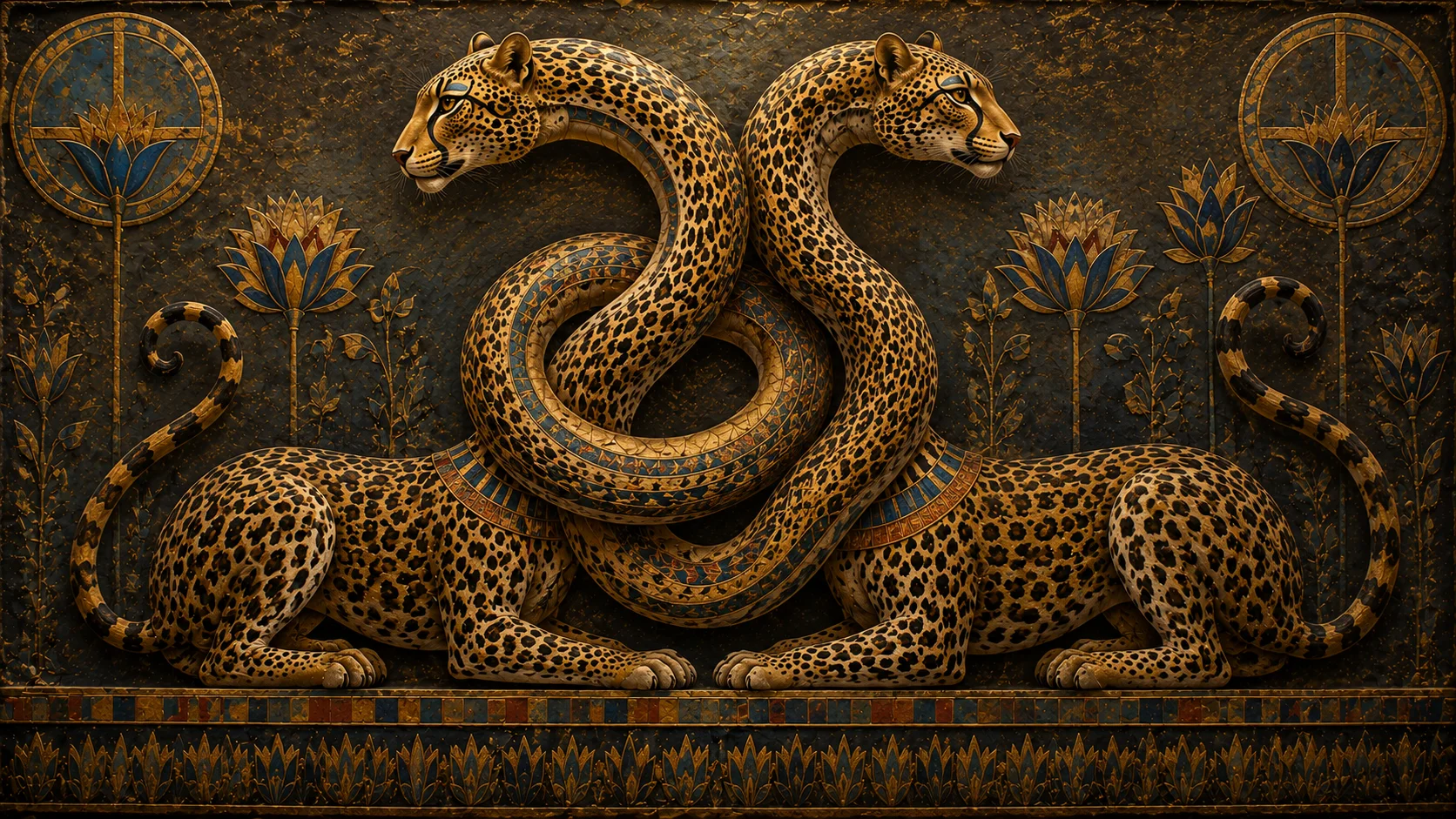
The uraeus — the rearing cobra on the pharaoh's brow — is the goddess Wadjet, and she spits fire at the king's enemies. Mehen is a serpent too, and he coils protectively around the sun-god in the boat, a snake used as armour against a snake. Renenutet, a cobra, presides over the harvest and the nursing of children. Meretseger, “she who loves silence”, lives in the pyramid-shaped peak above the Valley of the Kings and both punishes and forgives the tomb-workers who confessed their offences to her on small stelae. The same body plan that ends the world also protects the king's forehead, guards the grain and hears a workman's apology.
What distinguishes Apophis from all of these is not that he is a snake. It is that he cannot be brought into relationship. Every other serpent in Egypt can be placated, worn, fed, thanked or apologised to. He is the one that will not negotiate.
The King Who Took His Name
In the sixteenth century BC, Lower Egypt was ruled from Avaris by the Hyksos, and one of their last and most powerful kings was called Apepi — Apophis. A real, historical man, issuing real decrees, bearing the name of the serpent that eats the sun. Egyptologists still argue about what to make of it; the Hyksos rulers favoured Set, and it is possible the name carried associations for them that it did not carry at Thebes. We do not actually know.
What survives is stranger still. A New Kingdom literary tale, written down on Papyrus Sallier I some centuries after the events it describes, opens the war of liberation with a diplomatic insult of exquisite absurdity: King Apophis sends a message hundreds of miles south to the Theban ruler Seqenenre Tao, complaining that the hippopotami in the Theban canal are bellowing so loudly that he cannot sleep in Avaris. The demand is impossible on purpose — a pretext dressed as a grievance, and a scribe's joke about how wars really start. The papyrus breaks off before the answer.
History supplies an ending the story does not. Seqenenre Tao's mummy carries catastrophic head wounds, struck repeatedly with axe, dagger and spear. Whether he fell fighting or was killed after being taken is still argued by the people who scan the body; that he died violently, and that Thebes went to war with Avaris, is not. His successors drove the Hyksos out and founded the Eighteenth Dynasty and the empire that followed it. A king named for the serpent really did face the house of Thebes, and Thebes really did lose the first round.
The Battle That Is Never Won
Nearly every civilisation that tells a version of the fight against the chaos-monster brings it to an end. Marduk kills Tiamat and builds the sky from her body. Yahweh crushes the heads of Leviathan. Indra splits Vritra and releases the rivers. Thor and Jörmungandr destroy each other at Ragnarök. The monster dies, and something — a world, a covenant, a new age — is founded on the corpse.
Egypt refuses this. There is no founding victory because there is no linear time to found anything in: the Egyptian universe runs on neheh, cyclical repeating time, in which the important events do not happen once but happen every day, forever. Dawn is not a memory of a battle. Dawn is the battle, being won again.
This is a harder and more demanding cosmology than the ones with a final victory in them. If the monster stays dead, the priest's job is commemoration. If it does not, the ritual has to be performed again tomorrow, and the day after, for two thousand years — which is roughly how long the Egyptians kept performing it, from the Middle Kingdom coffins to the Roman-period temple walls. Egyptian religion contains almost no apocalypse; the one significant exception is a passage in the Book of the Dead in which Atum tells Osiris that the world will eventually sink back into the flood, and that the two of them will outlast it in the form of serpents no one will see. Even the end of Egypt's world is a snake in dark water.
The Serpent Comes Back as a Rock
In June 2004 astronomers found a near-Earth asteroid a few hundred metres across. Early observations were alarming: that December it was briefly rated 4 on the Torino impact scale — still the highest rating ever assigned to any object — with a roughly one-in-thirty-seven chance of striking the Earth on 13 April 2029. Better tracking removed that risk within days, and radar observations in 2021 ruled out an impact for at least a century. It will still pass closer than the geostationary satellites — near enough to be seen from the ground with the naked eye across parts of Europe, Africa and western Asia.
Its discoverers named it 99942 Apophis, after the serpent. They were, by their own account, fans of a science-fiction series in which the name belonged to a villain — so the myth reached them at second hand, through a television screen, four thousand years after a scribe first drew it with knives in its coils. The route hardly matters. What matters is that when human beings needed a name for a large dark object out beyond the sunlight that might one day end everything, the name that came to hand was the Egyptian one.
That is why the story persists. Every culture that has ever watched the sun go down has had to decide, without evidence, whether it is coming back. Egypt answered by admitting that the question was real, that something out there genuinely wanted the answer to be no, and that the only defence was to get up and do the work again in the morning. The serpent was never killed because the anxiety it embodies is not the kind of thing that dies. It is simply held off, one night at a time — which is, in the end, the only way anything is ever held off.
Sources & traditions
- EncyclopediaWikipedia — Apophis
- TraditionEgyptian texts, inscriptions and later retellings
Myths change from area to area and from time to time. This chronicle follows the most widely told versions; tellings in other villages, regions and eras may differ.