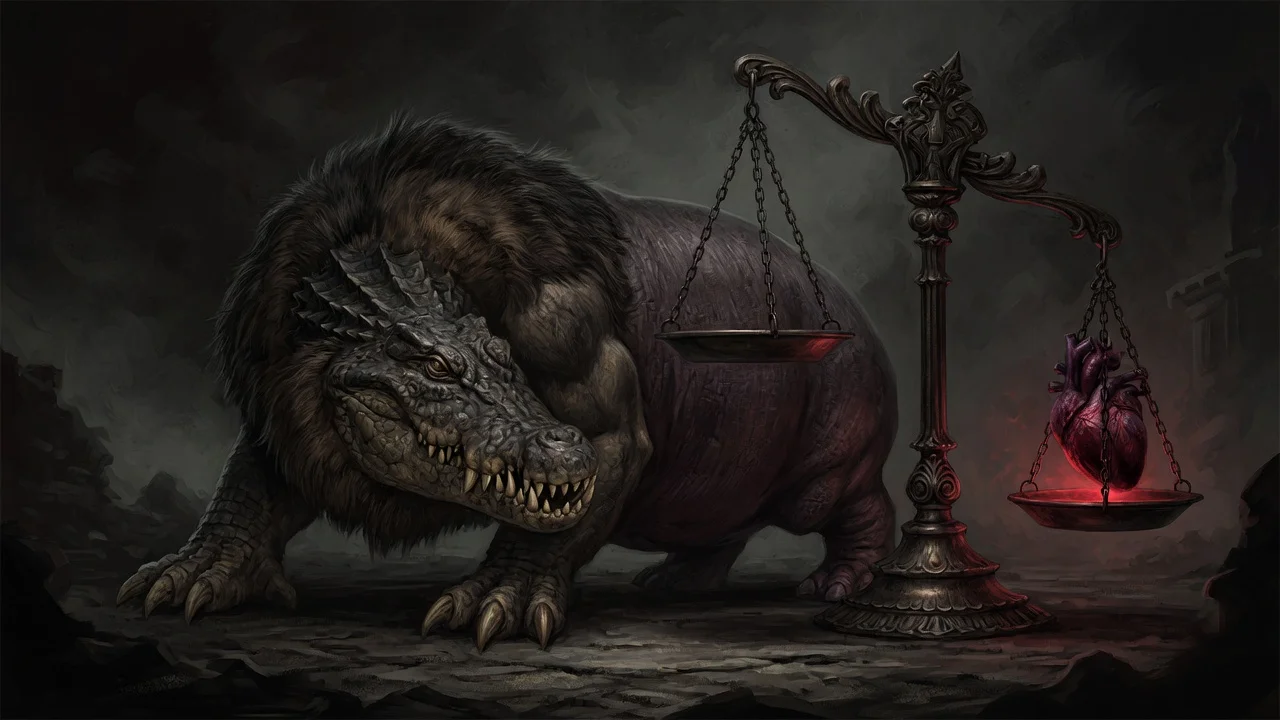
Ammit was the soul-devouring monster of the Egyptian underworld — the “Devourer of the Dead,” a fearsome composite beast (part crocodile, part lion, part hippopotamus) who waited at the judgement of the dead to devour the hearts of the wicked, condemning them to oblivion. The dreaded eater of souls, she is the second death that awaited those who failed the weighing of the heart.
Three Predators Made One
Ammit — rendered in Egyptian sources as Ammit or Ammut, meaning “Devourer” or “Eater of the Dead” — was not imagined as a single animal but as a deliberate composite of the three creatures the Nile Valley feared most. She carried the head of a crocodile, the forequarters of a lion (in some renderings a leopard), and the hindquarters of a hippopotamus. Each of these animals was independently capable of killing a person outright, and Egyptian iconography elsewhere used them individually to signal danger and chaos. Fused into one body, they became something more than the sum of three predators: a single figure built specifically to represent total, irreversible destruction. There was no ambiguity in the symbolism. A crocodile's jaws, a lion's forequarters, a hippopotamus's bulk — every part of Ammit's body was drawn from something an Egyptian audience already associated with sudden, violent death, and stitched together into a shape that could stand at the one place in the afterlife where such an outcome was actually possible.
Stationed Beside the Scales
Ammit's presence in Egyptian belief is almost entirely confined to a single setting: the Hall of Two Truths, also called the Hall of Ma'at, where the dead were brought for judgement as described in the Book of the Dead. She is not given a home, a origin story, or a place in the wider landscape of the underworld the way many other funerary figures are. She simply crouches beside the great scales, present at the judgement and nowhere else that Egyptian funerary texts record. This narrow, fixed role is itself part of what made her so effective as a figure of dread: she did not wander the underworld threatening the dead at every turn, she waited at the one moment that mattered, silent and immobile until the outcome of the weighing was decided.
The Weighing of the Heart
The ceremony at which Ammit waited is the psychostasia, the weighing of the heart, one of the central rites described in the Book of the Dead. The deceased's heart — understood by the Egyptians as the seat of conscience, memory, and moral character, not merely a physical organ — was placed on one pan of a great scale. On the other pan sat the feather of Ma'at, the goddess who personified truth, order, and cosmic balance. The two were weighed against each other in front of the assembled tribunal of the dead. A heart that balanced evenly with the feather, or proved lighter, testified that its owner had lived in accordance with Ma'at's order rather than against it. A heart weighed down by wrongdoing tipped the scale, and it was at that moment, and only that moment, that Ammit's role began.
Under the Eyes of Anubis and Thoth
Ammit did not preside over the judgement alone, and Egyptian sources do not depict her as an independent judge. The god Anubis conducted the actual weighing, adjusting and reading the scale, while Thoth, in his role as the divine scribe, stood ready to record the result. Ammit's place in this tribunal was that of consequence rather than judge: she did not decide whether a heart was heavy or light, she carried out what the scale had already determined. This distinction mattered to how the Egyptians understood her. She was not a figure of arbitrary cruelty weighing lives on a whim, but the mechanism through which an already-rendered verdict was made final and irreversible, operating alongside — and only alongside — the gods who oversaw truth and record-keeping.
Devouring the Failed Heart
When the heart proved heavier than the feather, Ammit acted. She devoured the heart outright, and with it, everything the heart represented. This was the single act for which she existed within Egyptian funerary belief, and the sources give her no other function. There is no version of the judgement scene in which Ammit intervenes before the weighing, argues a verdict, or pursues the deceased elsewhere. She is a consequence given form: the physical, irreversible enactment of a verdict already rendered by the scale, carried out the instant that verdict was reached and not before.
The Second Death
To be devoured by Ammit was understood as the “second death,” a fate categorically worse than ordinary death because it destroyed the very components of a person that Egyptian belief held necessary for continued existence. The devouring of the heart meant the destruction of the ba and the akh — the aspects of the self that Egyptian funerary religion depended on surviving into the afterlife. Where ordinary death was a transition, the second death was an ending with no further transition possible: no journey to the fields of Osiris, no continued existence in any form, nothing beyond it. This is what set Ammit apart in kind, not just in degree, from figures of punishment found in many other traditions.
Annihilation, Not Torment
It is worth being precise about what made Ammit's role distinctive within Egyptian belief: she was an instrument of annihilation, not an agent of eternal punishment. Many afterlife traditions imagine a place of ongoing suffering for the condemned — ongoing torment implies a self that continues to exist in order to suffer. Ammit's devouring worked the opposite way. It did not sentence the deceased to endless pain; it removed the possibility of any continued existence whatsoever. There was no realm of the condemned for Ammit to send anyone to. The heart, once eaten, and the ba and akh, once destroyed, left nothing behind to punish. This made her, in a sense, a more absolute figure than a torturer-deity would have been: not a warden of the damned, but the end of the story itself.
Devourer, Eater of Hearts, Great of Death
Egyptian funerary texts refer to Ammit under several epithets beyond her core name, each sharpening the same idea from a slightly different angle. She is called “Devourer of the Dead,” “Eater of Hearts,” and “Great of Death.” None of these titles soften or complicate her function; they restate it. Where many Egyptian deities accumulate epithets tied to different domains, festivals, or local cult identities, Ammit's titles all point back to the single act she performs at the scales. This consistency across her recorded names is itself informative: it shows a figure whose identity in Egyptian religious imagination had narrowed almost entirely to one function, repeated and reinforced rather than expanded.
Feared, Never Propitiated
Unlike the great gods of the Egyptian pantheon, Ammit had no temple, no priesthood, and no cult dedicated to her worship. She was not approached with offerings, prayers for favour, or festivals in her honour, because there was nothing to ask of her that would have been welcome to receive. Her presence in Egyptian religious life is confined almost entirely to funerary texts and the judgement vignette itself — she is invoked, depicted, and feared, but never propitiated the way a working relationship with a deity would require. This places her in a distinct category among Egyptian supernatural figures: a liminal being who mattered enormously to Egyptian belief about death and morality without ever functioning as an object of devotion in daily religious practice. She existed at the threshold, not in the temple.
A Whisper of Fire at the Threshold
Some funerary texts associate Ammit, more loosely and less consistently than her core judgement role, with imagery of a lake of fire that appears in certain Book of the Dead vignettes concerning purification and destruction in the afterlife. This connection is secondary and not as universally attested as her role at the scales; it does not appear as a fixed or standard part of her iconography the way the crocodile-lion-hippopotamus form does. Where it does surface, it reinforces the same underlying theme already carried by her devouring of the heart — fire as a further image of consuming, destructive finality — rather than introducing a separate domain or story for her.
A Figure Without a Family
Unlike the great majority of named beings in Egyptian mythology, Ammit is not given parents, a spouse, or offspring in any surviving text. She has no genealogy connecting her to the wider network of gods, no marriage tying her into a divine household, no children continuing a lineage. Egyptian myth is, on the whole, richly genealogical — deities are woven into family structures that explain their relationships to one another across generations. Ammit sits entirely outside that structure. She has no developed independent narrative of her own beyond the judgement scene; she exists in the sources almost exclusively within that single context, appearing fully formed at the scales with no origin recounted and no family to root her elsewhere.
Painted on the Papyrus of Ani
The standard image of Ammit — crouched beside the scales, composite-bodied, waiting — comes down through a substantial body of surviving New Kingdom and later Book of the Dead papyri, chief among them the celebrated Papyrus of Ani. It is this corpus of funerary manuscripts, produced to accompany the dead into judgement, that preserves her iconography in consistent enough detail to reconstruct with confidence. The repetition of her form across numerous papyri, made for different individuals across a considerable span of time, indicates that her appearance and role were a fixed, well-understood part of Egyptian funerary expectation rather than a rare or idiosyncratic image confined to a single text.
The Devourer Remembered
Of all the figures populating Egyptian ideas of the afterlife, Ammit has become one of the most widely recognized in later reception, her image reproduced again and again wherever Egyptian afterlife belief is discussed, illustrated, or dramatized. That recognition draws almost entirely on the same source that defined her in antiquity: the judgement-scene role captured on papyri like Ani's, the crocodile-lion-hippopotamus form crouched at the edge of the scales. She endures not as a rounded character with a story of her own, but precisely as what the Egyptians made her — the shape destruction took when a heart failed to balance against the feather of truth, the second death given a face, waiting in the Hall of Two Truths for the one verdict that would call her forward.
Sources & traditions
- EncyclopediaWikipedia — Ammit
- TraditionEgyptian texts, inscriptions and later retellings
Myths change from area to area and from time to time. This chronicle follows the most widely told versions; tellings in other villages, regions and eras may differ.