The Mnevis bull was a sacred bull of ancient Egypt — a living black bull worshipped at Heliopolis as the incarnation of the sun-god Ra (and Atum), the solar counterpart to the Apis bull of Memphis. The bull of the sun, the Mnevis was the living embodiment of the solar deity at the great cult-center of the sun.
The Bull of the Sun
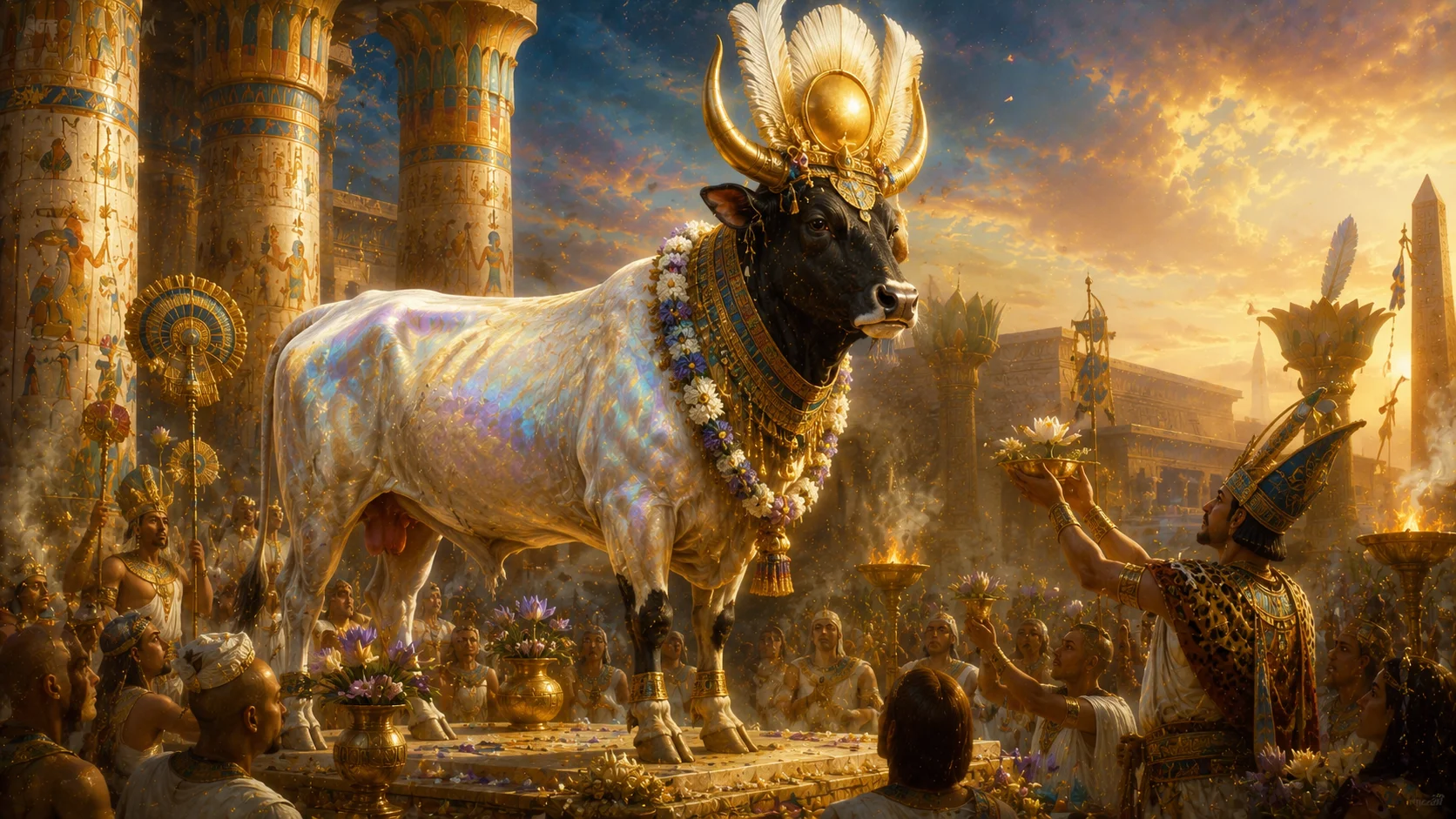
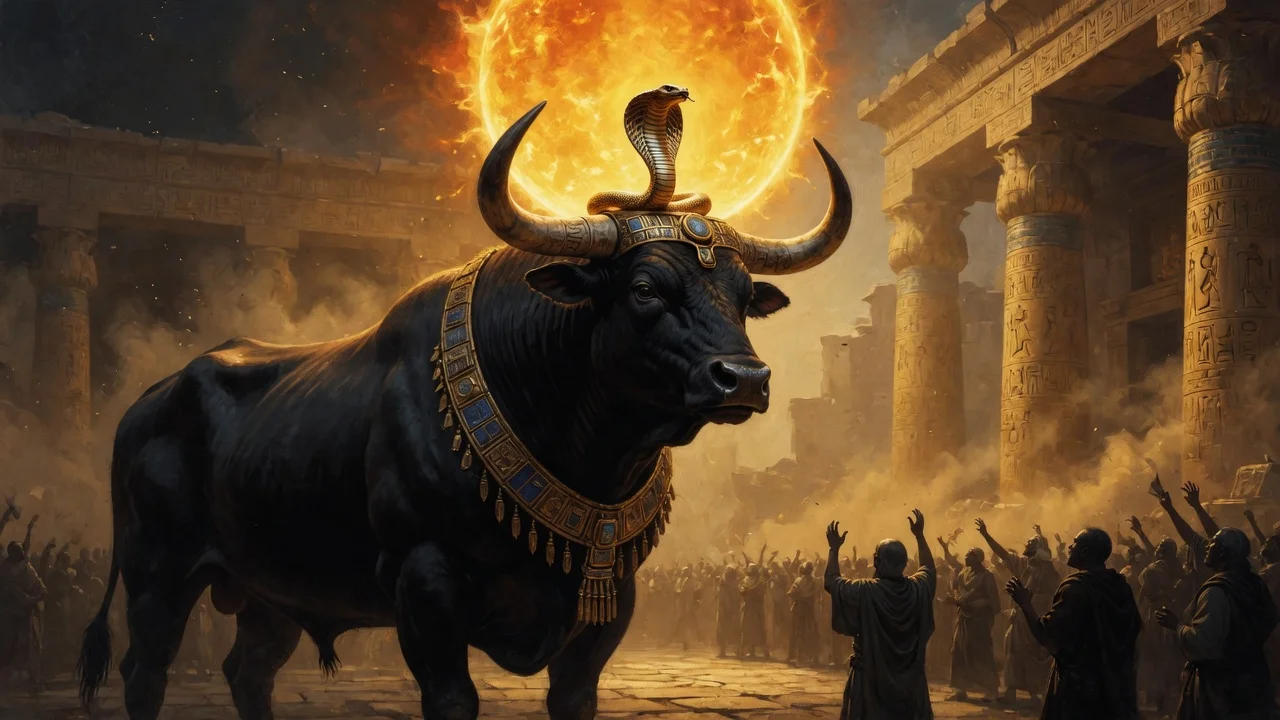
The Mnevis (Egyptian Mer-wer, “Great One” or perhaps “the great canal”) was a sacred living bull worshipped at Heliopolis, the great cult-center of the sun-god. As the Apis bull of Memphis was the incarnation of Ptah, the Mnevis bull of Heliopolis was the living incarnation of the sun-god Ra (and the creator Atum) — the solar bull, the earthly manifestation of the sun-god in animal form. It was depicted, and the living bull was, entirely black, sometimes shown with a solar disc and uraeus between its horns, marking its solar nature.
The Incarnation of Ra and Atum
The Mnevis was the “ba” (living manifestation) of Ra-Atum, the sun-god in his Heliopolitan forms — a god living in the form of a bull at the heart of the sun-cult. As such it was a powerful and venerated sacred animal, worshipped as the sun-god made present and embodied, the solar power incarnate. The bull was associated with fertility and strength (as bulls generally were), but its essential nature was solar: it was the sun-god's living form, the bull of the sun at the city of the sun. Notably, even the “heretic” pharaoh Akhenaten, who suppressed the other gods in favour of the sun-disc Aten, was said to have respected the Mnevis bull — fitting, given its solar nature.
The Sacred Solar Bull
Like the Apis, the Mnevis was a single living bull at a time, identified, venerated, kept and cared for at its sanctuary, and at its death mummified and given an honourable burial, with a new Mnevis then sought to incarnate the sun-god anew. It served as a focus of worship and possibly as an oracle. As one of the chief sacred bulls of Egypt — with the Apis (of Ptah) and the Buchis (of Montu) — the Mnevis represented the Egyptian practice of worshipping the divine incarnate in a living animal, here the great sun-god embodied in a magnificent black bull at his own holy city.
The Living Sun-Bull of Heliopolis
The Mnevis endures as a sacred bull of ancient Egypt — the living black bull worshipped at Heliopolis as the incarnation of the sun-god Ra and Atum, the solar counterpart to the Apis of Memphis. It embodies the Egyptian veneration of the divine made present in a living animal, and the worship of the sun-god incarnate; and it stands as the bull of the sun — the living solar deity in animal form at the great city of the sun, the black bull crowned with the solar disc, worshipped as Ra made flesh.
The sacred black bull of Heliopolis, crowned with the solar disc — the living incarnation of the sun-god Ra, the bull of the sun worshipped at the great city of the sun.
The City of Pillars
The bull had a city, and the city had a claim. Its Egyptian name was Iunu, the place of pillars; the Greeks who came later called it Heliopolis, the City of the Sun. It was never Egypt’s seat of government — Memphis and later Thebes held that — but what Heliopolis held was a cosmogony, and that outlasted every dynasty. Its priesthood taught that creation began on a mound rising out of the formless water of Nun, where the self-created Atum brought himself into being and then produced the rest: Shu and Tefnut, and from them Geb and Nut, and from them Osiris, Isis, Seth and Nephthys. Atum and those eight are the Ennead, the Nine, and their family quarrels became the backbone of Egyptian myth. Rival cities argued the point — Memphis credited Ptah, and Hermopolis an ogdoad of eight frog- and serpent-headed powers of the dark water — but it was the Heliopolitan version that the rest of Egypt largely inherited. The Mnevis did not invent this theology. It inherited it. A city claiming to stand on the exact spot where existence began needed a god who could be seen, garlanded and fed in daylight, and the black bull in its precinct was that claim made flesh.
A God Ordained by Decree
Egyptian tradition did not treat the bull-cults as customs that had simply always been there. Manetho, the Egyptian priest who wrote a history of the pharaohs in Greek for his Ptolemaic patrons in the third century BC, dated their founding with startling precision. His work survives only in quotations by later writers, and where those writers reach the Second Dynasty they agree: in the reign of its second king, whose name they render as Kaiechos, the Apis bull at Memphis, the Mnevis bull at Heliopolis and the sacred animal of Mendes were established as gods. (Manetho’s excerptors call the Mendes animal a goat, while Egyptian sources make Banebdjedet of Mendes a ram — the Greeks appear to have mistaken one horned beast for another.) Whether that date is history or priestly back-dating cannot be settled at this distance, but the claim itself is the interesting part. It places the Mnevis at the very beginning of dynastic religion, as old as kingship, and it frames the cult not as folk devotion that grew up unnoticed but as an act of state — a pharaoh decreeing that the sun would henceforth also walk on four legs.
The Bull and the Bird
The Mnevis shared its city with a second creature of the sun, and the pair of them make a neat theological argument. The Bennu was a heron, or a bird drawn like one, tied to Atum and to the benben, the sacred stone at Heliopolis on which the first light was said to have fallen. One version of the creation story has the Bennu flying over the waters of Nun until it alights on that stone and cries out, and the cry sets the terms of everything that follows. Like the Mnevis it was called a ba of the sun-god; unlike the Mnevis it also bore the title “he who came into being by himself.” So Heliopolis maintained two solar manifestations at once, at opposite ends of visibility: one a real animal that could be watched lowing and feeding in its enclosure, the other a bird that by definition almost never appeared. When Herodotus came through in the fifth century BC, the locals told him about the second one — a bird that returned only once in five hundred years, carrying its dead father encased in myrrh to the temple of the sun. He wrote it down, noted that he had seen the creature only in a painting, and added that he did not believe the story. This is the ancestor of the Greek phoenix. One correction worth making plainly: the famous death by fire and resurrection from ashes appears neither in the Egyptian material nor in Herodotus. It is a later Greek and Roman elaboration, grafted onto a bird whose original miracle was self-creation, not self-immolation.
What Akhenaten Chose to Keep
Akhenaten is remembered for what he erased. He moved his court from Thebes to an untouched site he named Akhetaten — modern Amarna — and sent men out with chisels to cut the names and images of the other gods from monuments across Egypt, pursuing even the plural word “gods” wherever they could reach it. Against that record, one line in his own foundation documents stands out. The boundary stelae carved into the cliffs ringing the new city set out what was to be built there: a tomb for himself, one for Nefertiti, one for their daughter Meritaten, temples for the Aten — and a cemetery for the Mnevis bull in the eastern mountain of Akhetaten, that he might be buried in it. The king who would tolerate no rival god made room in his sacred landscape for a bull belonging to the priesthood he had just dispossessed. The likeliest reason is that it did not read as a rival at all: the Aten was the visible sun, and the Mnevis was solar power walking about in a body — the same argument in a different medium. It should be said that no Mnevis burial has ever been found at Amarna, any more than the tombs promised to Nefertiti and Meritaten have been. The instruction survives. The cemetery may never have been cut.
What Is Left of the City of the Sun
Almost nothing above ground marks the place now. Heliopolis was quarried for building stone over centuries, and the site lies beneath the Cairo districts of Al-Matariya and Ain Shams. A single monument still stands on it: a red granite obelisk raised by the Twelfth-Dynasty king Senusret I around 1950 BC, one of an original pair, and the only Egyptian obelisk anywhere still upright on the spot where it was first erected. The city’s other needles were carried off. The Romans took several; a pair cut for Thutmose III was shipped down to Alexandria in 13 BC on the orders of Augustus and set up at the Caesareum, the temple Cleopatra had begun for the deified Julius Caesar. That accident of address is the whole origin of their name. Travellers afterwards called them Cleopatra’s Needles, though the queen had nothing to do with their making and they were already some fourteen centuries old when she was born. In the nineteenth century they moved once more, to the Thames Embankment in London and to Central Park in New York, a few thousand miles from the sun-cult that raised them.
The bull left less than that. A living god leaves no ruin behind — when the succession finally broke, there was nothing standing to fall down. What survives of the Mnevis is the idea underneath it: that the sun’s power was not thought sufficient in the sky alone, and needed, for a few thousand years, to come down and walk the ground at Heliopolis in the shape of a black bull.
Sources & traditions
- EncyclopediaWikipedia — Mnevis
- TraditionEgyptian texts, inscriptions and later retellings
Myths change from area to area and from time to time. This chronicle follows the most widely told versions; tellings in other villages, regions and eras may differ.