Isis was the great goddess of ancient Egypt — the supreme mistress of magic, the devoted wife who gathered and resurrected her murdered husband Osiris, the protective mother of Horus, and the goddess whose love, cunning and power made her one of the most beloved and widely worshipped deities of the entire ancient world. She is the very ideal of the loving wife and mother, and a powerful sorceress among the gods.
Throne-Born of Earth and Sky
Isis (Egyptian Aset) was born of the union of Geb, god of the earth, and Nut, goddess of the sky, placing her among the great Ennead of Heliopolis — the nine primeval deities descended from the sun-god's own self-creation. She came into the world alongside three siblings: Osiris, who would become her husband; Set, who would become his murderer; and Nephthys, who would stand beside her in grief and in magic. Her very name, meaning “throne,” was worn upon her head as a hieroglyphic crown, marking her from the outset as a goddess bound to kingship itself.
Weret-Hekau, Great of Magic
Above all else, Isis was the mistress of heka — magic, spoken power, the force that bent reality to will. She carried the epithet Weret-Hekau, “Great of Magic,” as a title earned rather than given. Her cunning was not idle; she turned it, again and again, toward the protection and restoration of those she loved. It was this same mastery of magic that let her outwit even the sun-god himself, and later let her mend a body that death itself had unmade.
The Secret Name of Ra
In one of the most celebrated tales of her cunning, Isis set her sights on the hidden, true name of Ra — the sun-god's most closely guarded secret, and the source of his supreme authority. She fashioned a magical serpent and set it in his path, so that when Ra was bitten, no remedy he knew could ease the poison coursing through him. Isis came to him offering to heal him, but only on one condition: that he speak his secret name aloud to her. In his agony Ra relented, and in learning that name Isis gained for herself significant magical power of her own.
The Sister's Grief, the Sister's Search
The defining tragedy and triumph of Isis's story began when her brother Set, consumed by envy, murdered Osiris and scattered the pieces of his dismembered body across the land of Egypt. This account is preserved most fully in the Greek-era writings of Plutarch's De Iside et Osiride, composed centuries after the core Egyptian tradition, though fragments of the same myth appear far earlier in the Pyramid Texts and Coffin Texts carved into royal tombs. Isis, in mourning and in resolve, set out across the land to recover every part of her husband, refusing to accept that death could be the end of him. Her sister Nephthys joined her in the search, and together the two goddesses combed Egypt until every scattered piece of Osiris had been found and gathered.
The Body Made Whole Again
Once the body of Osiris was reassembled, it was Anubis who performed the embalming that preserved him, while Isis herself supplied the magic that would restore what death had taken. Through her power, she conceived a son by Osiris — Horus — even though Osiris's life in the world of the living had already ended. It was an act without parallel among the gods: not a resurrection into life as it had been, but the conception of an heir from a husband already claimed by death, achieved through devotion and magic working together. Osiris passed into the underworld to reign there, while the child of that impossible union grew to carry his father's cause into the world of the living.
Hidden Among the Reeds of Chemmis
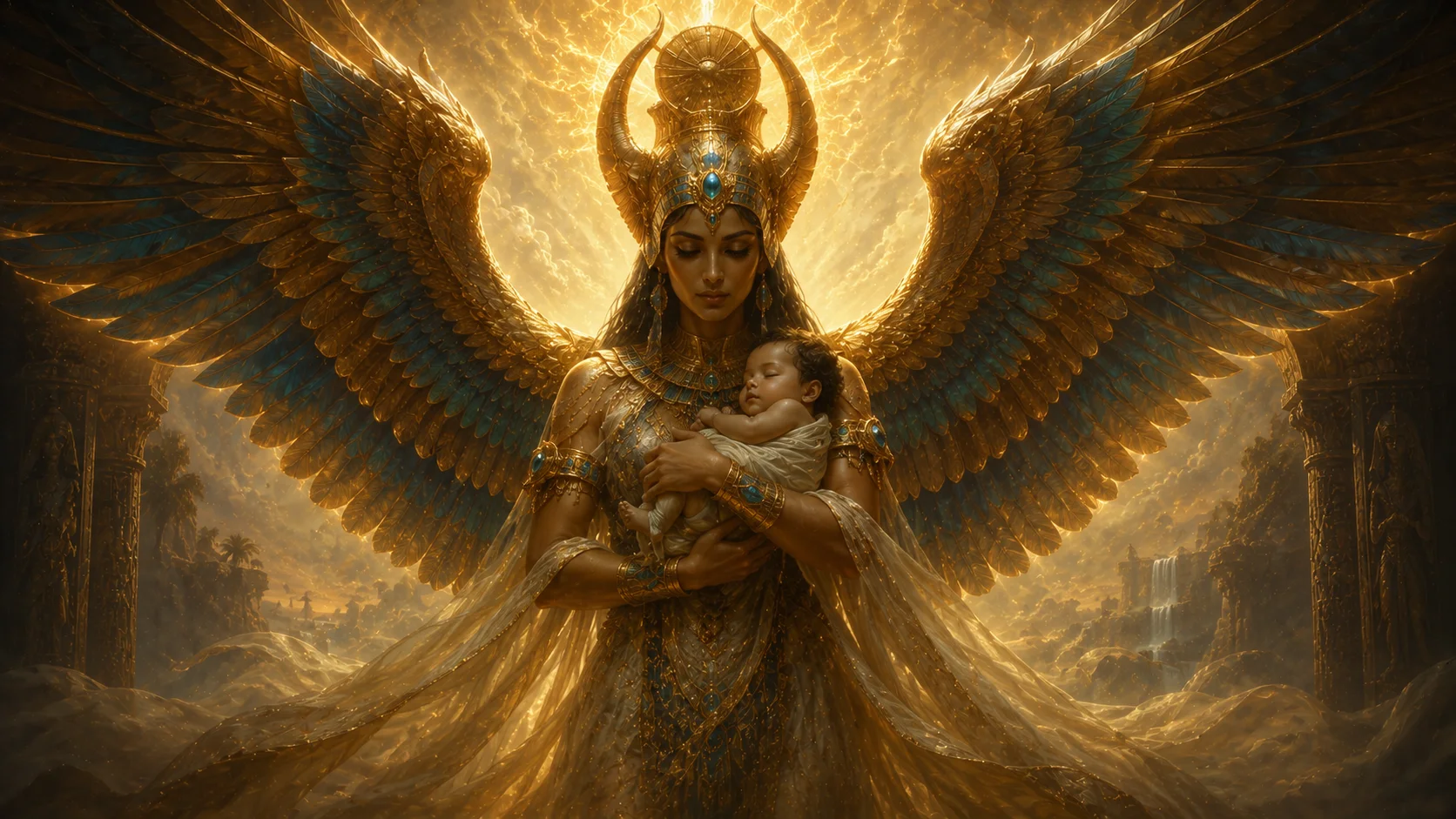
Knowing that Set would seek to destroy any heir who might one day challenge him, Isis withdrew into the marshes of the Nile Delta, to the hidden reaches of Chemmis, and there she raised the infant Horus in secrecy. The marshes offered concealment, but not safety, and Isis stood as her son's sole protector against every danger that found its way to him. Her devotion in this period became one of the most enduring images of Egyptian religion — the goddess-mother, alone in the reeds, shielding her child against a world that wanted him dead.
The Seven Scorpions and the Healing of Horus
Among the trials of that hidden time, one story was recorded with particular care: the tale of Isis and the Seven Scorpions, preserved on the Metternich Stela. In it, the infant Horus was stung by a scorpion's venom and lay dying, and Isis — though the mightiest magician among the gods — was, for a moment, without a remedy. She cried out, and through invocation and her own formidable power, she drew on magic sufficient to draw the poison from her son and restore him to life. The episode stands as one of the best-attested and most vivid demonstrations of her healing magic, and it was recited for centuries afterward by ordinary Egyptians seeking protection from the same venomous creatures that had threatened the god-child himself.
Guardian at the Four Corners of the Dead
Isis's protective power extended beyond the living. In funerary tradition she stood as one of four goddesses — alongside Nephthys, Neith, and Selket — who watched over the four Sons of Horus, the deities charged with guarding the embalmed organs of the dead within their canopic vessels. In tomb art she was shown with wings outstretched, sheltering the sarcophagus or the figure of the king beneath them, a winged guardian standing between the dead and harm exactly as she had once stood between the infant Horus and every danger of the marsh.
Throne and Horned Crown
The image of Isis shifted across the long span of Egyptian religion. In her earliest and most distinctive form she wore the hieroglyph of a throne upon her head, a crown that was also her name made visible. In later periods, particularly from the New Kingdom onward, she came to be shown wearing the solar disk cradled between cow's horns — an iconography drawn from the goddess Hathor, absorbed into Isis's own image as the two goddesses grew closer in worship and meaning. Both forms endured side by side, the throne recalling her ancient link to kingship, the horned disk marking her rise toward a still greater, more universal divinity.
Mother of the God, Mistress of the Sky
Isis carried titles that spoke to the very heart of what she meant to Egypt: Mut-netjer, “Mother of God,” honoring her as the one who bore Horus, the living king incarnate on earth; and “Lady of the Sky,” and “Lady of the Throne,” honoring her descent from Nut and her bond to the seat of rulership itself. In some astronomical texts of the New Kingdom she was linked to the star Sirius, known to the Egyptians as Sopdet, whose yearly reappearance in the sky was tied to the life-giving flooding of the Nile — Isis's presence written, quite literally, into the rhythm of the land's survival.
Philae, Where the Old Gods Lingered Longest
Her greatest cult center rose at Philae, an island temple complex that became one of the most important sites of her worship in all of Egypt. Philae's devotion to Isis proved remarkably durable: even as the old religion faded elsewhere, her temple there continued to function, making it one of the very last active centers of the ancient Egyptian faith. It was not closed until the sixth century CE, under the Byzantine emperor Justinian — centuries after most of Egypt's ancient temples had fallen silent, a testament to how deeply and how long Isis was still loved.
A Goddess Carried Beyond Egypt
Isis's worship did not remain confined to the land of her birth. In the Greco-Roman world her cult spread widely, carried by trade, migration and conquest into the cities of Greece and across the Roman Empire, where devotees gathered in Isiac mysteries dedicated to her name. This later, cross-cultural reception stands apart from the core Egyptian myths of her origin, yet it speaks to the same enduring qualities that had always defined her within Egypt itself: her steadfastness as wife, her fierceness as mother, and her command of magic, all of which crossed easily into new lands and new tongues.
The Ideal of Devotion, the Measure of Power
Within Egyptian religion Isis stood as the very model of the faithful wife and the protective mother, her devotion to Osiris and her fierce guardianship of Horus held up as the standard against which love and loyalty were measured. Yet she was never devotion alone; her mastery of magic was among the greatest of any deity, sufficient even to draw a portion of Ra's own power from him. She endures as the goddess who searched Egypt for her husband's scattered body, who conceived an heir where death should have made that impossible, who hid her son among the reeds and drew poison from his veins with nothing but her voice and her will — a goddess whose love was as boundless as her power, and whose memory outlasted the very temples built in her name.
By her magic she learned the secret name of the sun and gathered her murdered husband from death itself — the great goddess whose love was as boundless as her power.
Sources & traditions
- EncyclopediaWikipedia — Isis
- TraditionEgyptian texts, inscriptions and later retellings
Myths change from area to area and from time to time. This chronicle follows the most widely told versions; tellings in other villages, regions and eras may differ.