Hathor was the Egyptian goddess of love, beauty, music, joy, motherhood and the sky — one of the most beloved and ancient of all Egyptian deities, the cow-goddess who nurtured the living, welcomed the dead, and embodied feminine joy, yet who also held within her the fearsome destroying power of the Eye of Ra. She is the great goddess of all that is joyful and life-giving, and the tender protectress of the dead.
The Goddess of Joy and Love
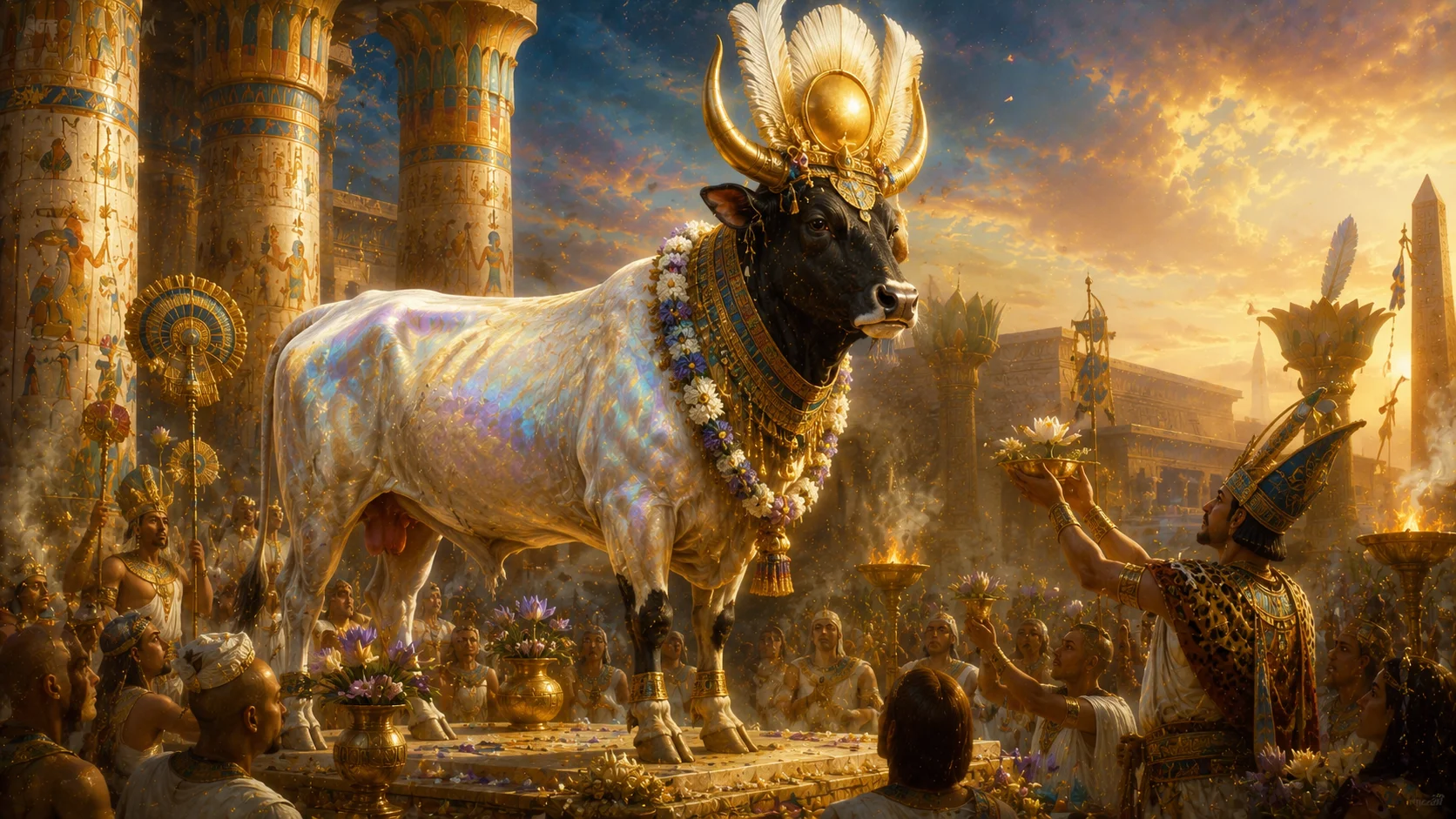
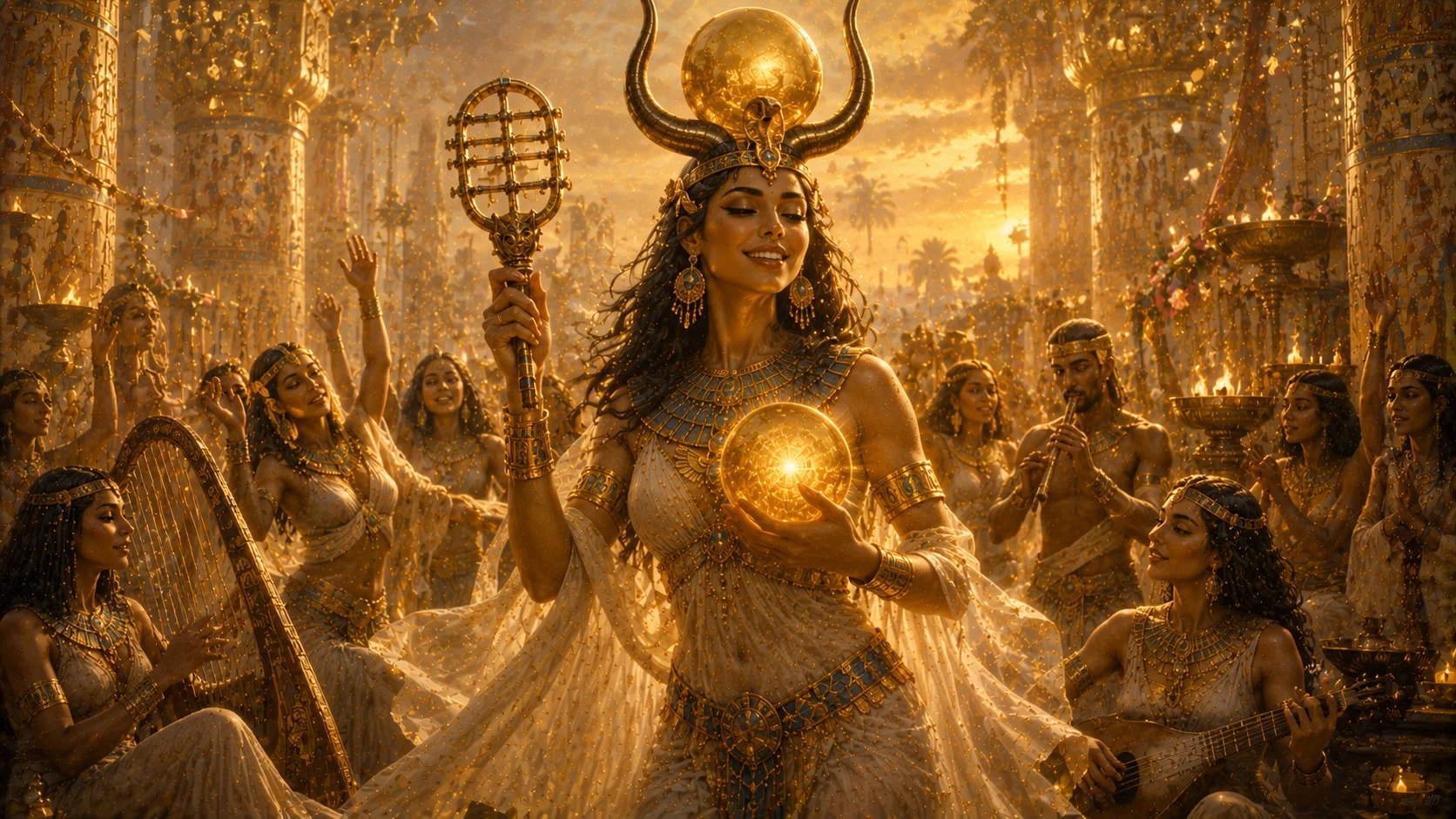
Hathor (Egyptian Hwt-Hor, “House of Horus”) was the goddess of love, beauty, music, dance, joy, drunkenness, fertility and motherhood — the radiant deity of all the pleasures and joys of life. She was depicted as a cow, or as a beautiful woman with cow's horns cradling the solar disc, or with cow's ears. As the goddess of love and beauty she was Egypt's counterpart to the great love-goddesses of other lands, invoked in matters of romance, music, celebration and feminine joy; her festivals were occasions of music, dancing and drinking. She was a sky-goddess too, sometimes imagined as a great celestial cow whose body was the heavens.
The Nurturing Mother
Hathor was a great mother and nurturer. As a cow-goddess she was associated with the nourishing milk that sustains life, and she was depicted suckling and nurturing the pharaoh and the gods. She was a goddess of fertility and childbirth, watching over mothers and children, and she nurtured all living things. Her name, “House of Horus,” marked her as the mother (or consort) of the falcon-god Horus, and by extension a divine mother of the pharaoh, who was the living Horus. She embodied the warm, life-giving, maternal aspect of the divine feminine.
The Welcomer of the Dead
Hathor had a tender role in the afterlife as the welcomer and protectress of the dead. She was the “Lady of the West,” who greeted the setting sun and the souls of the dead as they entered the realm of the west (the land of the dead), receiving them with comfort and nourishment. She was depicted emerging from the western mountain to welcome the deceased, offering them food and drink and easing their passage into the afterlife. Thus the goddess of the joys of life was also the gentle goddess who met the dead at the threshold of the next world, making her beloved in both life and death.
The Eye of Ra and the Destroying Lioness
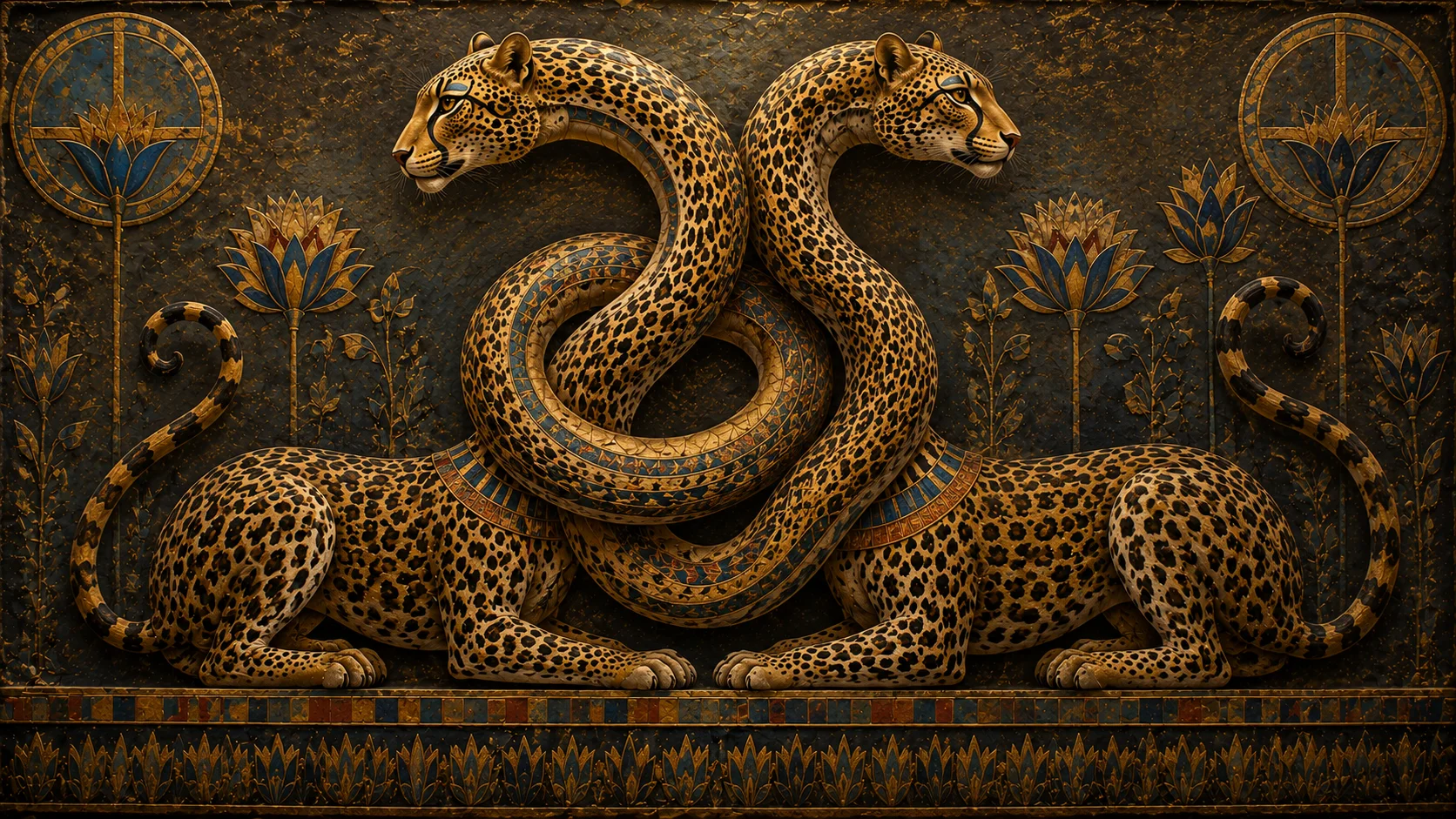
Yet Hathor had a terrible aspect too, for she was one of the goddesses who served as the Eye of Ra — the destroying power of the sun. In the famous myth, when mankind plotted against the aging sun-god Ra, he sent forth his Eye in the form of Hathor (transformed into the bloodthirsty lioness Sekhmet) to punish humanity — and she fell upon them in such a slaughter that she nearly destroyed the entire human race, drunk on blood. To stop her, the gods flooded the fields with beer dyed red like blood; the goddess drank it, became drunk, and was pacified, transforming back from the raging lioness Sekhmet into the gentle, joyful Hathor. This myth captures the dual nature of the goddess: the loving, nurturing Hathor and the destroying lioness Sekhmet were two faces of one power, joy and wrath, creation and destruction, within a single great goddess. Hathor endures as one of the most beloved goddesses of ancient Egypt — the radiant lady of love, beauty, music and joy, the nurturing cow-mother, the welcomer of the dead, and the bearer of the sun's terrible Eye.
The radiant goddess of love, music and joy who nurtures the living and welcomes the dead — yet within her sleeps the destroying lioness, the terrible Eye of the sun.
Origins in the Cattle Cults of the Nile
Long before Egypt raised a single pyramid, its people measured wealth in cattle. Cow-shaped amulets and bovine figurines turn up in graves from the Predynastic period, thousands of years before the pharaohs — evidence of a cattle cult woven into Egyptian identity earlier than any dynasty. Hathor's roots reach into that world. The great ceremonial palette of Narmer, carved around the time of Egypt's unification, carries at its top a pair of bovine faces with human features, cow's ears and curling horns: a cow-goddess presiding over the earliest surviving image of Egyptian kingship. Who she is remains genuinely disputed. Many Egyptologists identify the face as Bat, a separate cow-goddess of Upper Egypt, on the grounds that nothing attests Hathor's worship this early; others argue for Hathor, since it is Hathor who is bound up with the office of pharaoh throughout the dynastic period. Either way the two did not stay separate: Bat's iconography and role were steadily absorbed into Hathor's until the elder goddess survived only as an echo inside Hathor's face. It is one of the clearest examples in Egyptian religion of how a goddess could grow by quietly swallowing her neighbours.
Dendera and the Beautiful Reunion
Every year a barque carrying Hathor's cult image left her great temple at Dendera (ancient Iunet) and travelled upriver to Edfu, home of the falcon-god Horus. The voyage is recorded in relief on the walls of both temples from the Ptolemaic period, and it was called the Festival of the Beautiful Reunion — also rendered the Beautiful Meeting: days in which Hathor's statue was ferried to Horus's temple, the two images were brought together within the sanctuary, and the town outside gave itself over to music, feasting and procession. It was less a myth performed than a marriage renewed in public, staged every year for centuries, and it bound two of Egypt's great temples together as partners in a single recurring rite.
Dendera is among the best-preserved temple complexes to survive from ancient Egypt. Its hypostyle hall still stands on columns capped with Hathor's face carved four times over, one gazing out in each direction, beneath a ceiling worked with astronomical scenes. Much of the standing structure dates to the Ptolemaic and Roman periods, raised on foundations that reach back far earlier — inscriptions at the site claim a temple had stood there since the Old Kingdom, rebuilt and enlarged by successive dynasties who each wanted their name attached to the goddess's house.
The Festival of Drunkenness
Egyptian temple calendars record an actual festival built around the story of the goddess pacified by red-dyed beer: the Festival of Drunkenness, celebrated at Dendera and elsewhere around the start of Akhet, the season of the Nile flood. Worshippers gathered, drank to intoxication as an act of devotion, and — on the reading of the festival texts and reliefs recovered at the Mut precinct in Karnak — slept in the temple grounds until drums roused them, so that they woke into the presence of the goddess. It re-enacted the moment the raging deity was calmed and the world spared. Solemnity was not what honoured Hathor best; excess was — drink, music, dance — because in her cult joy itself was a form of worship, and drunkenness a way of communing with a goddess who had once nearly ended the world and had to be won back with beer.
Sistrum and Menat
Two objects mark Hathor's presence in Egyptian art more reliably than any other attribute. The sistrum, a hand-held rattle shaped like a loop on a handle, was shaken in her temples to drive off hostile forces and summon her favour with a sound she was said to love; many surviving examples carry her face cast directly onto the handle. The menat, a heavy beaded necklace with a counterweight, was worn and also used as a ritual object — held out and touched to a worshipper's body as a gesture of blessing, passing on the goddess's protective, fertile power through contact. Temple reliefs show kings and queens offering both objects to Hathor in exchange for her favour, a visual shorthand so consistent that a Hathoric scene can often be identified by the sistrum alone, even where her face has been damaged beyond recognition.
Lady of Turquoise
Far from the Nile, in the hills of the Sinai Peninsula, Egyptian mining expeditions cut a temple into the rock at Serabit el-Khadim and dedicated it to Hathor as Mistress of Turquoise. The temple is attested from the Twelfth Dynasty and stayed in use into the Ramesside period — some seven centuries of worship at a mine head. Miners who spent months working turquoise in one of the harshest landscapes the Egyptians exploited left votive inscriptions and stelae there, treating her as patroness of a very specific and very dangerous trade, far outside her usual domain of love and joy. The pattern repeats wherever Egyptians pushed into foreign or marginal territory — Hathor's cult followed them, reframed each time as protectress of the frontier, the goddess who watched over her people when they were furthest from home.
The Seven Hathors and the Reading of Fate
In Egyptian storytelling a child's future was not decided by the gods in the abstract but announced aloud, at the cradle, by seven identical goddesses. The Seven Hathors appear in surviving tales — among them The Doomed Prince and The Tale of Two Brothers — as a chorus of fate-speaking figures who visit a newborn and pronounce how that life will end. In The Doomed Prince they foresee death by crocodile, snake or dog, and the rest of the story becomes the prince's long effort to outrun a sentence already spoken over him. Whether he outruns it we will never know: the papyrus breaks off before the ending. In The Tale of Two Brothers the Hathors are more direct still, decreeing that a woman fashioned by the gods will die by the blade. They are not gentle figures in these stories — they are oracles, and a reminder that the goddess of love and joy also stood, in Egyptian imagination, at the very threshold of a life, able to speak its ending before it had properly begun.
A Genealogy That Never Quite Agreed With Itself
Ask an ancient Egyptian priest who Hathor's family was and the answer depended on which temple you asked in. In the solar theology bound up with the Eye of Ra she was reckoned a daughter of Ra, sent out from him as his own destroying power given female form. At Edfu and Dendera, in the theology built around the Beautiful Reunion, she was instead Horus's wife, and their union produced a son — though the two temples could not agree on which son. Dendera named Ihy, a child god of music whose name means something close to “sistrum-player,” shown as a naked youth with a sidelock shaking his mother's instrument before he was old enough to walk. Edfu named Harsomtus instead. Egyptian religion rarely felt obliged to choose one myth over another when both were useful, and Hathor is one of the clearest cases of a goddess who was daughter, wife and mother by turns, depending on which of her many temples was doing the telling.
Aphrodite's Egyptian Counterpart, and Isis's Long Shadow
When Greek travellers and later Greek rulers arrived in Egypt they recognised Hathor immediately — not by name, but by function. Greek and Roman writers identified her with Aphrodite and Venus, and more than one Egyptian town sacred to Hathor was known to the Greeks simply as Aphroditopolis. But Hathor faced a quieter and more permanent kind of absorption from within Egypt itself. From the New Kingdom onward Isis steadily acquired Hathor's imagery — the cow horns cradling the solar disc, the sistrum, the maternal figure nursing the divine child — until, by the time Isis worship had spread across the Roman Empire, a good deal of what travelled under Isis's name was in substance Hathor's older inheritance. Hathor's cult continued at Dendera into the Roman period and her distinct identity never entirely dissolved, but she had begun to fold into her more famous rival: one of the quieter mergers in a religion that was full of them, and a mirror image of what she herself had done to Bat three thousand years before.
The Goddess Who Is Still Visited
Dendera survived the end of Egyptian religion far better than most of its rivals, and was surveyed and then systematically cleared from the nineteenth century onward — a building complete enough that its roof and its Hathor-headed columns can still be walked beneath today. It remains one of the clearest windows historians have into how an Egyptian temple actually functioned, because so much of its architecture, ritual calendar and festival texts survived together rather than in scattered fragments: the walls still say what was done in the rooms they enclose. Beyond archaeology, Hathor has not entirely left living practice either. Modern Kemetic reconstructionist and pagan communities honour her as a goddess of joy, music and motherhood — not an unbroken lineage but a deliberate reconstruction, built from the same inscriptions the Egyptologists read. A goddess whose entire promise was joy turns out to be a difficult one to let go of.
Sources & traditions
- EncyclopediaWikipedia — Hathor
- TraditionEgyptian texts, inscriptions and later retellings
Myths change from area to area and from time to time. This chronicle follows the most widely told versions; tellings in other villages, regions and eras may differ.