Nephthys was the Egyptian goddess of the threshold — mourning, the night, and the protection of the dead — sister of Isis, Osiris, and Set, and in most traditions the wife of Set. Though bound by marriage to the god of chaos, she stood beside Isis at the darkest hour of the Osirian myth, and together the two sisters became the model for how Egypt mourned, protected, and ultimately restored its dead.
Nebet-Het, Lady of the House
Nephthys's Egyptian name, Nebet-Het, is usually rendered “Lady of the House” or “Mistress of the Mansion,” an epithet pointing to her domain over the household or temple sphere — the enclosed, sheltered, interior space, as distinct from the open cultivated fields associated with her sister. She was one of four children born to the earth god Geb and the sky goddess Nut within the Heliopolitan Ennead, arriving alongside Osiris, Isis, and Set as part of the same generation of gods who would carry the central drama of Egyptian myth. Where Isis was linked with the fertile, cultivated land of the Nile valley, Nephthys was sometimes associated conceptually with the desert and the edges of the fertile land — the boundary zone where the ordered world gave way to what lay beyond it. That association with edges and thresholds runs through nearly everything she does: she stands at the border between household and wilderness, between life and death, between loyalty and family bond.
Sister to Three, Wife to One
Nephthys's family position placed her at the center of the Osirian family cycle from the outset. She was sister to Osiris, the king who would be murdered; sister to Isis, who would spend the myth searching for him; and sister to Set, who would kill him — and Set was also her husband. That last fact gives her story its particular tension. In most tellings, Nephthys is bound to Set by marriage, yet nothing in the surviving tradition casts her as devoted to him or aligned with his violence. She is, instead, consistently placed on the side of Isis and Osiris. It is a family arrangement that has no clean resolution: a wife who does not follow her husband, a sister of a killer who chooses instead to stand with the killed.
When Osiris Fell
The event that defines Nephthys's role in Egyptian myth is the murder of Osiris. After Set kills and dismembers his brother, scattering the pieces of his body, it is Isis who leads the search for the remains — and Nephthys who joins her. The two sisters together travel the land gathering what was lost, and together they reassemble and revivify Osiris's body, restoring him at least long enough for him to become ruler of the dead and father of Horus. Nephthys's role here is not peripheral. She is named beside Isis at every stage of the recovery, a partner in the act of restoration rather than a bystander to her sister's grief. Her choice to help is also, implicitly, a choice against her own husband, made without any recorded hesitation in the myth as it survives.
The Two Kites at the Bier
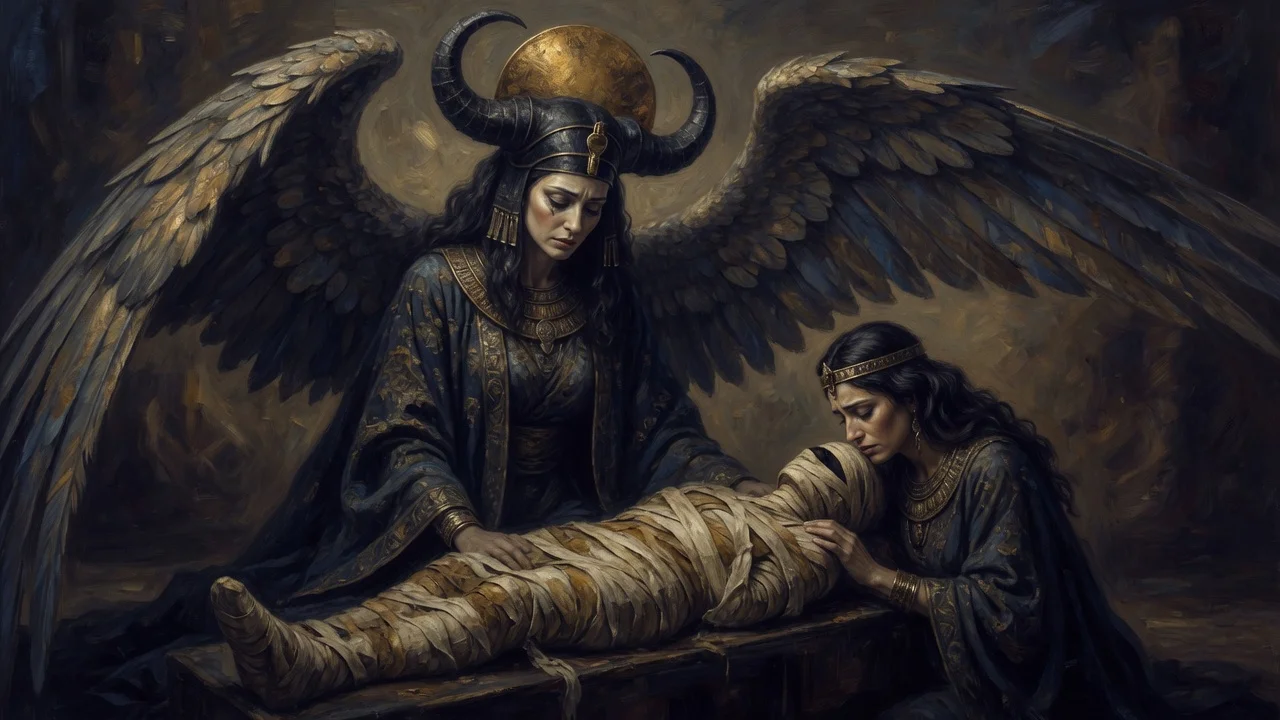
Out of that shared search grew one of the most enduring images in Egyptian funerary art: Isis and Nephthys as the two “Kites,” mourning women — sometimes shown literally as birds of prey — who flank the bier or coffin of the deceased, one at the head and one at the foot. The image is drawn directly from their mourning of Osiris and generalized to every burial modeled on his. Egyptian funerary ritual preserved this scene in the “Lamentations of Isis and Nephthys,” a ritual text in which the two sisters' grief for Osiris is spoken or performed over the newly dead, extending the myth's comfort to ordinary burials. To be mourned by the two sisters, even in ritual reenactment, was to be mourned as Osiris himself had been mourned — the highest assurance that one's body and name would be looked after.
Wings Spread Over the Coffin
Nephthys and Isis were paired not only as mourners but as protectors. Egyptian funerary art regularly shows the two goddesses standing at either end of sarcophagi and canopic shrines, wings outstretched in a gesture of protection over the body within. The wings recall their identity as kites, birds whose spread feathers become a shield rather than a weapon. This protective pairing extended into the machinery of mummification itself: among the Four Sons of Horus, the minor gods charged with guarding the deceased's embalmed organs, Nephthys was specifically linked to Hapi, the baboon-headed son who protected the lungs. Her guardianship was not a vague blessing but a specific, assigned task within the larger system that Egyptians built to secure the dead against decay and disorder.
Guardian in the Pyramid and Coffin Texts
Nephthys's protective role reaches back to some of the oldest religious writing to survive from Egypt. She appears in the Pyramid Texts and later the Coffin Texts as a guardian of the deceased king, invoked alongside Isis in spells meant to gather the ruler's body and secure his passage into resurrection. These texts predate the fully developed narrative form of the Osiris myth known from later sources, but they already show the two sisters working as a fixed pair in the vocabulary of Egyptian resurrection magic — called on together, trusted together, their names repeated in tandem across centuries of funerary spellcraft. The consistency of that pairing, across a millennium and more of religious texts, is itself a measure of how firmly Nephthys's identity was fused to the work of protecting the dead.
A Disputed Birth
One further episode attaches to Nephthys in later tradition, most notably in the Greek writer Plutarch's account On Isis and Osiris: that Nephthys secretly united with Osiris, and that the god Anubis, embalmer and guide of the dead, was born from that union. This should be understood as a later Greco-Egyptian syncretic account rather than a uniformly attested native Egyptian tradition — it does not appear consistently across earlier Egyptian sources, and different periods and locales preserved different understandings of Anubis's parentage. Where it does appear, the episode adds a further layer to Nephthys's entanglement with the Osirian family: a connection to Osiris that exists alongside, rather than instead of, her marriage to Set, and one more thread tying her to the god whose death she would later help mourn and mend.
A Goddess Without a Great House of Her Own
Unlike Isis, who eventually rose to command an extensive independent cult with major temples across Egypt and, later, the wider Mediterranean world, Nephthys never developed worship on that scale under her own name. She was venerated chiefly in conjunction with Osiris and Isis, within the funerary cult that surrounded them, rather than as a standalone goddess with dedicated cult centers built primarily to her. This is not a mark of lesser importance so much as a different kind of religious presence: Nephthys's power was invoked precisely where the Osirian mysteries were performed — at burials, in mortuary temples, wherever the dead needed the protection her myth promised — and largely nowhere else. Her cult, in other words, was as bound to the threshold of death as her character was.
Loyalty That Outran Marriage
What distinguishes Nephthys within the Osirian family is the direction her loyalty took. Egyptian myth does not offer an explanation for why she sided with Isis and Osiris against her own husband; it simply presents the fact and lets the consequences follow. She searched with Isis rather than staying with Set. She mourned Osiris rather than defending her husband's act. In some versions of the myth she is described as sympathetic to Osiris outright, her allegiance to her murdered brother stated plainly rather than left to inference. For a mythology that rarely lingers on interior motive, the consistency of Nephthys's choice — repeated across sources that otherwise vary widely in detail — reads as one of its more deliberate strokes: a wife whose place beside her husband was never assumed to be permanent, and a sister whose place beside her siblings never wavered.
Mourning as Inheritance
Through the Lamentations performed at Osiris festivals, the grief Nephthys and Isis expressed over one body became the pattern for how an entire civilization approached the deaths of its own people. Every deceased Egyptian who received the honor of being ritually mourned by figures standing in for Isis and Nephthys was, in a sense, being folded into the Osiris myth — granted the same sisters' vigil, the same promise of restoration that Osiris himself received. Nephthys's part in that promise was not decorative. Her willingness to search, to gather, to keen, and to protect was what made the restoration possible in the first place; without the second kite at the bier, the myth's central resurrection does not happen.
Into Later Memory
Nephthys's invocation did not end with the height of pharaonic religion. The Lamentations and the broader funerary cult built around Isis and Osiris continued to be performed through the Ptolemaic and Roman periods, carrying her name and her protective function forward even as Egyptian religion absorbed new political and cultural pressures. In the long afterlife of Egyptian mythology in modern popular understanding, she remains one of the most recognizable members of the Osirian family — known less for temples or a cult of her own than for the single, unwavering act that defines her: standing at her brother's side, wings spread, when the rest of the story might have expected her to stand at her husband's.
Wife to the murderer, sister to the murdered — Nephthys chose the bier over the marriage bed, and in the weeping of the two kites over Osiris's gathered body, Egypt found the shape its own mourning would take for two thousand years.
Sources & traditions
- EncyclopediaWikipedia — Nephthys
- TraditionEgyptian texts, inscriptions and later retellings
Myths change from area to area and from time to time. This chronicle follows the most widely told versions; tellings in other villages, regions and eras may differ.