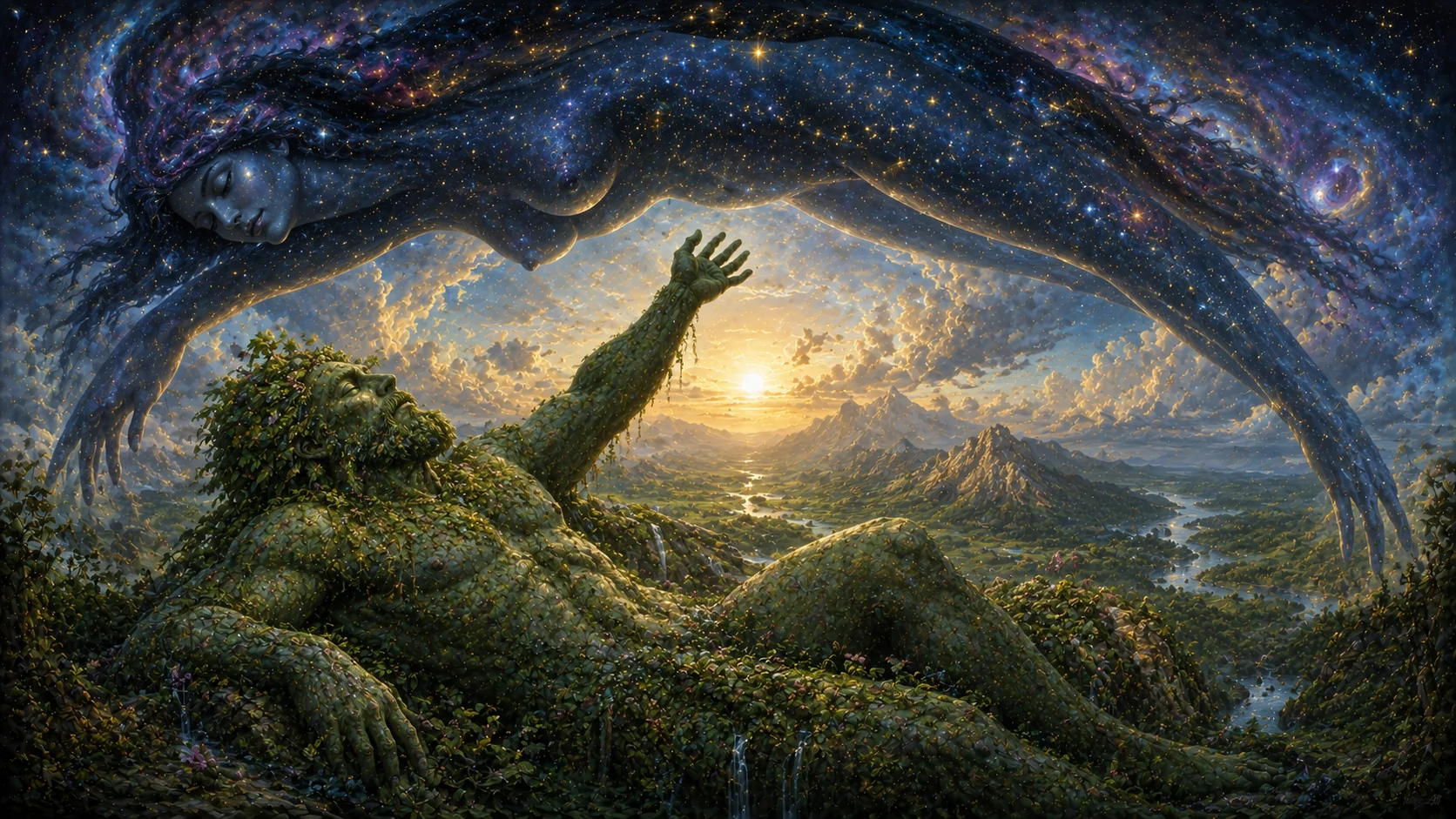
Geb was the Egyptian god of the earth — the great god whose body was the land itself, the father of Osiris, Isis, Set and Nephthys, and one of the foundational gods of the Heliopolitan Ennead. Lying beneath the arched body of his sister-wife Nut the sky, he is the very ground of the world, the earth on which all life depends, the throne beneath every pharaoh, and the silence beneath every tomb.
Third of the Nine
Geb belonged to the third generation of the Heliopolitan Ennead, the great company of nine gods through whom the Egyptian priesthood of Heliopolis accounted for the making of the world. He was a son of Shu, the god of air, and Tefnut, the goddess of moisture, themselves the first pair called forth by the sun-creator. Where Shu was breath and Tefnut was the wet that sustains, Geb was matter itself brought to rest — the solid answer to his parents' insubstantial natures. He was, in the strictest sense the theology allowed, the ground the rest of creation needed in order to stand on anything at all.
The Husband Who Was Also the Brother
Geb was the brother and husband of Nut, the sky-goddess, and their union was read by the Egyptians as a single continuous fact of the visible world: the earth lying always beneath the arch of the heavens, the two never truly parted even when prised apart by force. Ancient Egyptian religious thought did not flinch from a marriage between siblings among the gods — it mirrored, in fact, the way the earth and the sky were understood to belong to one another by nature, not by custom. Nut and Geb are barely separable as a concept: one is not spoken of for long without the other.
The Embrace That Filled the World
The central image of Geb's myth is an embrace so complete it left no space for anything else to exist. Geb and Nut lay entwined so closely, earth pressed to sky, that there was no room between them for air, for light, for the created world to unfold. Their father Shu stepped between his own children and lifted Nut bodily into the heavens, holding her arched form aloft on his upraised arms while Geb remained stretched beneath him on the ground. This was the Heliopolitan account of how earth and sky came to be separate at all — not two things that had always stood apart, but one entwined pair that had to be physically pulled asunder before there was a world in between them for anything else to occupy.
A Tableau Carved a Thousand Times
Few images from Egyptian religious art are as immediately recognisable as the cosmological tableau built from this one act of separation: Nut's body arched overhead, star-strewn, her fingers and toes touching the horizon at the world's four corners; Shu standing between, arms raised, bearing her weight; and Geb reclining below, often shown reaching upward, unable to close the distance his own father opened. It appears on coffin lids, temple ceilings, and papyri, repeated with only small variation for centuries, because it was doing more than illustrating a story — it was a diagram of the world as the Egyptians understood themselves to be standing inside it, earth underfoot and sky overhead, with breathable air, the gift of Shu, filling the space that made both life and vision possible.
The Green God and the Great Cackler
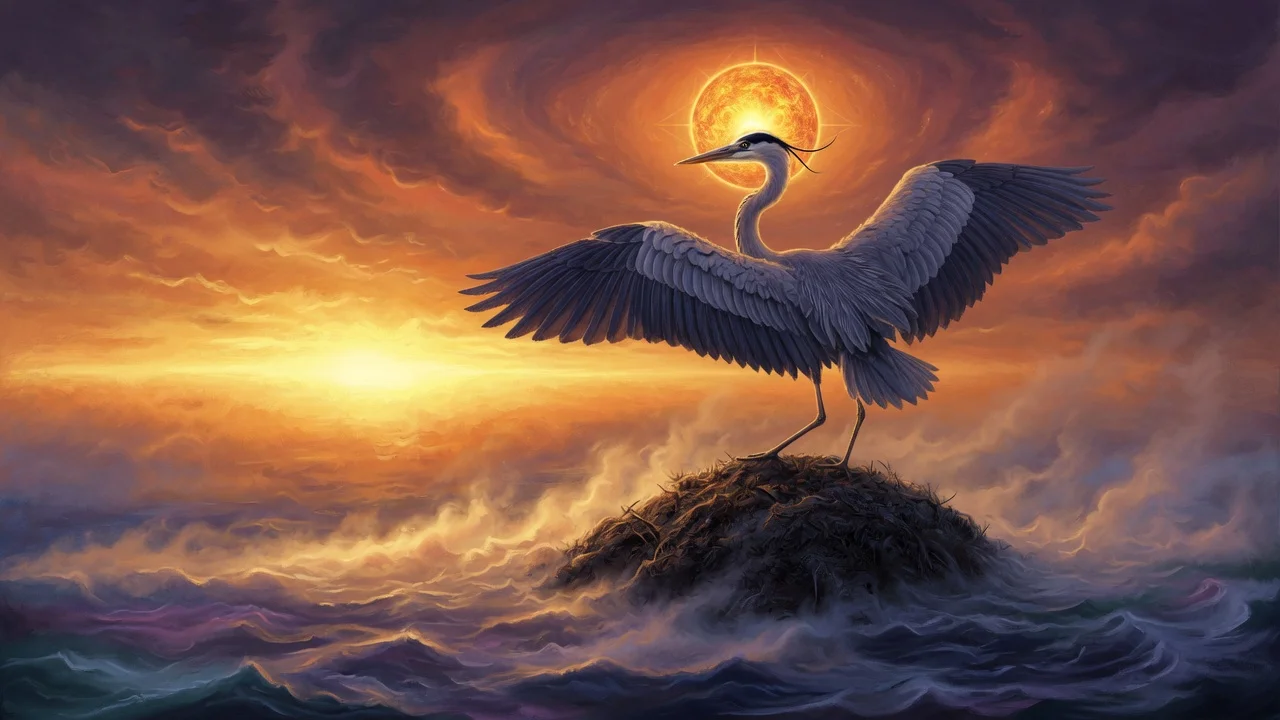
Geb was depicted as a man, his skin sometimes rendered green or black, both colours carrying the same meaning in Egyptian art: the fertile black silt of the inundated Nile valley and the green of what grows from it. He is shown reclining, the undulating line of his body reading as hills and furrows, and at times he wears or is accompanied by a goose upon his head. The goose was more than decoration — in the Egyptian language the same or a closely related sign served both as Geb's name-sign and as the sign for the goose, a phonetic pun that made the bird sacred to him and gave him the epithet the Great Cackler. That epithet carried real theological weight: in some tellings it was Geb, in his aspect as the Great Cackler, who was credited with laying the primeval World Egg from which the sun, or the sun-bird within it, first emerged — binding the earth-god, unexpectedly, into the mythology of the world's first light.
The Laughter That Shakes the Ground
Egypt sits on land that does, on occasion, tremble, and the theology had an answer ready for it: an earthquake was the laughter of Geb. It is a small detail but a telling one, because it treats the earth not as an inert stage on which the gods' dramas play out but as a living, feeling body in its own right, capable of mirth as much as of bearing crops. The god who fed the living through the soil could also, in an instant, remind them that the ground under their feet was not simply theirs to stand on.
Father of the Osirian House
By Nut, Geb fathered the four gods whose story would come to dominate Egyptian religion: Osiris, Isis, Set, and Nephthys. As their father, Geb stood at the head of the generation whose conflicts — the murder of Osiris by Set, the long contest that followed — became the central myth of Egyptian religious life, the story every temple and every funeral in some sense retold. Geb's role here was not merely genealogical bookkeeping; it made him the ancestral figure the entire Osirian cycle traced itself back to, the last common point before the family split into victim, murderer, widow, and avenger.
The Voice on the Tribunal
When the succession of Osiris came to be disputed between his son Horus and his brother Set, the matter was not settled by combat alone but argued before a tribunal of the gods. In some versions of that story it was Geb who presided over, or was directly petitioned within, the proceedings — and it was Geb who ultimately awarded the throne of Egypt to Horus as the rightful heir of Osiris, his own son. That a grandfather should be the one to confirm a grandson's inheritance fit the logic of Egyptian kingship neatly: legitimacy flowed downward through a divine family line, and Geb, as the family's earthly patriarch, was a fitting authority to certify where it landed.
The Throne Named for Him
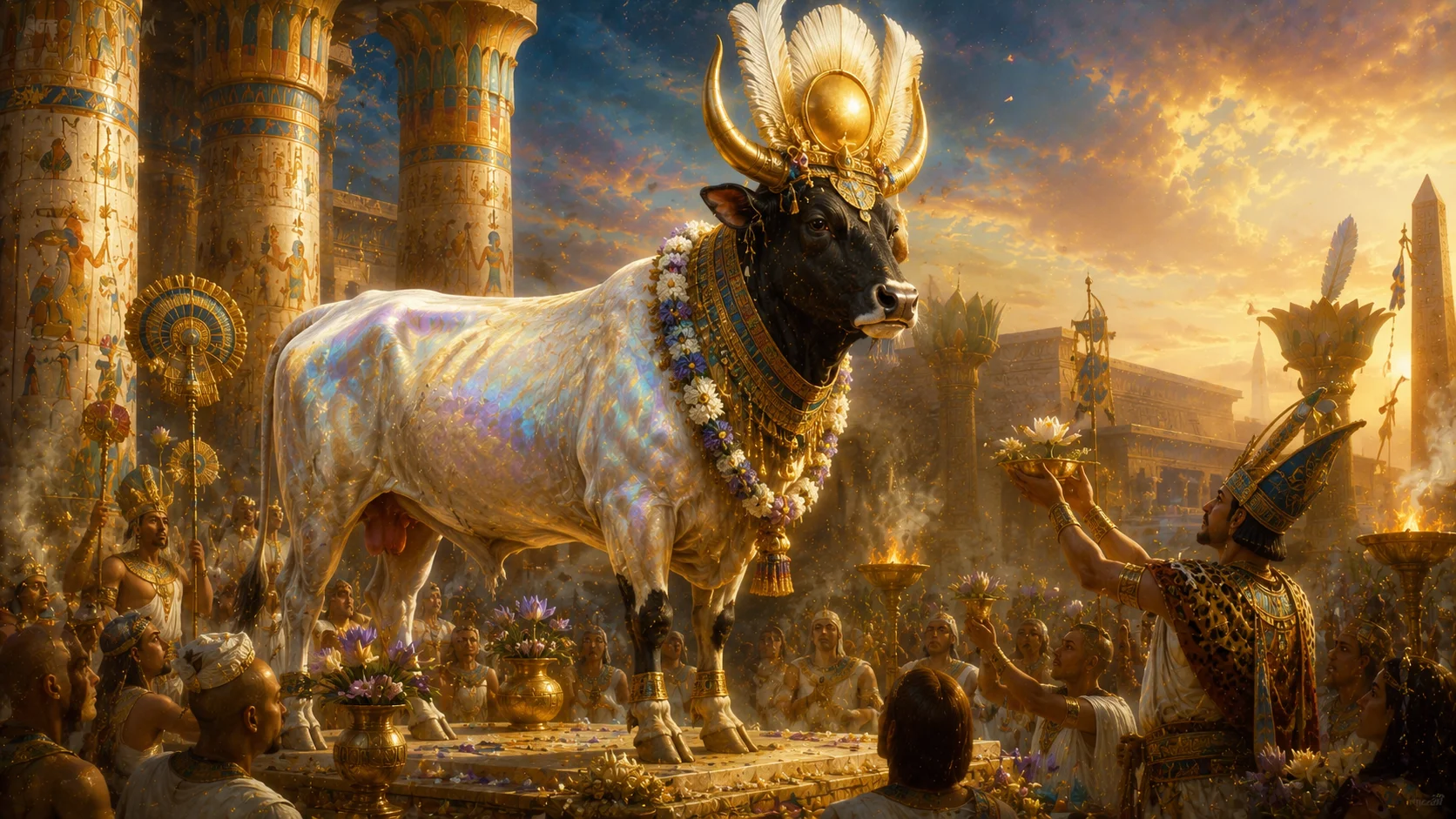
Egyptian mythological history arranged the earliest ages of the world as a sequence of divine reigns — the sun-god Ra ruling first, then Shu, then Geb himself, then Osiris, then Horus, before kingship at last passed to mortal pharaohs. Geb's place in that sequence made him, mythologically, a primeval king of Egypt in his own right, and the memory of that reign outlived the myth's own timeline: pharaohs were at times described as sitting upon "the Throne of Geb," a phrase that reached back past every human dynasty to claim descent from the earth-god's own kingship. To rule Egypt was, in that formula, to occupy a seat that had first belonged to the ground itself.
Keeper of What Lies Beneath
Because the dead were buried in the earth, and the earth was Geb's own body, he carried a protective role in funerary belief that ran alongside his cosmological one. Funerary texts could address him directly, asking that he open the ground to receive the deceased, or petitioning him not to harm the dead who now rested within him. This was not a role of judgment or menace so much as one of custody — the god was asked to be gentle with what had been entrusted to him, to treat the buried as a guest within his own body rather than as a thing simply swallowed by soil.
A God Without a House
Unlike Osiris or Ra, Geb never anchored a major independent cult centre of his own, no great temple built specifically to his name with a dedicated priesthood tending it. His worship is attested from the Pyramid Texts of the Old Kingdom onward, but it lived chiefly in cosmological and mythological writing — in the texts that explained how the world was shaped and how kingship descended — rather than in the daily offerings of a temple cult. Geb was, in that sense, everywhere and nowhere: too fundamental to need a single shrine, present in every field, every tomb, every throne, and every telling of how the sky came to stand apart from the ground.
The Ground of the World
Geb endures as the Egyptian god of the earth — the fertile ground, the father of the Osirian gods, the husband of the sky, the foundation of the world, and the ancestral king whose throne every later pharaoh claimed to inherit. He embodies the Egyptian vision of the earth as a living god, capable of laughter as much as growth, the source of all crops and the guardian of all graves, lying beneath the arch of the sky; and he completes, with Nut and Shu, the great cosmological picture of the Egyptian world: the earth below, the sky above, and the air between, holding them eternally apart so that the world may exist in the space carved out between earth and heaven.
His body is the earth itself, green with growing things and quick to tremble with a god's own laughter, and he reclines forever reaching up toward the star-filled sky of his beloved Nut, held apart from him by the air so that the world may exist between them.
Sources & traditions
- EncyclopediaWikipedia — Geb
- TraditionEgyptian texts, inscriptions and later retellings
Myths change from area to area and from time to time. This chronicle follows the most widely told versions; tellings in other villages, regions and eras may differ.