Shu was the Egyptian god of the air, wind and light — the firstborn of the creator Atum, who holds apart the sky and the earth and fills the space between with the breath of life. The very atmosphere of the world made divine, he is the air we breathe and the light of day, the god who stands forever between heaven and earth.
The God of the Air
Shu (Egyptian Shu, “emptiness” or “he who rises up”) was the personification of the air, wind, and the light of the atmosphere. He was the firstborn child of the creator-god Atum (with his twin sister Tefnut, moisture), brought forth at the very beginning of creation — the first deities to come from the creator. As the god of air, Shu was the dry breath of life, the wind, and the empty space filled with light that lies between the earth and the sky. He was depicted as a man, often with a feather (the hieroglyph of his name) on his head, his arms raised to hold up the sky.
The Holder-Apart of Sky and Earth
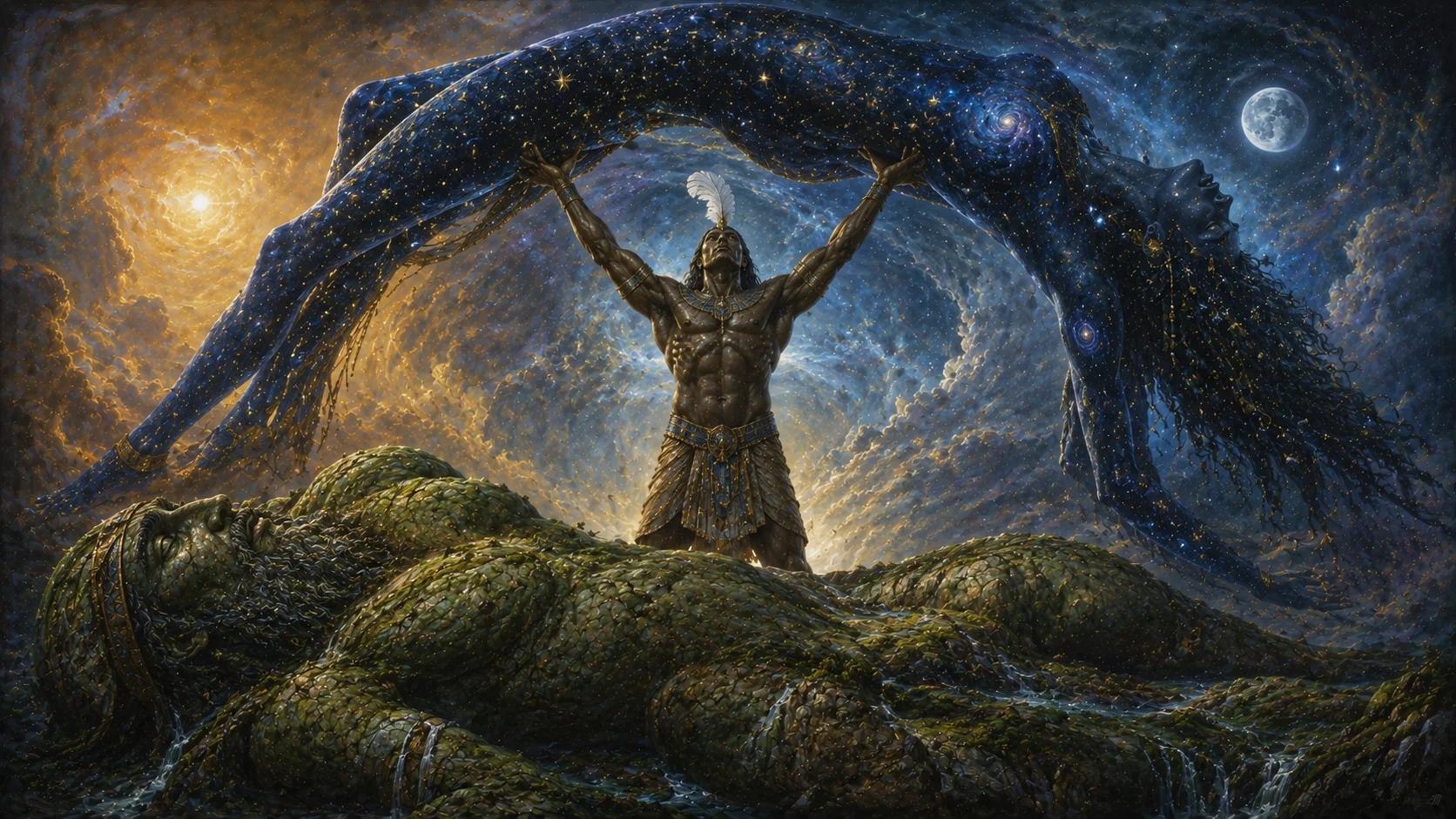
Shu's great and eternal role was the separation of the sky and the earth. His children, Geb (earth) and Nut (sky), lay locked together in such close embrace that there was no room between them for the world to exist. So Shu stepped between his children and, with his arms raised, lifted Nut the sky high up above, holding her arched body aloft above the reclining body of Geb the earth — and he holds her there still, standing forever between earth and heaven, the air that keeps the sky from falling back down upon the earth. This is one of the central images of Egyptian cosmology: Shu the air, standing with upraised arms, holding the starry sky-goddess up above the earth so that the world may exist in the space between them.
The Breath of Life
As the god of the air, Shu was the very breath of life — the air that all living things breathe to live. He was associated with the cooling wind, with the light of day (as opposed to the darkness), and with the life-giving atmosphere itself. To breathe was to take in Shu; the air in the lungs of every living creature was the god. He also had a role in the solar journey and, in some myths, briefly ruled as king of the gods after Ra and Atum, before the rule passed to Geb. He could also be a fierce god, associated with the punishing dryness and the hot winds, and one of the protectors of the sun against the chaos-serpent.
The Air Between Heaven and Earth
Shu endures as the Egyptian god of the air and one of the foundational deities of the cosmos — the firstborn of the creator, the breath of life, the light of day, and above all the god who holds the sky apart from the earth. He embodies the Egyptian understanding of the atmosphere as a living, divine force, the empty-yet-vital space that makes the world possible; and he stands at the very structure of the Egyptian cosmos, the air forever holding heaven and earth apart so that life may exist in the space between.
He is the air we breathe and the light of day — and he stands forever with upraised arms between the earth and the sky, holding the heavens aloft so the world may exist in the space between.
The Sneeze at the Beginning of the World
Egypt's oldest religious writing does not say that Shu was born. It says he was expelled. In the Pyramid Texts — carved into the burial chambers of the late Fifth and Sixth Dynasty kings at Saqqara, and the oldest substantial body of religious literature to survive from anywhere on earth — the creator Atum stands alone on the primordial mound at Heliopolis with nothing around him, and brings the first two gods out of his own body. In one telling he takes himself in hand and the seed becomes the twins. In another, more famous version, he simply sneezes out Shu and spits out Tefnut.
This is not a joke at the creator's expense. It is a pun with cosmological weight. Egyptologists have long noticed that the verbs the text uses — ishesh, to sneeze or splutter out, and tefen, to spit — play against the names of the gods they produce, most audibly in Tefnut's case. And both acts are exactly right for what the twins are. Shu is dry air forced out of a body under pressure. Tefnut is moisture. The first thing the universe does, in the Heliopolitan account, is breathe out. Creation begins as an exhalation, and Shu is that exhalation given a name.
From that pair the whole Egyptian family tree descends. Shu and Tefnut produce Geb and Nut; Geb and Nut produce Osiris, Isis, Seth and Nephthys. Together with Atum these nine constitute the Ennead of Heliopolis, the most influential of Egypt's competing accounts of how the world came to be — and Shu stands at its second rank, the hinge between the solitary creator and the populated world. Every myth that follows, including the murder of Osiris and the whole drama of kingship that descends from it, happens inside the space Shu opened.
The Pillars, the Cow, and the Eight
The image of a single god holding up the entire sky invites an obvious question, and the Egyptians asked it: does he ever get help?
He does. Egyptian texts speak of four supports at the corners of the world — the pillars or props of Shu — standing at the cardinal points and bearing the weight of heaven with him. And in the Book of the Heavenly Cow, one of the great New Kingdom compositions, the arrangement becomes vividly literal. The text survives on the walls of royal tombs in the Valley of the Kings and, in its earliest known version, on a gilded shrine from the tomb of Tutankhamun. In it, an ageing Ra withdraws from a rebellious humanity and is carried upward on the back of Nut, who has taken the form of an enormous cow. Shu stands beneath her belly with his arms raised, propping her up — and because a cow of that size is more than one god can manage, he is assisted by the heh-gods, crouching deities of infinity who grip the cow's legs, two to each.
The accompanying illustration is one of the most extraordinary pictures ever drawn of a cosmos: a star-spangled cow standing over the world, the solar barque sailing along her flank, and beneath her the air-god braced upright with his hands under her body, holding the sky in position by main force. It is worth noticing what the picture concedes. The Egyptian sky is not a permanent fixture. It is held, and it is held by someone who must keep holding.
Shu and Tefnut as the Twin Lions
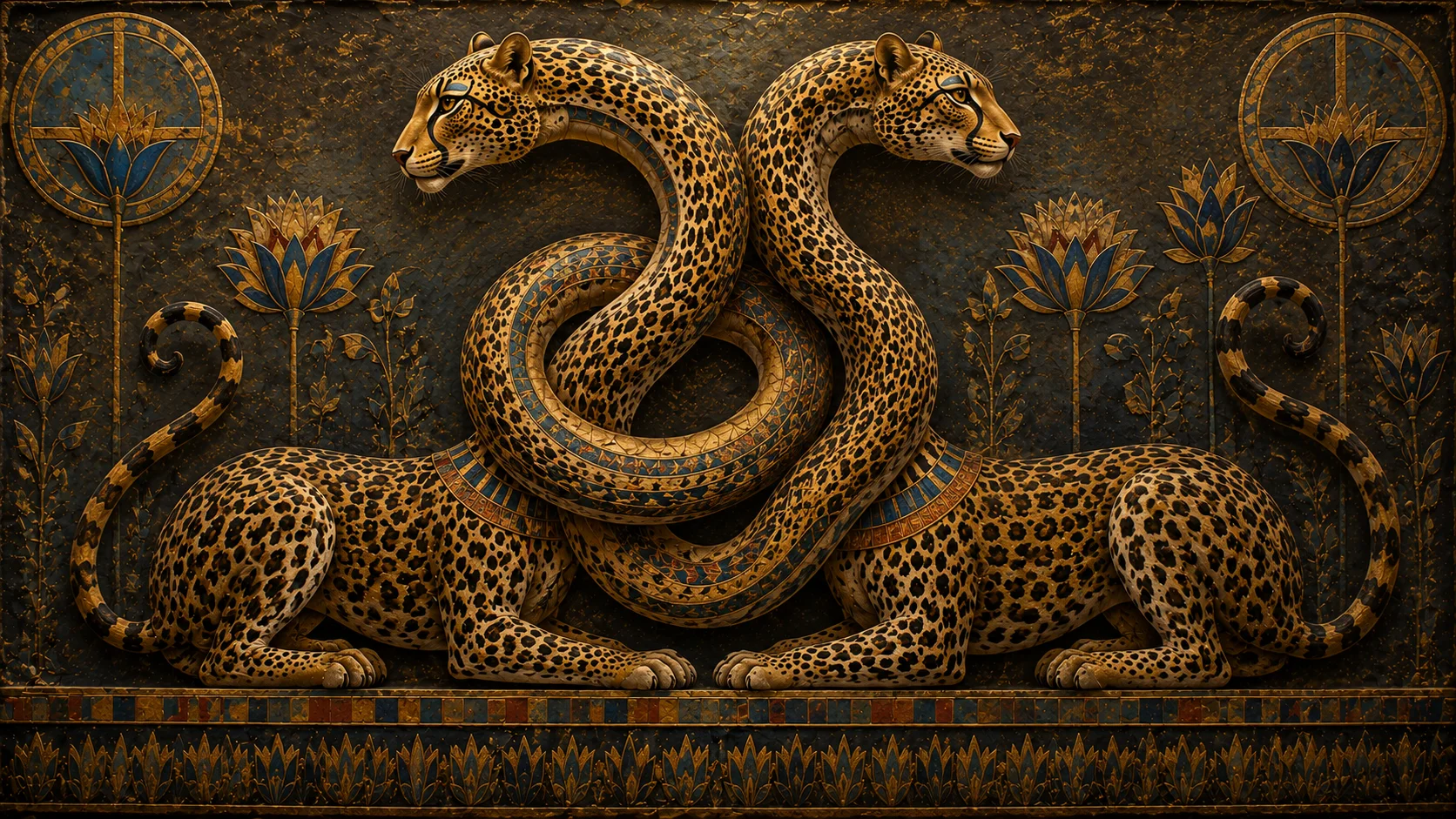
The feather and the upraised arms are not the only shape the god had, and the other one is not gentle. As Ruty, “the Pair of Lions”, Shu and his sister appear as two lions seated back to back, gazing in opposite directions — a form the funerary literature explicitly glosses as Shu and Tefnut, and one tied to the eastern and western horizons through which the sun passes. The god of the breath in your lungs was also, when he chose, a predator at the edge of the world.
They were honoured in that leonine form in the Delta, in the town the Greeks later called Leontopolis, the lion city. And the lion shape ties Shu to one of the most persistent story-patterns in Egyptian religion: the myth of the distant goddess. The daughter of the sun quarrels with her father, leaves Egypt in a rage, and settles in Nubia as a lioness, where her absence is a catastrophe — no eye of the sun, no protection, no return of the flood. A god must go south and coax her home, half by argument and half by flattery, and the country's fertility depends on his success. In the surviving Demotic version the negotiator is Thoth, talking her down with fables; in other strands of the tradition the task belongs to Shu, and the returning goddess is his own sister Tefnut.
That role fused him permanently with another deity. Onuris — Egyptian Anhur, a warrior god of Thinis in Upper Egypt and later of Sebennytos in the Delta — carried a name meaning something very close to he who brings back the distant one, and his consort was the lioness Mehit. The overlap was too neat to resist. From the New Kingdom onward the two are worshipped as Onuris-Shu: the air-god armed with a spear, a hunter and a bringer-back, hailed as a champion and a saviour, a god who fights on Egypt's behalf. It is a striking second career for a deity whose original job was to stand still.
The Reign of Shu and the Nine Days of Storm
Egyptian tradition held that before there were human kings, the gods themselves ruled Egypt in succession — Ra, then Shu, then Geb, then Osiris. Most of what survives of Shu's reign comes from a black granite shrine of the Ptolemaic period found at el-Arish, on the north Sinai coast, whose long inscription reads like the annals of a divine dynasty.
The story it tells is grim, and it is not the story of a serene sky-holder. Shu inherits the throne and rules from a residence in the eastern Delta. Then the children of Apophis, the serpent of chaos, come out of the eastern desert in rebellion, and the reign collapses into war. The text describes an illness or weakening of the god, and finally his withdrawal from the earth to the sky. His departure is followed by nine days of storm and darkness so violent that neither gods nor people can see one another's faces. Only when it clears does Geb take the throne — and the first thing the new king does is turn his attention to his mother Tefnut, an episode the text records with unmistakable unease.
The shrine is late, and its language is difficult; Egyptologists do not agree on every line of it. But the shape of the tale is unmistakably old, and its implication is one worth sitting with. The god who guarantees the structure of the world can be attacked, exhausted and driven out of it — and when he goes, what fills the gap is nine days in which nobody can see.
How to Recognise Him
Shu is one of the easier Egyptian gods to identify, because his posture is his function.
- The feather. A single tall ostrich plume, the hieroglyph that writes his name. Where a male figure wears one plume and nothing else to distinguish himself, Shu is the first guess.
- The arms. Kneeling or standing with both arms raised, elbows bent, palms upward — often with the arched body of Nut resting on his hands, or the sky-hieroglyph itself balanced above him.
- The lion. Occasionally lion-headed, or paired back-to-back with Tefnut in the Ruty form.
- The company. Where a scene shows a woman arched over a reclining man, the trio is nearly always Nut, Geb and Shu — and Shu is the one in the middle, doing the work.
He also turns up in places that are easy to overlook. Egyptian headrests — the curved wooden or ivory supports on which a sleeper's neck rested — sometimes carry a figure of Shu beneath the curve, holding it up exactly as he holds up heaven. A celebrated ivory example comes from the tomb of Tutankhamun, where the god kneels between two reclining lions with the curved rest raised on his hands. The reading usually offered is domestic and perfect: the head of the sleeper is the sun, the curve is the sky, and the god of air holds it through the night. Small amulets of Shu kneeling with raised arms were placed on mummies for much the same reason — to keep the sky, and the breath, from failing.
The Breath the Dead Ask For
Egyptian funerary religion is often described as an obsession with preservation. It is at least as much an obsession with air. Tomb after tomb asks not for gold or company but for the same modest thing: the sweet breath of the north wind, the cool air of the living, admitted to a nose that has stopped using it.
Shu is the god who grants it. In the Coffin Texts of the Middle Kingdom — the spells painted inside wooden coffins for officials and the well-to-do, in the centuries after funerary literature spread beyond kings — there is a long and remarkable sequence in which the deceased does not merely petition Shu but speaks as him. In the first person, the dead person declares that Atum made him, that he was not built in a womb nor knitted together in an egg, that he came into being as the life-breath itself and existed before the sky was raised. It is a bold piece of theology. To survive death, the spells reason, you must become the one thing in the cosmos that cannot be shut in a box: the air.
Behind it lies the plainest observation Egyptian religion ever built on. The difference between a living body and a dead one, visible to anyone who has watched someone die, is a movement at the nostrils. Egyptian texts say so directly — the gift a god gives to a mortal is the breath of life to your nose. Shu is that gift personified, which is why the same god who holds up the sky is also the one you beg for a draught of moving air in a sealed tomb.
The Air in the Aten's Name
Shu's strangest moment came in the fourteenth century BCE, when Egypt briefly abandoned its gods.
Akhenaten's revolution suppressed the old pantheon, hacked Amun's name from monuments, and reduced worship to a single visible disc. Yet in the earlier of the two great didactic formulations of the Aten's name — the theological titulary written in cartouches like a king's — the sun is proclaimed as Ra-Horakhty rejoicing in the horizon in his name of Shu who is in the Aten. The air-god was written into the new god's own name.
The reason is not hard to see. Shu was, before he was anything else, light and air; he was already what the Aten claimed to be, sunlight filling the space between heaven and earth. It has long been noticed, too, that Akhenaten and Nefertiti are presented in Amarna art in a way that echoes Shu and Tefnut — the first pair, the children of the creator, the couple through whom light reaches the world. When the doctrine was later tightened and a second didactic name replaced the first, the reference to Shu was struck out along with the other divine names. Even the most radical reform in Egyptian history had begun by borrowing him, and only later found him too much like a god.
Why the Sky Must Be Held
The separation of sky from earth is one of the motifs the human imagination seems to arrive at independently, over and over. Greek myth begins with Ouranos pressed upon Gaia until he is forced away from her. In Māori tradition, still told and still living, Ranginui the sky and Papatūānuku the earth cling together in darkness until their son Tāne sets his shoulders against his mother and his feet against his father and pushes them apart, and light enters the world for the first time. The pattern recurs because it answers something everyone can see: there is a floor, there is a ceiling, and there is a gap, and the gap is the only part of the arrangement we can live in.
What is distinctively Egyptian is the anxiety attached to it. Shu is not remembered for the moment of separation. He is remembered for the strain of maintaining it — a god frozen mid-effort, arms locked overhead, for the entire duration of the universe. The sky in Egyptian thought is a weight that wants to come down; its supports can be shaken, its holder can be wounded, and when he leaves the throne the world gets nine days of storm. Order is not the default state of things. It is a load being carried by someone who is not allowed to put it down.
That is why a god you cannot see, with no famous scandal and no great deed but one, sits so deep in the Egyptian system. Shu is the argument that the world is not self-supporting. Every breath a person takes is a small instance of the same act performed at cosmic scale — something being held open that would otherwise close.
Sources & traditions
- EncyclopediaWikipedia — Shu (god)
- TraditionEgyptian texts, inscriptions and later retellings
Myths change from area to area and from time to time. This chronicle follows the most widely told versions; tellings in other villages, regions and eras may differ.