Atum was the primordial creator-god of ancient Egypt — the self-created being who rose from the waters of chaos at the beginning of time and brought forth the first gods and the ordered world from his own substance. The first of the great Ennead of Heliopolis and the setting sun in his aspect, he is the source from which all things came, the god who made himself and then made everything.
The Self-Created One
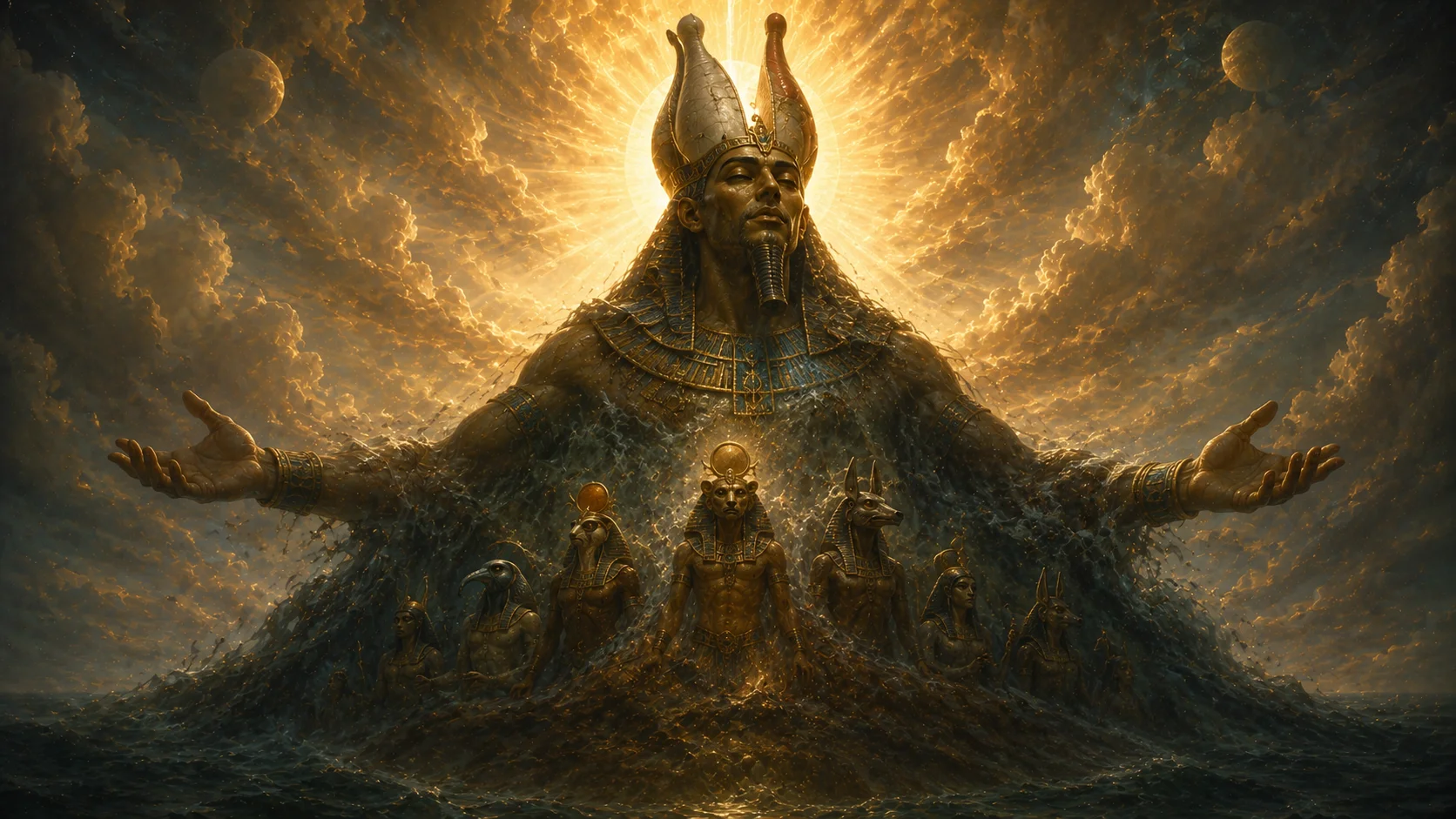
Atum (“the complete one,” or “the all”) was the creator-god in the cosmogony of Heliopolis, the most influential of Egypt's creation myths. In the beginning there was only Nun, the dark, formless primordial waters of chaos — and from these waters Atum brought himself into being, the first being to exist, self-created and self-generated, rising upon the first mound of dry land (the benben) to emerge from the endless deep. He was often merged with the sun-god as Atum-Ra, and represented the sun in its setting, evening aspect, as Khepri was the dawn and Ra the noon.
The First Creation
Having created himself, Atum then created the first other gods from his own body, without a partner. By his own act — spitting, or sneezing, or by his own seed — he brought forth the first divine couple: Shu, the god of air, and Tefnut, the goddess of moisture. From Shu and Tefnut came Geb (earth) and Nut (sky); and from Geb and Nut came Osiris, Isis, Set and Nephthys. These nine gods — Atum and the eight who descended from him — formed the Great Ennead of Heliopolis, the foundational family of the Egyptian pantheon. Thus Atum was the father and source of the gods, the single being from whom the whole divine family, and through them the ordered world, unfolded.
The Lord of Totality
Atum's name and nature express the idea of completeness and totality — he was “the all,” the one who contained all things within himself before they were separated out into the many. He was depicted as a man wearing the double crown of Egypt, a king among the gods, and he was associated with the finished, completed state of creation as well as its beginning. In some texts he was also the god who would, at the end of all things, return the world to the primordial waters from which it came, so that he was both the first and the last, the beginning and the end of the created order.
The Source of All Things
Atum endures as one of the great creator-gods of world mythology — the self-created being who rose from chaos and brought forth the gods and the world from his own substance, the father of the Ennead, the lord of totality. He embodies the Egyptian vision of creation as an emergence of order, life and multiplicity from a single, self-generated source rising out of the formless deep, and stands at the very head of the family of gods whose dramas would shape three thousand years of Egyptian faith.
Before there was anything, he made himself out of the waters of chaos — and then, alone, brought forth the first gods from his own body, and the whole world unfolded from the one who was "the all."
The Oldest Words in Egypt
In a limestone chamber south of Cairo, columns of hieroglyphs carved roughly four and a half thousand years ago still run floor to ceiling, their signs filled with a blue pigment that has never faded. This is the pyramid of King Unas at Saqqara, and the spells cut into its walls — the Pyramid Texts — are, by wide scholarly agreement, the oldest substantial body of religious writing to survive anywhere on earth. Atum runs through them constantly, and not as a footnote: he is the god the dead king must become in order to climb into the sky. Before there were myths about Atum written for the living, there were spells about him written for the dead — and he was already, at the very beginning of Egyptian religious literature, the point that everything else led back to.
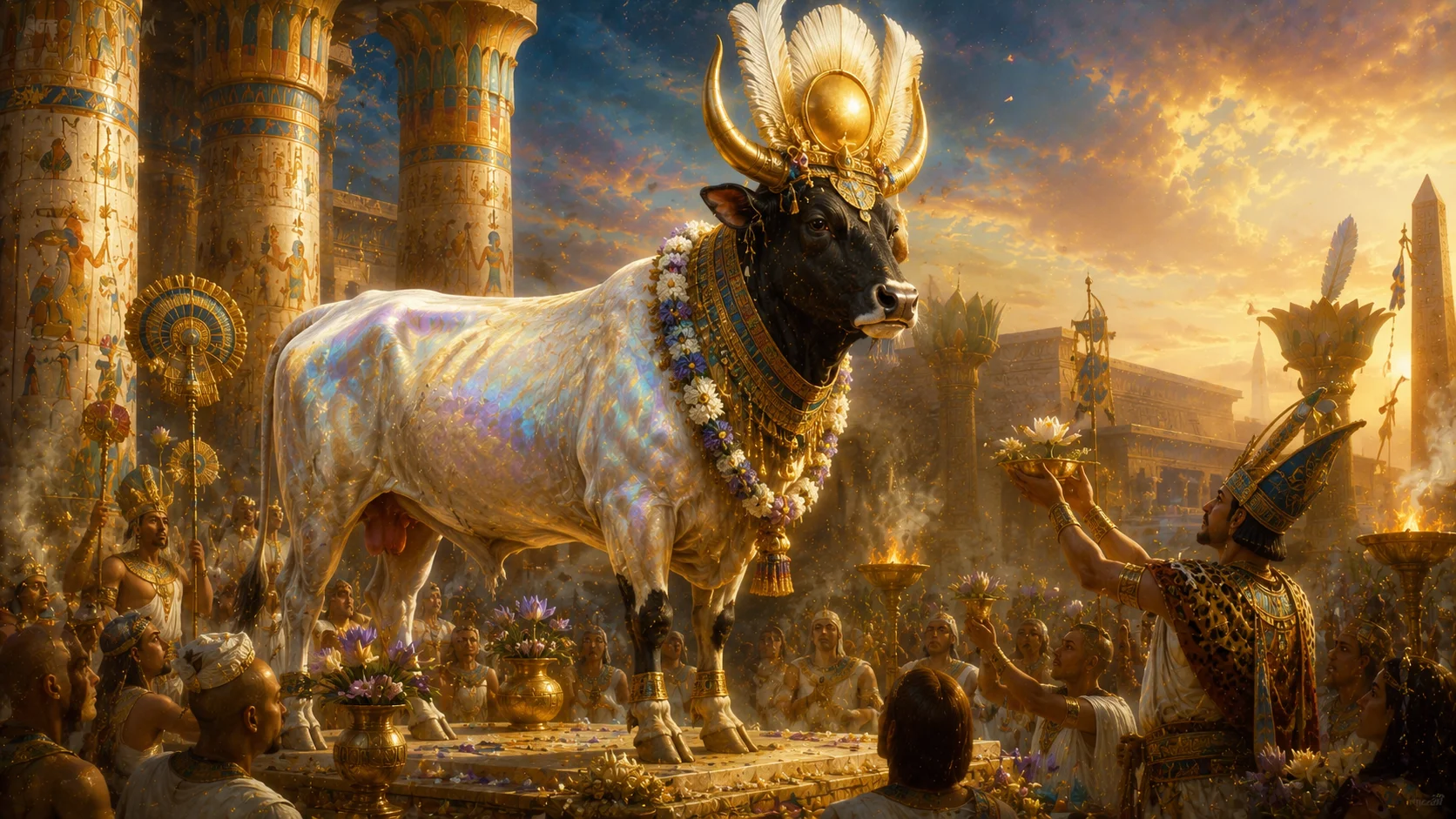
Those texts remember a specific, physical place: the benben, a sacred stone kept at Heliopolis — Iunu, “the city of pillars,” to the Egyptians themselves. It was not a symbol invented later to illustrate the myth. It was a real cult object, tended by real priests, housed in a shrine the Egyptians called the Mansion of the Benben, and treated as the physical anchor of a cosmic event. Egyptians did not have to imagine where creation had happened. They could walk to it.
The Hand That Made the World
Egyptian theology built an entire second layer of divinity out of the mechanics of that first solitary act. If Atum brought forth Shu and Tefnut from his own seed, with no partner yet in existence to help him, then something in him had to serve as the other half of the transaction — and the Heliopolitan answer was to personify his hand. The Hand of Atum was worshipped as a goddess in her own right: Iusaas in some traditions, Nebethetepet in others, both associated with Hathor and both understood as the female power residing inside the creator himself. Creation, in this telling, did not require two beings. It required Atum, and the part of himself that made action possible.
A further birth follows, stranger still. A gloss preserved in Coffin Texts Spell 335 — and again in its later form as Spell 17 of the Book of the Dead, a passage that opens with the creator announcing “I am Atum when I was alone in Nun” — explains that blood falling from the creator’s own body, from an act of self-cutting, became two more gods: Sia, perception and understanding, and Hu, authoritative utterance, the spoken word that cannot fail to take effect. Where the Ennead gave Egypt a family of gods, Sia and Hu gave it something closer to a theory of how creation worked at all: a god perceives, and a god speaks, and because he is Atum, what he says becomes true.
Three Rival Creations
Egypt never settled on a single creation story, and never seemed to feel the need to. At Memphis, priests taught that Ptah created first, conceiving the world in his heart and speaking it into being with his tongue — and the surviving Memphite text is explicit that Atum and his Ennead were themselves Ptah’s work, identified with the teeth and lips of the mouth that pronounced the name of every thing. At Hermopolis, the story began earlier still, with the Ogdoad: eight primordial beings arranged as four male-and-female pairs, each pair one quality in two forms — Nun and Naunet, the formless waters; Heh and Hauhet, boundlessness; Kek and Kauket, darkness; Amun and Amaunet, hiddenness. Their churning produced the egg, or in another version the lotus, from which the sun was born. And at Thebes, in the New Kingdom, hymns give Amun the attributes Heliopolis had claimed for Atum: self-created, hidden, existing before there was anything in existence that could have watched him do it.
Egyptian religion rarely forced these traditions to fight to the death. It merged them instead. Atum fused with the sun-god as Atum-Ra; Amun later absorbed both as Amun-Ra, folding Heliopolis’s oldest theology into Thebes’s newest state cult without ever formally retiring it. A single hymn could name the sun-god three or four different ways in successive lines and mean one being throughout. Atum was seldom erased by a rival cosmogony; he was absorbed into whichever one currently held political power — which is a large part of why his name survived across three thousand years of Egyptian history while the centre of religious gravity moved from city to city.
Becoming Atum
Atum was not a god most Egyptians carried through the streets at festival time, the way Osiris went out at Abydos or Amun sailed between temples at Opet. His importance was concentrated somewhere quieter and, in the end, more personal: the funerary texts that every Egyptian who could afford them hoped to take into the tomb. Spells in the Coffin Texts and later the Book of the Dead have the deceased speak as Atum, declaring themselves the one who existed before the world divided into pairs, before Shu and Tefnut, when there was no one else at all. To become Atum, even briefly and ritually, was to reach back past your own death to the single moment in the universe’s history that held no death in it yet, because nothing had yet happened that could end.
This gave the Heliopolitan priesthood a prestige built on learning rather than on popular devotion. Its chief priest carried the title Greatest of Seers, and Heliopolis was remembered by later writers, Egyptian and Greek alike, as a centre of astronomical and calendrical knowledge: Herodotus rated its priests the most learned in Egypt, and Strabo, visiting when the city was already half-ruined, was shown the rooms where Greek philosophers were said to have studied with them. Serving Atum meant, in practice, watching the sky — tracking the sun’s daily descent and its annual round, the same cycle Atum himself was thought to govern in his evening aspect.
The Serpent at the End
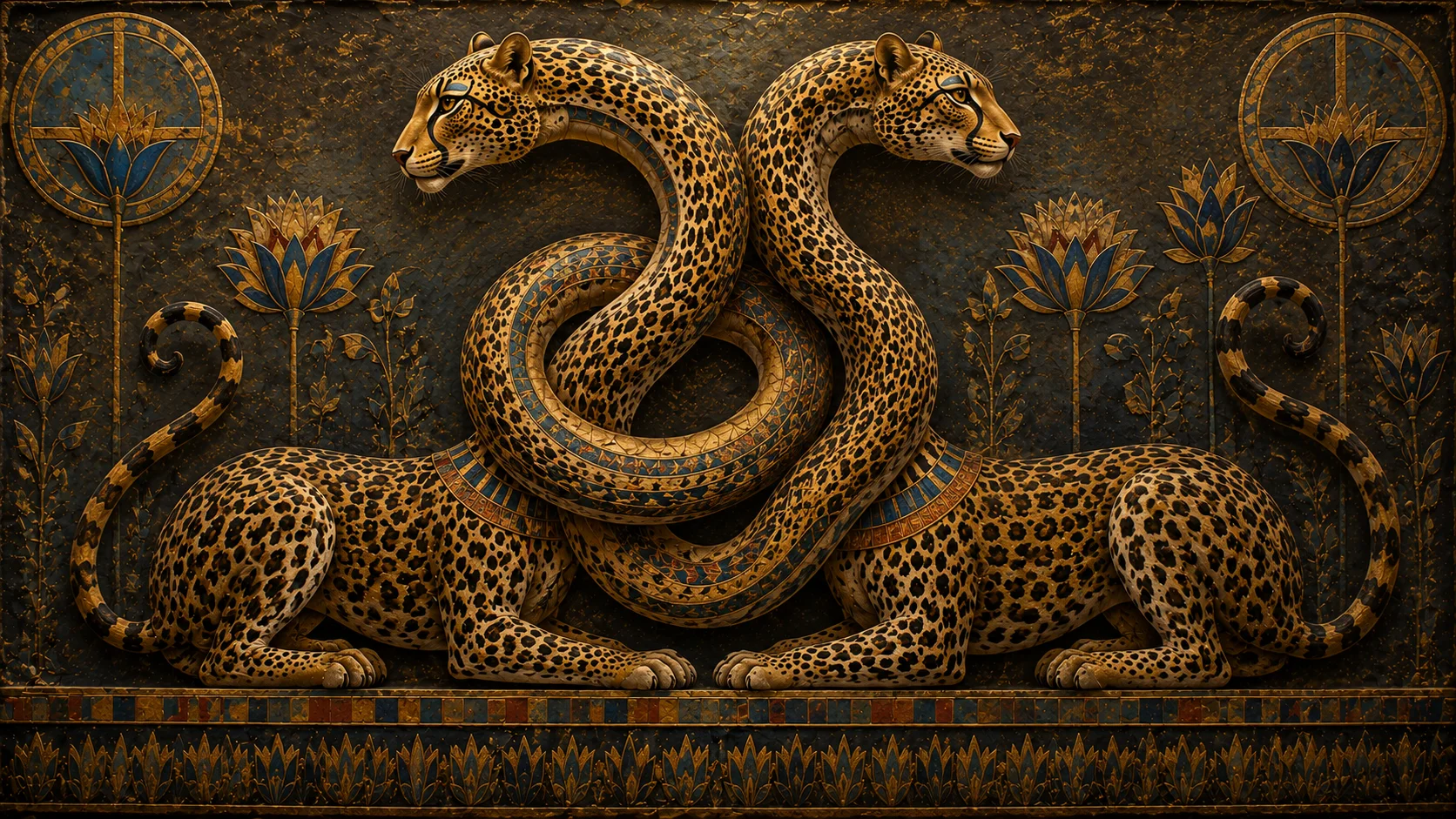
Egyptian myth gave Atum an ending to match his beginning, and it is one of the coldest passages in the whole funerary literature. In a dialogue preserved as Spell 175 of the Book of the Dead, Osiris complains about the underworld — its darkness, its lack of air and water — and Atum answers with something far bleaker than sympathy: a day will come when he undoes the world he made and lets it sink back into Nun, the land levelled, the gods gone, nothing left standing. Two beings alone will remain. Osiris, in whatever form the dead endure in, and Atum, who will by then have changed himself into a serpent that no man knows and no god sees — because a serpent is what moved through the waters before there was any land to stand on, and a serpent is what will still be moving through them once the land is gone.
It is worth holding this apart from Apophis, the great serpent that attacks the sun-god’s boat every night of the underworld journey. Apophis is chaos as an enemy, something creation must defeat again and again simply in order to keep existing. Atum’s serpent is nobody’s enemy. It is Atum choosing his own undoing, calmly and on his own schedule, because the shape that suits non-existence is the same shape that preceded existence in the first place. Where Apophis embodies the fear that order might lose, Atum’s transformation is closer to acceptance — the world was always on loan from the one being who could not be destroyed by losing it.
Stone Set Against the Sky
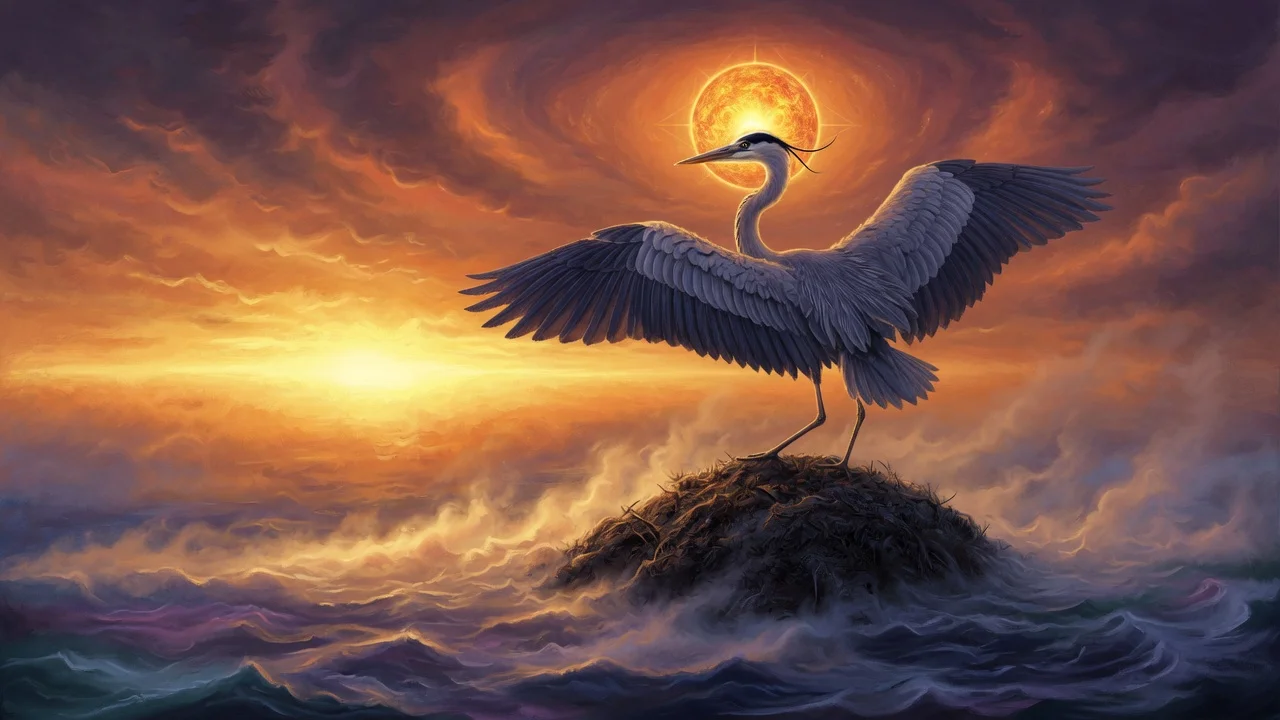
The benben did not stay a single sacred object confined to one temple. Egyptians held that the Bennu — a self-created, heron-like bird bound closely to both Atum and Ra — had been the first living thing to alight on it, and Greek visitors centuries later heard the Bennu’s story at Heliopolis and recognised, or half-invented, their own phoenix inside it. The stone’s shape became architecture: the pyramidion that capped a pyramid, and the tapering obelisk, raised in pairs before temples of Atum and Ra, its gilded tip catching the first and last light of the day much as the benben was said to have caught the first light of creation.
Heliopolis itself barely survives. Its temples were quarried for later building projects until almost nothing above ground remained; a single obelisk raised by Senusret I still stands on the site, alone, now swallowed by a suburb of modern Cairo. Two of its neighbours travelled further than the god they honoured ever did in myth: a pair of obelisks first raised at Heliopolis by Thutmose III were moved to Alexandria under Roman rule and, in the nineteenth century, shipped on to London and New York, where they still stand under the borrowed name Cleopatra’s Needles — catching sunlight over cities that have long since forgotten whose light they were cut to catch. Nor has Atum gone entirely quiet: modern Kemetic revivalist communities, small but serious, still count him among the netjeru they honour.
Why Someone Has to Come First
Every creation story eventually collides with the same problem: if a god made the world, who made the god? Most mythologies answer by pushing the question backwards — an earlier god, an earlier generation, turtles further down. Atum’s myth is unusual in refusing to play that game at all. It stops the regress cold by making self-creation the entire point. He rises from the waters already complete, with no parent to account for and no earlier chaos-god to overthrow, and the question is left with nowhere to go.
That is probably why he still pulls at the imagination, some sixteen centuries after the last offerings were made in the temples of Egypt. Atum is an answer to the question every child eventually asks and no religion can entirely dodge — where did the first thing come from — and Egypt’s answer was not a bigger god standing behind the god, but a being who refused to need one.
Sources & traditions
- EncyclopediaWikipedia — Atum
- TraditionEgyptian texts, inscriptions and later retellings
Myths change from area to area and from time to time. This chronicle follows the most widely told versions; tellings in other villages, regions and eras may differ.