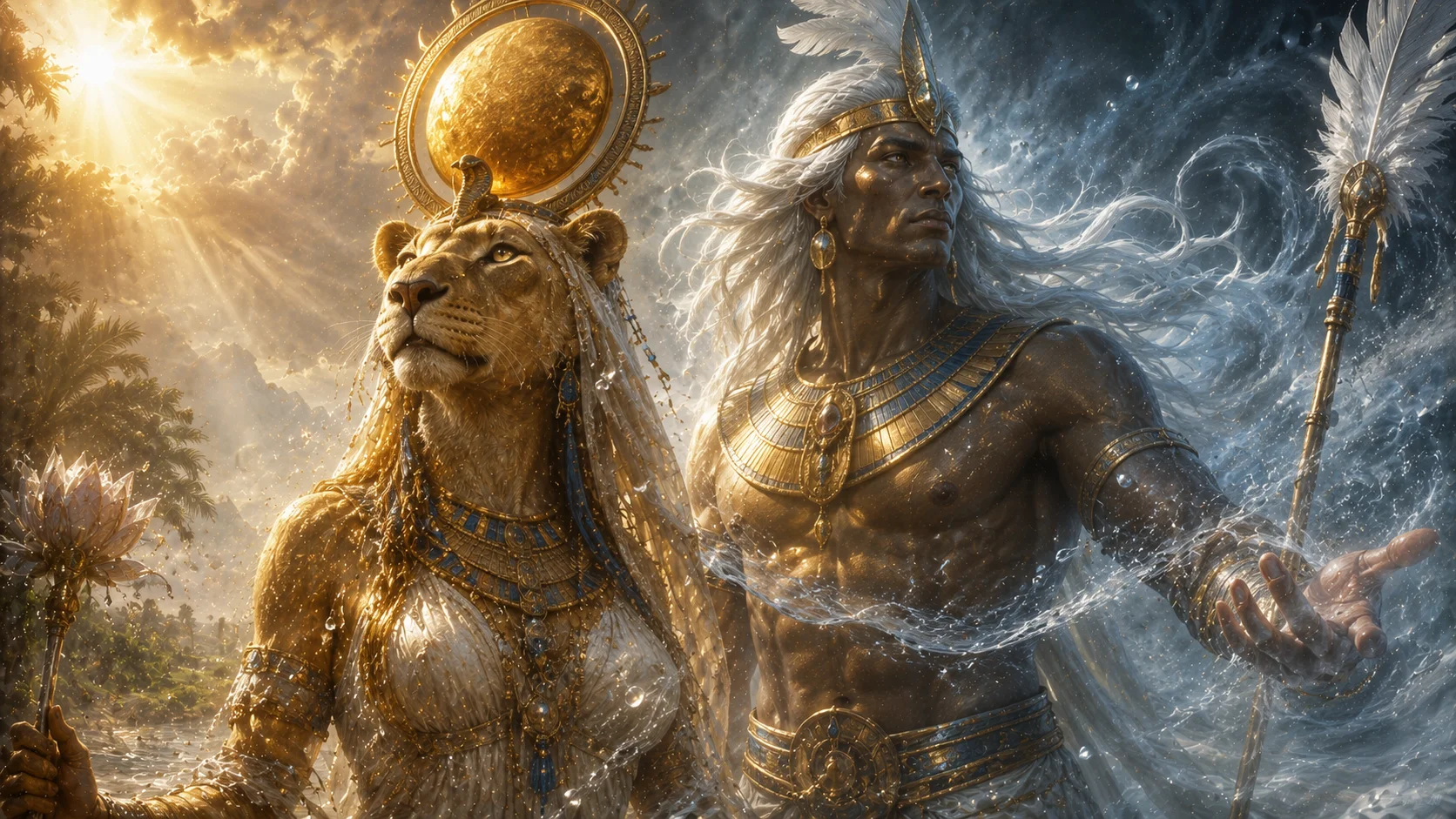
Tefnut was the Egyptian goddess of moisture, rain and dew — the twin sister and consort of Shu the air, one of the first two beings brought forth by the creator Atum, and the mother of the earth and sky. A lioness-goddess of the life-giving waters of the air, she completes, with Shu, the first divine pair from whom the ordered world descended.
The Goddess of Moisture
Tefnut (Egyptian Tefnut) was the personification of moisture — water in the air, dew, rain, and the life-giving wetness without which nothing can grow. She was, with her twin brother Shu (air), one of the very first two deities created by Atum at the beginning of the world, brought forth from the creator's own body. Together, Shu (dryness, air) and Tefnut (moisture, wetness) formed the first complementary pair — the dry and the wet, the two essential qualities of the atmosphere — the foundation upon which the rest of creation was built. She was often depicted as a woman with the head of a lioness, sometimes crowned with the solar disc.
The Mother of Earth and Sky
By her brother-consort Shu, Tefnut was the mother of Geb (the earth) and Nut (the sky) — and thus the grandmother of the great gods Osiris, Isis, Set and Nephthys. As the mother of earth and sky, Tefnut stood near the very root of the Heliopolitan family of gods, the second generation from the creator, the goddess from whom (with Shu) descended the whole structured cosmos of earth, sky, and the gods who dwelt within it. The first divine couple, Shu and Tefnut, were the parents of the world.
The Lioness Who Departed
One of the most famous myths concerning Tefnut tells of her departure and return. In a quarrel with her father Ra (or in her fierce lioness aspect), Tefnut left Egypt in anger and went south into the deserts of Nubia, taking her life-giving moisture with her — and in her absence, as a wild and raging lioness, the land suffered. The sun-god, missing his daughter (often identified with the Eye of Ra), sent Thoth (or Shu) to find her and persuade her to return. Through Thoth's clever words and soothing, the angry lioness-goddess was calmed and coaxed back to Egypt, and her return brought the renewal of moisture, life and joy to the land — a myth connected to the bringing of the life-giving waters and perhaps the seasonal return of fertility. The transformation of the raging desert-lioness back into the gentle, life-giving goddess was celebrated with great rejoicing.
The Wetness of the World
Tefnut endures as the Egyptian goddess of moisture and one of the foundational deities of creation — the twin of the air, the first divine consort, the lioness of the life-giving waters, the mother of earth and sky. She embodies the Egyptian understanding of moisture as an essential, divine force of life, complementary to the dry air of her brother Shu; and she stands, with Shu, as the first pair from whom the ordered cosmos descended — the wetness and the air that together made the world possible.
The first goddess, twin of the air and mother of earth and sky — the lioness of moisture whose return from the desert brings the life-giving waters back to the world.
Spat Out, Not Born: The Pyramid Texts
Carved into the burial chamber of the pyramid of Unas, last king of the Fifth Dynasty, at Saqqara around 2350 BCE, the Pyramid Texts are among the oldest surviving religious writings on earth — and Tefnut is already there, fully formed, already twinned with Shu, already standing at the root of the world's family tree. The texts give a strange and physical account of how she came to be. Alone in the undifferentiated waters of Nun before anything existed, the creator Atum brought forth the first pair not by lying with a partner but out of his own body: one line has him sneeze out Shu and spit out Tefnut. Egyptian scribes seem to have delighted in the pun. The verb used for spitting her out sounds like her name, so that the goddess of wetness is, in the very sound of it, the residue of the act that made her — spit given a face, moisture given a will. Another strand of the same creation, present already in the Pyramid Texts and elaborated in the Middle Kingdom Coffin Texts, makes the act explicitly masturbatory, with Atum's own hand standing in for the female principle the world did not yet have.
The Nine of Heliopolis
Tefnut's home was Iunu, the city the Greeks would later call Heliopolis, City of the Sun. It is not lost, exactly, but it is gone: the site lies under the Cairo suburbs of Matariya and Ain Shams, and a single standing obelisk of Senusret I is nearly all that remains above ground of what was once Egypt's great solar temple. There, in the precinct of Ra-Atum, priests kept the genealogy of the Great Ennead — nine gods across three generations, the whole structured universe accounted for as one extended family, with Shu and Tefnut on its second rung. What is striking is how little of that centrality translated into a cult of her own. Tefnut rarely received a temple or a priesthood by herself; she was venerated almost always as half of a pair, invoked with Shu in the same breath, the wet name that hardly ever appears without the dry one beside it. Her worship was an act of completion rather than isolation — you asked for Shu-and-Tefnut, air-and-moisture, the way one might ask for warp and weft rather than either thread alone.
Ruty: The Two Lions of the Horizon
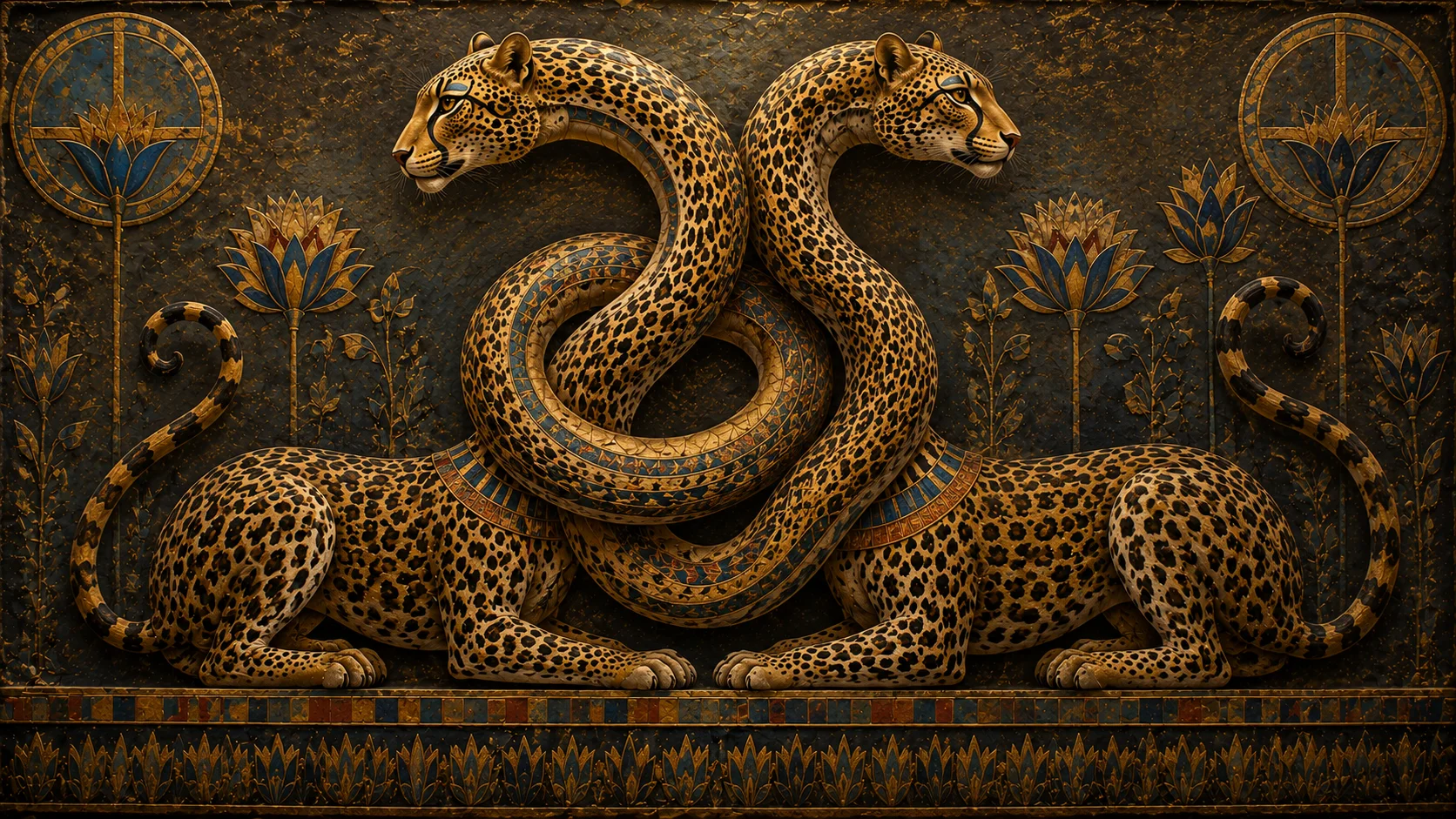
In funerary art, and in the commentary attached to one of the most frequently copied spells of the Book of the Dead, Shu and Tefnut appear together as Ruty — "the two lions" — a pair of recumbent lions set back to back with the sun disc rising between them, standing in for the two mountains of the horizon sign. It is an image about the gap: air and moisture holding the sky apart from the earth just long enough for one more day to happen. The spell that names them is also a reminder of how unsettled Egyptian theology could be about its own symbols, because its glosses openly disagree — the lion pair read as Yesterday and Tomorrow in one line, Yesterday and Tomorrow read as Osiris and Ra in another. The commentators are arguing in the margins of their own scripture. A separate pair of horizon lions, Aker, existed alongside Ruty and the two were sometimes visually conflated, which is why a double-lion horizon on a coffin or a papyrus cannot always be told apart at a glance.
A Goddess Who Could Become a Serpent
Tefnut's lioness head was not her only form. Like the other goddesses who could stand in for the dangerous, fire-eyed power of the sun — Sekhmet, Bastet, Hathor, Wadjet — she could also be shown as a rearing cobra, the uraeus, the serpent kings wore on the brow of the crown as a weapon in miniature, ready to spit flame at anyone who came too close to the throne. The emblem's defining act is spitting; the goddess's name plays on the same verb. The overlap with those other goddesses was not accidental either. All of them belonged to the theological category the Egyptians called the Eye of Ra — the sun-god's own dangerous, independent-minded power, sent out into the world and fully capable of turning on the world that sent it. Tefnut moved in and out of that company depending on which temple was telling the story, which is why her iconography was never fixed to a single animal the way Anubis's was fixed to the jackal.
The Wandering Goddess and the Egyptian Year
Tefnut's flight to Nubia and her coaxing home is not a story unique to her. It belongs to a much larger pattern, one shared with Hathor, Sekhmet and Bastet in their own local versions: the Distant Goddess who storms off into the southern desert and must be sung, danced and reasoned back to the Nile valley. Egyptologists have long read that pattern against the real Egyptian sky. Sopdet — the star we call Sirius — vanishes below the horizon for roughly seventy days each year and then reappears just before dawn, and in antiquity that reappearance fell close to the start of the Nile's flood and to the Egyptian New Year. On that reading, a goddess who disappears with the water and returns bringing the water back is a description of the inundation itself: the one indispensable event of the year, dramatised as a family quarrel with a happy ending. It is an interpretation rather than something the texts state outright — but it puts the myth where the people telling it actually stood. Tefnut's private story of departure and return was, for them, also a story about whether the Nile would rise again this year, which is to say whether they would eat.
Why a Goddess of Dew, and Not of Rain
The choice itself is worth looking at. Egypt has almost no rain; the word survives in Tefnut's usual English gloss only because it is the nearest available equivalent, but the Nile valley's own moisture is dew, mist off the river at dawn, and the humidity riding invisibly on the inundation — not storms. Cultures that depend on rainfall tend to produce weather gods with tempers, gods of thunder and sudden violence. Egypt, fed by a river whose flood arrived, mostly, on schedule from a source no one in the valley had ever seen, built its moisture-goddess around something quiet, thin and easy to lose. Tefnut is not a storm. She is the film of water that appears on stone in the desert morning and is gone by noon — and that is exactly the register in which the fear beneath her myth operates. Her anger does not threaten a flood; it threatens a drought, the withdrawal of something so unassuming that its presence is only ever noticed once it stops.
Sources & traditions
- EncyclopediaWikipedia — Tefnut
- TraditionEgyptian texts, inscriptions and later retellings
Myths change from area to area and from time to time. This chronicle follows the most widely told versions; tellings in other villages, regions and eras may differ.