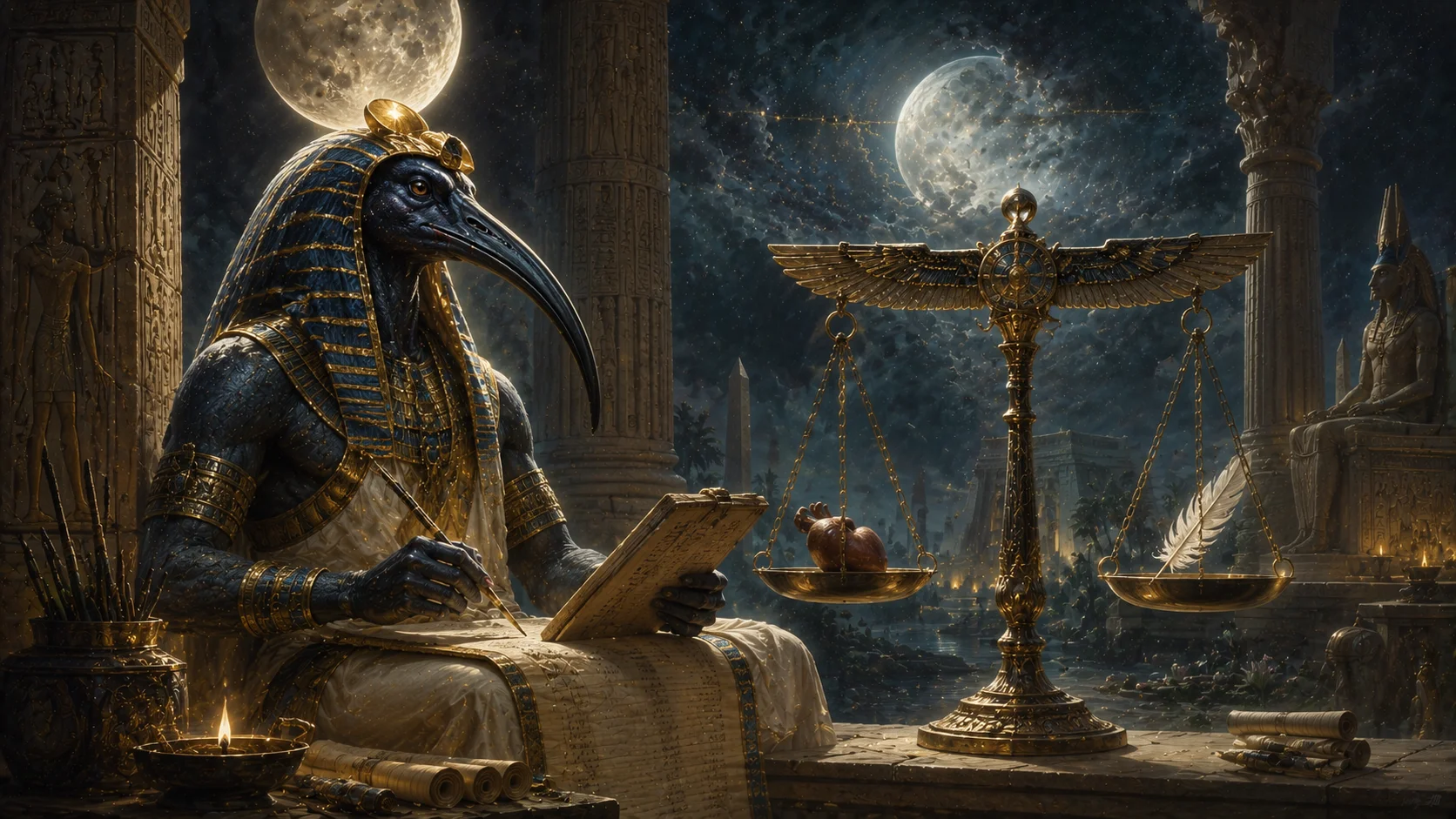
Thoth was the ibis-headed god of wisdom, writing, the moon, and reckoning in the pantheon of ancient Egypt — the divine scribe credited with inventing hieroglyphic writing, the impartial recorder who set down the verdict of every soul, and the wise mediator whose counsel the other gods sought when their own quarrels ran past resolving. Depicted as a man with the curved beak of an ibis, or as a seated baboon, he embodied a very particular kind of divinity: not a god of force or fire, but of the measured word, the correct number, and the record that outlasts the event it describes.
The Ibis, the Baboon, and the City of Eight
Thoth's two sacred forms were the ibis and the baboon, and both animals were bred, venerated, and mummified in vast numbers at his great cult center, Hermopolis Magna, known to the Egyptians themselves as Khmun. Here Thoth was linked to the Ogdoad, the eight primeval deities of Hermopolis, as an organizing, creative intellectual force present at the moment order was drawn out of the pre-created world. When the Greeks later arrived in Egypt and encountered Khmun, they renamed the city Hermopolis for no reason but the god they found enshrined there.
The Reed That First Touched a God's Words
Above all else, Thoth was remembered as the inventor of writing. The Egyptians called their own script “the words of the god,” what later ages rendered as hieroglyphs, and they held that Thoth had given this gift to the world, along with mathematics and the reckoning of the calendar and the stars. This made him, by extension, the patron of every scribe who ever sharpened a reed pen or mixed a cake of ink in Egypt — a literate class that ran the granaries, the courts, the temples, and the correspondence of the state, and that saw in Thoth not a distant creator but the god of their own craft. One of his enduring epithets, Lord of Divine Words, speaks directly to this: the words that mattered, that carried force and permanence, were his words first.
Reckoner of the Passing Years
Thoth's other great epithet, Reckoner of Years, points to his second domain: the moon, and the measurement of time that the moon's phases made possible. Where the sun's cycle governed the great wheel of the seasons, the moon offered a finer instrument, and Thoth was its keeper — the god who calculated, divided, and recorded the passage of months and years with the same careful hand he brought to hieroglyphs and to sacred numbers. Wisdom, writing, mathematics, and timekeeping were not separate portfolios to the Egyptians but a single competence: the ability to take the flow of experience and fix it into something exact, countable, and true.
The Third Voice at the Weighing of the Heart
In the judgment of the dead, the heart of the deceased was placed on one pan of a great scale, balanced against the feather of Ma'at, goddess of truth and cosmic order, on the other. The scene is often remembered for its scale and its monstrous devourer waiting nearby, but its outcome depended on a third figure standing at the balance: Thoth, scribe and record-keeper of the gods, who watched the weighing and set down its result. It was his hand, not the scale itself, that turned the physical event into a verdict — the written record against which a soul's fate was measured and made final. A universe that judged its dead by weight needed, in Egyptian thought, a witness who could also write; Thoth was that witness.
Husband of Truth, Companion of Order
Thoth's closeness to Ma'at ran deeper than their shared appearance at the scales. In the ordering of the divine world he was sometimes described as her husband, or as her close companion, standing beside the goddess of truth and order as the intellect that could articulate what she embodied. Ma'at was rightness itself, cosmic balance made divine; Thoth was the one who could measure it, record it, and speak it aloud. Together they represented two halves of the same idea — that truth is not only a state of the world but something that must be witnessed, calculated, and written down to have force among gods and mortals alike.
Mending the Wounded Eye of Horus
In the long dispute between Horus and Seth over the rule of Egypt following the murder of Osiris, Horus's eye was damaged in the course of their conflict. It was Thoth who healed it, restoring the Eye of Horus to wholeness through his mastery of sacred knowledge and words of power. The restored eye, the wedjat, became one of the most potent symbols in Egyptian religion, a sign of healing, protection, and completeness worn as an amulet by the living and the dead alike — and its restoration was remembered as an act belonging to Thoth's particular kind of power, knowledge applied with precision rather than force applied with violence.
Witness Before the Tribunal
The succession dispute between Horus and Seth was not settled by combat alone; it was argued before a tribunal of the gods, and Thoth held a central place within it, testifying and mediating as the assembly worked toward a judgment. His role there mirrored his role at the Weighing of the Heart — not a combatant, not a judge issuing sentence from personal authority, but the figure whose knowledge of precedent, words, and record made a just outcome possible at all. Later tradition remembered him more broadly still as the arbiter the gods turned to whenever their own conflicts ran beyond what force could settle, the mind called on to close the gaps that quarreling left open.
The Baboon Sent to Call the Goddess Home
In the myth of the Distant Goddess, the fierce Eye of Ra — embodied in goddesses such as Tefnut or Hathor — withdrew from Egypt into the wilds to the south, taking her dangerous heat with her. Persuading her to return required tact as much as authority, and Thoth was dispatched for the task, sometimes alongside the god Shu, and often appearing in the myth in his baboon form to undertake the long journey and the delicate work of coaxing the wandering goddess home. It was a mission suited to him precisely because it called for the diplomat's skill rather than the warrior's: patient argument, persuasive speech, the very faculties his other titles already named him master of.
Three Times Great
Among Thoth's epithets was one that would long outlive the temples where it was first spoken: he was called Three Times Great, an honor marking the completeness of his mastery over wisdom, writing, and magic. When Greek settlers and scholars encountered him in Egypt, they recognized in Thoth a figure close to their own Hermes, messenger and god of cunning knowledge, and folded the two together. Three Times Great passed into Greek as Hermes Trismegistus, and under that name the Egyptian god's reputation for hidden wisdom took on an entirely new life in the Hermetic writings of the Greco-Roman world, texts that claimed descent from his teaching and carried his name far beyond the Nile long after his temples had gone quiet.
A City Renamed for a God
The identification of Thoth with Hermes was thorough enough to reshape geography itself. Hermopolis Magna, once Khmun, was given its Greek name for no other reason than that its resident god was understood to be Hermes under Egyptian dress. It is a rare and telling honor: most gods lend their character to a myth or a title, but Thoth's syncretism with the Greek messenger-god was strong enough to overwrite the very name of the city built around his cult, ensuring that even visitors who knew nothing of Khmun's ancient history would still, in a sense, be walking into Thoth's own town.
The Hand Behind Every Sacred Record
Across all these roles — inventor of writing, timekeeper of the moon, scribe at the scales of judgment, healer of the wounded eye, mediator before the tribunal, emissary to the distant goddess — a single character holds steady. Thoth is never the god who acts first; he is the god who makes the action mean something, by naming it, counting it, healing it, or writing it down so that it endures. In a religious world built as much on precise ritual words and exact records as on raw divine power, that made him indispensable: the ibis-headed intelligence standing quietly at the edge of every great Egyptian scene, pen or knowledge in hand, ensuring that what happened among the gods would be remembered correctly among mortals.
Sources & traditions
- EncyclopediaWikipedia — Thoth
- TraditionEgyptian texts, inscriptions and later retellings
Myths change from area to area and from time to time. This chronicle follows the most widely told versions; tellings in other villages, regions and eras may differ.