Seshat was the Egyptian goddess of writing, measurement, record-keeping and libraries — the divine scribe whose reed and cord bound together two things the Egyptians never separated: the word that was written and the line that was measured. Her name is often translated “the female scribe” or “she who scrivens,” and from the Old Kingdom into the Ptolemaic period she stood at the king's shoulder whenever a reign was recorded or a temple's foundation was laid.
The Star Beneath the Bow
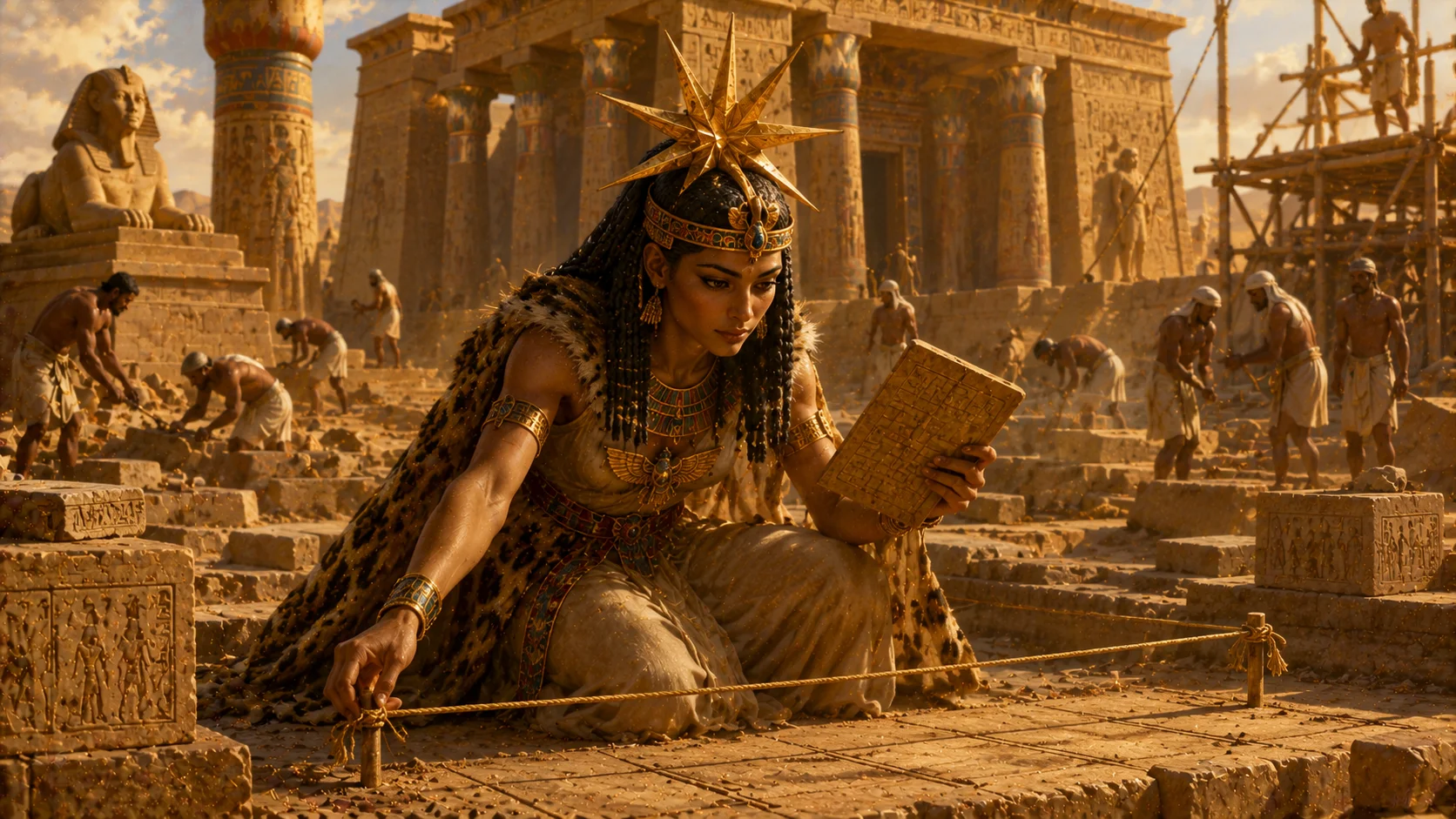
Seshat was depicted as a woman crowned with a distinctive headdress: a seven-pointed star or rosette emblem set beneath a bow-like or horn-like shape. Egyptologists have never agreed on what the seven points represent — a stylized flower, a cluster of stars, a leaf — and the debate remains open. Over her shoulders she wore a leopard-skin garment, the dress associated with priestly and funerary ritual, marking her as a figure of solemn ceremonial authority rather than a domestic or maternal goddess. In her hands she carried the tools of her office: a scribe's palette, a reed for writing, and a notched palm-rib used for counting years.
Mistress of the House of Books
Seshat held the title Mistress of the House of Books, patroness of the “House of Life” — the royal library and archive attached to Egypt's great temples, where sacred texts, ritual instructions and administrative records were copied, stored and guarded. She was also called Lady of Builders, extending her patronage from the written record to the architects and scribes who designed and documented the monuments of the kingdom. In this dual role she governed both halves of what the Egyptians considered a single discipline: the archive that preserved knowledge and the craft that gave knowledge physical form.
Foremost in the Library
A further title, Foremost in the Library, underscored Seshat's place at the center of Egyptian scholarship. She was one of relatively few prominent female deities directly tied to literacy and record-keeping, a portfolio that set her apart from the maternal and protective roles more commonly assigned to goddesses in the Egyptian pantheon. Her domain was not the household or the harvest but the shelf, the scroll, and the permanence of what had been set down in ink.
Stretching the Cord Among the Stars
Seshat's most distinctive ritual function was her role in the Stretching of the Cord ceremony, known as pedj shes, performed at the founding of a new temple. In this rite, Seshat and the king together used measuring cords and stakes to align the temple's foundations with the stars, ensuring the building's axes were fixed not by convention but by astronomical observation. Reliefs at the temples of Edfu and Dendera preserve depictions of this ceremony, showing the goddess assisting the king as together they drove the founding stakes and drew the cord taut across the ground that would become sacred space. Through this rite Seshat's authority over measurement became inseparable from her authority over the cosmos: a temple aligned by her cord was a temple aligned to the order of the heavens.
The Leaves of the Ished Tree
Seshat was credited with recording a king's regnal years and achievements upon the leaves of the sacred ished tree, the persea tree associated with divine record-keeping. This ceremony, sometimes called “inscribing the years,” symbolized the divinely sanctioned length of a pharaoh's reign — each leaf a mark of time granted and witnessed by the gods. In performing this rite, Seshat did not merely observe the passage of a king's years; she made them permanent, transferring the fact of a reign from the flow of time into the fixed record of sacred writing.
Counting the Years of Jubilee
Seshat's role in recording royal longevity extended to the Sed festival, the jubilee celebrated to renew a king's strength and rule after long years upon the throne. She was credited with recording the accumulation of years that led to this festival, linking her writing and counting functions directly to the ritual maintenance of kingship itself. In this capacity she stood alongside the ished-tree ceremony as one of the goddess's two great instruments for measuring a reign: one counting toward jubilee, the other inscribing the reign's final tally.
Tallying the Spoils of War
Beyond the quiet work of the archive, Seshat appears in New Kingdom royal temple reliefs, including scenes at Karnak, in a starker role: recording and counting the dead and captives taken in the king's military campaigns. In these scenes she tallies enemy losses and prisoners for the pharaoh, her scribal function turned toward the grim arithmetic of conquest. The image is consistent with her broader character — wherever a number needed to be fixed permanently, whether the years of a reign or the count of the fallen, Seshat was the one who set it down.
A Complement to the God of Wisdom
Seshat's relationship to Thoth, the principal god of writing and wisdom, was one of shared function rather than a fully narrated bond. In some traditions she appears as his female counterpart or consort; elsewhere she is described as a daughter of Ra. The textual evidence for a formal marriage between Seshat and Thoth is thinner than for their shared scribal domain, and their pairing is best understood as a functional complement — two deities who together embodied the full scope of writing, from Thoth's broader wisdom and invention of the written word to Seshat's specialized command of measurement, counting and the archive itself.
A Presence Without a Great Temple
Unlike deities who commanded major independent cult centers, Seshat's presence in Egyptian religion was woven primarily through temple ritual rather than through a shrine of her own. She is attested from the Old Kingdom onward, with early depictions connected to foundation scenes from the reigns of Sneferu and Khufu, continuing in an unbroken thread through temple reliefs of the Ptolemaic period. This long continuity, sustained not by a single great sanctuary but by her recurring presence at foundation ceremonies and record-keeping rites across many temples, speaks to how essential her function was considered: every new sacred building, in some sense, required her.
The Precision Behind the Sacred
Because so much of Egyptian religious and administrative life depended on written record and precise measurement, Seshat's portfolio touched both the mundane and the sacred at once. The scribe who tallied grain and the priest who aligned a temple to the stars were, in Egyptian thought, drawing on the same authority — hers. Her leopard-skin garment, tying her visually to funerary and priestly ritual dress, reinforced that her writing and measuring were never merely clerical acts but ceremonial ones, carried out under the same solemnity as any rite performed for the dead or the gods.
A Reference Point for Later Ages
Seshat's association with measurement, foundation ritual and astronomically aligned architecture has made her a recurring reference point in later discussions of ancient Egyptian building practice and the history of writing and record-keeping. The image of a goddess stretching a cord between stakes, orienting a temple by the stars alongside the king, has endured as one of the clearer surviving pictures of how the Egyptians understood the link between the heavens, the written record, and the buildings they raised to their gods.
The Archive That Outlasted the Reign
Seshat endures as the goddess who made permanence possible — the reign fixed in the leaves of the ished tree, the temple fixed by the stretched cord and the stars, the tally of years and of spoils fixed in her count. Where Thoth held the wider domain of wisdom and invention, Seshat held the narrower and no less essential craft of setting things down so that they would remain: the precise line, the accurate number, the record that a library could keep long after the reign it described had ended.
Sources & traditions
- EncyclopediaWikipedia — Seshat
- TraditionEgyptian texts, inscriptions and later retellings
Myths change from area to area and from time to time. This chronicle follows the most widely told versions; tellings in other villages, regions and eras may differ.