Ptah was the Egyptian god of creation, craftsmen and architects — the great creator-god of Memphis who brought the world into being through his thought and his spoken word, and the divine patron of all makers, sculptors and builders. Worship of Ptah is attested from the Early Dynastic period, when Memphis first rose as capital, through to the Greco-Roman era, and the city remained a major religious center for the whole of that span. He is the god who conceived the world in his heart and spoke it into existence.
The Enclosure of His Ka
Ptah's chief cult temple at Memphis was called Hut-ka-Ptah, the "Enclosure of the Ka of Ptah." It is widely cited — though the derivation is disputed among scholars — as the likely root of the Greek name Aigyptos, from which the modern name Egypt itself descends. If the derivation holds, then the very name by which the outside world came to know this civilization traces back to a single god's temple precinct at Memphis, a striking testament to how thoroughly Ptah's cult was bound up with the identity of the place he ruled. Memphis stood as Egypt's political and religious anchor for millennia, and Ptah's presence there was never eclipsed by the rise of other cult centers elsewhere in the land.
South of His Wall
Among Ptah's epithets was "South of His Wall," a name referencing the great temple precinct at Memphis around which his cult was organized, along with titles such as "Lord of Truth" and "Fashioner of the Earth." These epithets together sketch a god who was at once a builder of physical and cosmic order — the wall that bounded his sacred enclosure, the truth that underlay right conduct, and the earth itself, shaped by his hand. Such titles were not mere decoration; they were the terms by which priests and petitioners addressed him, terms that located Ptah simultaneously as a local Memphite lord and as a power whose authority extended over the created world entire.
A Mind That Made the World
The fullest statement of Ptah's role as creator survives in the Memphite Theology, a text recorded on the Shabaka Stone, a Late Period copy of a considerably older tradition. In it, Ptah creates the world and the other gods through the power of his heart — the Egyptian seat of thought and intention — and his tongue, the organ of utterance and command. He conceives all things in his mind and then speaks them into being, so that creation unfolds as an act of divine cognition followed by divine speech. This conception-and-command model stands in deliberate contrast to the Heliopolitan account, in which Atum brings forth the first gods through a physical, masturbatory act of emission. Where Atum's cosmogony is generative in a bodily sense, Ptah's is generative in an intellectual one: the world exists because a god first thought it and then declared it.
Thought Against Flesh
Set beside Egypt's other creation accounts, Ptah's method reads as a considered philosophical counterpoint. Atum's self-generation and Khnum's modeling of human beings on a potter's wheel are both creations of the hand and the body — acts of physical fashioning that any craftsman could recognize in miniature. Ptah's creation, by contrast, is a creation of reason and word, the world as the product of a god's interior life made external through speech. The Memphite Theology does not discard the older, more physical myths so much as answer them, proposing that behind any act of making, even a bodily one, there must first be a thought that conceives it and a word that commands it into form.
The Craftsman's God
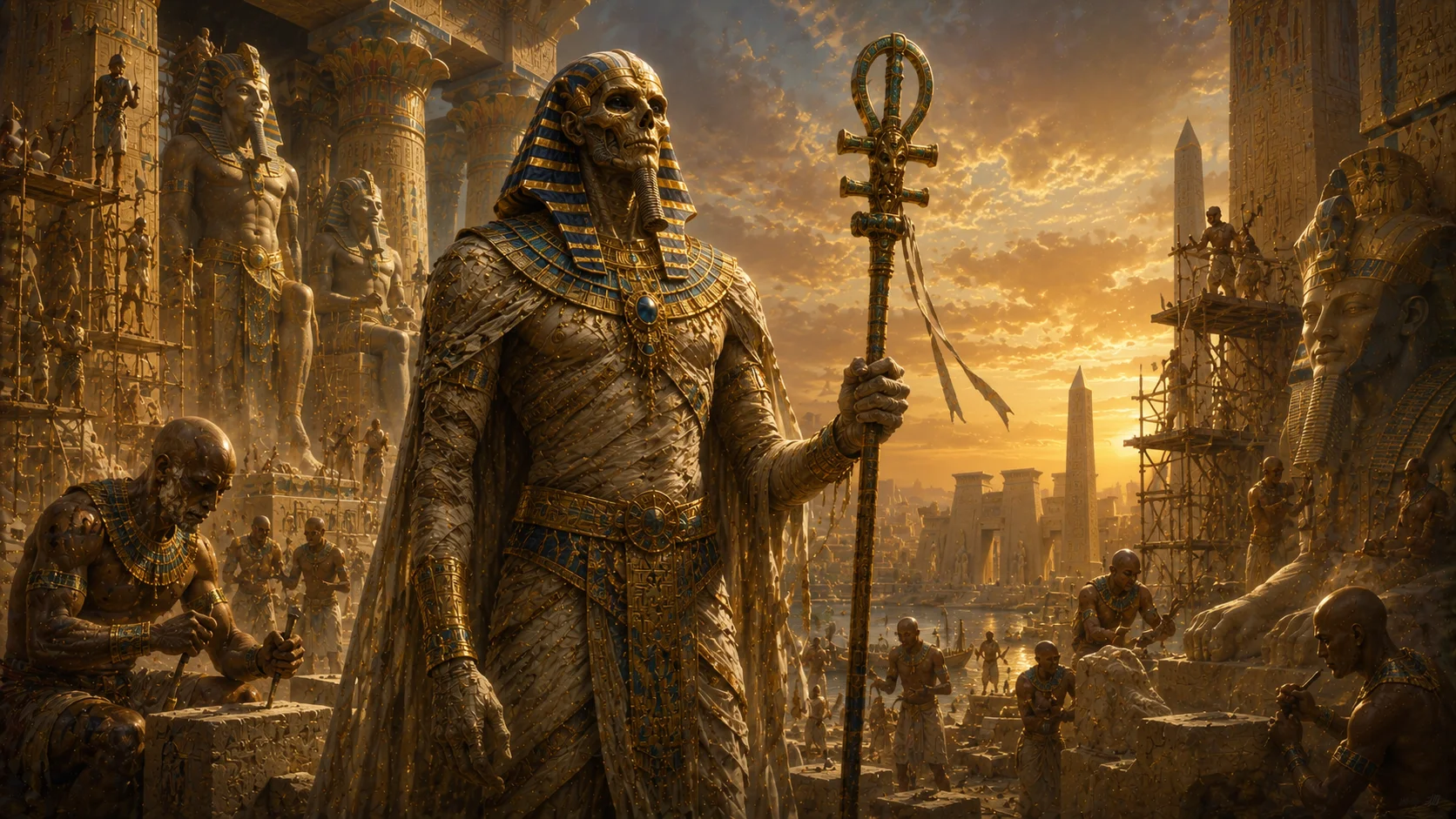
Ptah was the great patron of craftsmen, artisans, sculptors, metalworkers, builders and architects — all those who shape and make. As the god who fashioned the world through thought and speech, he stood as the divine model for every human maker, and the skilled workers of Egypt looked to him as their patron and their exemplar. Through the craftsman's hands, the primal act of creation was echoed again and again, in the carving of statues, the raising of temples, and the working of metal into tool and ornament.
Great Leader of Craftsmen
Ptah's high priest at Memphis carried the title "Great Leader of Craftsmen," rendered in Egyptian as wr-kherep-hemut — a title that made explicit the bond between the temple hierarchy and the guilds of workers the god was believed to oversee. The office was not merely honorific: it placed the chief priest of Ptah at the head of a religious structure whose very language of rank was borrowed from the workshop. To lead the craftsmen of Egypt, in this sense, was inseparable from serving as the highest human intermediary of the god who had first fashioned the world with his own faculties of mind and voice.
The Bound Form and the Threefold Scepter
Ptah was depicted as a mummiform man, his body wrapped close after the manner of the dead, wearing a tight skullcap. From within this bound form his hands emerge to grasp a scepter that fuses three separate symbols into one: the was scepter of power, the ankh sign of life, and the djed pillar of stability. That single composite staff condenses the qualities Ptah was believed to hold and to grant — dominion, vitality, and endurance — into an image immediately recognizable across Egyptian religious art, distinguishing him at a glance from the many other gods of the pantheon.
The Bull of Memphis
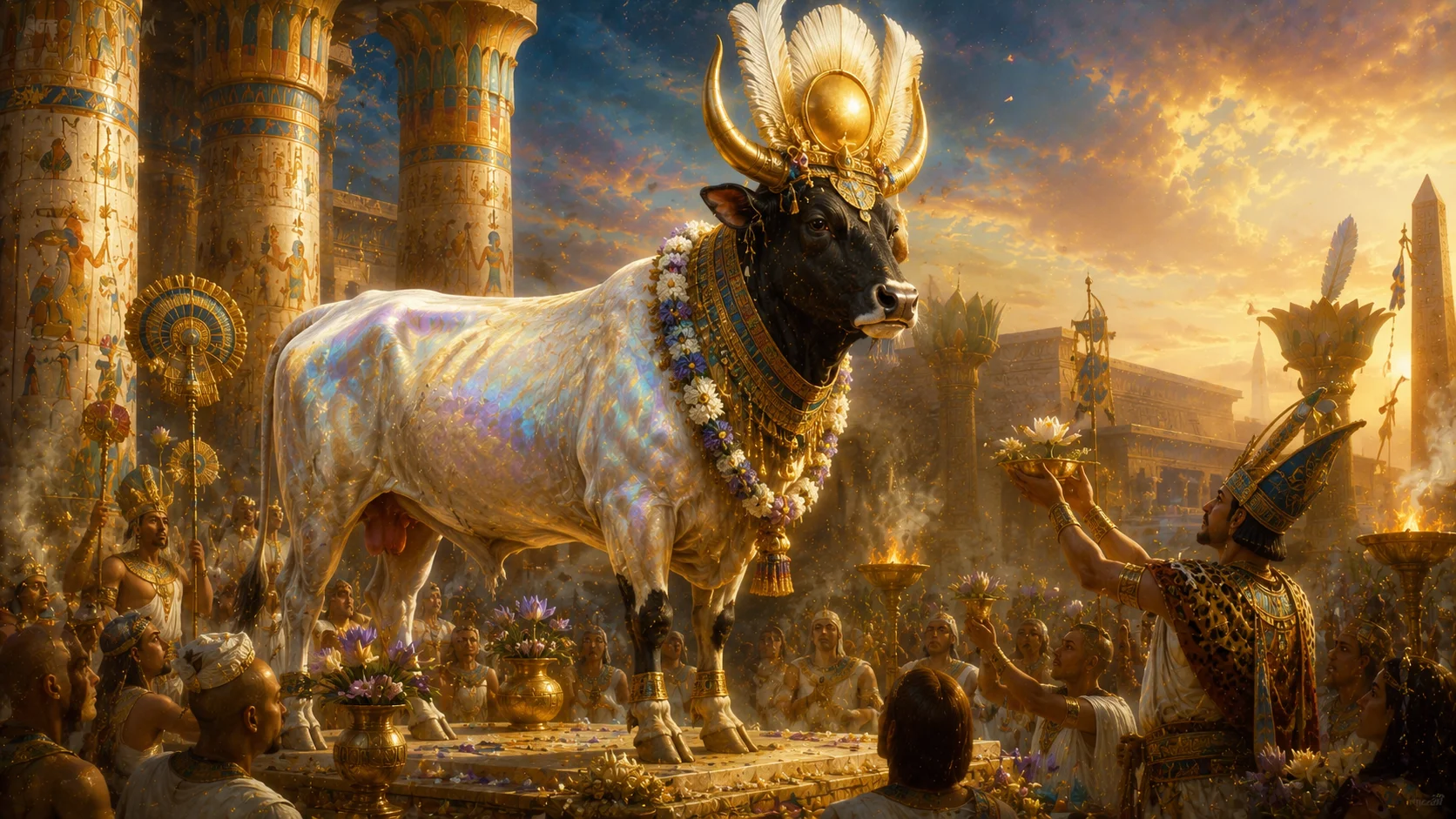
Ptah was closely associated with the Apis bull, which was worshipped at Memphis as the living manifestation, or ba, of the god on earth. The Apis was not a symbol standing at a remove from Ptah but was treated as the god's own vital force made present in a living animal, housed and venerated within the city that was Ptah's own cult center. This pairing of an unseen creator-god with a visible, physical animal counterpart gave ordinary worshippers at Memphis a tangible point of contact with a deity otherwise defined by abstract faculties of thought and speech.
The Triad at Memphis
Ptah stood at the head of the Memphite Triad together with his consort — the lioness goddess Sekhmet, or in some contexts Hathor — and their son Nefertem. This triad gave Memphis its own complete divine family, paralleling similar groupings at other major cult centers, and situated Ptah not only as a solitary creator but as the founding figure of a household of gods rooted in his city. The pairing with the fierce Sekhmet in particular set a striking contrast beside Ptah's own composed, deliberative character as a maker of worlds through calm thought and utterance.
Fused with Sokar and Osiris
In later periods Ptah was joined with two other gods to form the composite funerary deity Ptah-Sokar-Osiris, a figure especially prominent in the Late Period in the form of small funerary statuettes placed with the dead. This fusion drew together Ptah the creator, Sokar the Memphite god long tied to craftsmen and to the necropolis, and Osiris, lord of resurrection and the afterlife. The resulting composite god linked the making of the world to the renewal of life beyond the grave, so that the same divine power credited with speaking creation into being was also invoked to secure a person's passage into a continued existence after death.
A God Who Heard the Humble
Alongside his role in state cult and royal theology, Ptah was regarded as a god who could grant hearing to the prayers of ordinary people. Stelae carved with images of ears, dedicated to Ptah by common petitioners, are attested from his cult and reflect a mode of personal piety distinct from the formal rites of temple and priesthood. These "ears" stelae were not offerings of state but individual acts of appeal, placed by people who believed the great creator of Memphis would attend to concerns far smaller than the fashioning of the cosmos — evidence that Ptah's reach extended from the grandest theological claims made on his behalf down to the private hopes of a single worshipper.
He conceived the whole world in his heart and spoke it into existence — the divine craftsman who thought creation into being, patron of every maker and builder, and a god who, for all the vastness of his first act, still bent an ear to those who came to him plainly asking to be heard.
Sources & traditions
- EncyclopediaWikipedia — Ptah
- TraditionEgyptian texts, inscriptions and later retellings
Myths change from area to area and from time to time. This chronicle follows the most widely told versions; tellings in other villages, regions and eras may differ.