Neith was one of the most ancient and powerful goddesses of Egypt — the goddess of war, hunting, weaving and creation, a primordial creator-goddess who existed before all things and brought the world into being, and the divine mother and protector. Both a fierce warrior with bow and arrows and a wise creator and weaver, she is among the oldest deities of Egypt, present from the very beginning.
The Ancient Warrior-Goddess
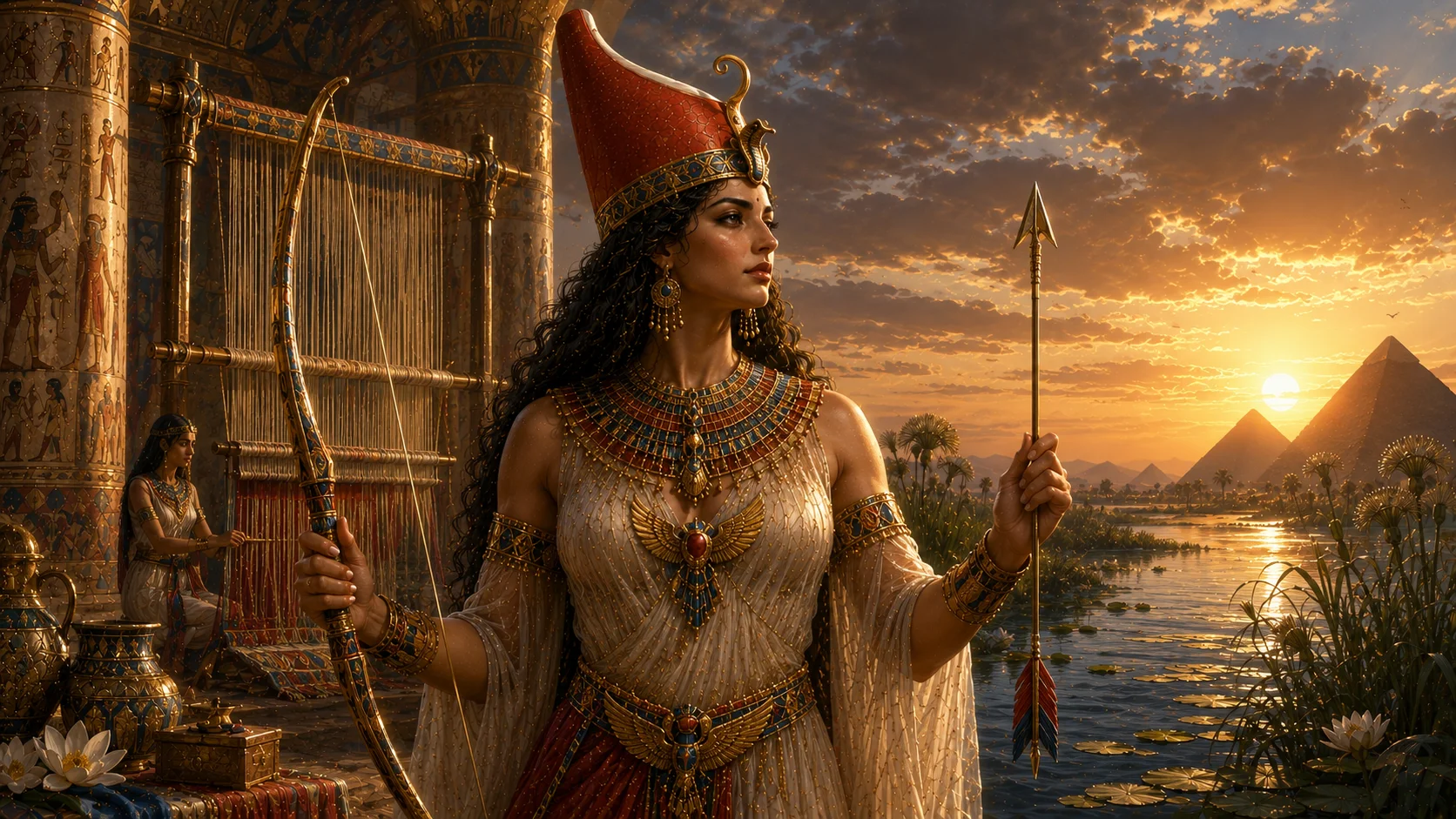
Neith (Egyptian Neith) was one of the oldest deities in the Egyptian pantheon, worshipped from the earliest dynasties and before. She was a goddess of war and hunting, depicted often with a bow and arrows or crossed arrows over a shield (her ancient emblem), and wearing the Red Crown of Lower Egypt, of which she was a patron. As a war-goddess she was fierce and protective, a fighter and a guardian; her weapons made her a formidable defender. She was also a goddess of weaving (her name may be connected to weaving, and she was the patroness of weavers and the maker of the cloth that wrapped the dead), uniting the arts of war and the domestic crafts in one ancient goddess.
The Primordial Creator
Neith was, in her own theology, a great primordial creator-goddess — a deity who existed before creation, who emerged from the primordial waters and brought the world into being. At her cult-center of Sais, she was honoured as the self-created mother of the gods, the goddess who was “the first to give birth to anything,” who existed when nothing else did and who created the world and the gods, including (in some accounts) the sun-god Ra himself. She was thus a creator on the level of Atum or Ptah — a self-generated primal deity from whom the cosmos came, the divine mother of all. Her famous inscription at Sais declared her the goddess “who was, who is, and who will be,” whose veil no mortal had lifted — a mysterious, eternal, all-encompassing divine power.
The Mother and Protector
Neith was a great mother-goddess and protector. She was the mother of the crocodile-god Sobek, and a divine mother-figure to gods and pharaohs. As a protective goddess, she watched over the dead: she was one of the four goddesses (with Isis, Nephthys and Serqet) who guarded the corpse and the canopic jars holding the organs of the deceased, protecting them in the tomb. She was also a wise judge and arbiter among the gods — in the Contendings of Horus and Set, her wise counsel was sought to help settle the dispute over the throne. Thus she combined fierce strength, creative power, maternal protection and wisdom in a single ancient goddess.
The Eternal Goddess
Neith endures as one of the most ancient, powerful and many-sided of the Egyptian goddesses — the warrior with her bow, the weaver, the primordial creator who brought the world into being, the divine mother and protector of the dead, the wise arbiter. She embodies the great age and depth of Egyptian religion, reaching back to its very beginnings, and a vision of the divine feminine as at once fierce and creative, warlike and nurturing, eternal and all-encompassing — the goddess “who was, who is, and who will be,” present from before the dawn of the world.
The ancient goddess of war and weaving who existed before all things and wove the world into being — "who was, who is, and who will be," whose veil no mortal has lifted.
A Goddess Older Than the Pyramids
Long before the Great Pyramid rose at Giza, and before hieroglyphic writing had settled into its classical forms, Neith’s emblem was already standing on royal monuments and on the standards carried before early kings. It appears on ceremonial objects from the late Predynastic Period, and by the First Dynasty — around the thirty-first century BCE — her name was carried by one of the most powerful women in early Egyptian history: Neithhotep, “Neith is satisfied,” whose vast mudbrick tomb at Naqada rivals those of the kings she may have served as queen, as regent, or possibly ruled alongside as a sovereign in her own right. That a goddess’s name was thought fit for the most powerful woman of the founding dynasty says something about how seriously her authority was already taken at the dawn of Egyptian history — centuries before Isis or Osiris appear in the written record at all.
The Temple at Sais and the Feast of Lamps
The Greek historian Herodotus visited Neith’s temple at Sais in the fifth century BCE and left the closest thing we have to an eyewitness account of her cult in action. He describes a sanctuary of extraordinary size, with the tombs of the Saite kings set inside the temple precinct itself, and one night each year that he calls the Feast of Lamps. Those who gathered at Sais for the sacrifice burned lamps in the open air around their houses — saucers of salt and oil with the wick floating on the surface, kept alight until morning — while Egyptians who could not make the journey lit their own lamps on the same night, so that the whole country, and not Sais alone, burned until dawn. Herodotus also describes, and then pointedly refuses to name, a tomb standing behind the shrine, and a mystery performed by night on the temple’s lake re-enacting the sufferings of the god buried there — a rite he judged too sacred to set down in writing. Sais was no backwater shrine: under the pharaohs of the Twenty-Sixth Dynasty it was the seat of the royal house, and Neith’s temple stood at the centre of Egypt through the last great age of native rule before the Persian conquest of 525 BCE.
The Egyptian Athena
When Greek visitors reached Sais they did not think they were looking at a foreign goddess — they thought they recognised their own. Herodotus never once gives her Egyptian name; throughout his account she is simply Athena. Plato, writing in the following century, has an Egyptian priest at Sais tell the Athenian lawgiver Solon that the founder of the city was a goddess “whose Egyptian name is Neith, and in Greek, as they say, Athena” — the same goddess, the priest claims, who afterwards founded Athens; and it is in the temple records of Sais, not in Athens, that the story of Atlantis is said to have survived. The equation was not merely convenient. Both were armed goddesses of war, both patrons of weaving and craft, both standing over their cities as founders rather than consorts. But their beginnings pull in opposite directions. Athena is born fully grown from the head of Zeus, brought into being by a father and defined ever afterwards by him. Neith has no father at all: she brings herself into existence out of the primordial waters, before anything else exists. In folding a self-made goddess into a mythology of divine birth, the Greeks quietly erased the one thing about her that had no parallel at home.
Two Faces of Creation: Sais and Esna
Egyptian religion never demanded a single, consistent theology, and Neith’s own priesthoods told two rather different stories about how she began the world. The Saite account is the one usually repeated: she creates alone, self-engendered out of Nun, the formless primeval water. Far to the south at Esna, in Upper Egypt, a second version survives. The temple standing there belongs to the ram-headed craftsman god Khnum, who shapes bodies on his potter’s wheel — but its walls carry a cosmogony of Neith, and in it she is not simply female. The Esna inscriptions describe her as two-thirds masculine and one-third feminine, a being of both natures who rises out of Nun and raises the first dry land from the water before there was any place to stand. Those texts are late, cut under Roman emperors more than three thousand years after her emblem first appeared on the Predynastic standards — which is rather the point. Rather than ruling one account authentic and the other corrupt, Egyptian priests were content to let her be a solitary creatrix at Sais and a dual-natured cosmic power at Esna: a goddess old enough to outlast any need to choose between them.
Arrows into a Shuttle
The oldest sign for Neith’s name is unambiguously military: a shield or bow-case with two arrows crossed over it, an emblem carried on standards since before the pharaohs. Yet by the time Greek and Roman writers met her, Neith was at least as famous for the loom as for the bow. Part of that shift may lie in the hieroglyph itself. The sign has been read in more than one way, and an older strand of scholarship took it not for a shield at all but for a weaver’s shuttle — an object of roughly the same outline, crossed by the same diagonal lines. Whether the weaving cult grew out of a reinterpreted sign, or the sign was reread because the cult was already there, cannot now be settled. Either way the outcome is one of the more elegant accidents in Egyptian religion: the huntress and the weaver are not two goddesses reconciled but one goddess whose oldest emblem holds both readings at once.
The Veil That Travelled to Europe
Plutarch, writing in Greek around the turn of the second century CE, records an inscription he had been told stood on a seated statue at Sais: “I am all that has been, and is, and shall be, and no mortal has yet lifted my veil.” The Greek word is closer to a robe than a veil, but it was veil that stuck. Plutarch assigns the statue to “Athena, whom they also hold to be Isis” — folding the goddess of Sais into Isis inside a single clause, a conflation already old in his day and impossible to undo afterwards. Sixteen centuries later, Immanuel Kant quoted the same sentence in a footnote to the Critique of the Power of Judgment, remarking that perhaps nothing more sublime had ever been said, and attributed it, following Plutarch, to a temple of Isis. The German Romantics seized on the image: Schiller’s poem The Veiled Image at Sais made it a parable about the cost of forcing nature to surrender her secrets, and Novalis built an entire unfinished novel, The Novices of Sais, around initiates arguing over whether the veil should ever be lifted at all. Not one of them was writing about Isis. The goddess behind the veil was Neith, in her own temple, in her own city — and the borrowed name she still carries in the familiar phrase “the veil of Isis” is a case of mistaken identity two thousand years old, inherited so quietly that even her most devoted admirers never noticed they had made it.
Sources & traditions
- EncyclopediaWikipedia — Neith
- TraditionEgyptian texts, inscriptions and later retellings
Myths change from area to area and from time to time. This chronicle follows the most widely told versions; tellings in other villages, regions and eras may differ.