Sekhmet was the lioness-headed Egyptian goddess of war, destruction, plague and healing — the fierce and bloodthirsty Eye of Ra who nearly annihilated mankind, the “Powerful One” whose breath was the desert wind and whose arrows brought pestilence, yet who was also invoked to ward off the very plagues she sent. The most terrifying of the Egyptian goddesses, she embodies the destroying fury of the sun.
The Powerful One
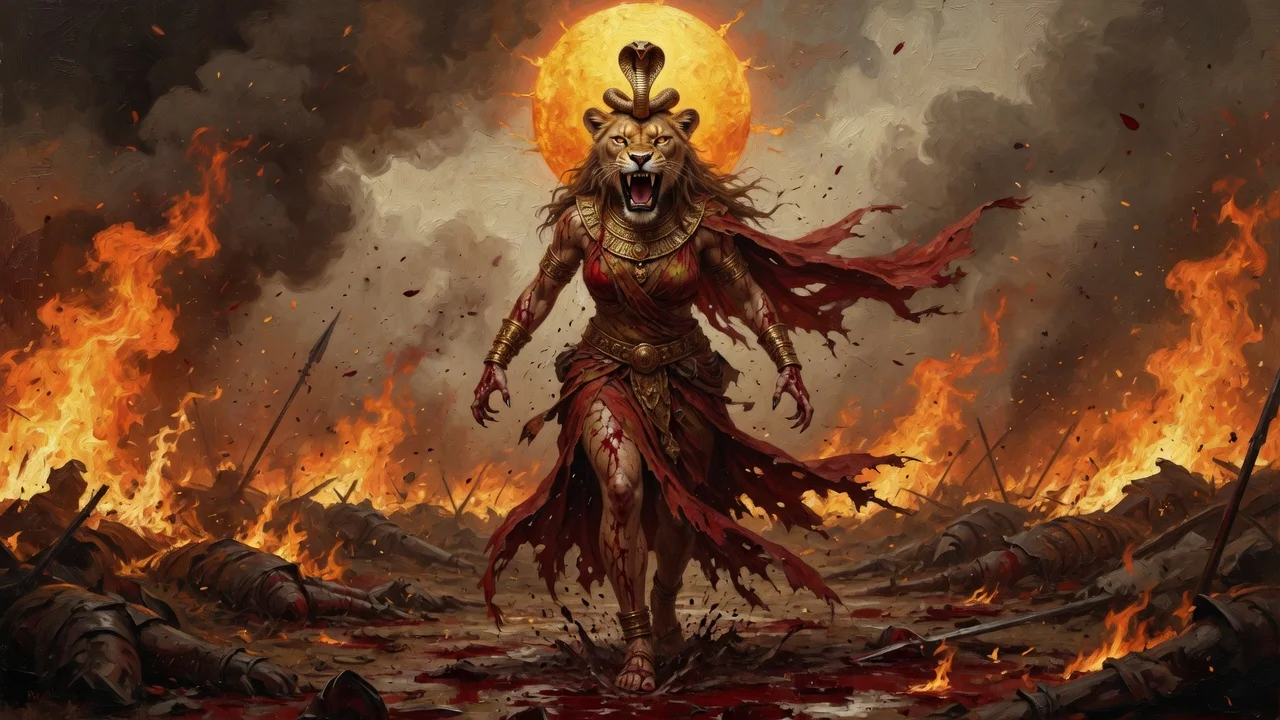
Sekhmet (Egyptian Sekhmet, “the Powerful One”) was depicted as a woman with the head of a lioness, often crowned with the solar disc and a cobra, and her name itself proclaimed her power. She was the goddess of war, destruction, fire, plague and vengeance — the embodiment of the fierce, scorching, destroying power of the sun. She was a warrior-goddess of terrifying ferocity, the protector of the pharaoh in battle who breathed fire against his enemies, and her hot breath was said to be the desert wind. She was one of the chief forms of the Eye of Ra, the feminine personification of the sun's destructive heat sent out to punish.
The Destroyer of Mankind
Sekhmet's most famous myth is the near-destruction of the human race. When mankind plotted rebellion against the aging sun-god Ra, he sent forth his Eye in the form of Sekhmet (or Hathor transformed into her) to punish them. The lioness-goddess fell upon humanity in a frenzy of slaughter, killing without mercy and drinking the blood of the slain, until she had nearly wiped out the entire human race — and she could not be stopped, for she was drunk on the joy of killing and would not cease. To save the remnant of mankind, the gods devised a trick: they brewed a vast quantity of beer dyed red to look like blood, and flooded the fields with it. Sekhmet, thinking it blood, drank it greedily, became thoroughly drunk, and fell into a stupor — and when she awoke, her bloodlust was spent, and she was pacified, transformed back into the gentle goddess (Hathor). Thus mankind was saved by beer, and the festival of Sekhmet's pacification was celebrated with drinking ever after.
The Bringer and Healer of Plague
Sekhmet had a profound dual association with plague and healing. As the goddess of destruction, she was believed to send pestilence and disease — her “arrows” and the “messengers of Sekhmet” brought epidemics, and her hot breath spread plague. But for this very reason, she was also the goddess to whom one prayed for protection from plague and for healing: since she sent disease, she could also withhold or cure it, and her priests were associated with medicine and healing. Sekhmet was thus both the bringer of pestilence and the great healer, the goddess whose terrible power could destroy or, if appeased, protect and cure — a vivid expression of the Egyptian sense that the same fierce divine power was both the danger and the defence against it.
The Fury of the Sun
Sekhmet endures as the most fearsome of the Egyptian goddesses — the lioness of war and destruction, the bloodthirsty Eye of Ra who nearly destroyed mankind, the bringer and healer of plague, the protector of the pharaoh whose breath was fire. She embodies the destroying, scorching fury of the sun and the terrible power of the divine feminine when roused to wrath; and she stands, with the gentle Hathor, as the two faces of a single great goddess — joy and fury, healing and plague, the nurturing cow and the bloodthirsty lioness, within one divine power.
The bloodthirsty lioness who nearly destroyed all mankind and was stopped only by a flood of beer dyed red as blood — she who sends the plague is also she who heals it.
Born in the Age of Pyramids
Long before beer saved mankind in her most famous story, Sekhmet was already old. Her name is built from the root sekhem, meaning “power” or “might” — she is not named for how she looks or where she lives, but for the raw force she embodies, the way a storm might simply be called “Violence.” Her earliest known appearances are in the Pyramid Texts, carved into the burial chambers of Old Kingdom rulers from the pyramid of Unas onward and among the oldest religious writing to survive from anywhere on earth. There, in one spell, the king is said to have been conceived by Sekhmet — a claim meant to pass her ferocity directly into his body, so that his authority in battle carried her fire in his own blood. She was not a later addition grafted onto an existing war cult; she stood at the very foundation of how Egyptians thought about royal power, and her cult centre at Memphis, Egypt’s ancient capital, kept her close to the throne for the better part of three thousand years.
Ptah’s Fierce Wife, and Two Different Sons
At Memphis, Sekhmet was not worshipped alone. She was one third of the Memphite Triad, married to Ptah, the patient craftsman-god who was said to have spoken the world into being through his heart and tongue — about as far from a bloodthirsty lioness as a god could be — and mother of Nefertem, a young god born from a blue lotus at the dawn of creation, associated with perfume, healing scent and the first sweetness of morning. It is a strange household to picture: the maker, the destroyer, and a son whose whole domain was pleasant smells. Elsewhere Egypt told the family differently. At Taremu in the Delta — a city the Greeks later called Leontopolis, “Lion City” — and at nearby Bubastis, the lion-headed war god Maahes was worshipped as the son of a feline goddess, named as Sekhmet’s child in some traditions and Bastet’s in others. His epithets are among the bluntest in the Egyptian record: “Lord of the Massacre,” “Wielder of the Knife.” Egypt rarely insisted on one family tree for its gods; each temple kept the version that made sense of its own rites.
The Goddess Who Fled to Nubia
The destruction of mankind is not the only story in which a lioness-goddess’s rage has to be talked down. In a separate strand of myth — the tradition of the wandering Eye of Ra, told in fragments for centuries but preserved whole only in a papyrus written down late in Egypt’s history — the fierce solar Eye-goddess quarrels with her father the sun-god and storms off into the desert to the south, into Nubia, prowling as a lioness and scorching the land. Ra, diminished without his Eye, sends a god of persuasion — usually clever, quick-tongued Thoth, sometimes Shu — to follow her and coax her home not with force but with stories, flattery, music and dance. Mile by mile she softens, until she crosses back into Egypt and the cool water of the Nile completes her transformation from a raging lion into a placid, beautiful goddess, her return associated with the rising of the flood that made the whole land fertile again. Sekhmet is not the goddess usually named in this tale — Tefnut and Hathor wear the lioness mask in the surviving tellings — but she belongs to the same family of Eye-goddesses, and the pattern matches her own myth of pacification exactly: an unstoppable divine fury that only cunning, pleasure or intoxication, never violence, can bring to an end.
The Five Days No One Trusted
Egypt’s civil calendar counted 365 days, but that will not divide evenly into twelve months of thirty days, so five extra days were added at the very end of the year to close the gap. These epagomenal days fell outside the ordered months altogether — a crack in the calendar through which chaos could reach in — and Egyptians expected the wandering plague-demons called the slaughterers to be at their most active in them, unsupervised and loose on the land. Amulets were worn and spells recited specifically to survive the five days unharmed, and priests performed a rite whose name translates as “pacifying Sekhmet,” repeating at the turn of every year the same appeasement the gods had improvised to stop her the first time. It is a yearly admission that the goddess who protected Egypt for 365 days could, in the gap between them, become the danger Egypt needed protecting from.
A Guild of Priest-Physicians
The people who studied disease in ancient Egypt organised themselves under the goddess who sent it. Inscriptions record men holding the title “wab-priest of Sekhmet” — a rank that functioned, in practice, as a medical office. These were the specialists called on for the ailments with no visible cause: plague and fever, the kind of sickness that arrived from nowhere and was therefore hers. Some were credited with diagnosing by observing the movement of blood in the body; others were responsible for the health of the bulls kept in the temple stables, making the same priesthood Egypt’s veterinary authority as well. This was not incidental overlap between religion and medicine; it was one office. A goddess whose arrows caused epidemics was the only sensible authority to license the men who claimed to turn them aside, and her priesthood operated as something close to a professional guild — a small, named class of practitioners, working alongside the secular physicians the Egyptians called swnw.
Seven Hundred Lionesses at Karnak
Sekhmet survives in more sculpture than almost any other Egyptian deity, because of one king’s spectacular anxiety. The pharaoh Amenhotep III, in the fourteenth century BCE, commissioned hundreds of granodiorite statues of her — dark, hard, highly polished stone, worked into seated and standing figures — for his mortuary temple at Kom el-Hettan on the west bank at Thebes. Ancient texts describe the programme as a seated and a standing statue of the goddess for every day of the year, which puts the original total somewhere past seven hundred. The scale was itself an act of appeasement: a statue for every sunrise, an ongoing insurance policy against the plague and misfortune she could unleash. Many were later moved across the river to the precinct of the goddess Mut at Karnak, where rows of them still stand; others were carried off over the centuries and now sit in museum collections worldwide. Look for the ankh of life balanced in one hand against a papyrus sceptre of dominion in the other — even her gentlest attribute arrives paired with a claim to power — and for the lioness’s long, narrow muzzle, which Egyptian sculptors kept visibly distinct from the rounder face of a domestic cat.
The Cat Who Softened the Lion
Sekhmet’s closest relative in the Egyptian pantheon is not a rival but a mirror. Bastet, goddess of the Delta city of Bubastis, is attested as far back as the Second Dynasty, and for the first two thousand years of her worship she looked essentially as Sekhmet did: a lioness, martial and solar, a defender of the king rather than a pet. Only around the Third Intermediate Period did artists begin giving Bastet the head of a domestic cat instead, recasting her as a gentler, more approachable goddess of the home, of women and of joy — a change that tracked the rising status of the cat itself in Egyptian households. Egyptians came to speak of the pair as two temperaments of one feline nature: Sekhmet the lioness who destroys, Bastet the cat who protects and delights, aggression and affection drawn out of a single animal into two goddesses, sometimes fused into one composite figure and sometimes kept carefully apart. It is the same instinct that splits the Eye-goddess into a killer in the desert and a bride at the riverbank. Egyptian religion was rarely content to let ferocity and gentleness share one image for long without giving each its own name.
Sekhmet Now
Sekhmet’s worship has no unbroken line into the present the way some living traditions do, but she has not stayed confined to museum labels either. A temple of goddess spirituality named for her has stood in the Nevada desert since 1993, where visitors hold ceremonies drawing on her old imagery of fierce protection and healing power — a modern community consciously choosing an ancient goddess of destruction as a figure of strength rather than dread. She has also returned to a much larger audience through video games set in Ptolemaic Egypt, where she appears as a towering lion-headed boss the player must survive — ringed in fire, firing beams of solar light, which is at least a fair reading of the source material. Her face is being reintroduced, one screen at a time, to people who have never opened a book on Egyptian religion.
Why the Desert Still Roars
Strip away the statues and the hieroglyphs and Sekhmet is a very old answer to a very simple observation: in Egypt, the same sun that ripens the grain also kills the traveller who crosses the sand at noon, and the same heat that keeps the land alive breeds the fevers that empty it. A civilisation strung along a single river, hemmed in by lethal desert on both sides, did not need to invent an abstract idea of destructive power — it only had to look up. Sekhmet gave that danger a face, a temper, and crucially, a way of being reasoned with: not eliminated, because the sun could never be eliminated, but negotiated with, fed, flattered, and occasionally made drunk. That is the most human thing about her cult. The Egyptians did not pretend the lioness could be tamed. They built her a household, licensed their doctors in her name, carved her likeness by the hundreds, and trusted that a power this dangerous, treated with enough respect, might spend her fury on their enemies instead of on them.
Sources & traditions
- EncyclopediaWikipedia — Sekhmet
- TraditionEgyptian texts, inscriptions and later retellings
Myths change from area to area and from time to time. This chronicle follows the most widely told versions; tellings in other villages, regions and eras may differ.