Bastet was the cat-goddess of ancient Egypt — the goddess of home, fertility, women, childbirth, joy and the protective hearth, who began as a fierce lioness-goddess and softened over time into the beloved gentle cat, the protector of households and one of the most cherished deities of Egyptian daily life. She is the gentle, domestic counterpart to the fierce Sekhmet, the warm guardian of home and family.
The Cat-Goddess
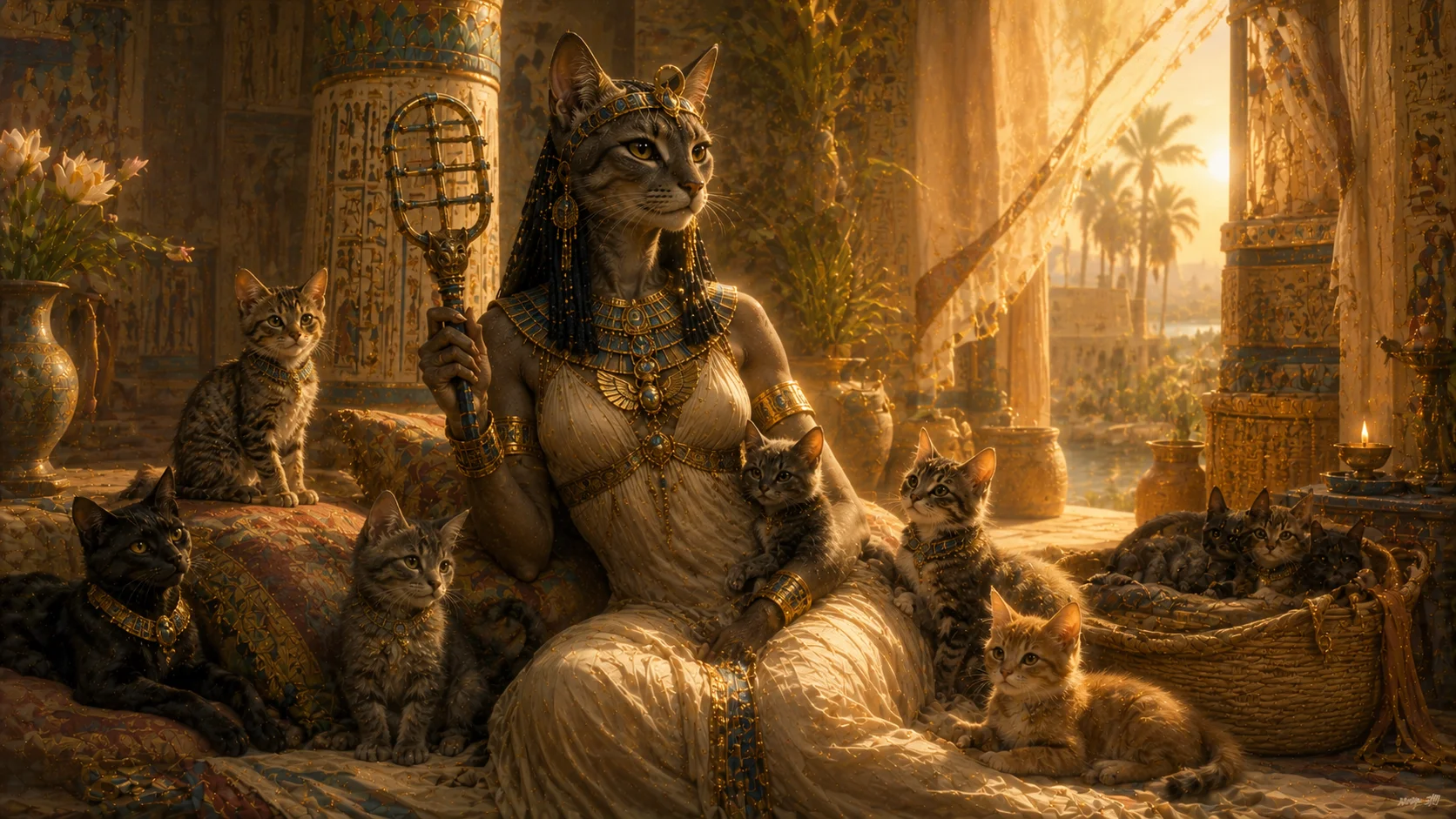
Bastet (Egyptian Bastet, Bast) was depicted, in her most famous form, as a woman with the head of a cat, or as a cat itself — often a sleek seated cat, sometimes surrounded by kittens, sometimes holding a sistrum (a musical rattle). In her earliest forms she was a fierce lioness-goddess, like Sekhmet, a protective and warlike deity; but over the long centuries of Egyptian history she gradually softened, transforming from the fierce lioness into the gentler domestic cat, the warm and beloved goddess of the home. Cats were sacred to her and cherished throughout Egypt, kept in homes, mummified in their millions and buried at her great cult-center of Bubastis.
The Protectress of the Home
Bastet was, above all, the goddess of the home, the household, women, and family. As cats protected Egyptian homes and granaries from snakes, scorpions and vermin, so Bastet was the divine protectress of the household and its inhabitants, guarding the family from evil, disease and harm. She was a goddess of fertility, childbirth and motherhood, watching over women in labour and protecting children, and she embodied the warm, nurturing, protective qualities of the home and the mother-cat with her kittens. To have Bastet's favour was to have a safe, fertile, joyful household.
The Goddess of Joy and Festival
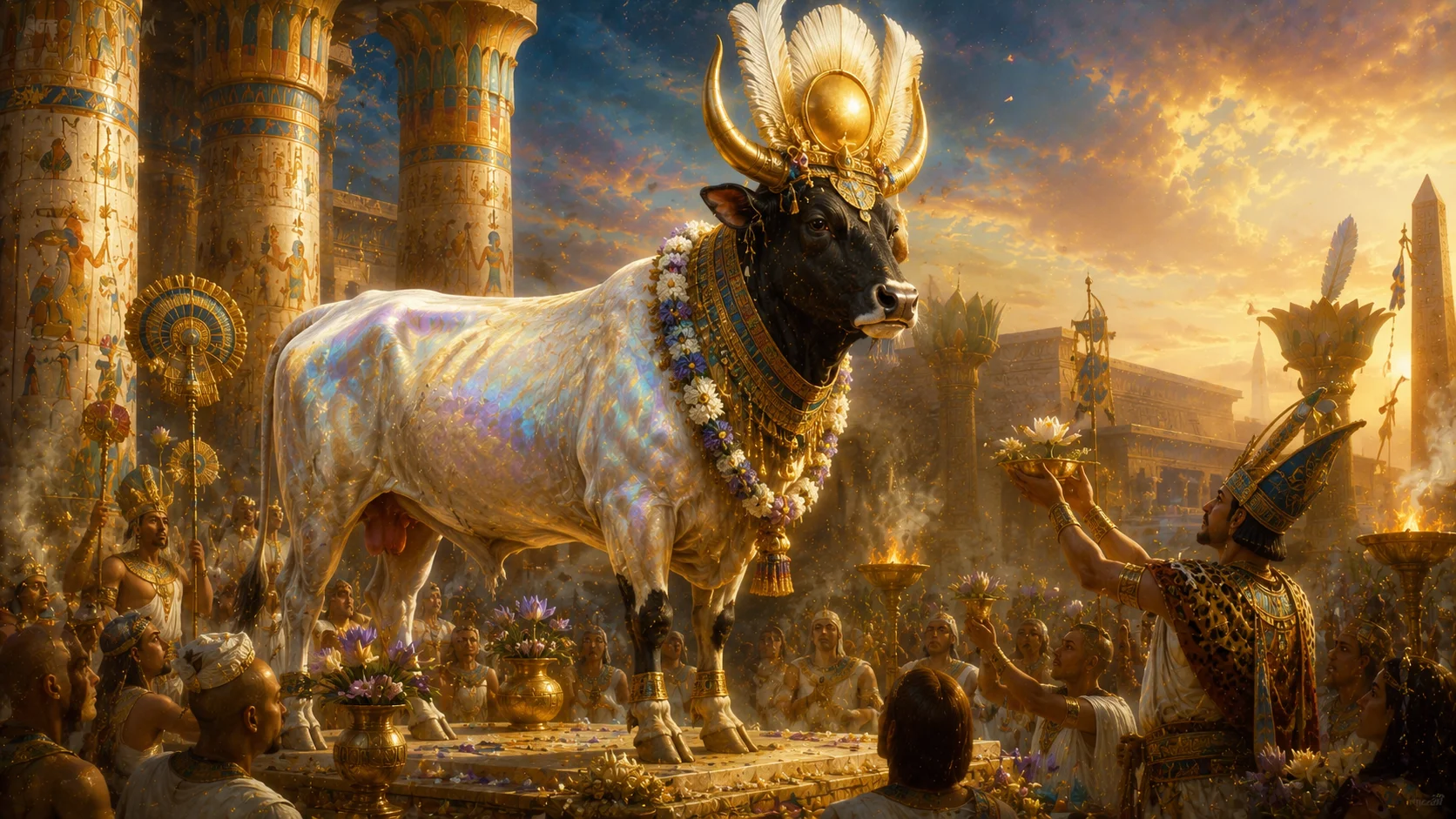
Bastet was also a goddess of joy, music, dance and celebration. Her great annual festival at Bubastis was, according to the Greek historian Herodotus, one of the most popular and exuberant in all of Egypt — an occasion of enormous crowds, music, dancing, drinking and revelry, with hundreds of thousands traveling by boat to celebrate. This festive aspect linked her to the joyful, life-affirming side of the divine feminine, the celebration of life, fertility and pleasure. Like Hathor, she embodied joy — but joy centered on the home, the family and the community rather than romantic love.
The Beloved Guardian of Home
Bastet endures as one of the most beloved deities of ancient Egypt — the cat-goddess of home, fertility, women and joy, the gentle protectress of the household, the goddess whose sacred cats were cherished throughout the land. She embodies the Egyptian love of the home and family and their deep affection for the cat; and she stands as the gentle counterpart to the fierce lioness Sekhmet — the same protective feminine power turned from the fury of war to the warmth of the hearth, guarding the home, the mother and the child with the watchful care of the sacred cat.
Once a fierce lioness, she softened into the beloved cat — the gentle guardian of the home, the protector of women and children, and the goddess of one of Egypt's most joyful festivals.
Older Than the Cat
Bastet's name was written in Egypt long before anyone drew her with the face of a house cat. It appears in the Pyramid Texts — the funerary spells cut into the burial chambers of Fifth and Sixth Dynasty kings at Saqqara, among the oldest religious writing to survive anywhere — where she stands among the powers attending and guarding the dead king. What the name meant is less certain than the fact of it. One long-standing proposal reads it against bas, a type of sealed ointment jar, and glosses her as She of the Ointment Jar: a guardian who worked through perfumed unguent, the costly oil of temple ritual and of preparing the dead. Egyptologists have never settled the question, and the gloss is best held loosely — but it is a useful corrective to the assumption that a goddess so bound up with cats must have been named for one.
She did not begin as a cat in any case. The earliest Bastet is lioness-headed, and stays that way through most of Egyptian history; the seated domestic cat and the cat-headed woman do not become her standard image until the first millennium BCE, roughly two thousand years after her name is first attested. Egypt was not swapping one goddess for another so much as letting a single feline power settle into a new register — and it kept both registers running side by side, Sekhmet holding the lioness end at Memphis, Bastet the cat end in the Delta city the Greeks would call Bubastis.
Daughter of the Sun, Mother of a Lion
Egyptian theology counted Bastet among the goddesses who could be called the Eye of Ra — daughters and detachable extensions of the sun god, each a fragment of his own power sent out into the world and capable of a violence Ra preferred to keep at arm's length. Hathor, Sekhmet, Tefnut, Mut and Wadjet all carry the title in one place or period or another, which is precisely why their myths bleed together so readily. The Eye is less a person than an office, and more than one goddess held it.
The same blurring shows in her son. Where a tradition names Bastet's child, he is usually Maahes, a lion-headed god of war and of royal protection, worshipped at Taremu in the Delta — the town the Greeks called Leontopolis, the city of lions — and honoured in a temple of his own at Bubastis. His parentage will not sit still: he is son of Bastet and Ptah in some sources, son of Sekhmet and Ptah in others. That inconsistency is not scribal carelessness. It is evidence of how completely the lioness-goddesses of Memphis and of the Delta had run together in practice, whatever the theologians preferred.
The Dynasty That Came From Her City
Bubastis — Per-Bast, "House of Bastet" — is attested from the Old Kingdom, with Sixth Dynasty kings maintaining chapels there. Its moment came around 943 BCE, when a commander of Libyan descent named Shoshenq I, whose family seat was Bubastis, took the throne and founded the Twenty-second Dynasty; Manetho, listing Egypt's dynasties centuries later, simply calls the line the Bubastites. Shoshenq is usually identified with the Shishak who marches on Judah in the Hebrew Bible. The dynasty in fact resided mainly at Tanis, but the ancestral tie to Bastet's town was real and it paid: her city was rebuilt and enlarged, Osorkon II raised a jubilee hall there whose carved blocks still lie on the site, and Bastet's standing across Egypt rose with the family that claimed her home ground.
Herodotus at Bubastis
The Greek historian Herodotus reached the city in the fifth century BCE and left one of the fullest descriptions of an Egyptian temple to survive from antiquity. Other temples, he says, were larger and more costly; none was more pleasing to look at. Two channels led in from the Nile and ran round the sanctuary on either side, stopping short only at the entrance, so that it stood almost on an island, each channel shaded by trees. The town around it had been built up over generations while the temple was left at its original level, with the result that the whole city looked down into it. Within a stone wall carved with figures stood a grove of very tall trees, and inside the grove the shrine that held the image of the goddess. A stone-paved road ran to the entrance through the marketplace, broad and lined with trees.
The site is now Tell Basta, on the edge of the modern city of Zagazig: a ruin field of fallen red granite, colossal statuary and broken column drums, where the building Herodotus stood in has to be read from the ground up rather than looked at.
An Industry of Cats
Devotion to Bastet ran on an industrial footing. Cats were bred in quantity, killed young, mummified and sold to pilgrims as votive offerings — a bought prayer, deposited at the shrine so that it would go on praying after the visitor went home. The catacombs of the Bubasteion at Saqqara and the cemeteries around Bubastis have yielded these bundles in enormous numbers. Radiography and CT scanning have also shown that a large share of Egyptian animal mummies contain no complete animal: linen shaped convincingly into a cat's silhouette around a few bones, or around nothing at all. Demand for the sacred animal outran the supply of it, and someone was willing to sell the difference.
What a living cat was worth is recorded by Diodorus Siculus, who visited Egypt in the first century BCE and claims to have watched it happen: a Roman killed a cat by accident, a crowd gathered at his house, and neither the officials the king sent to plead for him nor the general dread of Rome could save the man from being killed for it. Egypt at that moment was courting Roman friendship and could ill afford the incident. The crowd did not care.
Reading Her Image
Beyond the sistrum and the kittens, Bastet's most particular attribute is the aegis: a broad beaded collar surmounted by a small feline head, carried on a pole as a standard in her processions and cast in bronze by the thousand as a portable offering. The workshops of the Late Period turned out her seated bronze figures on a scale matched by few devotional objects anywhere in the ancient world, which is why a great many museum collections hold one.
Telling her from Sekhmet is a question of attributes and company rather than of species. A lioness-headed woman crowned with a sun disc and uraeus, standing beside Ptah at Memphis, is Sekhmet — the Eye sent to punish. A cat-headed figure with a sistrum, an aegis and a basket, kittens at her feet, is Bastet. Where the head is leonine and the setting offers no other clue, specialists often cannot say for certain which goddess is meant, and a careful catalogue entry will admit it.
The Egyptian Artemis
Greek visitors to Bubastis did not find a strange goddess; they found one they believed they already knew. Herodotus states it flatly: Bastet is, in the Greek tongue, Artemis. The equation sits oddly with what the two actually did — Artemis a virgin huntress of the wild margins, Bastet a mother and guardian of the settled house — but both kept watch over animals, and for a traveller trying to make Egyptian religion legible that was enough. Plutarch, writing later, preserves the reasoning that pulled the cat towards the moon: its activity by night, its fertility, and the belief that its pupils swelled and narrowed with the lunar phases. Under Ptolemaic and then Roman rule this borrowed Greek identity kept Bastet legible to a Mediterranean audience long after Egypt's own temple religion had begun to fail.
What Became of the Cats
The mummies outlasted the worship by two thousand years, and their rediscovery produced one of Egyptology's strangest footnotes. In the nineteenth century, cat mummies were dug out of Egyptian cemeteries by the ton and shipped to England not for museums but for agriculture — ground down and spread on fields as fertiliser. Almost all of it went into the soil; a handful of skulls were held back for the scientific record, and are the reason anything of those consignments survives at all. Offerings prepared at real expense, to hold a goddess's attention forever, ended as cheap phosphate on English farmland.
Bastet herself came through better than her cats. She is among the few Egyptian deities a modern audience recognises on sight, carried along by a single idea most people can state without having read a line of Egyptian religion: that the Egyptians worshipped cats. It flattens a religion that also mummified ibises in the millions, along with baboons, crocodiles and falcons, for gods who have no such afterlife in popular memory. But the shorthand holds because something under it is true. Egypt looked at the wholly ordinary business of a cat in a house — the snake killed at the threshold, the litter of kittens, the animal asleep by the fire — and found a goddess in it.
Sources & traditions
- EncyclopediaWikipedia — Bastet
- TraditionEgyptian texts, inscriptions and later retellings
Myths change from area to area and from time to time. This chronicle follows the most widely told versions; tellings in other villages, regions and eras may differ.