Khnum was the ram-headed Egyptian god of the Nile's source, creation and the potter's wheel — the divine craftsman who fashioned each human being and their ka (life-force) from clay upon his potter's wheel, and who controlled the life-giving flood of the Nile. One of the oldest Egyptian gods, worshipped above all at the First Cataract, he is the molder of mankind, the god who shapes every person at their making and releases the waters that feed the land.
Lord of the Cataract
Khnum's home was Elephantine (Abu), the island city at the First Cataract of the Nile, where the river's rush over granite boulders marked, in Egyptian belief, the very point at which the Nile entered the world. Here he bore the epithet Lord of the Cataract, and here he was worshipped as the god who governed the river at its wellspring — not merely a god who blessed the flood downstream, but the one who held its source. Egyptian myth placed vast caverns beneath the cataract region from which the Nile's waters were believed to emerge, and it was in these caverns, tradition held, that Khnum himself dwelt, keeper of the sluices of the inundation.
The Withheld and Released Flood
Khnum's command over the Nile's waters is nowhere clearer than in the Famine Stela, a text inscribed on Sehel Island near the First Cataract in the Ptolemaic period but set in narrative within the distant reign of king Djoser. In it, Egypt suffers seven years of famine because the Nile flood has failed, and the king turns to Khnum at Elephantine, petitioning the god who alone holds the waters back. Khnum answers, revealing that he has withheld the inundation, and promises to open his caverns and release the flood from its source. Whatever the stela's true date and purpose, it stands as a central testimony to Khnum's mythology: he is the god who can starve the land or feed it, simply by choosing whether to let the river run.
The Ram of the Ancient Breed
Khnum was shown as a man bearing the head of a ram, and specifically the head of the older, curved-horned breed known to Egyptologists as Ovis longipes — the ram of Egypt's earliest domesticated flocks, whose horns swept outward and down rather than curling in against the skull. In later periods, syncretic images multiplied his ram heads to four, each said to embody a different divine aspect — those of Ra, Shu, Geb and Osiris fused into a single crowned figure — a visual statement that the fashioner of bodies also carried within himself the powers of sun, air, earth and the underworld's ruler. His ram form belongs to a broader Egyptian tradition of ram-headed gods, and though the great state god Amun of Thebes was also pictured with a ram's head, the two were understood as separate and distinct figures, sharing an animal image but not an identity.
Clay Given Breath
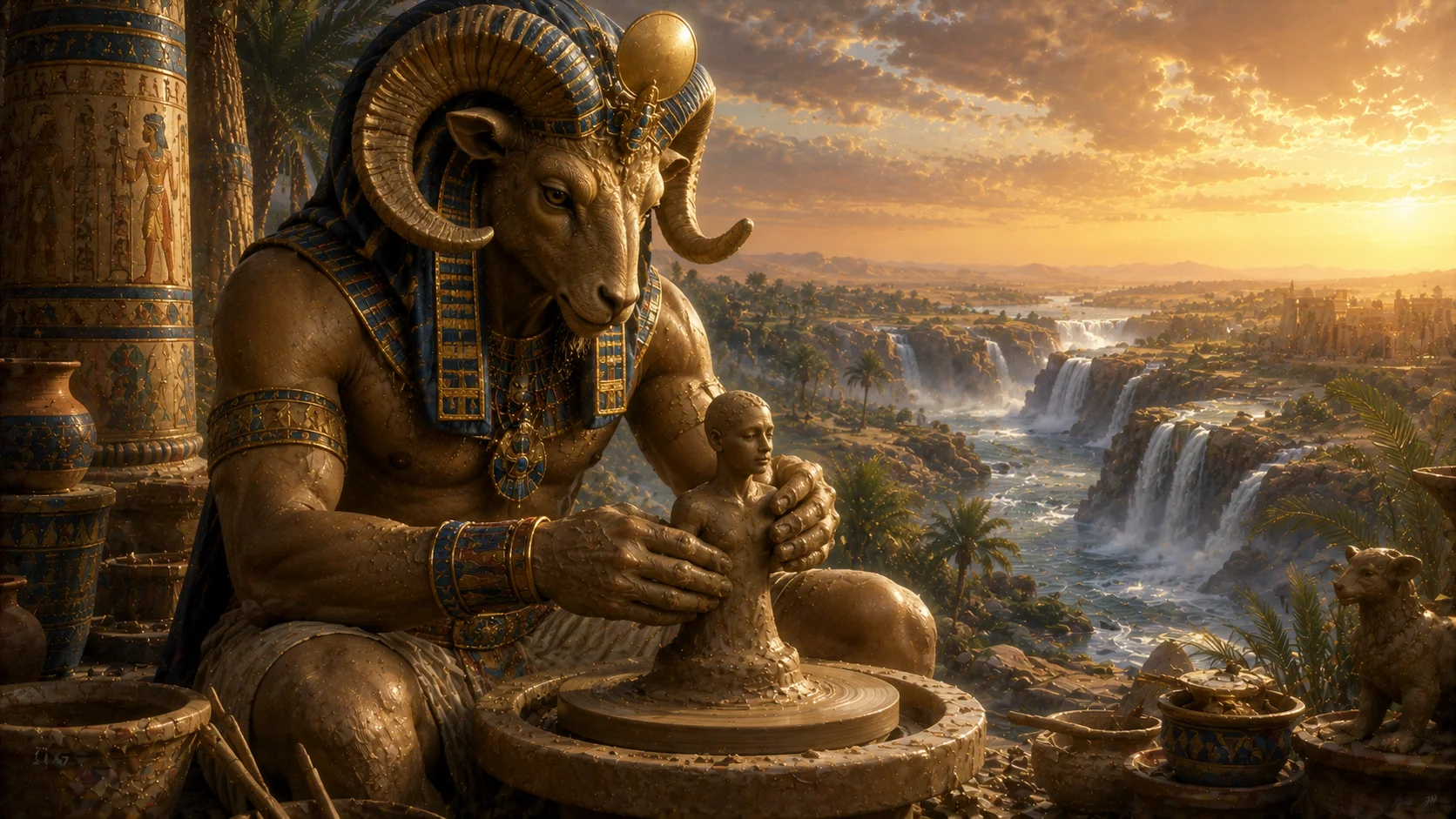
Khnum's most enduring role was as the Divine Potter, an epithet that named him directly: the god who molds each human body, and with it each person's ka, upon a potter's wheel, working the clay of the Nile itself into the shape of a living being. In this vision, human life did not simply appear; it was thrown, turned and finished by a god's hands, exactly as a potter at Elephantine might shape a vessel from the same river silt that Khnum's own flood had laid down. Body and life-force were not separate acts of creation but a single working of the wheel — the ka spun into being alongside its body, so that each person entered the world already whole, already breathing, already themselves.
Fashioner of That Which Is
Temple hymns credit Khnum with a scope far wider than human bodies alone: he was said to have knitted together the bodily framework of every living thing, fashioning not only humankind but the animals and even other gods, each shaped and set upon its wheel-turned form. This epithet, Fashioner of that which is, marks him as a creator-god in the broadest craftsman's sense — not a distant first cause but a hands-on maker, continually at work, responsible for the ongoing fact of created things rather than a single act at the dawn of time. The potter's wheel, in this telling, never stopped turning.
Scenes of the Royal Wheel
Khnum's craft is depicted nowhere more vividly than in the Divine Birth reliefs carved at Deir el-Bahri and at Luxor, where temple walls show him seated at his wheel, shaping the body of the future king and, beside it, the king's ka, as twin figures taking form beneath his hands. These reliefs cast the ruler's coming into being not as an ordinary birth but as an act of divine manufacture, witnessed and guaranteed by the god who fashions all bodies — the king made legitimate in part by having been, like every person, turned on Khnum's wheel, but turned there by the god's own particular attention.
A Family at the River's Edge
At Elephantine, Khnum did not stand alone but headed a local triad distinct from the great Osirian family of the Heliopolitan Ennead. His consort was Satet, goddess who guarded Egypt's southern border at the cataract frontier, and their daughter was Anuket, a goddess likewise bound to the cataract region and its waters. Together the three formed the divine household of the First Cataract, a family grouping rooted specifically in that stretch of river and answerable to its particular geography — the border, the rapids, the source — rather than to the cosmological dramas told elsewhere in Egypt.
The Hymns of Esna
Much of what is known of Khnum's developed theology survives on the walls of his temple at Esna, a structure built and decorated chiefly in the Ptolemaic and Roman periods, though the cult it served long predated that construction. The Esna hymns extend Khnum's creative reach into an extensive cosmology, praising him as the maker of the world's living order upon his wheel and elaborating, in dense and repetitive verse, on the craftsman-god's role as the one who shapes and sustains life. These texts are a principal source for reconstructing Khnum's theology, since they preserve, in the god's own temple's words, claims about his power that earlier and sparser sources only gesture toward.
Waters That Make the Land Bear Fruit
Khnum's command of the flood tied him inseparably to Egypt's agricultural year: the inundation he released from his cataract caverns each year deposited the silt that made the fields fertile, and so his worship reached into the practical rhythms of planting and harvest as much as into questions of individual origin. A god who shaped bodies from Nile clay and a god who controlled the Nile's flood were, in Khnum, one and the same figure seen from two angles — the water that fed the crops was, symbolically, kin to the clay that formed the people who ate them. His province was accordingly invoked wherever fertility, birth and the turning agricultural cycle were at stake, procreation and inundation bound together under a single ram-headed lord.
An Image That Outlasted Its Temple
Among the creation images that Egypt produced, Khnum's potter's wheel has proven one of the most frequently cited in later comparative study of the world's creator-gods, drawn on again and again as an example of the "divine potter" figure found across many mythologies — the maker who does not merely speak or think a world into existence but physically works it from formless material with craftsman's hands. That the image has traveled so far from Elephantine's caverns says something of its power: a god shaping a person, one at a time, out of river clay, remains one of the most immediate and human pictures ancient Egypt left of how a life begins.
The Wheel That Never Stills
Khnum endures as one of the oldest and most intimate of the Egyptian gods — Lord of the Cataract who holds the Nile's source in his caverns, the Divine Potter who turns every human body and its ka into being upon his wheel, and the fashioner whose hymns at Esna name him maker of all that lives. He offers a vision of creation as ongoing craft rather than a finished act of the distant past: the flood rises again each year at his release, and each new life is shaped again at his wheel, clay taken from the same river he governs, given breath, and set into a mother's womb to be born.
At his potter's wheel he molds every human being and their very ka from the clay of the Nile — the ram-headed lord of the First Cataract, who shapes each new life and releases, from his caverns, the flood that feeds the land.
Sources & traditions
- EncyclopediaWikipedia — Khnum
- TraditionEgyptian texts, inscriptions and later retellings
Myths change from area to area and from time to time. This chronicle follows the most widely told versions; tellings in other villages, regions and eras may differ.