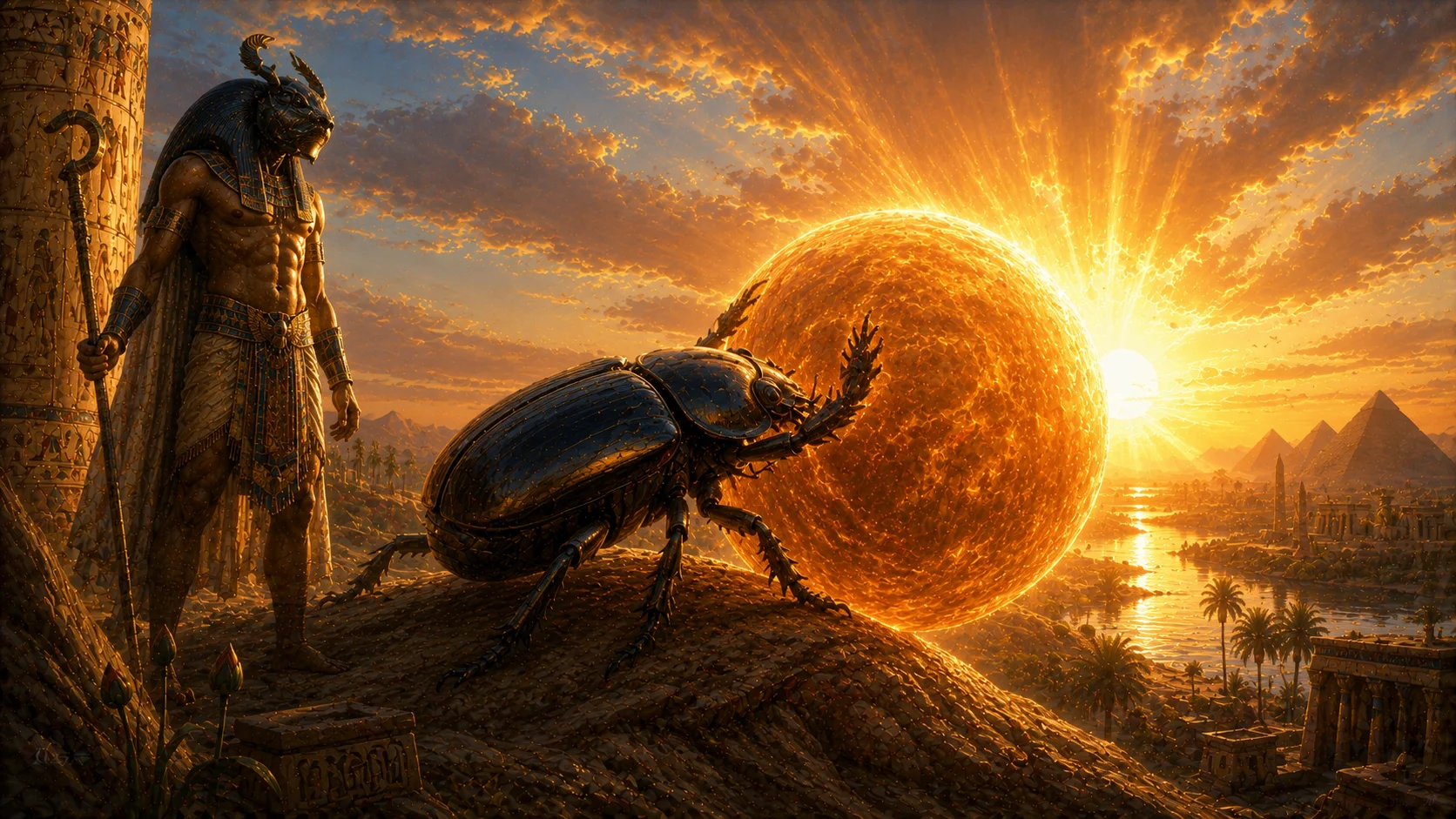
Khepri was the scarab-headed Egyptian god of the rising sun, creation and rebirth — the form the sun-god took at dawn, who rolled the new sun up over the horizon each morning as a scarab beetle rolls its ball of dung, and who embodied the self-creating power at the heart of existence. Attested from the Old Kingdom Pyramid Texts onward, where the dead king is said to “become Khepri,” he is the morning sun, the god of becoming, the dawn of every new day and every new life.
The Beetle That Made Itself
Khepri’s name comes from the Egyptian verb kheper, “to come into being,” “to become,” “to develop” — and his beetle-form was chosen because it seemed to demonstrate that very idea in nature. The Egyptians watched the dung beetle push a great ball of dung across the ground and read it as an image of the sun being rolled across the sky. They then watched young beetles emerge from that same ball with no visible parent, and read it as a picture of spontaneous self-creation: life appearing to make itself out of nothing. A god built from that observation could hardly be anything but the deity of dawn, of coming-into-being, and of a creation that needs no other cause than itself.
One Face Among the Sun’s Three
Khepri was not the whole of the sun but one phase of it. Egyptian theology divided the sun’s daily course into three faces: Khepri at dawn, Ra at the height of noon, and Atum as the sun set in the evening. Together the three could be spoken of as a single triad tracing one day’s journey from birth to zenith to death. Khepri’s place in that triad was always the beginning — the fragile, new-made light of first sunrise, distinct from Ra’s full strength and from Atum’s aged descent, yet inseparable from both as three moments of one continuous sun.
Ra-Khepri, One Name Among Many
Because Khepri was understood as a manifestation of the sun-god rather than a wholly separate actor, he was frequently invoked joined to Ra’s own name, as Ra-Khepri, or listed simply as one of the sun-god’s many names within longer solar litanies. Hymns such as the Great Hymn to the Aten and the solar litanies of the Book of the Dead catalogue Khepri alongside Ra and Atum as forms the one sun-god assumes through the day, rather than as gods with independent careers. This is part of why Khepri, unlike deities of the Ennead such as Osiris or Isis, was not given a spouse, children, or a family position — he functions as an aspect of the solar creator, not as an actor with a myth cycle of his own.
The Self-Created God
Khepri belonged to the category of autogenous, self-created gods — beings whose existence required no prior creator, who called themselves into being out of nothing. This placed him close in concept to Atum, who was likewise said to have created himself before creating the world, and it made the scarab a natural emblem for the deepest Egyptian idea about creation: that at the origin of all things stood something that simply began, without cause outside itself. Where Atum’s self-creation belonged to the first moment of cosmic time, Khepri’s belonged to every single morning — the same miracle of self-origination repeated at each sunrise.
Pushing the Disk Through the Night
Khepri’s central mythic labor was performed largely out of sight, in the hours before dawn. In the Amduat and other funerary texts describing the sun-god’s nightly journey through the underworld, Khepri is the form the sun takes as it completes that passage, pushing the regenerated solar disk up and over the eastern horizon to begin a new day. The imagery follows the beetle exactly: as a scarab pushes its ball along the ground with no visible means of pulling it, Khepri pushes the sun with no team, no boat-crew of his own, no visible support — the sheer force of becoming made visible as labor.
Guardian of the Passage Through Darkness
That nightly journey was not undertaken in safety. The sun-god’s passage through the underworld was contested each night by the serpent-demon Apep, chaos given monstrous form, who sought to halt the sun before it could be reborn. The sun-god’s crew, among them Set, repelled Apep in the darkness so that the disk Khepri carried could reach the horizon intact. Read this way, the dawn scarab was not simply a pretty image of renewal but the announcement of a victory: every sunrise meant that chaos had been fought off again, and that light had beaten the night one more time.
Sailing Among the Sun’s Company
On temple ceilings and in the astronomical and solar-boat scenes painted across tomb walls, the scarab-headed man appears as one figure among the sun-god’s several manifestations riding the solar barque across the sky and through the underworld. He is shown not as a lone actor but as part of a company of solar forms, taking his turn as the vessel that the rising sun temporarily inhabits. This iconography — the beetle head on a human body, seated or standing within the boat — became one of the recognizable ways Egyptian artists signaled that a scene depicted the specific moment of the sun’s return at dawn rather than its journey at any other hour.
A Name for Every King Reborn
From the Pyramid Texts of the Old Kingdom onward, Egyptian funerary literature used Khepri as a model for the fate hoped for by the dead. The deceased king was described as coming to “become Khepri” — language that borrowed the god’s very name, built from the verb for coming-into-being, to describe the king’s own rebirth after death. To become Khepri was not to worship a god from a distance but to be transformed into the same process the god embodied: the passage from death back into new light, exactly as the sun completed that same passage every single night.
The Scarab Placed Upon the Heart
That funerary association gave rise to one of the most widespread objects in all of Egyptian material culture: the scarab amulet. Carved scarabs were placed on mummies, especially over the heart, to invoke the rebirth symbolism carried by Khepri’s beetle form. It is worth noting precisely what these heart scarabs did and did not do: the specific funerary spell inscribed on many of them, Book of the Dead Spell 30B, addresses the heart itself — commanding it not to testify against the deceased at judgment — rather than addressing Khepri directly. The scarab’s presence on the body drew on Khepri’s meaning of transformation and renewal without every inscribed object being a direct invocation of the god by name.
An Amulet Beyond Counting
Scarab-form amulets, seals, and jewelry extended far beyond funerary use and far beyond any single named deity. The beetle shape on its own, evoking regeneration and protection, became one of the most widely produced protective amulet forms in Egypt, continuing in use into the Late Period, worn by the living as well as placed with the dead. Its protective and regenerative meaning was general enough that a scarab amulet did not always need to name Khepri explicitly to carry his symbolism — the shape itself had come to mean rebirth.
A Beetle Carried Beyond the Nile
The scarab’s reach extended past Egypt’s own borders. Scarab seals and amulets bearing the beetle form were traded and exported widely across the ancient Mediterranean world, carrying Egyptian religious imagery into cultures that had no direct stake in Khepri’s theology. That reach has continued into the present: the scarab remains one of the most immediately recognizable Egyptian religious symbols in modern popular culture, instantly identified even by those who have never heard the god’s name or the verb his name comes from.
The Sun Reborn Each Morning
Khepri endures as one of the most evocative figures in Egyptian religion precisely because his meaning asked so little translation: everyone who has watched a sunrise has watched what he was believed to do. He embodied a vision of existence as constant renewal — of the sun and of life itself as things that die and are made new in an unbroken cycle, and of the deep power of becoming by which all things come into being in the first place. His scarab, rolling the sun up over the horizon each dawn with no visible help and no visible cause but its own persistence, remains one of the most enduring images of resurrection and new life to survive from the ancient world.
Each dawn he rolls the new sun up over the horizon as a beetle rolls its ball of dung across the earth — the god of becoming, of self-creation and rebirth, the sun made new every single morning.
Sources & traditions
- EncyclopediaWikipedia — Khepri
- TraditionEgyptian texts, inscriptions and later retellings
Myths change from area to area and from time to time. This chronicle follows the most widely told versions; tellings in other villages, regions and eras may differ.