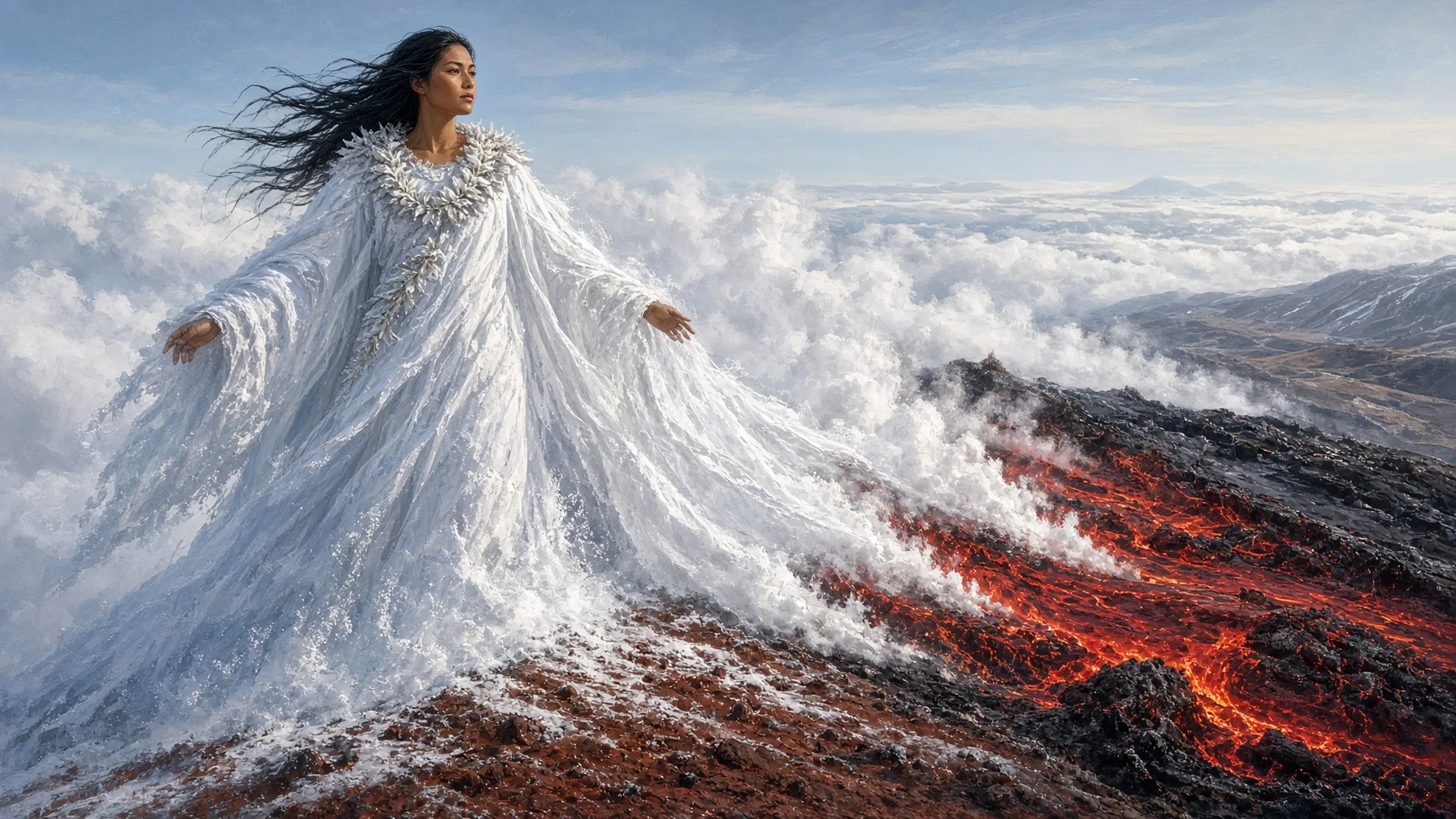
Ku'ula, more fully honored as Ku'ula-kai, is the Hawaiian god of fishermen, fish, and the fishing grounds — a patron deity whose memory survives not in temples of stone piled high for chiefs, but in the low, weathered platforms that still stand along the shorelines of Maui, Molokai, and Hawaii Island. Where the great Pele commands the volcano and Poliahu the snows of Mauna Kea, Ku'ula's dominion is quieter and closer to daily survival: the reef, the current, the run of fish that a family depended on to eat. Tradition places his home at Hana, on Maui, where he is said to have built the very first ko'a, the fishing shrine, and to have taught human beings the rites that would keep the sea generous.
The Fisherman Who Became a God
Unlike the volcanic and sky deities whose power is elemental and cosmic, Ku'ula's divinity is bound up with craft and stewardship. He is remembered as having lived among people, at Hana, practicing and perfecting the knowledge of where fish gathered, when they ran, and how they could be drawn to a given shore. What set him apart from an ordinary skilled fisherman was that he formalized this knowledge into ritual — he built a shrine, dedicated it, and established the reciprocal relationship between fisherman and sea that Hawaiian tradition still recognizes: take what you need, and give back the first share.
The First Ko'a at Hana
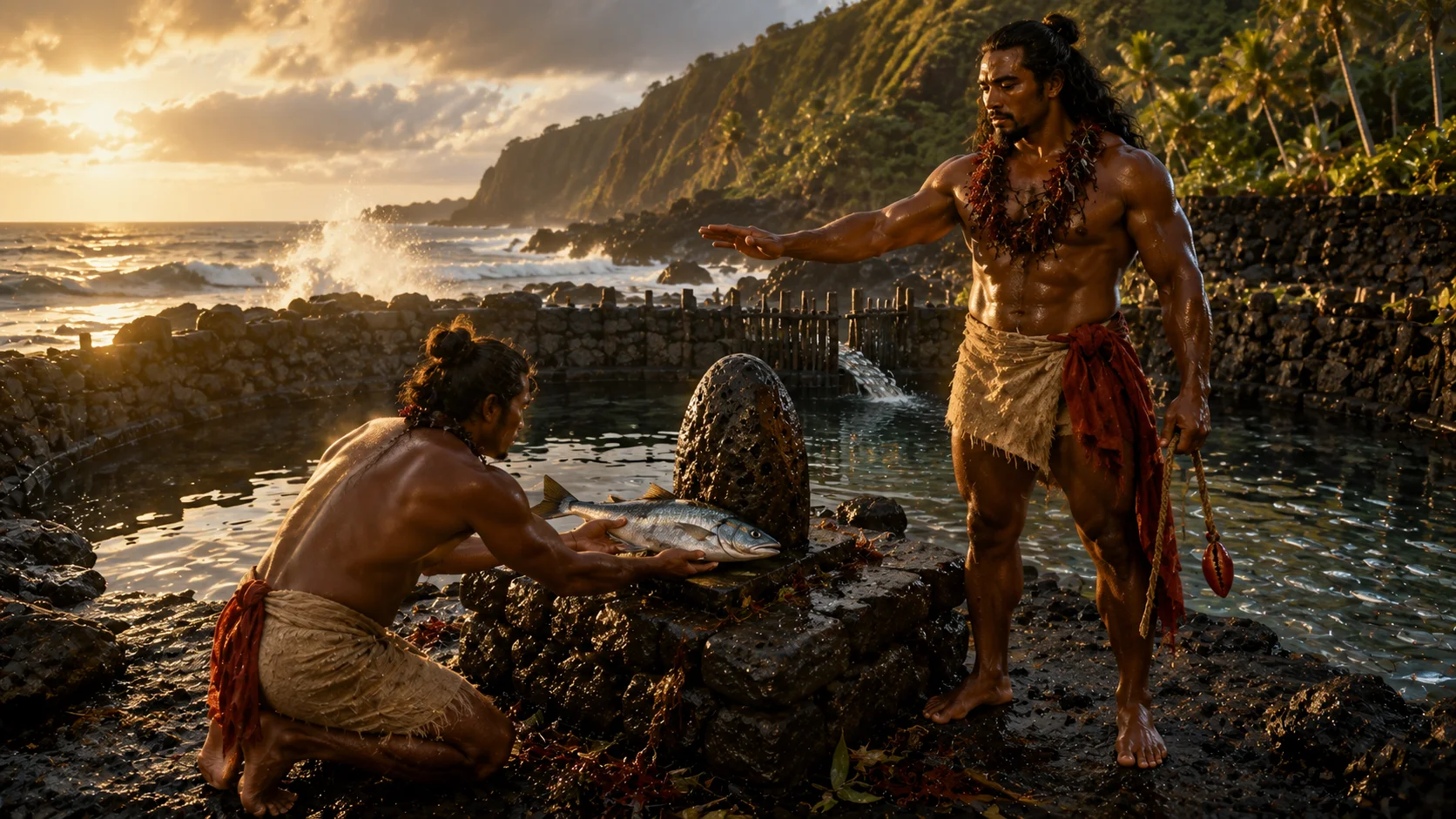
The ko'a Ku'ula built at Hana is remembered as the archetype for every fishing shrine that followed across the islands. Structurally these were unassuming: stacked-stone platforms set near the shoreline, modest beside the large heiau built for chiefly rule or war. Their purpose was narrow and practical — a fixed point where the sea's abundance could be petitioned and thanked. That very plainness is part of what preserved so many of them; stone platforms half-hidden in beach grass have outlasted grander constructions, and Ku'ula-kai shrine sites at Hana and elsewhere are still identified today as wahi pana, storied and sacred places.
Hina of the Fish-Gathering Tides
Ku'ula's wife, Hina-puku-i'a — Hina who gathers fish — carries her own portion of this sacred work. Where Ku'ula's legend emphasizes the shrine and the ritual offering, Hina's name preserves the more immediate, hands-on labor of drawing food from tide pools and shallows. In a pantheon full of goddesses named Hina, each attached to a different craft or element, this Hina's identity is fixed entirely to the sea's edge and its harvest — a reminder that the fishing tradition Ku'ula founded was never his labor alone, but a shared household economy of sea and shore.
Ai'ai and the Spreading of the Shrines
The work begun at Hana did not stay at Hana. Ku'ula and Hina's son, ʻAiʻai, is remembered as having traveled through the islands establishing koʻa in his father's honor, carrying the practice from Maui outward until fishing shrines dedicated to Ku'ula-kai could be found on multiple islands. This detail matters more than it might first appear: it explains why Ku'ula veneration is not a single-site cult tied only to Hana, but a distributed practice, recognizable wherever Hawaiian fishing communities built their own modest platforms and passed the same etiquette of offering down through generations.
The First Catch, Given Back
The central rite associated with Ku'ula is recorded consistently across Maui, Molokai, and Hawaii Island: a fisherman's first catch of the day, or of a new fishing ground, was to be laid at the heiau ko'a as an offering. This was not mere superstition tacked onto labor — it was the visible half of a relationship. The sea gives; the fisherman is expected to acknowledge that gift before claiming the rest of the catch for the household. Failure to observe the offering was understood to risk the very thing the shrine existed to protect: continued abundance. In this way Ku'ula's worship functioned as an early form of resource stewardship, embedding restraint and gratitude directly into the practice of a livelihood that could otherwise be exploited without limit.
Shrines That Still Stand
What distinguishes Ku'ula-kai from many Hawaiian deities is how physically present his worship remains. The stone platforms identified at Hana and other coastal sites are not reconstructions or symbolic markers — they are the surviving fabric of an actual, sustained religious practice, weathered by centuries of salt spray and treated with the same respect owed any wahi pana. Their humble scale — a pile of stacked stones rather than a monumental structure — is itself part of their meaning: a god concerned with the everyday sustenance of ordinary families did not need a palace, only a fixed and honored place by the water.
A God Without Rivalry
It is worth noting what Ku'ula's mythology lacks compared to figures like Pele or Poliahu: there is no recorded contest, no jealous rival, no dramatic battle for territory. His story is one of instruction and continuity rather than conflict. This absence of drama is not a gap in the tradition but a reflection of what the god represents — a domain of patient, repeated labor rather than sudden catastrophic force. Where the volcano goddess and the snow goddess each stage their power through eruption and storm, Ku'ula's power is demonstrated only in the quiet, reliable return of fish to a family's nets, season after season.
Fishing Ritual Within the Wider Pantheon
Ku'ula's household sits somewhat apart from the great genealogical chains that link deities like Haumea, Kapo, and Laka as siblings and daughters in a single cosmological lineage. His family — himself, Hina, and ʻAiʻai — is instead an occupational lineage, a chain of practice rather than of birth. This is common in Hawaiian religion, where alongside the great akua of elemental forces there existed a whole layer of deities and demigods tied to specific crafts: canoe-building, hula, sorcery, and fishing each had their own patrons, their own shrines, and their own etiquette, even when they were not woven into the same genealogical chant.
Comparisons Across the Islands
The pattern of a founding ancestor-deity who establishes a craft, followed by a descendant who spreads it, echoes elsewhere in Hawaiian tradition — the forest deity Laka, for instance, is invoked at the hula altar much as Ku'ula is invoked at the shoreline shrine, each anchoring a body of practical, repeated ritual to a divine origin. Even the mysterious Menehune, credited with engineering feats like the Alekoko fishpond on Kauai, share this same thread of a supernatural figure whose gift to humanity is technical mastery over a resource — stone, fish, or forest — rather than raw destructive power.
Guardianship and Its Limits
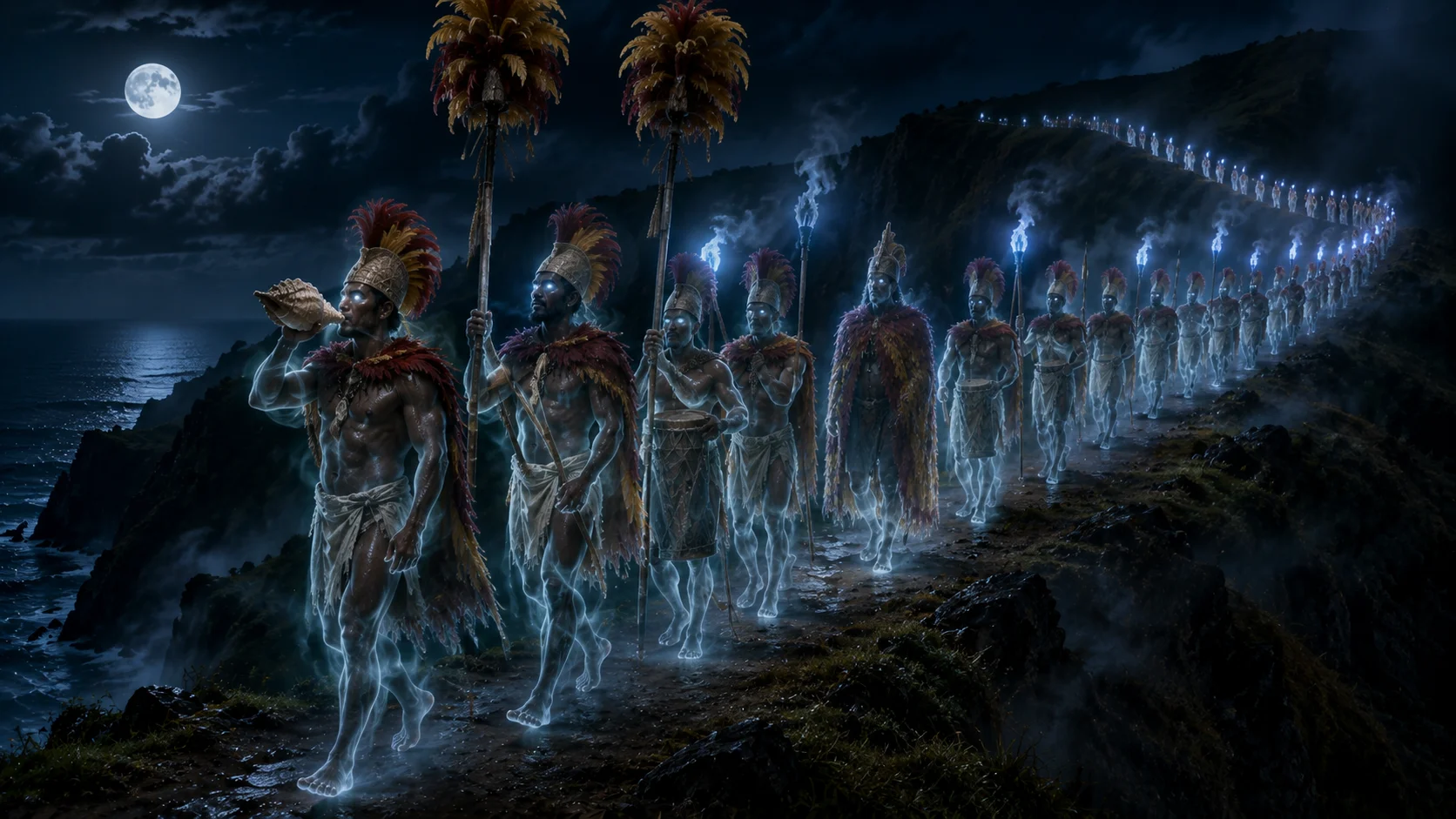
Hawaiian tradition draws a firm line between deities who protect a resource within its proper bounds and those whose power turns dangerous when a taboo is broken — as with the shark-man Nanaue, whose father Kamohoaliʻi forbade him from eating human flesh, a prohibition he eventually violated with fatal consequences. Ku'ula's tradition carries no such cautionary reversal; his worship is preserved almost entirely in its positive form, as an unbroken chain of offering and abundance rather than a warning about transgression. This makes his cult one of the more straightforwardly benevolent strands within a mythology that elsewhere holds considerable menace, from the nightly processions of the Nightmarchers to the destructive sorcery invoked through figures like Kapo.
Why the Tradition Endured
Fishing shrines dedicated to Ku'ula-kai persisted in practice long after many larger heiau fell into disuse, likely because the need they served never went away. Chiefly power structures rose and fell, but a family still needed to eat, and the shoreline platform asked for nothing but a small, sustainable act of gratitude in return for continued fortune at sea. That practical durability, as much as any single dramatic myth, is what has kept Ku'ula-kai's stones standing and his name remembered along the coasts of Hana and beyond — a god whose story is less about the marvel of his power than about the discipline he asked of the people who depended on it.
Sources & traditions
- TraditionHawaiian texts, oral tradition and village tellings
Myths change from area to area and from time to time. This chronicle follows the most widely told versions; tellings in other villages, regions and eras may differ.