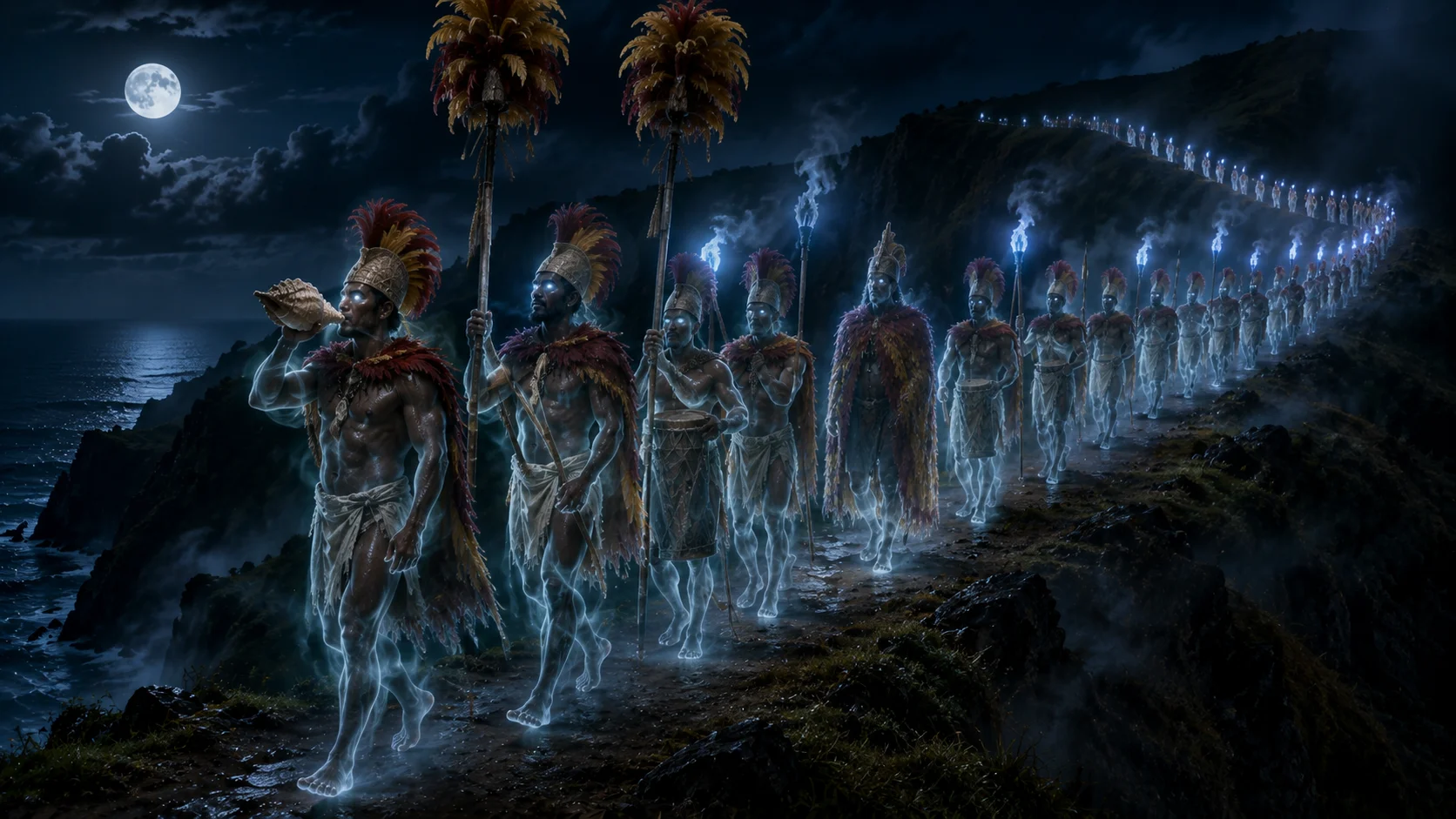
Nanaue is the were-shark of Hawaiian legend, a man who could shed his human skin for a shark's and who fed, in secret, on the very people who trusted him. Born of the mortal woman Kalei and the great shark-god Kamohoali'i, he carried in his body a truth he was raised to hide from the moment he could walk: a mouth, gaping and full of teeth, set into his own back. His story belongs to a wider family of Polynesian tales in which an aumakua, a shark ancestor-god, fathers a child who is neither fully human nor fully shark, and it survives today chiefly because the great folklorist Martha Beckwith set it down in Hawaiian Mythology as one of the clearest examples of that pattern.
A Union Between the Human World and the Deep
The legend begins, as so many Hawaiian genealogical chants do, with a meeting between a woman of the shore and a god of the open water. Kalei was a mortal woman; the being who came to her was Kamohoali'i, identified in the tradition as a shark-god, and in some versions of the story as a form the shark god took to meet her. Their union was not spoken of as an ordinary marriage. It was understood, in the way these stories are always understood, as the meeting of two orders of being that were never meant to stay separate for long — and the child born of it would carry both orders in a single body for the whole of his life.
The Child With the Hidden Mouth
When Kalei's son was born, the women attending her found something no midwife had prepared for: a second mouth, small but unmistakably a shark's, set into the flesh of the infant's back between his shoulders. The people around Kalei recognized at once what this meant, even if they did not yet know what it would cost them. The child was named Nanaue, and from his earliest years the mouth on his back marked him as something other than an ordinary child — a sign of the shark nature waiting inside him, long before anyone knew what it would drive him to do.
The Cloak That Kept a Secret
To hide the shark's mouth on his back, Nanaue was made to wear a cloak or a length of kapa, the beaten bark-cloth of old Hawaii, draped always over his shoulders. To his neighbors this was simply a young man's way of dressing. In truth it was the one thing standing between the village and the knowledge of what shared its shores with them. For years the cloak did its work. Nanaue grew up among people who had no reason to look twice at him, who saw a covered back and thought nothing more of it, never guessing that the covering was doing the work of concealing a second nature entirely.
Two Bodies, One Hunger
What the kapa cloak could not hide forever was what happened when Nanaue entered the water. There, away from watching eyes, he could let his shark nature take him over completely, slipping from human shape into the long grey body of a shark and back again as easily as another man might change clothes. It is this transformation — inherited whole from his father Kamohoali'i — that marks Nanaue as belonging to the shark-ancestor tradition rather than to ordinary Hawaiian legend of monsters or ghosts. He was not a man cursed to become a beast. He was, in the oldest and most literal sense, his father's son, carrying the shark's nature in his blood the way any child carries a parent's inheritance.
The Killings Off Waipio
In most tellings the horror unfolds along the coast of Waipio Valley on Hawaii Island, though other versions move the setting to Molokai, and the story was told and retold enough across the islands that both settings have their defenders. There, in the water where villagers swam and fished and bathed as they always had, something began seizing people and dragging them under. No one connected the disappearances to the quiet young man with the cloak over his shoulders. Why would they? He walked among them by day, ate at their fires, seemed no different from any other islander — while in the water, unrecognized, he was becoming the very shark that was emptying their shoreline of its people.
A Predator Wearing a Familiar Face
What makes the Nanaue legend endure is not simply that a man could become a shark, but that he could return to human shape and walk back into the company of the very people he had just preyed upon. This is the particular cruelty folklorists have noted in the tale: the monster was never a stranger arriving from outside the community. He was already inside it, sitting at the same gatherings, sharing the same fires, protected by nothing more than a piece of cloth and the simple fact that no one imagined such a thing was possible. The shark in the water and the neighbor on the shore were never two different threats. They were the same one, and that was precisely what let him go on for as long as he did.
The Cloak Slips
The end of Nanaue's secret came, as it does in so many stories built around a single hidden mark, through an ordinary moment of carelessness rather than any deliberate unmasking. At a community gathering — the kind of everyday assembly where cloaks might be set aside, where people relaxed among neighbors they trusted — Nanaue was seen without his covering. In that instant the shark's mouth on his back, the thing his whole life had been arranged around concealing, was visible to everyone present. There was no explaining it away. The villagers who had lost sons, daughters, and kin to the water now had, in front of them, the answer to a mystery that had cost them dearly.
Recognition and Reckoning
What had been suspicion, grief, and fear among the people of the shore hardened at once into certainty. The quiet neighbor was the killer in the water; the two things they had never let themselves connect were, after all, one and the same person. In nearly every surviving version of the legend, the response was swift and communal — Nanaue did not face a single avenger but the gathered anger of a community that had been preyed upon in secret for far too long. The story does not linger on cleverness or heroics in this part; it lingers on the plain fact that once the truth was seen, it could not be unseen, and the people acted on it together.
The Hunt and the End of the Killings
Nanaue fled once he was discovered, and the villagers pursued him. In most versions of the legend he is caught and killed, and with his death the disappearances and the killings along the shore come to an end. The story does not dwell on triumph so much as relief — the sense of a wound finally closed, a danger finally named and finished. Some tellings place small variations on how exactly the pursuit ended, as is common with a legend carried by word of mouth across generations and islands, but the outcome that survives most consistently is the same: the shark-man is found out, hunted down, and the terror in the water stops with him.
A Story Told Across the Pacific
Nanaue's tale is not unique to Hawaii in its bones, even if its details — Waipio's coastline, Kamohoali'i's fatherhood, the specific cruelty of the hidden mouth — belong distinctly to Hawaiian tradition. Folklorists studying Polynesian oral literature, Beckwith foremost among them, have classified Nanaue as part of a broader shark-ancestor motif found across the Pacific, in which a shark aumakua fathers a child who moves between human and shark form. What sets the Hawaiian telling apart is its intimacy: this is not a monster from a distant reef but a son raised by a known mother, covered by a known cloak, exposed at a known gathering. The horror is domestic before it is ever oceanic.
Shark Ancestors and the Aumakua Tradition
To understand why this story carried the weight it did for the people who told it, it helps to remember that sharks in Hawaiian tradition were never simply predators to be feared and nothing more. Many families trace their aumakua, their guardian ancestor spirits, to sharks, and a shark-god like Kamohoali'i belongs to a tradition of real reverence, not mere dread. Nanaue's tragedy gains its force precisely because it inverts that expectation — the shark lineage that should have been a source of protection and guardianship became, in his case, the very thing that turned against the community he lived among. The story is less a simple monster tale than a meditation on what happens when an inheritance meant to guard a people instead consumes them.
Why the Legend Endures
Centuries on, the Nanaue legend still holds its place in Hawaiian oral literature because it fuses two enduring fears into a single figure: the fear of what moves unseen beneath the water, and the fear of what might be hidden behind a familiar face on land. Preserved chiefly through Martha Beckwith's record in Hawaiian Mythology, the tale survives not as a simple warning against the ocean but as a story about concealment itself — about a cloak that worked exactly as intended for years, and about a community that, once the truth was finally visible, did not look away from it. In that sense Nanaue's story is remembered less for the killings themselves than for the moment the covering slipped, and the shore finally understood what had been walking among them all along.
Sources & traditions
- EncyclopediaWikipedia — Nanaue
- TraditionHawaiian texts, oral tradition and village tellings
Myths change from area to area and from time to time. This chronicle follows the most widely told versions; tellings in other villages, regions and eras may differ.