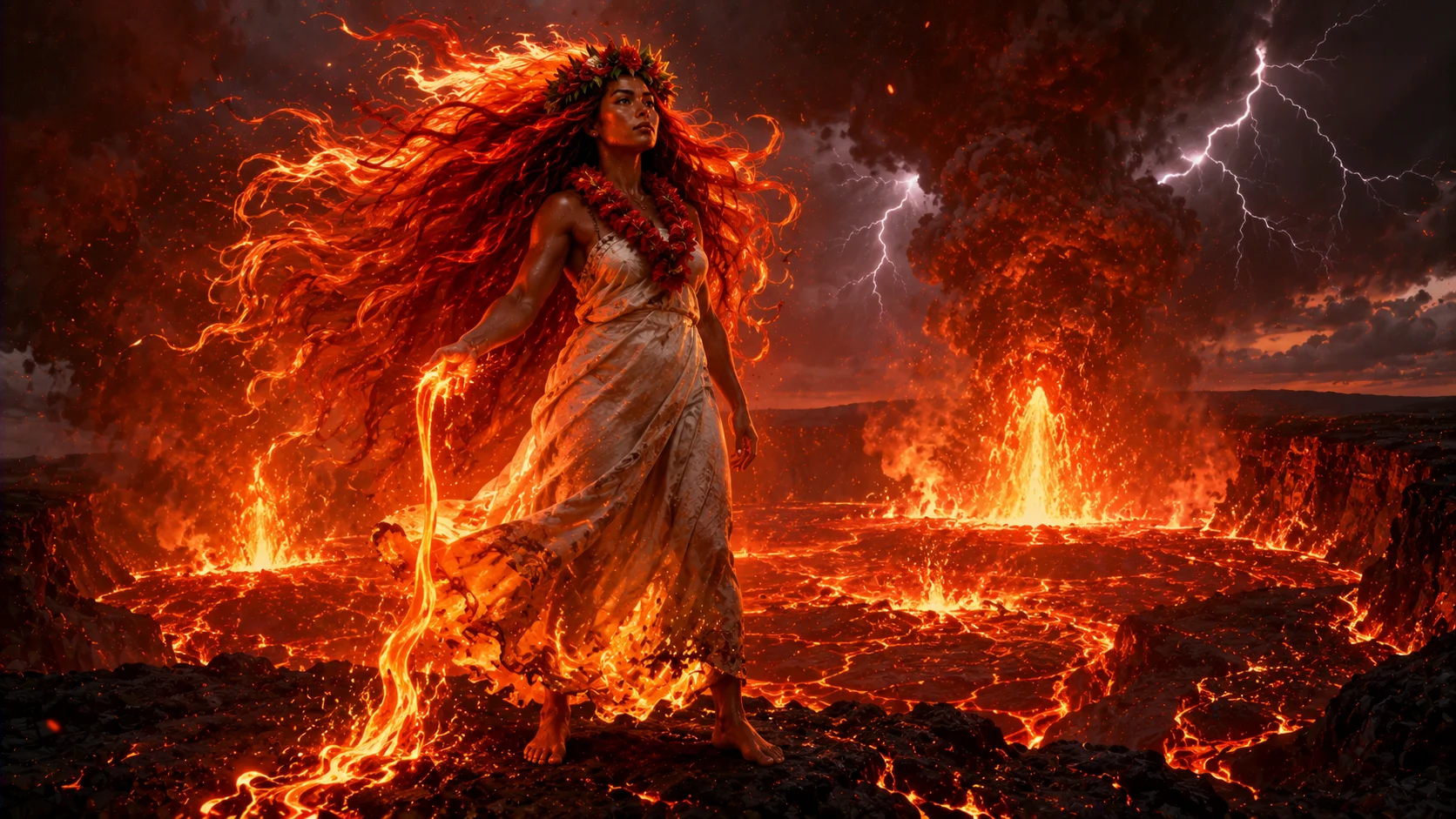
Pele, honoured in chant as Pelehonuamea, is the akua of volcanoes and fire in Hawaiian tradition — the power that pours molten rock from the earth, burns the forest in its path, and, as the lava cools, makes new land where there was none. Her home is Halema'uma'u, the crater at the summit of Kilauea on the island of Hawai'i, and for many Hawaiians she is not a figure of the past but a living presence, spoken of with affection and caution as Tutu Pele, Grandmother Pele. Her stories are among the richest in Hawaiian oral literature, and they are still told, chanted and danced today.
The Names of Pele
Pele is addressed by many names, each pointing at a different face of the same power. Pelehonuamea is usually rendered “Pele of the sacred land,” and the kumu hula and scholar Pualani Kanaka'ole Kanahele reads it as the lava that creates land — honua is the earth, and mea the substances from which earth is made. Another epithet, Ka-wahine-'ai-honua, “the woman who eats the land,” names the other half of her nature: the flow that swallows fields, roads and villages as it moves toward the sea.
The two names belong together. In Hawaiian understanding the destruction and the making are a single act. The lava that buries a forest is the same lava that becomes, in time, a new shoreline, a new plain, the young rock on which ferns and then 'ohi'a trees take root. Kanahele has argued from close study of the old chants that Pele's essential task, her kuleana, is precisely this — the creation of land.
A Family Born in Kahiki
Pele belongs to a large and powerful family whose genealogies trace back to Haumea, the earth-mother and goddess of birth. In many tellings Pele is Haumea's daughter, and her brothers and sisters divide the elements between them. Her elder sister Namaka is the goddess of the sea. Her youngest and most beloved sister is Hi'iaka, whose full name, Hi'iakaikapoliopele, means “Hi'iaka in the bosom of Pele”: she is said to have been carried as an egg in Pele's care on the long voyage, and to have hatched only after the family reached the islands. Her brothers include the shark god Kamohoali'i, a protector of the family at sea, and gods of thunder and of the explosive force of eruption. Her sister Kapo appears in the same family circle.
The family's homeland is Kahiki, the distant ancestral land beyond the horizon from which, in Hawaiian tradition, the first voyagers and many of the gods came. Some versions identify Kahiki with Tahiti; others leave it as the great elsewhere of origins. Either way, Pele is a goddess who arrived. Her story begins with a voyage.
The Quarrel and the Voyage
Tradition gives Pele's departure from Kahiki a human cause. She quarrelled bitterly with her sister Namaka, and in several versions the quarrel turned on a lover, the hero-voyager Aukelenuiaiku, whose presence set the sisters against one another. The rupture could not be mended. Pele left her homeland with members of her family in a voyaging canoe named, in one well-known account, Honuaiakea, and set out across the open ocean to find a new home.
She came first to the northwestern end of the Hawaiian chain. At each island she dug into the ground with her digging stick, Pa'oa, seeking a place deep enough and dry enough to hold her fire. On Kaua'i she dug and raised the hill called Pu'uopele, “Hill of Pele.” But Namaka had followed her, and wherever Pele dug, the sea came in and drowned the fire pit. Pele moved on to O'ahu, to Moloka'i, to Maui, digging and being driven out again.
On Maui the sisters met at last in open battle. In the chants of that encounter Namaka overcame her, and Pele's body was broken on the land at Kahikinui, where a hill bears the name Ka-iwi-o-Pele, “the bones of Pele.” Yet Pele did not end there. Freed from her body, her spirit crossed to the island of Hawai'i, and there, at Kilauea, she found a home the sea could not reach.
Listeners have long noticed that the route of the story matches the land itself. The Hawaiian Islands do grow younger from northwest to southeast: Kaua'i is the oldest of the main islands and its volcanoes are long silent, while the island of Hawai'i, at the southeastern end, is the youngest and the only one still building itself in eruptions today. The tale of Pele moving down the chain, driven from each older island, carries in narrative form what geologists describe in millions of years.
Halema'uma'u, the House of Pele
Pele's dwelling is Halema'uma'u, the great crater within the summit caldera of Kilauea. Its name is often explained as “house of the 'ama'u fern.” For much of recorded history the crater has held a lake of molten rock or a churning vent, and the eruptions of Kilauea and its neighbour Mauna Loa are, in the old understanding, Pele at work: travelling, building, sometimes raging.
Her presence has even entered the language of science. The fine threads of volcanic glass that wind spins from lava fountains are called Pele's hair, and the small droplets of glass that cool as they fall are called Pele's tears. Volcanologists around the world use both terms, a small sign of how closely the goddess and the volcano are bound together in the islands.
Hi'iaka and the Chief of Kaua'i
The longest and best-loved cycle of Pele stories concerns her sister Hi'iaka and a mortal chief. While Pele slept at Kilauea, her spirit travelled the length of the island chain, drawn by the sound of hula drums, until it reached Ha'ena on Kaua'i. There she met the handsome chief Lohi'au and fell in love. When she woke, she wanted him brought to her, and she chose Hi'iaka, her favourite, to make the dangerous journey and fetch him.
Hi'iaka agreed, but asked one thing in return: that Pele would guard her beloved groves of lehua trees in Puna, and her dear friend Hopoe, while she was away. Then she set out. The journey that follows, across island after island, is the heart of the epic. Hi'iaka faces monsters and hostile spirits, heals the sick, and chants and dances her way through danger, and in doing so she becomes a patron of hula and of healing in her own right.
But the journey takes longer than Pele can bear. Restless and jealous, imagining that Hi'iaka has taken Lohi'au for herself, Pele breaks her promise: she sends her fire through the lehua groves of Puna and destroys them, and Hopoe is lost. When Hi'iaka returns with Lohi'au and sees what has been done, her grief turns to defiance, and the story ends in a fierce confrontation between the sisters in which Lohi'au is struck down by Pele's fire and later restored to life. The epic is a story about love and jealousy, about loyalty between sisters, and about the cost of a promise broken by a power too great to be restrained. Pualani Kanaka'ole Kanahele's Ka Honua Ola (“The Living Earth”) gathers chants from this epic, and the cycle remains central to hula traditions devoted to Pele and Hi'iaka.
Pele and Kamapua'a
Pele's other great love story is also a war. Kamapua'a, the pig-demigod whose forms include the hog, the rain-fed grasses and the plants of the wet uplands, came courting her, and she rejected him with insults. Their quarrel became a battle of elements: Pele sent her lava against him, and Kamapua'a answered with rain, fog, and herds of pigs that rooted up and smothered the fire. Neither could destroy the other.
In a version recorded in Abraham Fornander's collection of Hawaiian traditions, the struggle ended in a settlement that divided the island of Hawai'i between them. Pele took the districts of Puna, Ka'u and Kona, the drier lands where her flows run; Kamapua'a took Hilo, Hamakua and Kohala, where the rain falls and the land stays green. Other tellings say they became lovers or husband and wife. Read together, the stories describe a real landscape: the leeward, lava-scarred side of the island and the windward, rain-soaked side, each with its own ruling power.
Pele and Poli'ahu
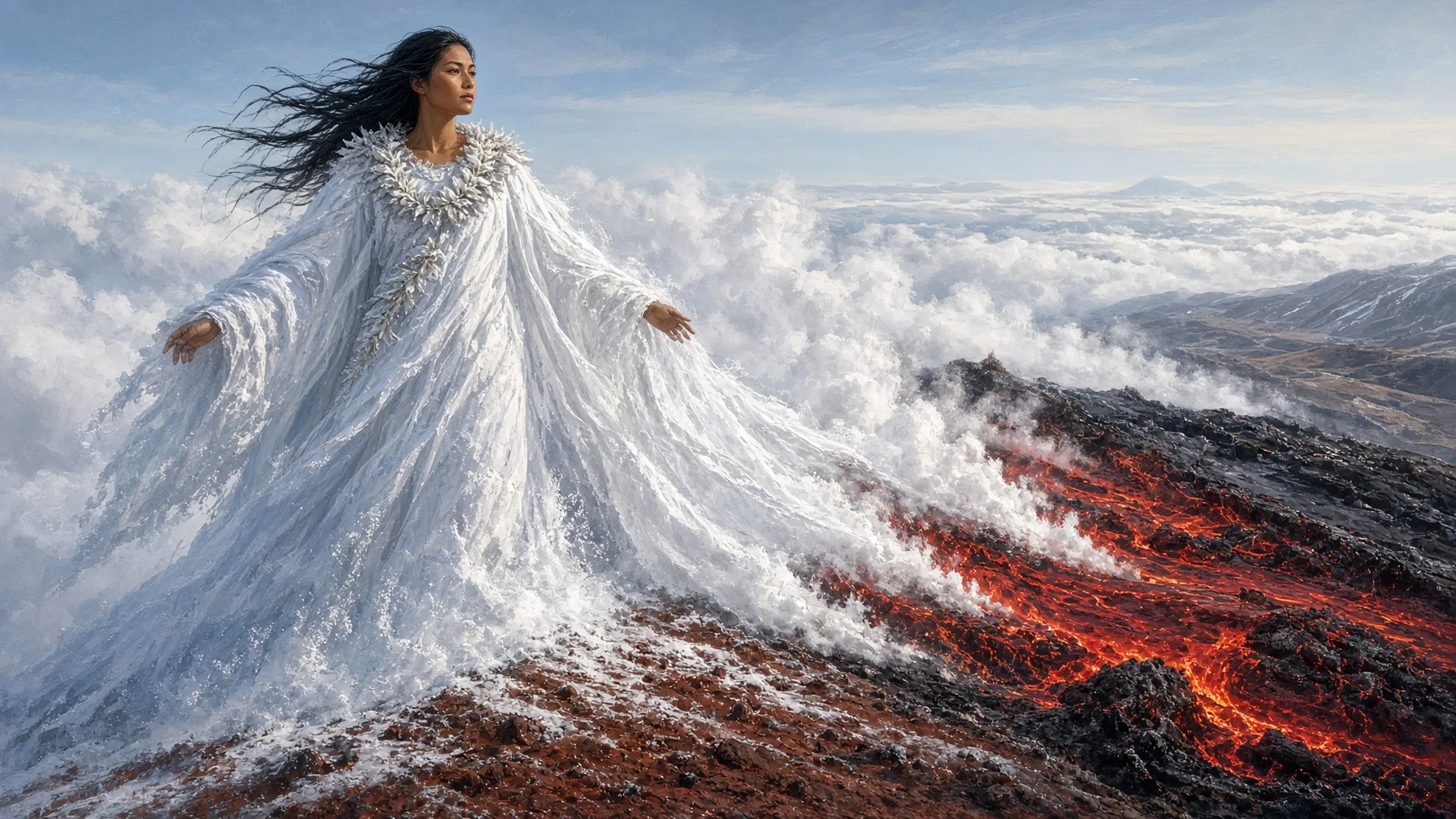
Pele's rivals are often goddesses of the forces that check her. Poli'ahu, the goddess of the snow on Mauna Kea, is the best known. In the most widely told story, Pele came to the slopes in disguise as a beautiful stranger and challenged Poli'ahu to a race on the holua, the steep sled courses of old Hawai'i. Poli'ahu won. Pele, revealing herself in anger, sent fire up the mountain; Poli'ahu answered with snow and cold until the fire was driven back. The tale pictures the island's high summits as a meeting place of fire and ice, each holding the other in balance.
The Chiefess at the Crater
Pele's place in Hawaiian life was tested openly in the years after Christian missionaries arrived in 1820. In December 1824 the high chiefess Kapi'olani, a convert to the new faith, travelled to Kilauea to show her people that Pele held no power over her. Ignoring the warnings of her companions and of a priestess of Pele who met her at the crater, she ate 'ohelo berries — fruit sacred to Pele and customarily offered to her first — and threw stones into the crater. She returned home unharmed. Missionary writers celebrated the act as a victory for Christianity, and it became a well-known episode of the period.
Yet the reverence it was meant to end did not disappear. Pele remained the goddess of the volcano in the minds of many Hawaiians, Christian and otherwise, through the rest of the nineteenth century and beyond.
The Princess and the Flow
The clearest sign of that survival came in 1881. A long eruption of Mauna Loa had sent a flow of lava down toward the town of Hilo, and by the summer of that year it was close enough that residents feared the town would be lost. Princess Ruth Ke'elikolani, a high chiefess known for her loyalty to the old ways, travelled to the edge of the flow. There, according to the accounts of the time, she chanted to Pele and made offerings, among them red silk handkerchiefs and brandy. Within days the flow stopped short of the town. Many in Hilo credited the princess with saving it, and the story is still told there with pride.
A Living Presence
Pele is not only a figure of legend. For many Native Hawaiians she remains an akua to be honoured, and Kilauea a sacred place. Offerings, called ho'okupu, are still brought to the crater's edge, and chants are offered there. Hula schools that keep the Pele and Hi'iaka traditions — among them the lineage of the revered kumu hula Edith Kanaka'ole and her daughters — continue to perform dances and chants in her honour. When eruptions threaten homes, as they did in the lower Puna district in 2018, residents often speak of Pele not as a metaphor but as a presence whose land it is.
That reverence carries with it a deep respect for the land itself: the lava, the steam, the new black rock are part of the goddess, and they are approached with care rather than as scenery.
Madame Pele and the “Curse”
Alongside the old traditions, Pele has gathered a modern folklore. Stories circulate of Madame Pele appearing to travellers as an old woman or a striking young woman, sometimes with a small white dog, shortly before an eruption, and of drivers who give her a ride only to find her gone from the back seat. These tales belong to the twentieth century, but they show how present she remains in island life.
The best-known modern belief is “Pele's curse”: the idea that anyone who takes a lava rock home from Hawai'i will suffer bad luck until it is returned. Every year the national park at Kilauea receives packages of rocks mailed back by visitors, often with letters of apology. Park staff have stated that the curse does not appear in Hawaiian oral tradition, and its origin is unclear; a common suggestion is that it was invented in the twentieth century to discourage the removal of rock. What is not in doubt is that taking rock from a national park is against the law, and that many Hawaiians regard the land, and the lava that forms it, as belonging to Pele.
Kindred Fire
Pele has relatives across Polynesia. In Maori tradition Mahuika is the keeper of fire, from whose fingernails the trickster Maui won flame for humankind, and Ruaumoko is the god of earthquakes and volcanic force beneath the ground. None of them is the same figure as Pele, and each belongs to its own islands, but together they show how the peoples of the Pacific, living on volcanic land, gave the fire beneath their feet a face and a name.
The Goddess Who Makes the Land
Pele is often summed up as a goddess of destruction, and her stories do not hide her temper: the broken promise in Puna, the rivalry with Namaka, the fire sent against Poli'ahu and Kamapua'a. But the oldest understanding of her points the other way. Each flow that reaches the sea adds to the island; each eruption is a birth as well as a burning. To the people who have lived beside Kilauea for centuries, Pele is the reason there is land to live on at all — fierce, unpredictable, and still at work.
Sources & traditions
- EncyclopediaWikipedia — Pele (deity)
- TraditionHawaiian texts, oral tradition and village tellings
Myths change from area to area and from time to time. This chronicle follows the most widely told versions; tellings in other villages, regions and eras may differ.