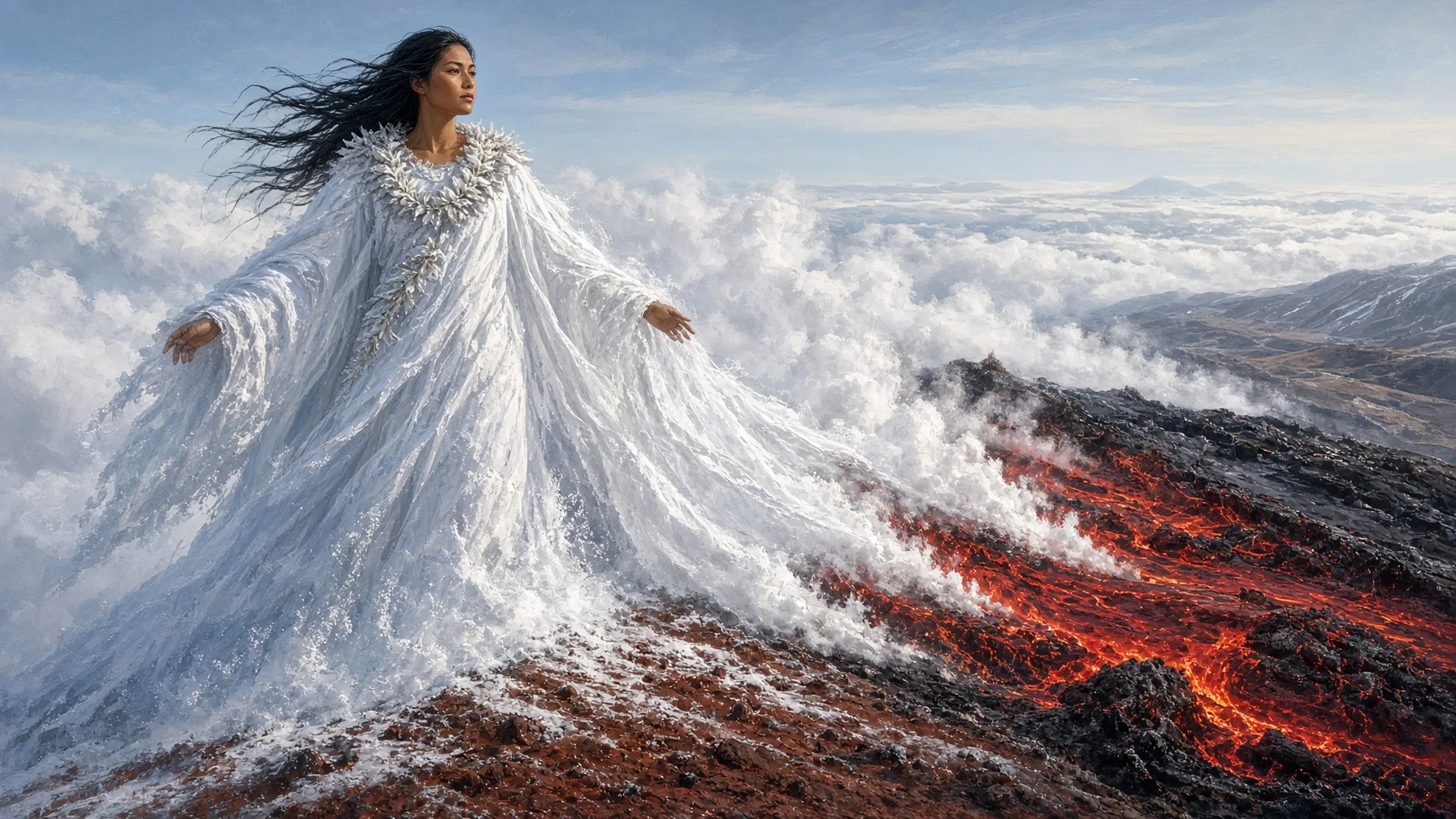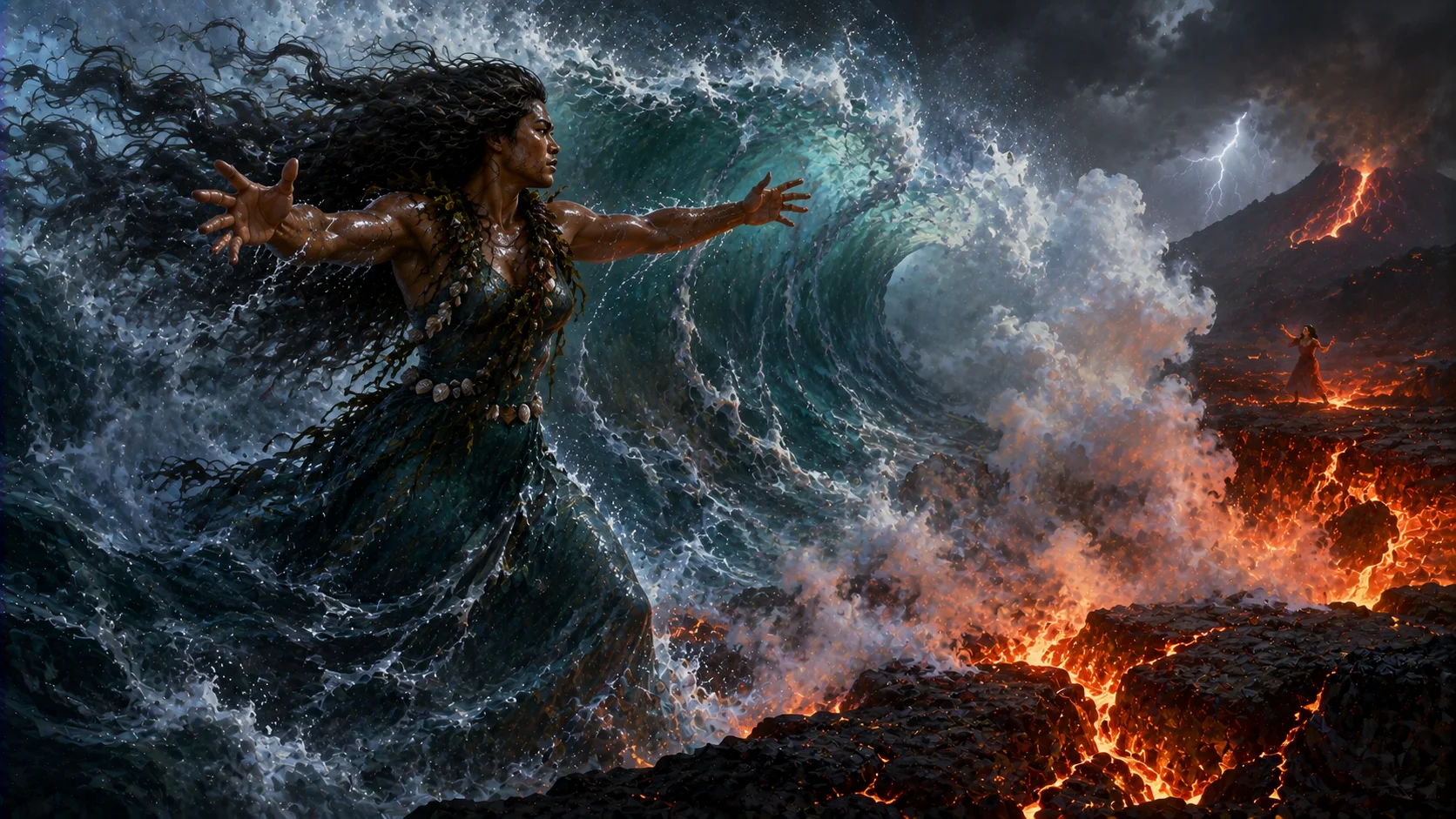
Namakaokaha'i, known simply as Namaka, is the great sea-goddess of Hawaiian tradition — a deity of tides, currents, and the cold, patient power of the ocean. She is remembered above all as the elder sister and rival of Pele, the volcano goddess, and their mythic conflict is one of the most enduring stories in Hawaiian oral tradition, a living explanation for the very shape of the land where black lava meets white surf.
Daughter of the Earth-Mother's House
In the genealogies (mo'okuauhau) that Hawaiian families once recited to root themselves in place and lineage, Namaka is counted among the many children said to descend from Haumea, the fertility goddess and ancestral matriarch whose line produced some of the most consequential akua in the islands. Where Haumea is associated with renewal, childbirth, and the deep generative power of the earth, her offspring divide the natural world between them — fire below the surface, water above and around it. Namaka's domain is the ocean in its full range: the shallow reef water where fishermen wade, the deep blue channels between islands, and the raw open sea that voyagers crossed to reach Hawai'i at all.
Some tellings identify Haumea with Papahanaumoku, the earth-mother figure whose union with the sky father Wakea stands at the center of Hawaiian creation genealogy. Whichever thread of the mo'okuauhau a family followed, Namaka's place in it was the same: elder sister, keeper of the sea, and rival of Pele.
Sisters and Rivals
Namaka's seniority over Pele is remembered as part of what defines their relationship: she is consistently described as an older sister, and Pele as the younger. Tradition frames the two as rivals, their opposition standing in for a wider pattern of forces held apart from one another — the sea keeping the fire in check, the fire never fully able to escape the sea's reach. Beyond the fact of the sisterhood and the rivalry itself, Hawaiian oral tradition does not fix a single detailed account of Namaka's temperament or of how the sisters treated one another day to day; what endures is the elemental contrast the relationship is used to express: water against fire, ocean against volcano.
The Quarrel That Set the Sisters Apart
Hawaiian tradition gives the falling-out between the sisters a human cause: a dispute over a lover. In some versions of the story, the contested figure is Aukelenuiaiku, a hero-voyager whose presence divided the sisters' loyalties and pride. Whatever the precise cause in any given telling, the rupture between Namaka and Pele was total and lasting. It transformed two sisters from the same divine house into adversaries whose confrontation would be re-enacted, in the physical world, every time the island grew.
This is characteristic of how Hawaiian myth works: a domestic wound — jealousy, betrayal, wounded pride between kin — becomes the hidden mechanism behind a landscape-scale phenomenon. The sisters' quarrel is not merely a backstory decoration; it is offered as the actual reason the natural world behaves as it does.
Pele's Journey and Namaka's Sea
Hawaiian tradition holds that Pele journeyed to the Hawaiian archipelago from a distant, mythic homeland called Kahiki, digging fire pits across the island chain before finally settling at Kilauea on the island of Hawai'i. Separately, the ongoing conflict between Namaka and Pele is the story oral tradition uses to explain a visible feature of the land: the pattern of molten lava meeting, and being cooled by, the ocean along Hawai'i Island's coastlines. The two threads — Pele's journey of fire pits, and the sisters' rivalry as an explanation for lava meeting sea — are both part of the wider Pele tradition, though they are not typically told as a single continuous chase narrative in which Namaka pursues Pele from crater to crater.
Kilauea, Pele's Home
Pele is said to reside in Halema'uma'u crater at the summit of Kilauea, on the island of Hawai'i — the place where, by tradition, her fire pit-digging journey from Kahiki ended and her flame endured. Pele herself is remembered as one of the most widely worshipped deities in modern Hawaiian religion, and Kilauea is understood in Hawaiian religious life as her home and the seat of her presence to this day.
Where Lava Meets the Sea
The enduring cultural function of the Namaka–Pele conflict is etiological — it explains a visible feature of the land. Along the coastlines of Hawai'i Island, molten lava flowing from Kilauea regularly reaches the ocean, where it meets seawater in violent, steaming collisions that harden instantly into black rock. Generations of Hawaiians who watched this happen, and who watch it still, have understood it through the sisters' ongoing rivalry: Pele's fire pushing outward and downward toward the sea, Namaka's water rushing in to cool and claim whatever reaches her boundary.
This is not a story treated as settled in some distant past. Every new lava delta that steams and collapses at the shoreline, every acre of new black-sand coastline created where flow meets surf, is understood within this tradition as a continuation of the same rivalry — a way the myth still describes something true about the living land.
Fire and Water as a Larger Pattern
The antagonism between Namaka and Pele sits inside a broader Hawaiian pattern of paired, complementary — and sometimes opposed — elemental forces. Kane and Kanaloa, for instance, are frequently paired throughout Hawaiian mythology as gods of fresh water and salt water, order and adventure, traveling together and striking the earth to bring forth springs. Namaka and Pele echo that structural logic from the opposite direction: instead of two forces cooperating, they are two forces in ongoing contest, water against fire, ocean against volcano. Together, these paired and opposed deities describe a cosmos organized around elemental balance, where no single force — however immense — goes unchecked by another.
A Rivalry Without Resolution
Unlike myths that end in reconciliation or a decisive victor, the Namaka–Pele story is told as an open, ongoing state. Neither sister destroys the other. What the tradition preserves instead is a kind of standoff that produces the coastline itself as its visible residue. This unresolved quality is part of what has kept the story alive and retold: it does not require an ending, because the phenomenon it explains has none. As long as Kilauea erupts and lava reaches the Pacific, the sisters' contest is, in a sense, still being told through the land.
Namaka Beside Pele's Wider Family
Namaka's rivalry with Pele stands apart from the more famous devotion within Pele's household — particularly the bond between Pele and her youngest sister, Hi'iaka, who is remembered for her long journey to fetch Pele's lover Lohiau and for bringing the first hula to the beach at Ha'ena. Where Hi'iaka's stories are ones of loyalty and eventual reconciliation despite hardship, Namaka's story is defined by lasting opposition. Together they frame a range within Pele's family: one sister who ultimately stands by her despite conflict, and one sister remembered chiefly as her rival. Pele's other notable adversary, the shapeshifting demigod Kamapua'a, offers a third variation again — a stormy, romantic-and-adversarial relationship whose battles are said to explain the alternating bands of fertile and barren land across Hawai'i Island, much as Namaka and Pele's rivalry is used to explain the coastline.
The Sea as Guardian and Adversary
It is worth holding two ideas about the Hawaiian ocean together, because Namaka embodies both. The sea in Hawaiian belief is not only a place of contest; it is also, through the 'aumakua tradition, a source of protection — ancestral guardian spirits often take the form of sharks and other sea creatures, watching over descendants and guiding fishermen home safely. Namaka's role as guardian of the ocean's boundary against her sister's fire sits alongside this same protective character of the sea in Hawaiian belief, even as the two figures are remembered chiefly as rivals rather than as a single unified portrait of Namaka's own temperament.
A Story the Land Keeps Telling
What distinguishes Namaka's place in Hawaiian tradition is how directly her myth remains legible in the physical world. Visitors to Hawai'i Island can still watch, on days when Kilauea is active, molten rock reach the Pacific and turn to steam and stone in real time — the same elemental contest the old stories describe, playing out on the same coastline, in the same terms. For Native Hawaiians, this has never been a metaphor read backward onto geology; it is understood as the geology itself continuing to narrate the relationship between two sisters whose rivalry, by tradition, stands behind the meeting of fire and sea. Namaka endures in that telling not as fire's defeated opponent, but as the sea that fire has never managed to outlast.
Sources & traditions
- EncyclopediaWikipedia — Nāmaka
- TraditionHawaiian texts, oral tradition and village tellings
Myths change from area to area and from time to time. This chronicle follows the most widely told versions; tellings in other villages, regions and eras may differ.