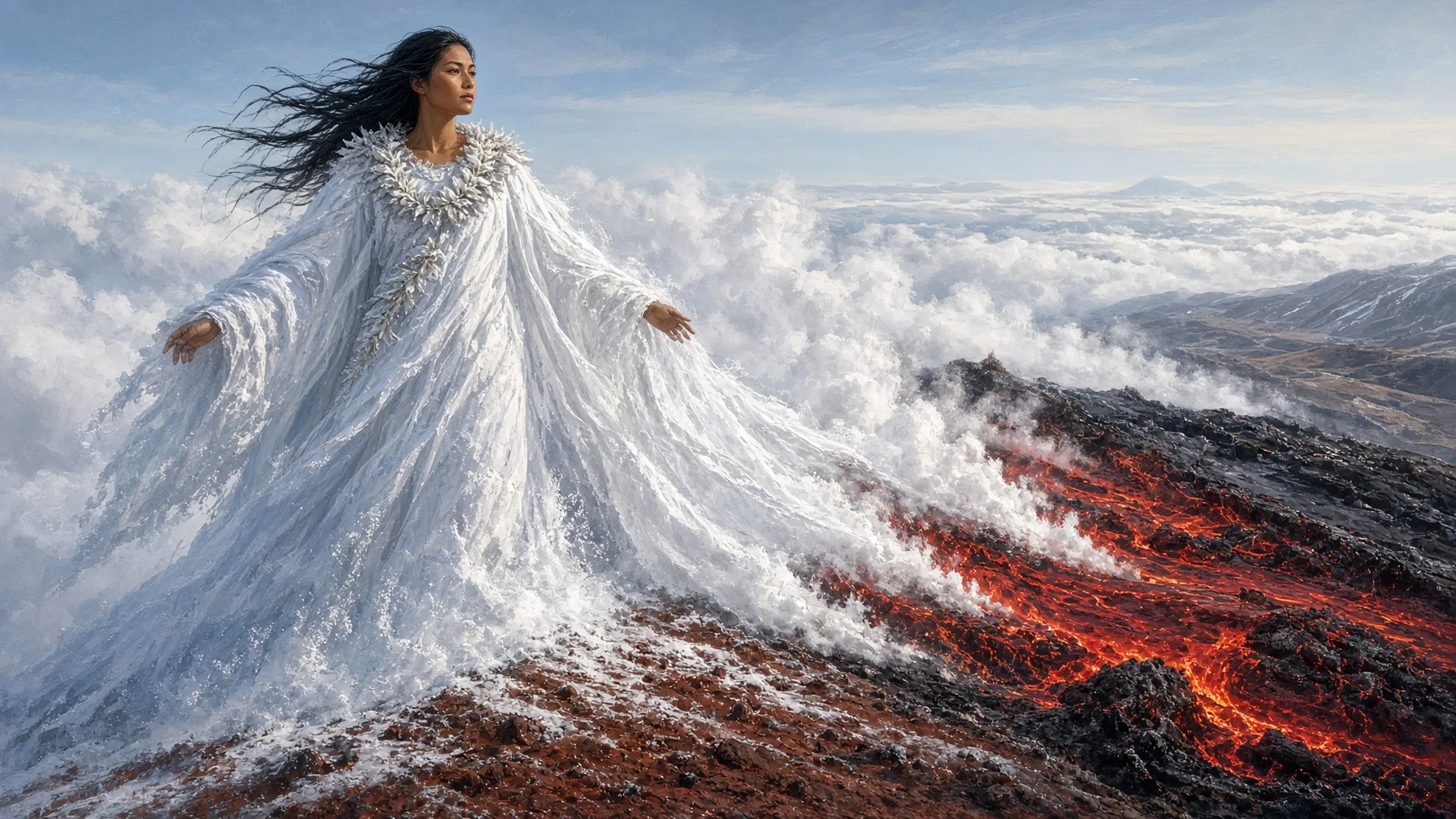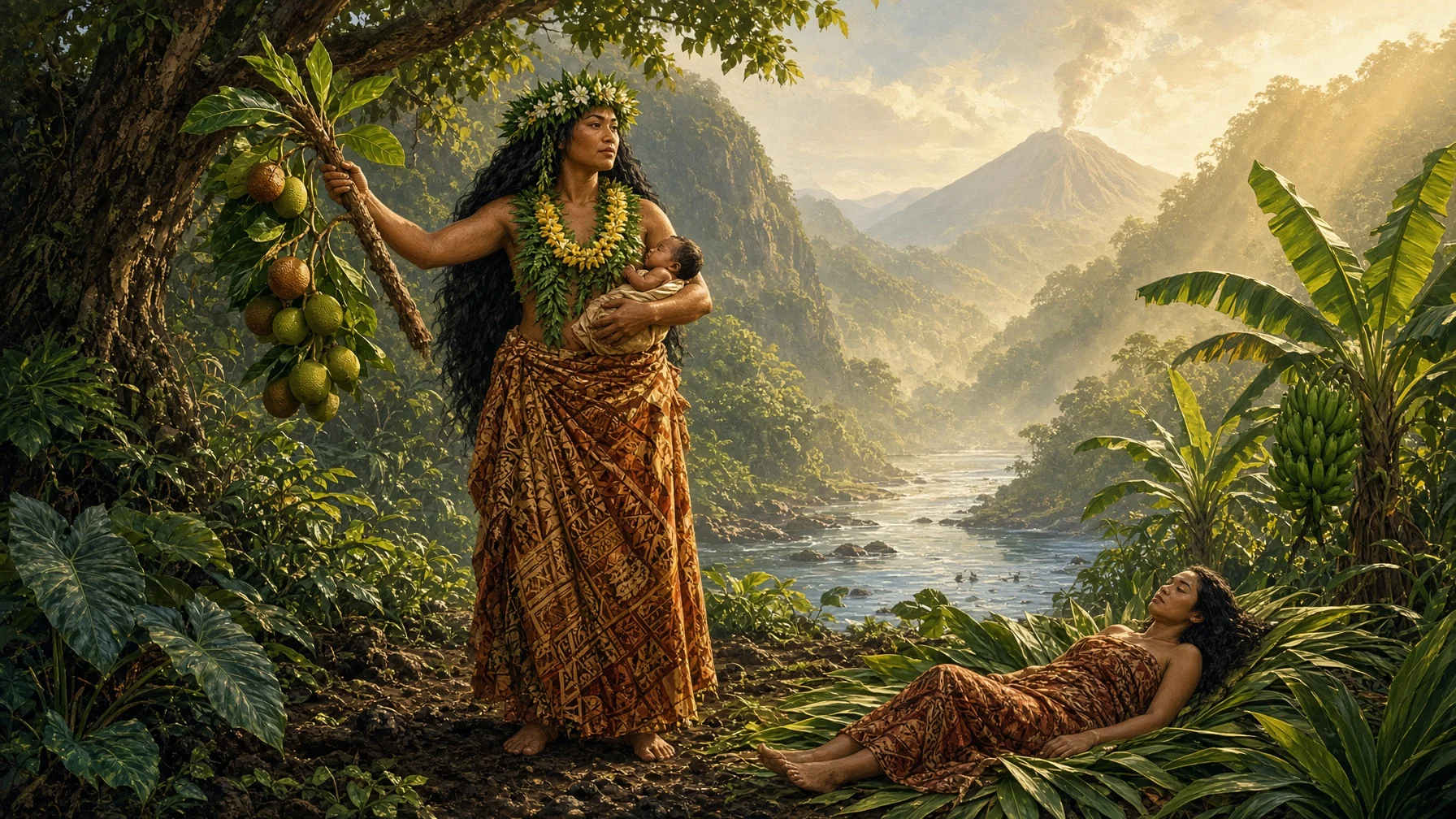
Haumea stands among the oldest and most far-reaching of the akua in Hawaiian tradition: an earth-mother and goddess of fertility and childbirth whose descendants populate the volcanic and mythic landscape of the islands. She is frequently identified with Papahanaumoku, the earth-mother figure whose union with the sky father Wakea is remembered in the great genealogical chants as the origin of the Hawaiian Islands themselves. To speak of Haumea is to speak of beginnings — of the long chain of birth, land, and lineage that Hawaiian genealogy holds sacred, and that many Hawaiian families still trace today with care and reverence.
The Womb from Which Islands and Gods Arose
In the chant traditions that carry Hawaiian cosmogony forward, Haumea is honored as the mother goddess whose body and spirit are bound to the land itself. She is not merely a deity who exists alongside the earth; in her identification with Papahanaumoku she becomes an expression of the earth's own generative power — the ground from which islands, plants, and people are said to spring. This layering of goddess and land is central to understanding her place in the pantheon: Haumea is birth in its most expansive sense, encompassing not only human childbirth but the birth of the world.
The union remembered between Wakea and Papa is credited with bringing forth the islands, beginning with Hawai'i island, as well as the first taro plant and the first human ancestor. These genealogical claims are not treated as distant folklore by the communities who carry them; they are living chants, recited and protected, that root a people's identity directly in the land beneath their feet.
Mother of Pele and Her Siblings
Among Haumea's most celebrated children is Pele, the volcano goddess whose fire and temperament shape so much of Hawaiian storytelling. Alongside Pele, tradition names Hi'iaka, Kamohoali'i, and Namaka, a sea deity, among Haumea's many children. Haumea's motherhood extends still further, into an entire family of deities whose separate stories fill out the wider mythic landscape of the islands.
This vast lineage is significant beyond its size. It positions Haumea as a kind of originating trunk from which many of the island chain's most vivid personalities branch outward, all traced back to a single generative mother. Genealogy of this kind carries weight in Hawaiian tradition that reaches well past myth-telling; it is a structure for understanding kinship among natural forces themselves.
Another Daughter: Kapo of the Sorcerers
Tradition also names Kapo, or Kapo'ulakina'u, as a daughter of Haumea and, in some genealogies, a sister to Pele and Hi'iaka. Kapo is remembered as a goddess of sorcery, fertility, and healing — a figure invoked in kahuna 'ana'ana practices for her power to both harm and heal, and honored as a patroness of hula alongside her association with the sacred maile plant. One of the most striking episodes attached to her involves a detachable, flying body part she used as a decoy to distract the boar-god Kamapua'a and rescue Pele from his pursuit, a story tied to a specific place name on O'ahu. Even in her most startling myths, Kapo's role folds back into the same family concern that runs through Haumea's whole line: protection, fertility, and the safeguarding of kin.
Endless Renewal: The Goddess Who Remains Young
Few aspects of Haumea's character are as distinctive as her repeated renewal of her own youth. Hawaiian tradition describes her taking younger husbands across generations, each union a fresh assertion of vitality rather than a break from what came before. This is not framed as vanity or evasion of age; it is framed as regeneration, a divine capacity to remain a wellspring of life across long stretches of time. For a goddess whose very identity is bound to childbirth and the ongoing fertility of the land, the ability to renew herself is less a personal trait than a natural extension of what she represents — the earth does not simply age and fade, it renews itself season upon season, birth upon birth.
This theme of rejuvenation gives Haumea a temporal depth unlike many other figures in the pantheon. She is simultaneously the ancient point of origin for a sprawling genealogy and a perpetually youthful presence, folding the beginning of time and its constant renewal into a single figure.
Goddess of Childbirth
Haumea's core identity in Hawaiian tradition is as goddess of childbirth and fertility, a role bound up with her standing as mother goddess and earth goddess. Her domain here is intimate rather than cosmic: not only the sweeping generative power identified with the earth itself, but the fact of birth as a recurring, defining act attached to her name. That the same figure governs both scales — the birth of land, through her identification with Papa, and the birth of children — reflects how tightly Hawaiian tradition weaves fertility, motherhood, and the generative land together in a single goddess, though the surviving accounts do not detail specific birth rites or invocations addressed to her.
Haumea and the Wider Family of Creation
Haumea's story does not stand apart from the other great genealogical threads of Hawaiian cosmogony. The union of Wakea and Papa is remembered elsewhere as producing Ho'ohokukalani, whose stillborn child became the first taro plant, and whose second child became Haloa, the first Hawaiian person — establishing taro as an elder sibling deserving of care and respect. Whether approached through Haumea's identification with Papa or through the parallel chant lines that name Wakea and Papa directly, the throughline is the same: land, plant, and person emerge from one continuous act of birth, and every generation since has been asked to honor that continuity.
This is part of why genealogy chants like the Kumulipo are treated with such care by those who maintain them. They are not simply origin stories told for entertainment; they are living records of descent that tie a family, and indeed a whole people, back to the earth-mother herself.
A Presence Felt Rather Than Housed
Unlike deities honored through elaborate temple structures and public ritual, Haumea's presence is felt most directly through the land's own fertility — the growth of plants, and the enduring productivity of the earth. Her worship is less about a single site of pilgrimage than about an ongoing relationship with the generative capacity of the natural world. In this she shares something with other Hawaiian akua whose truest shrine is the phenomenon itself rather than a carved image: just as fresh water is held to be a living manifestation of the god Kane, the fruitful, renewing earth can be understood as Haumea's own continuing expression.
A Goddess Woven Into 'Ohana and 'Aumakua Traditions
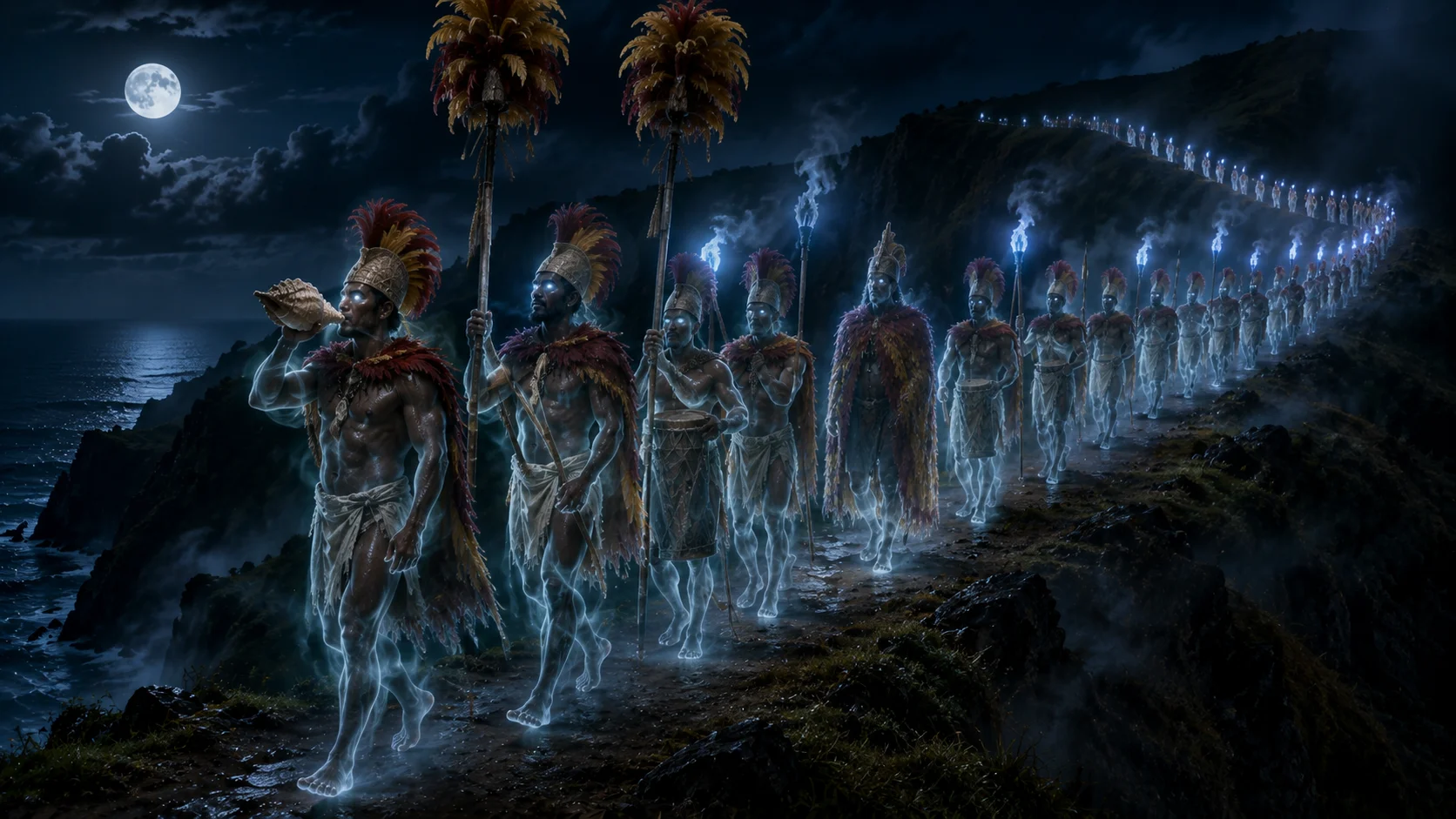
The broader Hawaiian spiritual framework surrounding ancestral guardianship, embodied in the 'aumakua — family guardian spirits who might take the form of sharks, owls, sea turtles, or eels — sits naturally alongside a genealogy that begins with Haumea. Families who trace their line back through this vast web of birth are not engaging in abstract mythology; they are situating themselves within a living system of kinship that includes both human ancestors and the natural and divine forms their forebears might take. Haumea, as an originating mother of so many of these forms, anchors that system at its root.
Approaching Haumea's Traditions with Care
These genealogies and birth-narratives remain part of a living tradition, carried forward by Hawaiian families, cultural practitioners, and chant-keepers today, not relics of a closed past. Accounts of Haumea's children, her renewals, and her place beside Wakea and Papa vary between sources and lineages, reflecting the same diversity found across island communities and chant traditions more broadly. Engaging with her story calls for the same respect owed to any living indigenous tradition: an acknowledgment that these are sacred narratives actively maintained by the people whose ancestry they describe, not simply colorful tales detached from the community that holds them.
The Enduring Shape of a Mother Goddess
Taken together, Haumea's mythology presents a figure of extraordinary scope: mother of the volcano goddess Pele and her siblings, mother of the sorceress-healer Kapo, a goddess identified with the very earth from which the islands and their first inhabitants emerged, and a being who renews her own youth without end. She threads together the cosmic and the intimate, the birth of land and the birth of a child, in a single continuous act of creation. In the genealogies that name her, Haumea is less a distant origin point than a constantly renewing source — the mother goddess whose story, and whose descendants, continue to shape how the Hawaiian Islands understand their own beginning.
Sources & traditions
- EncyclopediaWikipedia — Haumea
- TraditionHawaiian texts, oral tradition and village tellings
Myths change from area to area and from time to time. This chronicle follows the most widely told versions; tellings in other villages, regions and eras may differ.