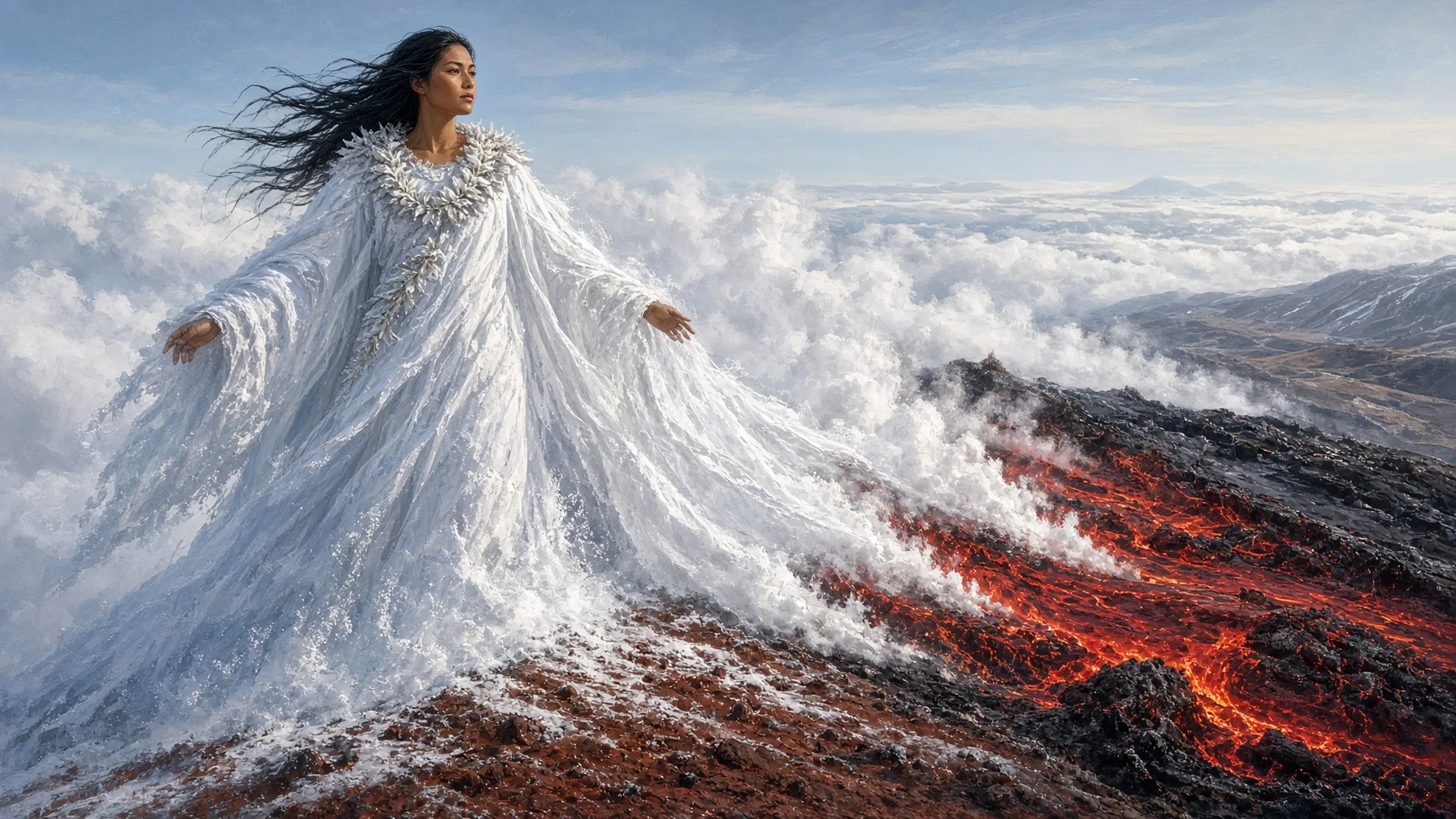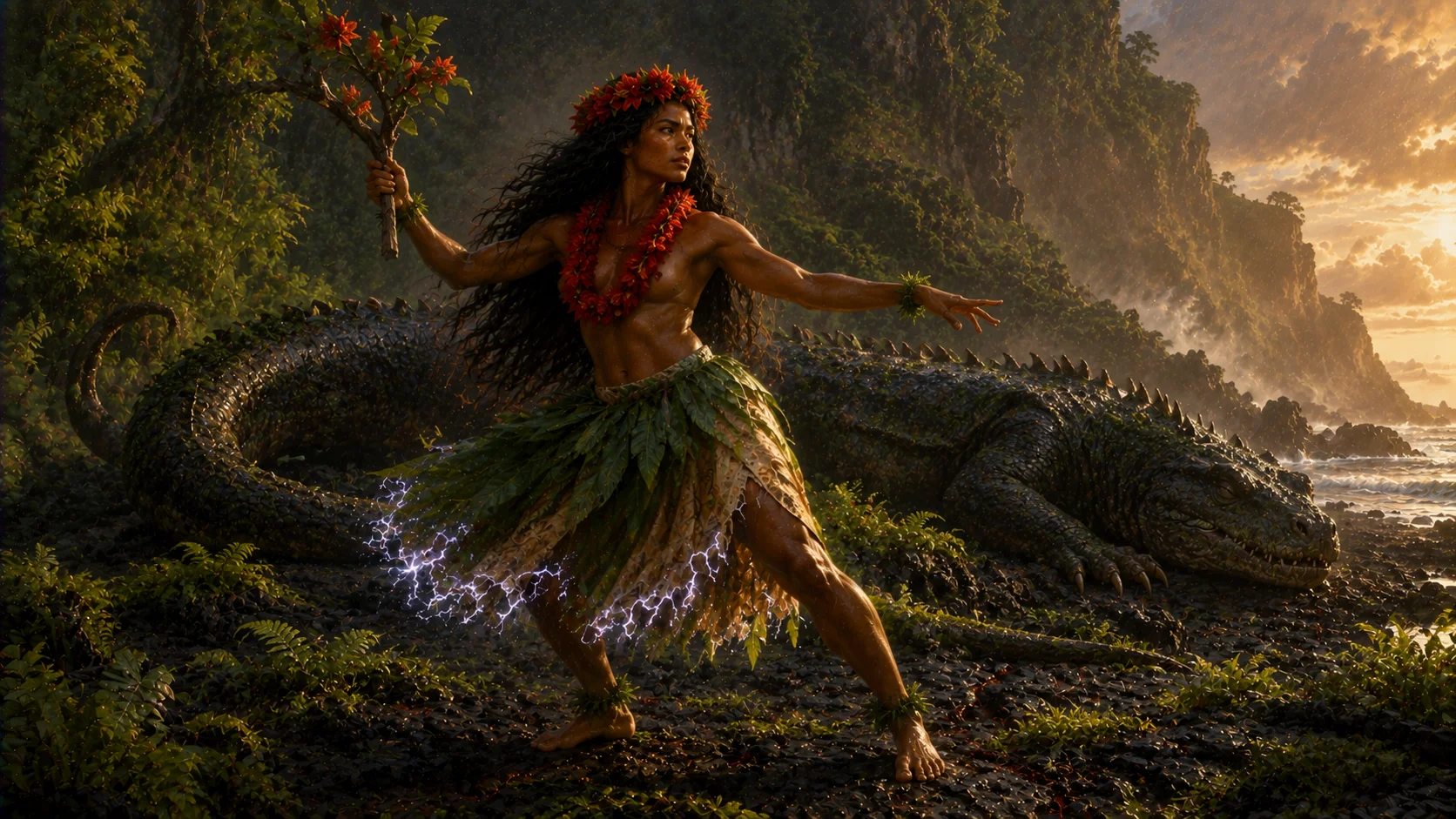
Hi'iaka, more fully Hi'iakaikapoliopele—"Hi'iaka in the bosom of Pele"—is the akua of hula, herbal healing, and sorcery in Hawaiian tradition, the beloved youngest sister of the volcano goddess Pele. She is remembered above all for one great labor: the journey across the island chain to fetch Pele's mortal lover, the chief Lohiau, from Kaua'i and bring him back to Kilauea. That journey, told and retold in chant, forms one of the longest and most treasured narrative cycles in Hawaiian oral literature.
Pele's Favorite Sister
Hi'iaka is remembered as Pele's youngest and most favored sister, set apart among her siblings by her gifts of hula, herbal healing, and sorcery. This closeness is inseparable from the great genealogical web the family belongs to: many traditions trace Pele, Hi'iaka, and their many siblings back to Haumea, the earth-mother figure and fertility goddess whose descendants populate so much of the Hawaiian pantheon.
Among her sisters, Hi'iaka occupies a distinct and gentler province. Where Pele commands fire and the raw upheaval of the volcano, Hi'iaka is goddess of hula, of healing herbs, and of sorcery—powers that mark her as fundamentally different in kind from her fire-wielding sister, even as the two remain devoted to one another. She is remembered as a patroness of hula dancers, and tradition holds that she performed the very first hula on the beach at Ha'ena to appease Pele's temper. That single act of dance is often cited as the sacred origin point of the art form itself, which is why hula practitioners have long counted Hi'iaka among their guardian spirits.
A Sister Among Rivals
Pele's family is large and often fractious, and Hi'iaka's closeness to her sister stands in pointed contrast to the enmity between Pele and Namaka, the sea goddess also known as Namakaokaha'i. Namaka and Pele's rivalry, rooted in a contested lover, is remembered in tradition as the mythic explanation for the endless contest along Hawai'i Island's shorelines, where molten lava meets and is cooled by the ocean. Hi'iaka's devotion to Pele placed her, at least for a time, on the opposite side of that family conflict—loyal to the fire that Namaka's sea sought endlessly to quench.
It is worth setting Hi'iaka's story against the wider architecture of the akua she moves among. Kane, Kanaloa, Ku, and Lono stand as the four major gods invoked in daily prayer, presiding respectively over creation and fresh water, the ocean and voyaging, war and male power, and agriculture and peace. Pele and her siblings belong to a different, more intimate register of belief—deities of place and family, bound to specific craters, shorelines, and forests, whose stories are carried less through formal daily invocation than through genealogical chant and the hula itself. Hi'iaka's tale sits at the very center of that second tradition.
The Vow to Fetch Lohiau
The great cycle begins with Pele. In one of the recurring devices of this mythology, Pele's human form is said to travel in spirit while her body rests at Kilauea—a device Hawaiian tradition uses to explain why Pele so often sends her sister Hi'iaka on physical journeys on her behalf. On one such spirit-journey, Pele fell in love with a handsome young chief of Kaua'i named Lohiau. Unable to leave her body and her volcanic duties to go herself, she turned to Hi'iaka, her youngest and most capable sister, and asked her to travel the length of the island chain to Kaua'i, find Lohiau, and escort him safely to Kilauea.
Hi'iaka agreed, but tradition remembers her setting conditions before she left, extracting a promise from Pele that her sister would look after what Hi'iaka held dear during her absence and would not act against Lohiau while the journey was underway. Pele agreed, though the audience for this chant cycle has always understood that such promises, in myths about a volcano goddess, rarely survive contact with jealousy and time.
The Long Road Across the Islands
What follows is an odyssey. Hi'iaka's path took her across island after island, and tradition remembers her meeting and overcoming hostile forces along the way, each encounter tackled with her own considerable powers of chant, herbal knowledge, and command over supernatural forces. Her skill with healing plants proved as essential as her sorcery: the same botanical knowledge that makes her a patroness of herbal medicine let her treat wounds, break curses, and press on where a lesser traveler could not.
The journey across the archipelago doubled, in the way of these chant-cycles, as a kind of moving map of the islands themselves—each headland, pool, and grove named and sanctified by what happened there, so that reciting the Hi'iaka cycle in full is also a way of reciting the geography of Hawai'i.
Finding Lohiau
When Hi'iaka reached Kaua'i, she found Lohiau and, as her sister had asked, undertook to bring him back to Kilauea. With Lohiau in her company, Hi'iaka began the long return journey, retracing much of her outbound path and growing closer to the chief through the shared hardship of travel in a way that would prove fateful.
Pele's Broken Promise
While Hi'iaka labored on Pele's behalf, Pele's patience curdled into suspicion. Watching from Kilauea and growing convinced—rightly or not, depending on the telling—that her sister and Lohiau had grown too close during the long journey, Pele broke the very promise she had made before Hi'iaka set out, turning against what she had sworn to protect. It was an act of betrayal that Hi'iaka discovered only upon her return to the rim of Kilauea with Lohiau beside her.
Love, Grief, and Fire
Wounded by her sister's betrayal, Hi'iaka acted in a way the chant tradition treats as both an act of defiance and a natural consequence of what Pele had already done: she turned to Lohiau herself, a deliberate answer to the promise Pele had failed to keep. The tragedy that follows is central to the cycle: Pele's jealousy and Hi'iaka's grief play out against one another, each sister wronged and wronging in turn, in a story so central to hula performance that it has been elaborated, varied, and re-told by generations of chanters across the islands.
Hawaiian tradition treats both sisters as sympathetic figures rather than as simple villain and victim—Pele's jealousy answering Hi'iaka's initial devotion, and Hi'iaka's grief answering Pele's cruelty. As with much of Hawaiian mo'olelo, different islands, families, and hula lineages preserve their own versions of exactly how the cycle resolves, and no single retelling should be treated as the sole authoritative text.
Guardian of Hula and Green Growing Things
Beyond the Lohiau cycle, Hi'iaka's enduring identity in Hawaiian religious life is as a goddess of hula, healing herbs, and sorcery. Where her sister presides over fire and the volcano's upheaval, Hi'iaka presides over the living, growing world—forest groves, healing plants, and the chant that carries prayer. This is part of why the two sisters, despite the tragedy between them, are so often invoked together: fire and the green life associated with Hi'iaka are understood as complementary rather than simply opposed.
Practitioners of hula have long honored Hi'iaka as a patron spirit of the art, tracing the dance's sacred origin to that first performance on the beach at Ha'ena. Her mastery of medicinal plants likewise anchors her place among healers, who look to her command of herbal knowledge as a model for the careful, respectful use of the forest's resources in treating the sick.
A Story That Belongs to a Living Tradition
The Pele and Hi'iaka cycle is not a fossil narrative confined to old chant books; it remains part of a living body of Hawaiian oral literature, performed, taught, and reinterpreted by hula practitioners and cultural tradition-bearers today. As with much of Hawaiian mo'olelo, different islands, families, and hula lineages preserve their own versions of specific episodes, and no single retelling should be treated as the sole authoritative text. The account here reflects the widely shared shape of the saga—the vow, the journey, the fetching of Lohiau, the broken promise, and the tragedy that follows—while leaving room for the many local variations that different communities continue to hold as their own.
Read alongside the wider family history that connects Pele, Hi'iaka, and their siblings back to Haumea, and against the backdrop of a pantheon that also includes the four great gods of daily invocation, Hi'iaka's story stands out for its intimacy. It is a tale less of cosmic order than of sisterhood, promise, and betrayal—a journey undertaken out of love that ends, as the volcano so often insists its stories must, in fire.
Sources & traditions
- EncyclopediaWikipedia — Hiʻiaka
- TraditionHawaiian texts, oral tradition and village tellings
Myths change from area to area and from time to time. This chronicle follows the most widely told versions; tellings in other villages, regions and eras may differ.