Lono stands among the four great akua of the Hawaiian pantheon, honored alongside Kane, Kanaloa, and Ku as one of the foundational forces that shape the islands and the lives lived upon them. Where Ku's many kino lau reach toward conquest, toolmaking, and the sharp edges of survival, Lono's domain is the soft work of the world: the rain that swells the taro patch, the wind that carries clouds over the uplands, the music that rises at a gathering, and the peace that lets a harvest be brought in without fear. He is a god of return and renewal rather than domination, and each year his presence is not merely remembered but re-enacted, carried bodily across the land in a season that reorders the rhythm of Hawaiian life.
A God Who Governs the Rains
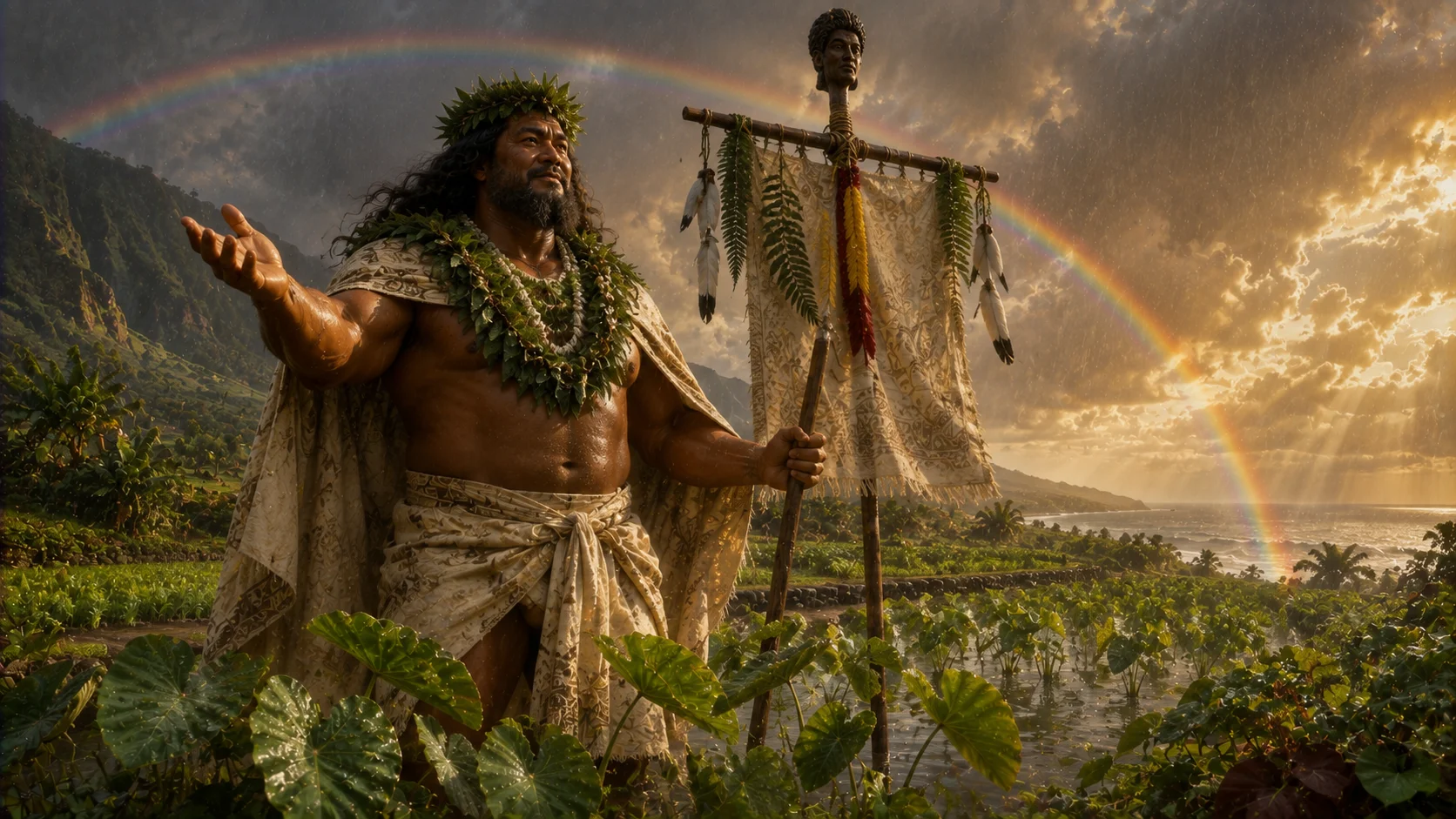
Lono's authority begins in the sky. He is petitioned for rainfall, and by extension for everything rain makes possible — the swelling of kalo in the lo'i, the ripening of 'uala on the hillside, the green flush that follows a storm after a dry season. In a land where the difference between abundance and hunger often came down to whether the clouds broke over the right valley at the right time, a god whose favor could be read directly in the weather held enormous practical as well as spiritual weight. Farmers, more than warriors, kept Lono close in memory throughout the year, and his shrines were often modest agricultural markers rather than the imposing war temples built for Ku.
This same rain-bringing character extends to fertility more broadly. Lono is invoked not only for the fertility of the fields but for households and communities hoping for abundance in a fuller sense — children, food stores, and the general flourishing that a community needs to survive the leaner months. Where Haumea governs the fertility of birth itself, Lono governs the fertility of the land that must feed what is born.
The Long Season of Makahiki
Lono's most visible presence in Hawaiian life came through the Makahiki, an extended festival season running roughly from October through February, timed to the agricultural and astronomical calendar. For these months, ordinary time was suspended in a very literal sense: warfare was forbidden across the islands, the usual kapu structures eased, and communities turned toward feasting, sport, dance, and tribute rather than conflict. It was, in effect, a sanctioned truce written into the yearly calendar and placed under Lono's protection — a season in which the god of peace, rather than the god of war, held authority over the islands.
The suspension of warfare during Makahiki was not incidental to the festival; it was close to its purpose. A society organized substantially around chiefly rivalry and periodic conflict built into its own calendar a guaranteed stretch of months in which fields could be tended, debts of tribute settled, and community bonds renewed without the disruption of war. That such a structure existed and was widely observed says a great deal about how central Lono's peaceful character was to Hawaiian social order, not merely to private devotion.
The Akua Loa and Its Long Circuit
Central to the Makahiki observances was the akua loa, an image of Lono built as a long wooden pole crowned with a carved head and hung with kapa cloth and feather streamers that moved in the wind as it traveled. This image was carried in procession clockwise around the perimeter of each island, following the ahupua'a land divisions that ran from mountain to sea. As it passed through each district, local chiefs and communities were expected to present ho'okupu — tribute in the form of food, cloth, and other goods — acknowledging both Lono's provision over the past year and the chief's obligation to the wider social order.
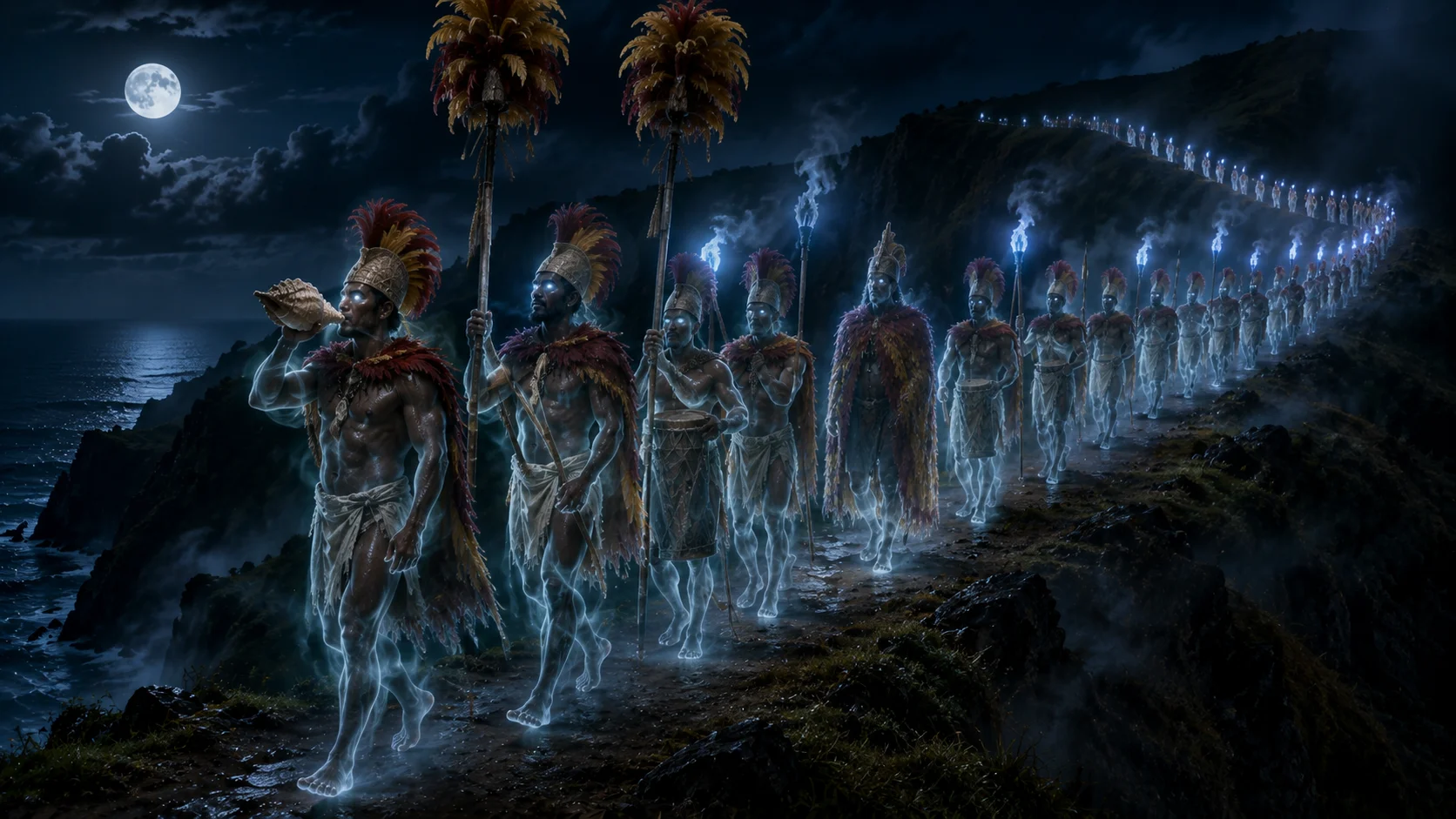
The circuit of the akua loa was not a brief ceremony but a sustained, months-long procession, and its clockwise path around the island carried its own symbolic weight, tracing the boundary of the land under Lono's seasonal authority before returning the god's image to the sea at the festival's end. The collection of tribute along the way functioned simultaneously as religious observance, a census of agricultural productivity, and a redistribution mechanism that reinforced the standing of chiefs who honored the god properly.
Sails on the Horizon: Cook at Kealakekua Bay
No episode in Lono's later history is as widely discussed as the arrival of Captain James Cook's ships at Kealakekua Bay in January 1779 — a moment that fell, by chance or not, squarely within the Makahiki season. Accounts describe some Hawaiians reportedly associating the shape of the ships' sails, and the timing of their arrival, with Lono and the expectations of his seasonal return.
How literally any of this was intended — whether Cook was received as a manifestation of Lono himself, or whether later tellings (both Hawaiian and European) shaped the story into something more absolute than it was at the time — has been the subject of real scholarly disagreement. The exchange between Marshall Sahlins and Gananath Obeyesekere over exactly this question became one of the more closely argued debates in the anthropology of the Pacific, with Sahlins arguing that Hawaiian cultural structure genuinely shaped the reception of Cook along Lono's lines, and Obeyesekere countering that much of the "worship as a god" framing reflects European projection more than Hawaiian belief. The episode is worth holding with that complexity intact rather than flattening it into a simple legend in either direction. Cook's return to the island soon afterwards, outside the Makahiki season, and his death there in February 1779 after a dispute over a stolen boat belong to the historical record of his voyage rather than to Lono's own story.
Lono Beside Ku: Two Faces of Order
Hawaiian religious life did not ask communities to choose between Lono and Ku so much as to move between them with the calendar. Ku, whose kino lau range from the war-aspect Ku-ka'ili-moku to peaceful forms governing fishing, forestry, farming, and canoe-building, presided over most of the year, including the periods when conflict between chiefdoms was a live possibility. Lono's season was the counterweight: a fixed, sanctioned interval in which the machinery of war stood down and the machinery of harvest and tribute took its place.
The contrast runs deeper than temperament. Ku-ka'ili-moku, the "snatcher of land," was the personal war god of Kamehameha I, who inherited the sacred feathered image from his uncle Kalani'opu'u and credited it with helping unify the Hawaiian Islands by 1810. Ku worship at its most severe involved human sacrifice at luakini heiau — war temples such as Pu'ukohola Heiau, built by Kamehameha I in 1791 and dedicated to Ku-ka'ili-moku — a form of devotion with no equivalent anywhere in Lono's worship, which centered on tribute, feasting, and games rather than blood offerings. This alternation reflects something important about Hawaiian cosmology more broadly — that the same society could hold a war god whose sacred image, and the sacrifices made to it, helped a single chief unify the islands, and a peace god whose annual festival demanded that warfare stop entirely, without treating these as contradictory. Order required both capacities, exercised in their proper time.
Kane, Ku, and Lono: Shapers of the First Man
Lono's standing among the major gods is reinforced by his role in one Hawaiian creation account, in which he joins Kane and Ku in forming the first man from red earth ('alaea), breathing life into the figure through its mouth, nose, and ears. That Lono stands alongside Kane — generally regarded as the highest-ranking of the major gods, associated with sunlight, fresh water, and procreation — and Ku in this originating act places him firmly among the architects of human existence rather than a secondary or purely seasonal figure. Notably, Kane himself has no formal heiau or idol worship in many traditions; rather than temples built in his name, he is worshipped in nature itself — in springs, in the sunrise, in living things — with fresh water ('wai') considered a physical manifestation of him. Fresh water and the rains Lono governs are close cousins in this cosmology: both bring life to land that would otherwise lie inert, even though one god is honored through built temples and processions and the other largely through the natural world he inhabits.
Land, Lineage, and the Wider Family of Gods
Lono's place in the harvest cycle connects him to the deeper Hawaiian understanding of the land itself as kin. The genealogical chants, central to the Kumulipo, describe Wakea, the sky father, and Papahanaumoku (Papa), the earth mother, as a paired union credited with birthing the Hawaiian Islands themselves — Hawai'i island first among their children — as well as the first taro plant and the first human ancestor. In one widely cited version, Wakea's daughter Ho'ohokukalani bore a stillborn child that became the first taro plant, named Haloa-naka, and then a second child, also named Haloa, who became the first Hawaiian person — establishing taro as an elder sibling to be respected and cared for. Lono's rains are what make that inherited obligation possible to fulfill season after season; a people bound by genealogy to the very islands and the taro that fed them needed a god whose favor could be tracked, honored, and renewed on a reliable calendar, and Makahiki provided exactly that structure.
Papahanaumoku's identification with Haumea, goddess of childbirth and fertility and mother of Pele, Hi'iaka, and many other deities, extends this web of fertility figures further still. Where Haumea's renewals are personal and bodily, described in myths of her repeatedly restoring her own youth by taking younger husbands, Lono's renewal is agricultural and collective, arriving each year at the same point in the calendar rather than at a moment of individual choice.
Rain, Boars, and the Wetter Side of the Islands
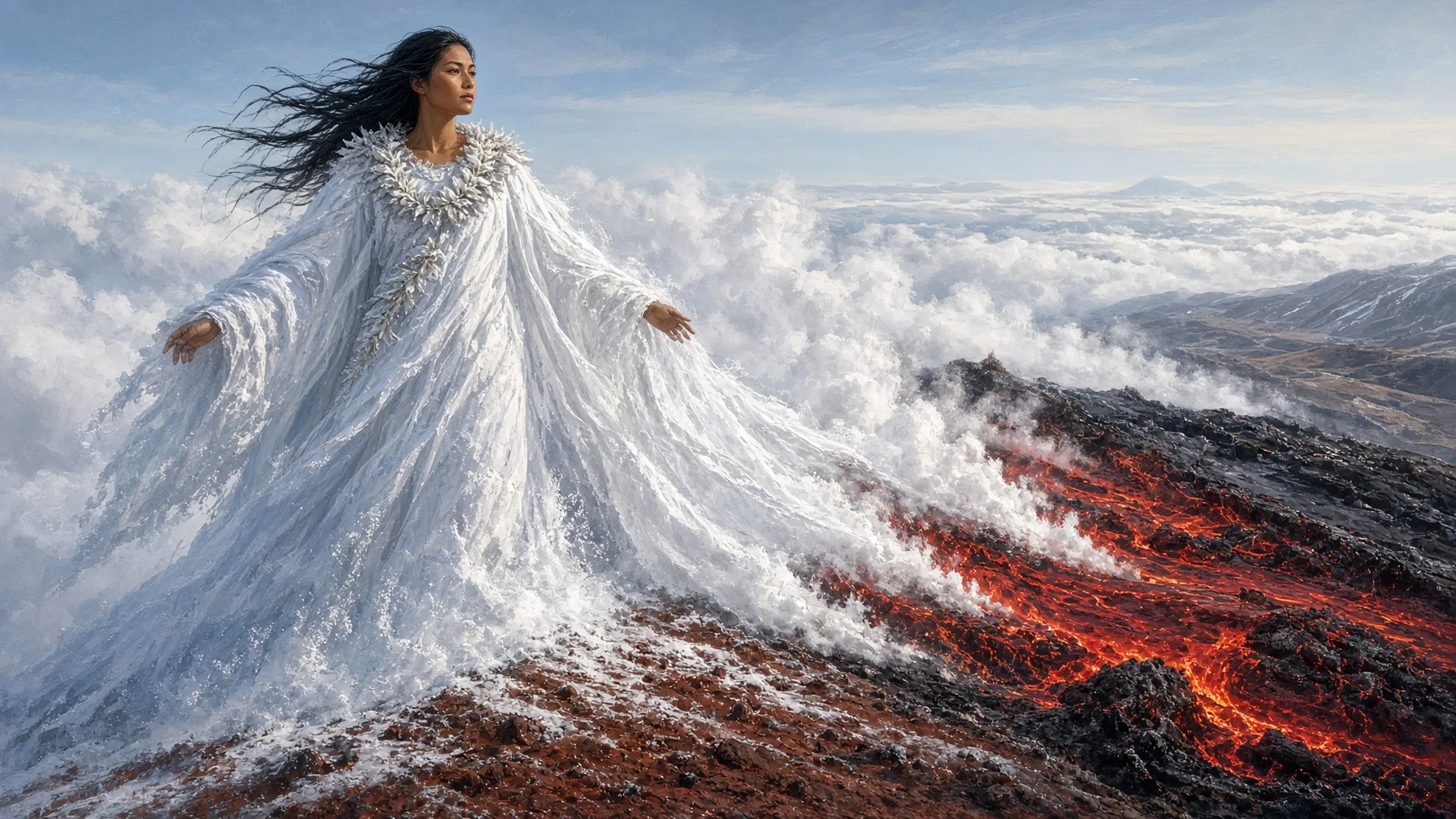
Lono's association with rain and fertility finds an unruly echo in Kamapua'a, the shapeshifting boar demigod tied to the windward, wetter regions of the islands. Kamapua'a was born to Hina and Kahikiula on Oahu, and as a boar-child he was so unruly and destructive that his own family moved to kill him; his grandmother Kamaunuaniho intervened to save his life. That origin of disorder and near-destruction sets his character apart from Lono from the start: where Lono's rain-bringing is stately and calendrical, arriving with the ordered procession of the akua loa, Kamapua'a's connection to rain and vegetation is chaotic and personal, most famously expressed through his long rivalry and adversarial romance with the fire goddess Pele — a conflict often read as an allegory of rain and green growth contending with volcanic fire for the land itself. The two figures are not identified with one another, but they occupy adjacent conceptual territory: both stand for the wet, fertile, growing side of an island landscape that also holds fire, drought, and war within it.
Household Gods and the Everyday Reach of Devotion
Beside the great seasonal drama of Makahiki, Hawaiian households maintained their own quieter religious life through 'aumakua, personal or family ancestral guardian spirits who took physical form — as sharks, owls, sea turtles, or eels — and who were believed to guide, warn, and protect their descendants. Families honored specific kapu tied to their own 'aumakua, such as never eating the species that embodied their guardian, since to do so risked offending, in effect, one's own ancestor. This layer of devotion ran alongside, rather than beneath, worship of gods like Lono: the great akua governed the shared calendar and the shared harvest, while 'aumakua watched over individual families through prayer, offerings, and the reading of dreams.
Sorcery, Healing, and the Goddess Kapo
The wider circle of deities connected to fertility and the Pele family also includes Kapo, goddess of sorcery, fertility, and healing, remembered for the striking myth of her detachable flying kohe, used as a decoy to draw Kamapua'a away from Pele — the same shapeshifting boar-god whose rain-linked fertility echoes Lono's own. Kapo's dual capacity to harm enemies through sorcery and to heal through kahuna practice, along with her patronage of hula and her association with the sacred maile plant, situates her as another figure whose power touches fertility and growth from an unexpected angle — proof of how many threads in this pantheon circle back toward the same core concerns of land, body, and abundance that Lono governs at the largest scale.
Music, Sport, and the Human Side of the Harvest God
Because Lono's season set warfare aside, Makahiki became, by necessity, a season for everything war usually crowded out: music, dance, wrestling, sledding, boxing, and competitive games held across the districts as the akua loa made its circuit. Lono's patronage of music and peace was not abstract piety but a lived, embodied experience for ordinary Hawaiians — months in which communal energy that might otherwise go toward conflict was directed instead into performance, contest, and celebration, all understood as fitting tribute to a god whose favor was, after all, what had filled the storehouses being celebrated.
A Legacy Carried Forward
Lono's story endures as a reminder that Hawaiian religious life was never organized around a single mode of power. Ku's aspects made conquest and craft possible, at a cost of sacrifice paid at temples like Pu'ukohola; Kane's presence in fresh water and sunlight sustained daily life at its most basic level without a single temple built in his name; and Lono's rains, his long-carried image, and his sanctioned season of peace ensured that the community had both the material abundance and the social breathing room to endure. The debates over how his name became entangled with a foreign captain's arrival should not overshadow the far older and more central fact: that an entire people organized months of its year, its warfare, and its labor around honoring a god of rain, harvest, and peace, and in doing so built one of the more distinctive religious calendars anywhere in the Pacific.
Sources & traditions
- EncyclopediaWikipedia — Lono
- TraditionHawaiian texts, oral tradition and village tellings
Myths change from area to area and from time to time. This chronicle follows the most widely told versions; tellings in other villages, regions and eras may differ.