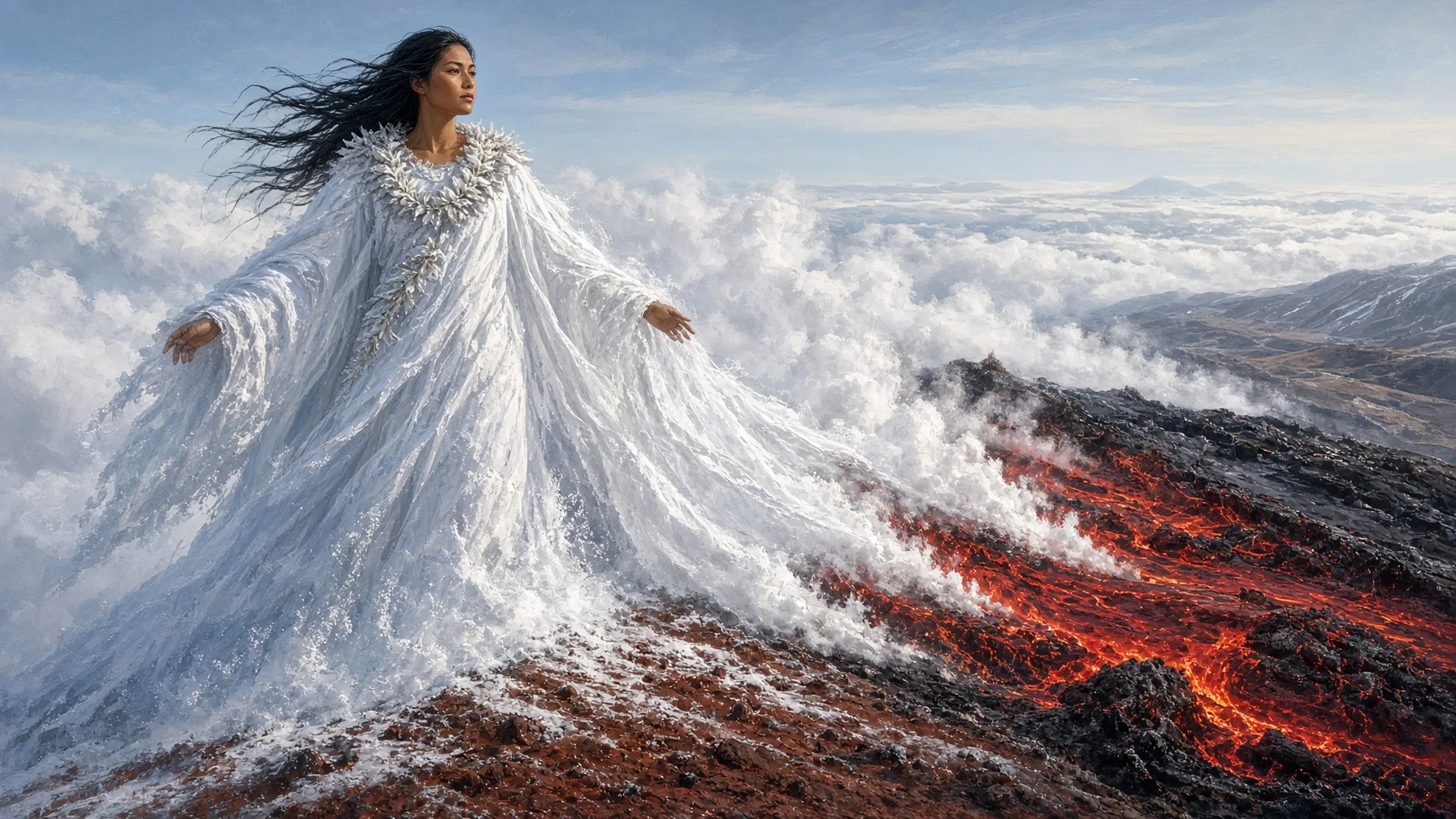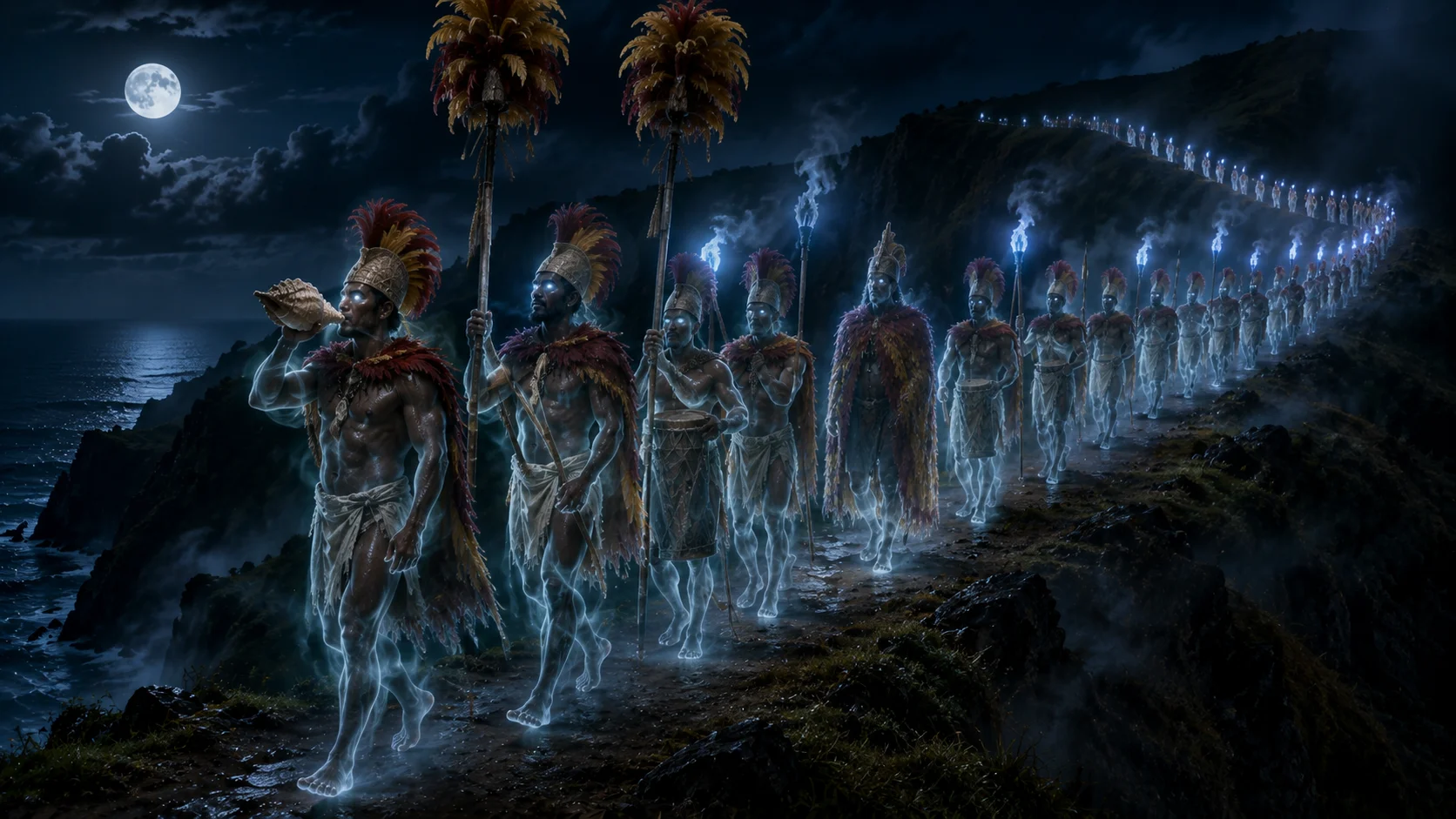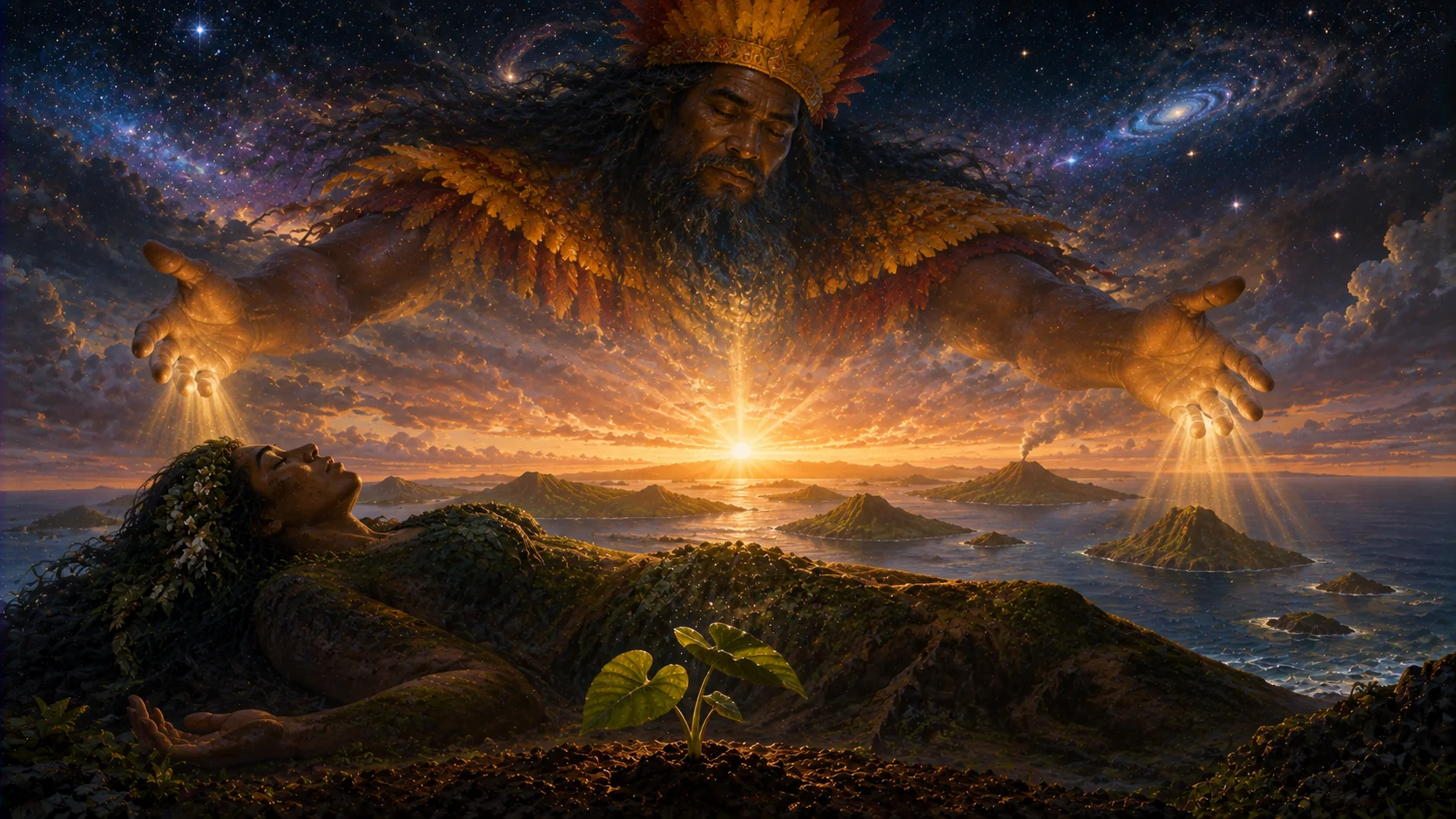
Wākea is the sky father of Hawaiian tradition, the primal husband of the earth mother Papahānaumoku. Together, in the great chant lines that carry the Hawaiian people's origins, Wākea and Papa are remembered as the ancestral pair from whom the islands themselves were born, and through whom the chiefly genealogies of Hawaiʻi trace their descent back into the world of the gods.
The Clear Sky Above
The name Wākea shares its root with the wider Polynesian word atea, meaning space, light, or the clear open sky. In the cosmology recorded by Martha Beckwith in her 1940 study Hawaiian Mythology, Wākea is the personification of that overarching sky dome, ka lani, which was understood to curve down and meet the earth at the horizon. He embodies la, day and daylight, standing in complement to Papa, whose domain is the depth and darkness of the earth itself. Together they form one of the oldest and most complete cosmic pairings in Hawaiian thought: sky and earth, light and depth, male and female, locked in a union from which all else proceeds.
A Genealogy Reaching Into the Night
Wākea does not appear at the beginning of Hawaiian cosmogony but well into it. The Kumulipo, the great creation chant translated by Queen Liliʻuokalani in 1897, traces a long unbroken line of pō, or night generations, moving through gods, plants, corals, and creatures of the sea and land before Wākea himself is born into the chant. This placement matters: it embeds the sky father within an unbroken continuum of creation rather than setting him apart from it, and it is this same chant line that Hawaiian aliʻi, high chiefs, later recited to anchor their own rank in a lineage stretching back to the birth of the cosmos.
Wākea and Papa, Sky and Earth
The union of Wākea and Papahānaumoku is remembered, in the most widespread version of the tradition, as the act that produced the Hawaiian archipelago. According to Beckwith and to Kepelino's Traditions of Hawaii (1932), the islands were born of this pairing one after another, beginning with Hawaiʻi island itself and continuing through Maui and the chain beyond. This is not offered as simple poetic metaphor within the tradition; the islands are literally genealogical offspring, children born of sky and earth, which is part of why land in Hawaiian thought is so often spoken of in terms of kinship rather than mere possession.
Some genealogical strands complicate this single tidy sequence. In certain moʻolelo recorded in the Fornander Collection of Hawaiian Antiquities and Folklore, the island of Oʻahu is instead described as the offspring of Wākea and a different wife, one of the several figures in Hawaiian tradition who carry the name Hina. Hawaiian oral literature holds many such variant threads side by side rather than resolving them into one official account, and the differences between islands, between families, and between chant lines are themselves part of the tradition's living texture rather than errors to be corrected.
The Kapu Born of Desire
One of the most consequential episodes in the Wākea moʻolelo concerns his daughter, Hoʻohōkūkalani. Wākea desired to lie with her, and rather than act openly against Papa, he is said to have instituted the practice of separating men's and women's eating and sleeping spaces, creating the private opportunity to be with Hoʻohōkūkalani without his wife's knowledge. Beckwith's account situates this episode as the etiological origin of ʻaikapu, the gender-separated eating restrictions that structured so much of traditional Hawaiian daily and religious life. In this telling, a deeply personal domestic deception becomes, on the scale of the tradition, the founding explanation for an entire social and religious institution.
The Stillborn Child and the First Taro
From the union of Wākea and Hoʻohōkūkalani came a child born prematurely, without life. Wākea buried the small body, and from that buried place grew a plant unlike any that had come before: the first kalo, or taro, which was given the name Hāloa-naka. David Malo's Hawaiian Antiquities, set down in 1898, and the ethnographic work of Mary Kawena Pukui both preserve this account, and it is difficult to overstate how much rests on this single image. The taro plant, staple food of the Hawaiian table, is here not simply provided by the gods but grown directly from the body of an unborn child of the sky father and his daughter.
Hāloa, Elder Brother of the People
Wākea and Hoʻohōkūkalani's second child survived, and he too was named Hāloa, after his elder sibling grown from the earth. This second Hāloa became, in Hawaiian tradition, the first human being and the direct ancestor of the Hawaiian people. Pukui and Handy, writing in The Polynesian Family System in Kaʻu in 1958, set out plainly what follows from this sequence: because the taro plant came first and the human child came second, kalo is understood as the elder sibling, the kaikuaʻana, of humankind. The younger sibling owes care and respect to the elder, and so the relationship between Hawaiian people and taro is framed within the tradition not as a matter of agriculture but as a matter of family obligation.
Kalo as Kin, Not Crop
This single genealogical fact, that taro is the elder sibling born before humanity, underlies a reverence for the plant that runs through Hawaiian custom to this day. E. S. Craighill Handy and Elizabeth Green Handy, in Native Planters in Old Hawaii (1972), documented how thoroughly this kinship shaped practical life: the care given to a lo'i kalo, the taro patch, was understood as care given to family, and disrespect toward the plant carried weight beyond the merely practical. It is a rare example of a culture's most basic food source being classified, without qualification, as a relative rather than a resource.
Papa's Departure
When Papahānaumoku learned of Wākea's deception and his union with their daughter, she did not remain passive. Tradition holds that she left Wākea in anger, taking up afterward with another god, variously identified in different tellings as Lua or as Kāneʻāpua. Beckwith's compiled accounts preserve this rupture as part of the moʻolelo rather than smoothing it away, and it lends the story of the sky father and earth mother a texture closer to lived family conflict than to a static, idealized divine marriage. The pairing that produced the islands is remembered honestly, including its unraveling.
Ancestor of the Aliʻi Nui
Beyond the domestic episode with Hoʻohōkūkalani, Wākea occupies a central place in the genealogical chants, the mele koʻihonua, that linked the Hawaiian high chiefs to the gods themselves. Abraham Fornander, compiling Hawaiian genealogies between 1878 and 1885, recorded traditions in which Wākea appears less as a purely cosmic figure and more as a legendary ancestral chief and priest standing at the head of the royal line, a figure in whom myth and dynastic history are woven together rather than kept separate. Samuel Kamakau's nineteenth-century compilation Ka Poʻe Kahiko likewise preserves this genealogical material as it was recited by kahuna and aliʻi to assert rank and to justify claims to land, a practice in which the chant itself functioned as a form of legal and social authority.
A Wider Polynesian Sky Father
Wākea is not a figure isolated to Hawaiʻi alone. Katharine Luomala's 1955 study Voices on the Wind traces his cognate presence across the wider Pacific, where related sky-father figures appear under names such as Vātea or Atea in the traditions of Mangareva, the Cook Islands, and Tahiti. This shared figure reflects the common cosmological inheritance of Polynesian voyaging cultures, each of which carried and reshaped a sky-and-earth pairing to explain the origin of their own particular islands, even as the details, names, and emphases shifted from archipelago to archipelago.
Sites and Sacred Associations
Traditions concerning Wākea also attach to specific places. J. Gilbert McAllister's 1933 survey Sites of Oahu, together with Beckwith's broader mythological work, records associations between Wākea and certain heiau connected to sky worship and to creation, though the specific dedications and details vary considerably from island to island and from chant line to chant line. As with the islands' own birth order, this variation is not a flaw in the record but a reflection of how the tradition was carried independently across different communities, each with its own emphasis and its own custodianship of the story.
Hāloa and the Living Claim to ʻĀina
The genealogy running from Wākea through Hāloa, both the taro plant and the human ancestor, forms the foundation of a broader and still vital Hawaiian understanding: that people are kin to the land itself, not simply occupants of it. Pukui, Haertig, and Lee explored this principle at length in Nānā i ke Kumu in 1972, describing how the ʻāina is treated within Hawaiian thought as family rather than territory. In the contemporary period, and especially in movements such as the protection of Mauna Kea since 2014, this same Wākea-Papa-Hāloa genealogy continues to be invoked by Native Hawaiians to assert identity, ancestral relationship to the land, and the legitimacy of care and protection that follows from being descended, however many generations removed, from the sky father and the earth mother themselves.
An Ancestry Still Recited
What survives of Wākea today is not a fixed text but a living chant tradition, carried first by kahuna and aliʻi reciting genealogy to legitimize rank, and carried now by a broader community reclaiming that same genealogy as a statement of belonging to place. The story holds together cosmic creation, family rupture, agricultural reverence, and chiefly authority in a single continuous line, and it remains, in its many variant forms, one of the central threads by which the Hawaiian people describe where the islands came from and who they are in relation to them.
Sources & traditions
- EncyclopediaWikipedia — Wākea
- TraditionHawaiian texts, oral tradition and village tellings
Myths change from area to area and from time to time. This chronicle follows the most widely told versions; tellings in other villages, regions and eras may differ.