Kanaloa is one of the four great akua of Hawaiian tradition, named with Kane, Ku and Lono as the principal gods of the islands. He is the god of the ocean in its depth and distance — the deep water beyond the reef, the long swells that carry voyaging canoes, and the creatures of the sea, above all the octopus. He is also the constant companion of Kane, and the two are so often named together that in many chants and stories they act as a pair. Kanaloa is the Hawaiian form of a god known across Polynesia, and the island of Kaho'olawe still carries his name.
One Name Across the Pacific
Kanaloa's name is the Hawaiian form of a name carried across the Pacific by the ancestors of the Polynesian peoples. In Aotearoa he is Tangaroa, god of the sea and of fish; in Samoa he is Tagaloa, the great god of the heavens and creator; in Tahiti he is Ta'aroa, who in one celebrated account existed alone in his shell before shaping the world from it; in Tonga he is Tangaloa. The sound changes from island to island — the Hawaiian language turned the t of the south into a k and the ng into an n — but the name is recognisably one.
What the god does changes as well. In parts of southern Polynesia he stands at the very top of the order of the gods, a creator and source of everything. In Hawai'i his place is different. He is one of the four great gods rather than the first of them, and the creative role that Ta'aroa plays in Tahiti belongs in Hawai'i largely to Kane. Kanaloa's realm is the sea and what lives in it, and his character is shaped by his partnership with Kane rather than by a cosmos of his own.
One of the Four Great Gods
When the first Christian missionaries reached Hawai'i in 1820, Hawaiians named four great gods to them: Ku, Kane, Lono and Kanaloa. Each had a wide field of power. Ku was the god of war, of the forest, of fishing and of many crafts; Lono the god of rain, agriculture, peace and the season of the Makahiki; Kane the god of sunlight, fresh water and procreation, the giver of life. Kanaloa completed the four as the god of the ocean.
The four were not rivals sealed off from one another. They were invoked in combination, and households and specialists turned to whichever akua suited the work in hand. A fisherman, a canoe builder or a voyager might call on Kanaloa; a farmer on Lono; a chief preparing for war on Ku. Together they described a world in which every part of life had its divine power, and Kanaloa's part was the water that surrounded and fed the islands.
Kane and Kanaloa
Above all, Kanaloa is remembered with Kane. The two gods appear together in story after story, travelling the islands side by side, and many traditions present them as complementary halves of a single work. Kane was called upon when a canoe was being built, Kanaloa when it was sailed: one god for the tree and the shaping of the hull on land, the other for the open water where the finished canoe had to survive. In a tradition about the heavens, Kane governed the northern edge of the sun's yearly path and Kanaloa the southern.
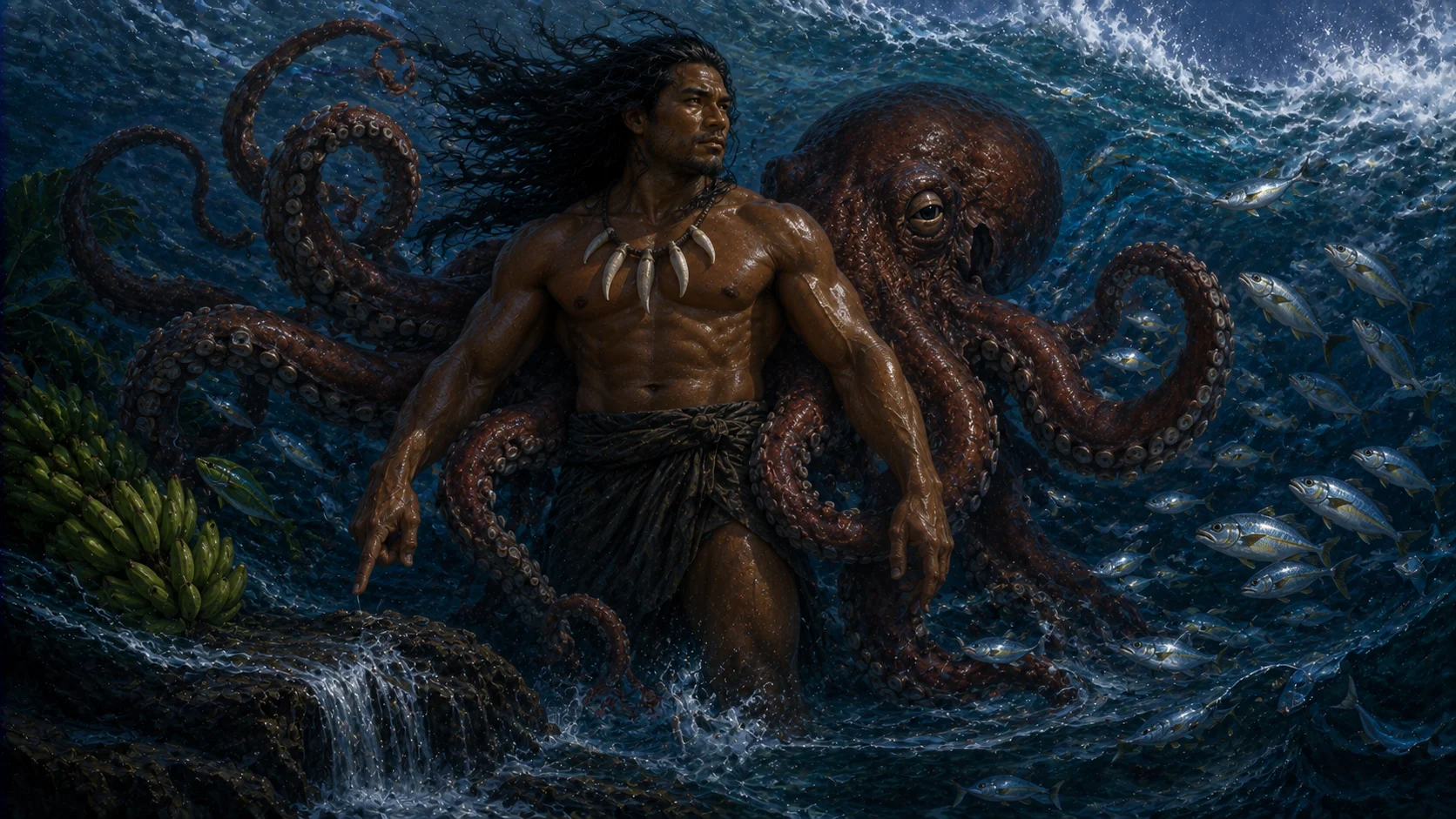
The most famous stories of the pair concern water. As they travelled together, the two gods were fond of drinking 'awa, the ceremonial drink made from the root of the kava plant, and they needed fresh water to prepare it. Where there seemed to be none, Kanaloa would point out where water lay hidden beneath the ground, and Kane would strike the rock with his staff so that a spring burst out. Springs across the islands are remembered as places where the two gods found water in this way, and several are still known by names linking them to Kane. The story is a fitting picture of the pair: the god of the sea knowing where water hides, the god of fresh water and life bringing it to the surface for people to use.
Partners in Hawai'i, Rivals in Aotearoa
The partnership is all the more striking because the same two names meet very differently elsewhere in Polynesia. In Maori tradition, Tangaroa of the sea and Tane of the forest are brothers who become enemies. The quarrel between them explains why the creatures of the sea are hunted from the land, and why the canoes, nets and fishhooks that people make from Tane's trees are used against Tangaroa's children; in turn, Tangaroa's waves wear down the shore and claim the canoes back.
In Hawai'i the same pairing of forest and ocean becomes a collaboration. The tree is felled and shaped under Kane, the finished hull is launched and sailed under Kanaloa, and both gods are needed for the canoe to make its voyage at all. The comparison shows how a shared Polynesian inheritance could be worked out in opposite directions by peoples living on different islands, each telling the relationship between land and sea in its own way.
The Octopus and the Deep
Hawaiian akua have kino lau, “many bodies”: the plants, animals and natural forces in which their presence is seen. Kanaloa's best-known body is the he'e, the octopus, and he is linked as well with the squid. The choice suits him. The octopus is a creature of the reef and the deep, intelligent and secretive, able to change its colour and shape and to slip through the narrowest gap. Fishermen who sought it, and the many people who relied on the sea for food, had good reason to keep the god of the deep in mind.
More broadly, Kanaloa is associated with the ocean as a whole — its currents, its depths and its creatures. Other akua also had places at sea: Ku'ula was a god of fishermen and fishponds, and the sea-goddess Namaka belongs to the family of Pele. Kanaloa is the broadest of these powers, the god of the sea itself rather than of one craft or one shore.
The Island Called Kanaloa
The small island of Kaho'olawe, southwest of Maui, is in Hawaiian tradition the island of Kanaloa, and it is still called by his name. Its western point, Kealaikahiki, means “the pathway to Tahiti”: tradition holds that voyagers set their course for the southern islands from there, and the point is used today for the protocols of traditional navigation. For an island sacred to the god of the deep ocean, there could hardly be a more fitting landmark.
In the twentieth century Kaho'olawe suffered greatly. After the attack on Pearl Harbor in 1941, the United States Navy took the island for bombing practice and gunnery training, and for nearly fifty years it was shelled from sea and air. From the 1970s a Native Hawaiian movement, the Protect Kaho'olawe 'Ohana, landed on the island in protest and challenged its use in the courts, and the struggle became one of the defining causes of the Hawaiian cultural renaissance. In 1990 the bombing was ordered to stop. Congress provided for the island's return to the State of Hawai'i, which took place in 1994, and after years of work to clear unexploded ordnance, control of access passed to the State in 2003. Large parts of the island are still not cleared. Today Kaho'olawe is a reserve, held in trust for a future Native Hawaiian sovereign entity, and cultural practices, including observances of the Makahiki season, are again held there.
The Rebel of the Later Stories
Some accounts of Kanaloa read very differently. In them he is the leader of the first spirits made by the gods, who rebelled against them, was defeated, and was thrown down with his followers into the underworld, where he became a power of darkness, death and sorcery, opposed to the good god Kane. These versions appear in nineteenth-century writing, after the coming of Christianity, and they have the shape of a familiar story: a rebel angel cast down into hell.
Many scholars see them as shaped by the missionary period, when the four great gods were reinterpreted to fit a Christian pattern — three gods matched to a trinity, and the fourth cast as the adversary. The older material points another way. Kanaloa and Kane are invoked together, honoured by the same devotees and paired in the same work, which is hard to square with a war between them. And in Hawaiian tradition the underworld had its own ruler, Milu, rather than Kanaloa. The rebel Kanaloa is best read as a chapter in the history of how Hawaiian religion was retold under Christian influence, not as the god's original character.
Kanaloa Today
Kanaloa's name has taken on new life with the Hawaiian cultural renaissance. The return of Kaho'olawe made his island a symbol of the recovery of land and culture, and the revival of traditional voyaging, which began with the canoe Hokule'a's voyage to Tahiti in 1976, brought renewed attention to the ocean and to the knowledge of the navigators who crossed it. For people who once again sail the long ocean roads between the islands of Polynesia, the god of the deep sea is a natural figure to remember.
The God Beyond the Reef
Kanaloa has fewer surviving stories than Pele or Maui, and many of those that survive show him in partnership rather than alone. But that partnership is itself the point. Kane and Kanaloa together describe the islands' two great waters — the fresh water that rises from the land and gives life to fields and people, and the salt water that surrounds the land, feeds it, and joins it to the rest of the Pacific. Kanaloa is the god of that second water: vast, deep, generous and dangerous, the road by which the ancestors came.
Sources & traditions
- EncyclopediaWikipedia — Kanaloa
- TraditionHawaiian texts, oral tradition and village tellings
Myths change from area to area and from time to time. This chronicle follows the most widely told versions; tellings in other villages, regions and eras may differ.