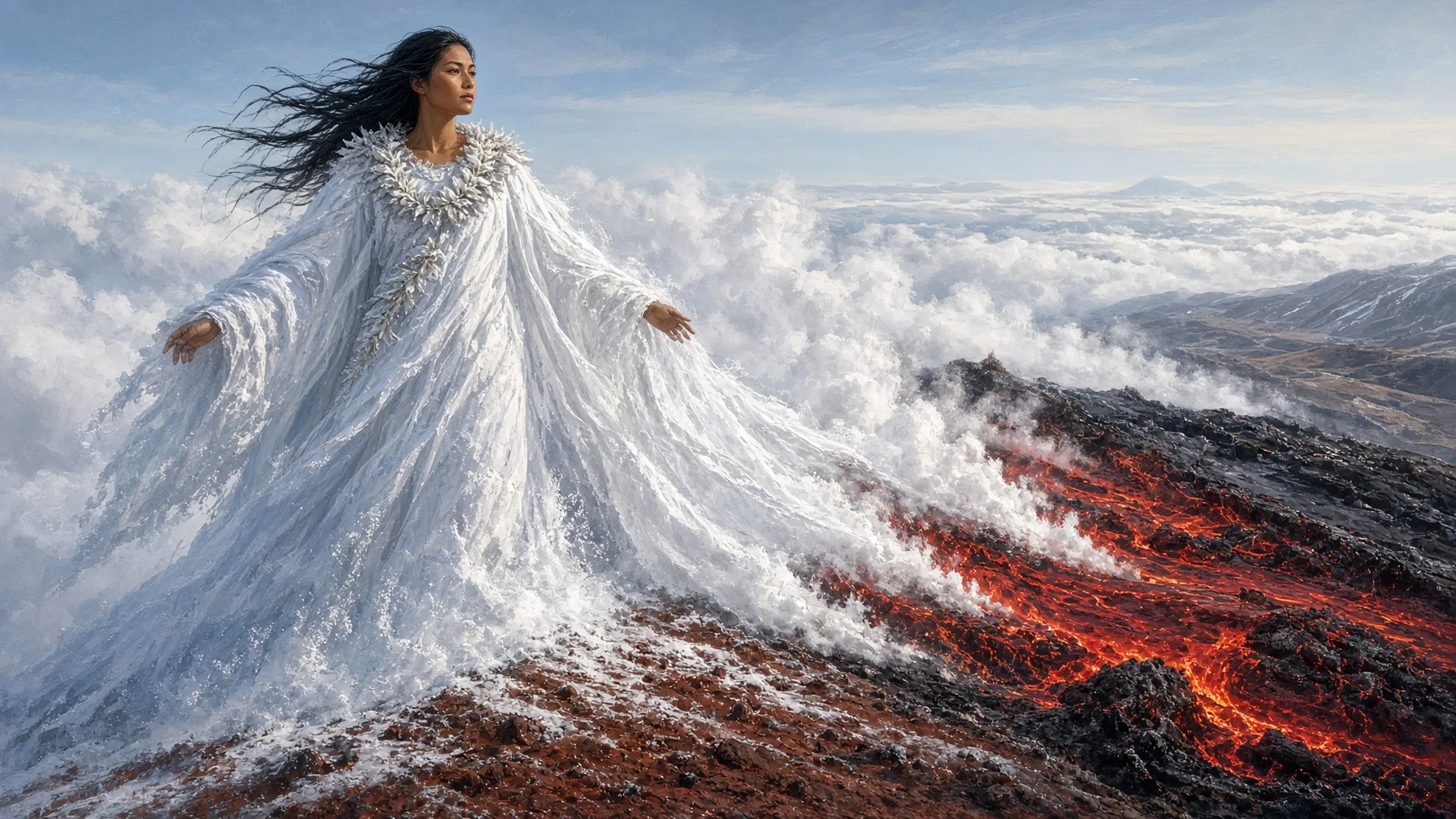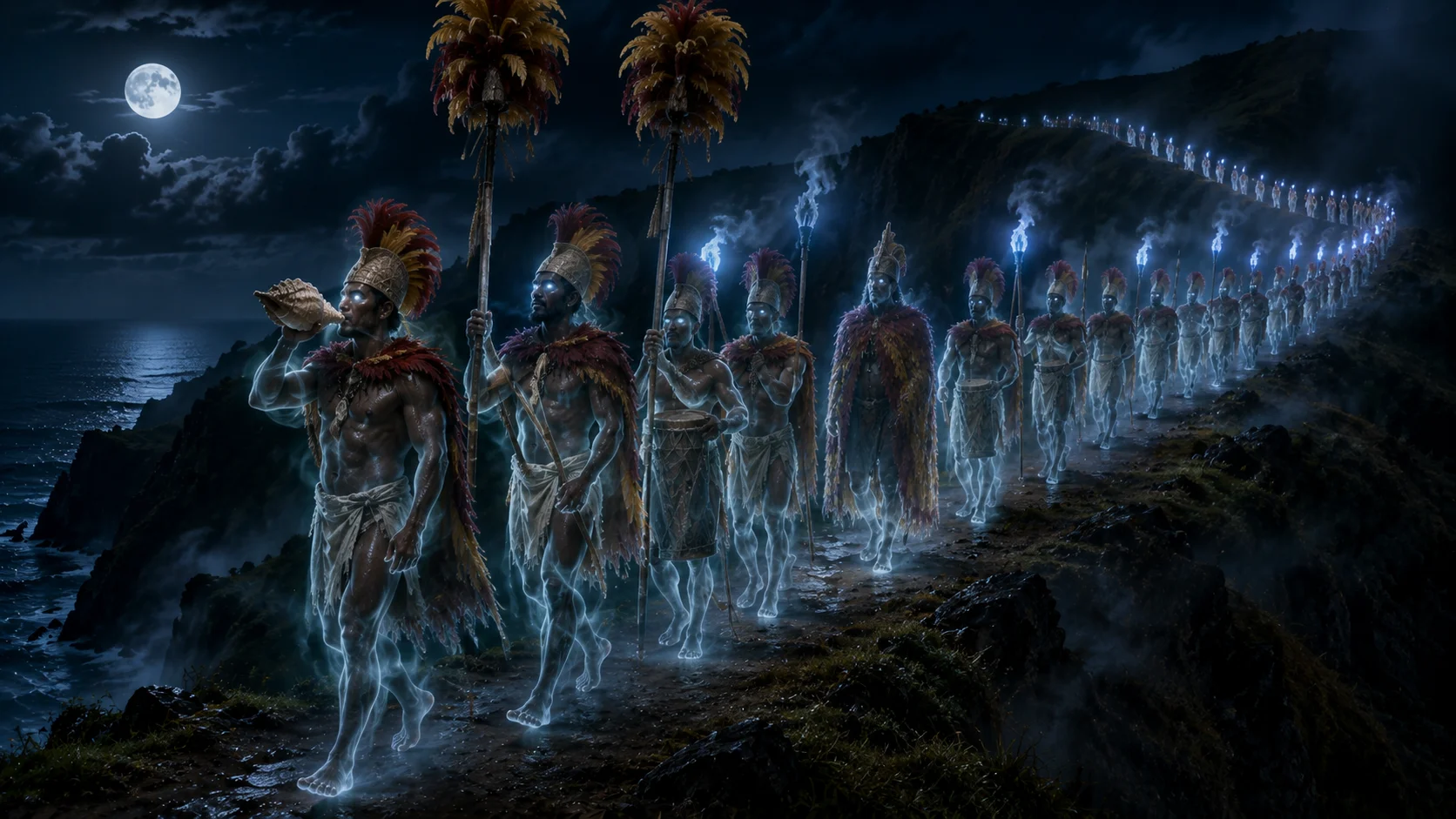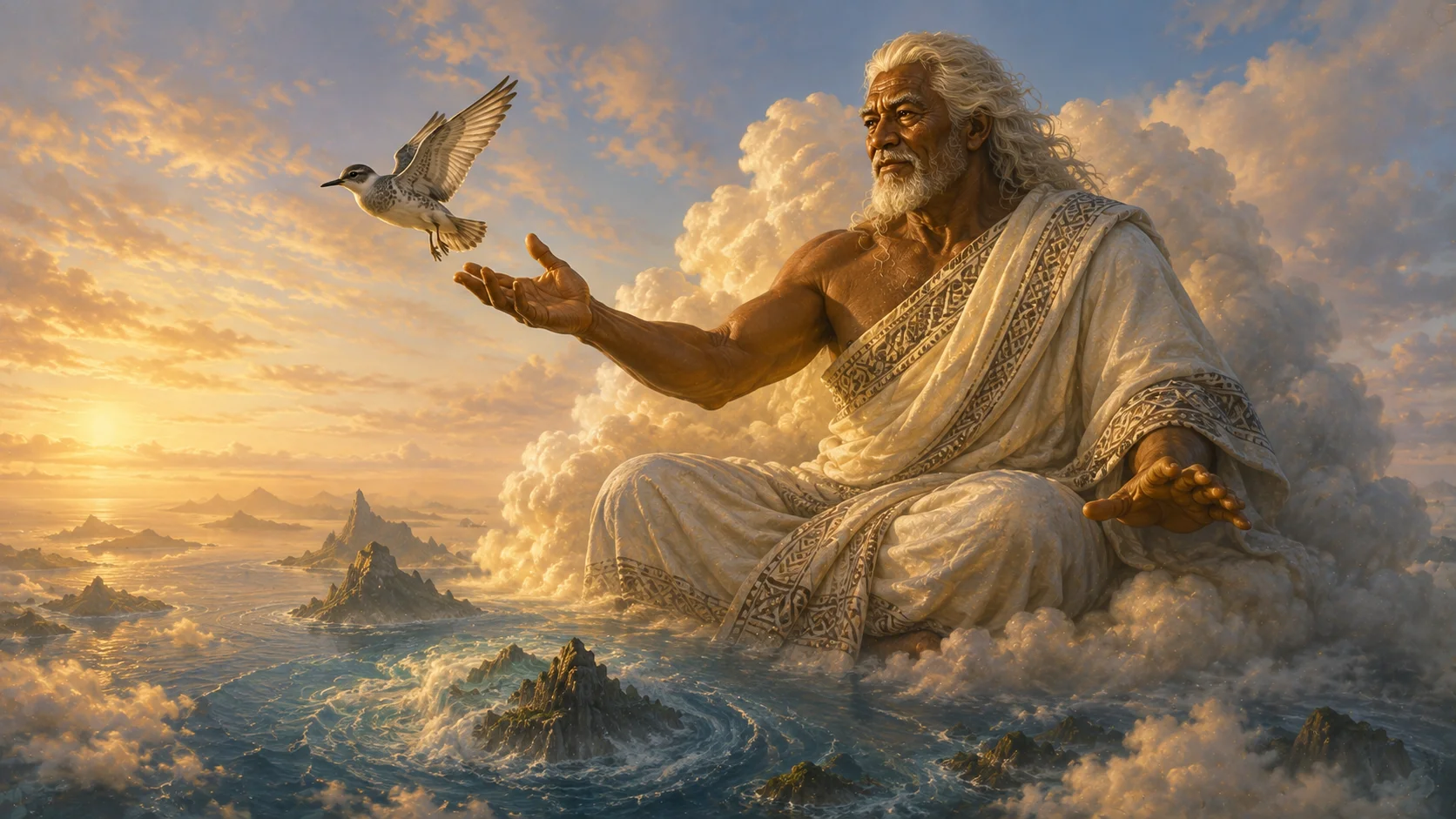
Tagaloa is the supreme creator deity of Samoan oral tradition — Tagaloa-a-lagi, "Tagaloa of the heavens," the great being who existed before all things in the formless dark of the po and from that void set the heavens, the sea, and the land in their places. He is not a single fixed episode but a cosmogony carried in genealogical creation chants, the solo, recited by orators and passed down through districts that do not always agree with one another on the order or the manner of what he made. That variation is not a flaw in the record; it is the record — a living tradition rather than a closed text.
A Voice Recorded, Not a Scripture Written
What is known of Tagaloa today reaches us chiefly through two nineteenth-century missionary-ethnographers, George Turner, whose "Samoa a Hundred Years Ago and Long Before" (1884) remains a primary source, and John B. Stair, both of whom transcribed the cosmogonic chants directly from Samoan orators. There is no single canonical account to point to. The wording, the sequence of creation, even which acts belong to Tagaloa himself and which to his named agents, shift from orator to orator and from island to island. German ethnographer Augustin Krämer's "Die Samoa-Inseln" (1902) later set out these district-level differences explicitly, treating the variation itself as part of the subject rather than noise to be edited away. Any telling of Tagaloa's myth, including this one, is therefore one thread among several kept by the tradition, not the whole of it.
The Uppermost of the Heavens
In Samoan cosmology the sky, lagi, is arranged in nine or ten ascending levels, and Tagaloa presides over the highest of them. From that summit he is credited as the originator of the physical world, of the first humans, and of the chiefly matai titles that structure Samoan society to this day. This sky-father, creator role places him among a family of cognate figures found across the wider Polynesian triangle — Tangaloa in Tonga, Kanaloa in Hawai'i, related names in the Cook Islands and Tahiti — but with a distinctive difference: where several of those cognates are sea deities, one voice among a pantheon of siblings, the Samoan Tagaloa stands as the primary creator himself, not a specialist god assigned to the ocean.
Striking the Rock in the Formless Dark
The most widely cited version of the creation begins with Tagaloa existing entirely alone, before land, before light, in the po. Out of that emptiness he strikes or separates rock, and by that act the sky is formed, then the sea, then the land, each brought into being in its turn. Having shaped the physical stages of the world, he does not people it in a single motion but sends down other beings bearing his own name — Tagaloa's messengers, sometimes called his offspring — to carry the work of creation the rest of the way to completion. This multiplication of Tagaloa-titled beings, a whole class of intermediaries rather than one solitary god acting alone, is itself something the early ethnographers found distinctive, and at times admitted they found confusing, about the Samoan material.
Land Cast Down, or Land Drawn Up
Alongside the rock-and-void account, Turner also collected variant tellings in which the islands come into being by a different act altogether — Tagaloa casting down a vine or a rock that becomes land, or drawing land up from beneath the sea in a fishing act. This second image echoes a motif found throughout Polynesia, most familiar elsewhere as the story of Maui fishing up islands from the deep. In the Samoan case it is Tagaloa's act, one of several competing local creation accounts rather than a single settled narrative, and its coexistence with the rock-striking account is a reminder that Samoan cosmogony was never asked to resolve into one version — different islands, and sometimes different orators on the same island, kept different tellings side by side.
Manu'a, the Cradle Where the First Man Was Made
One episode carries particular weight beyond the realm of story. Tagaloa is said to have created the first man, Pili, on the island group of Manu'a — Ta'u, Ofu, and Olosega — and Samoan tradition treats Manu'a as the cradle of creation itself, the place where the world's peopling began. This is not merely a piece of folklore kept for its own sake. The paramount title of the region, the Tui Manu'a, claims direct descent from Tagaloa, and the myth therefore performs a documented political function: it legitimates the Tui Manu'a's precedence among Samoan chiefly titles by tracing that authority in an unbroken line back to the creator himself. Anthropologist Margaret Mead, working in Manu'a in the 1920s, along with native Samoan scholars, recorded a version of the tradition that gives this direct-creation, direct-descent claim particular emphasis, distinct in shape from the accounts gathered further west.
The Sending of the Messenger and the Founding of the Matai
Creation, in the Samoan telling, does not end with land and the first man. Tagaloa is said to have sent a son or messenger — named Tagaloa-le-Fuli in some tellings, Pava or another agent in others, the name itself changing significantly by island and source — to organize the islands and appoint the first chiefs. This act establishes the fa'amatai, the chiefly system, as something divinely sanctioned rather than merely inherited custom. The variation in the messenger's name across sources is worth sitting with rather than smoothing over: it suggests a tradition maintained locally, island by island, each community holding its own thread of how the founding chiefs came to be appointed, rather than a single royal genealogy dictated outward from one center.
A God Without Parents, Standing Apart
Where the Samoan spirit world, the aitu, is thick with populated genealogies — beings born of other beings, descended and interrelated in the ordinary way of kinship — Tagaloa is generally described in the creation chants as self-existent, without parents, standing apart from that crowded lineage. His subordinate namesakes, the other beings who carry the Tagaloa name and act as intermediaries between him and the created world, do not diminish this singular status; if anything they underline it, since they are agents sent by him rather than kin who preceded him. He is, in this sense, the point from which every other genealogy in the tradition ultimately descends, without himself descending from anything.
The Genealogical Thread to Nafanua
The great warrior figure Nafanua belongs, in some genealogical accounts, to the broader family of Tagaloa-descended chiefly lines, connected through her father Saveasi'uleo. It is important to be precise about the nature of this connection: Nafanua's own myth cycle is centered on Pulotu and on Savai'i, and unfolds largely independently of the Tagaloa creation cycle proper. The link between them is genealogical and political — a matter of descent and title, the kind of connection an orator might invoke in ceremonial oratory — rather than a direct parent-child relationship or a shared narrative. The two traditions touch at this one genealogical point without merging into a single story.
Invoked in the Chiefly Oratory of Lauga
Tagaloa's presence in Samoan life did not remain confined to the chants of origin. He functions as the apex of legitimacy for the entire fa'amatai system, and to this day orators, the tulafale, invoke Tagaloa genealogies in formal ceremonial oratory, the lauga, to validate high-ranking titles — especially those with ties to Manu'a and the Tui Manu'a line. A title's standing can be argued, in the proper oratorical setting, by tracing its descent back toward this single point of origin. The name has not receded into pure antiquity either: Samoa's modern constitution carries a preamble reference to the nation being founded "in the name of God," and the drafting debates behind that language noted, at the time, the pre-Christian association carried by the name Tagaloa.
Manu'a's Primacy Against the Western Genealogies
The differences between district traditions are not minor variations in phrasing; they shape rival claims to precedence. Manu'a traditions, recorded in part by Mead and by native Samoan scholars, emphasize Tagaloa's direct creation of Manu'a as the primal land and the Tui Manu'a as his direct line, which gives Manu'a a distinct claim to primacy among Samoan polities. The traditions of Savai'i and Upolu, recorded mainly by Turner and Stair from western Samoan informants, instead offer more elaborate, multi-generational Tagaloa genealogies, with alternate sequences for the making of sky, sea, and land. Krämer's documentation treats these as genuinely different regional traditions rather than corrupted copies of one another — the scholarship does not attempt to flatten Samoan cosmogony into a single uniform account, and neither should any retelling of it.
Reinterpretation After the Missionaries Arrived
Christianization reached Samoa from the 1830s onward, and in its wake some missionaries and some Samoan Christians came to treat Tagaloa as an analogue of the biblical God, folding the pre-Christian creator into the new faith's supreme being. Later ethnographers and Samoan scholars have debated this conflation pointedly, and it is best understood as a genuinely contested interpretive move rather than a natural or settled equivalence — an imposition shaped by the moment of contact, not a claim the pre-Christian tradition made about itself.
An Open Question the Scholarship Does Not Resolve
That contested equivalence connects to a deeper and still-unresolved disagreement among Pacific historians: whether Tagaloa represents an original, indigenous concept of a monotheistic high god native to Samoan thought, or whether his supremacy was emphasized, or even reshaped, by the nineteenth-century missionary-ethnographers who recorded him, in part because they were seeking a Samoan parallel to the Judeo-Christian idea of one supreme god. Critiques of Turner's and Stair's methodology have kept this question alive rather than settling it. It is presented here, as the literature presents it, as a live and open disagreement — not a fact resolved in either direction, and not a judgment this account is positioned to make on the tradition's behalf.
Sources & traditions
- EncyclopediaWikipedia — Tagaloa
- TraditionSamoan folk and village traditions
Myths change from area to area and from time to time. This chronicle follows the most widely told versions; tellings in other villages, regions and eras may differ.