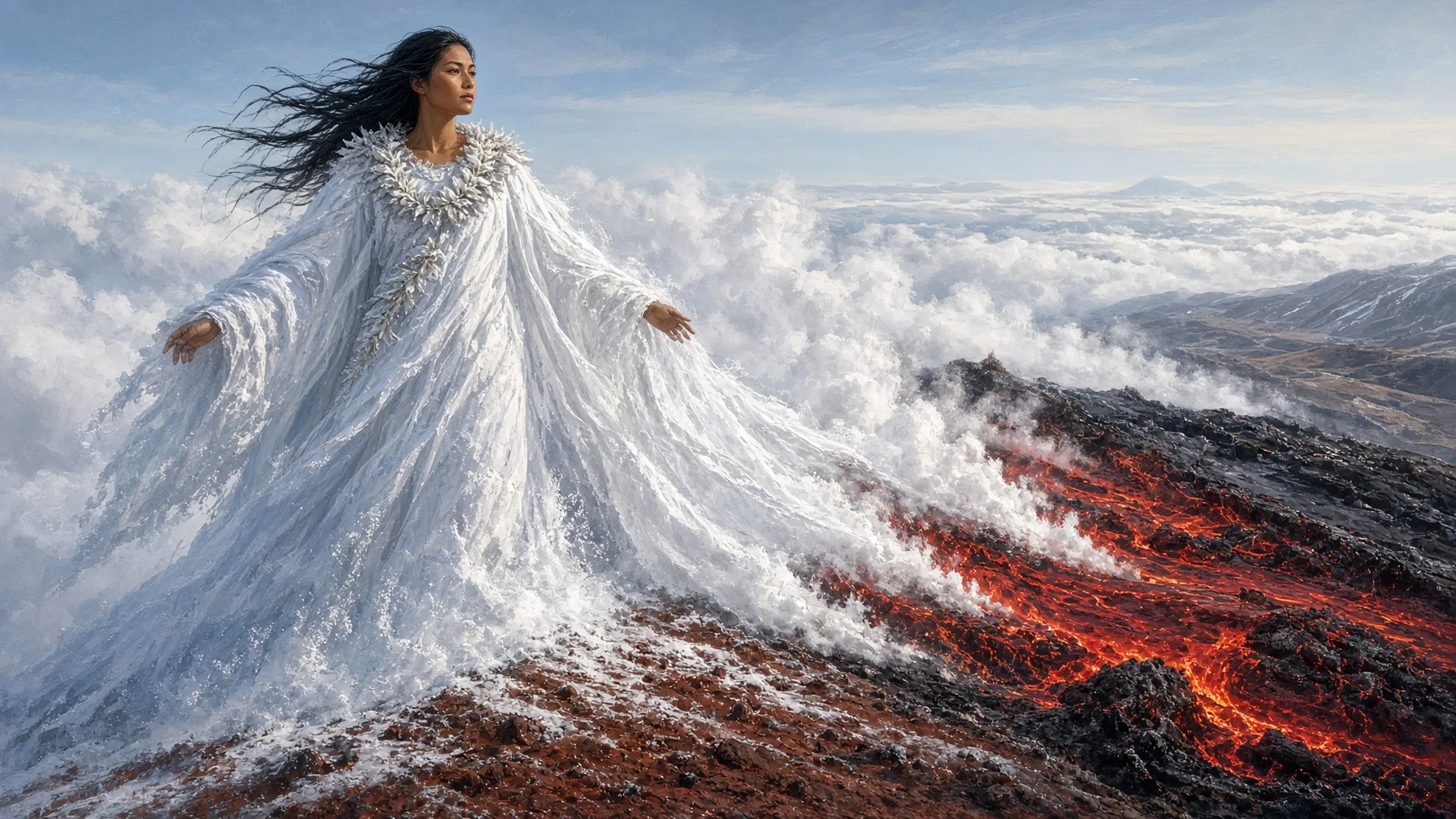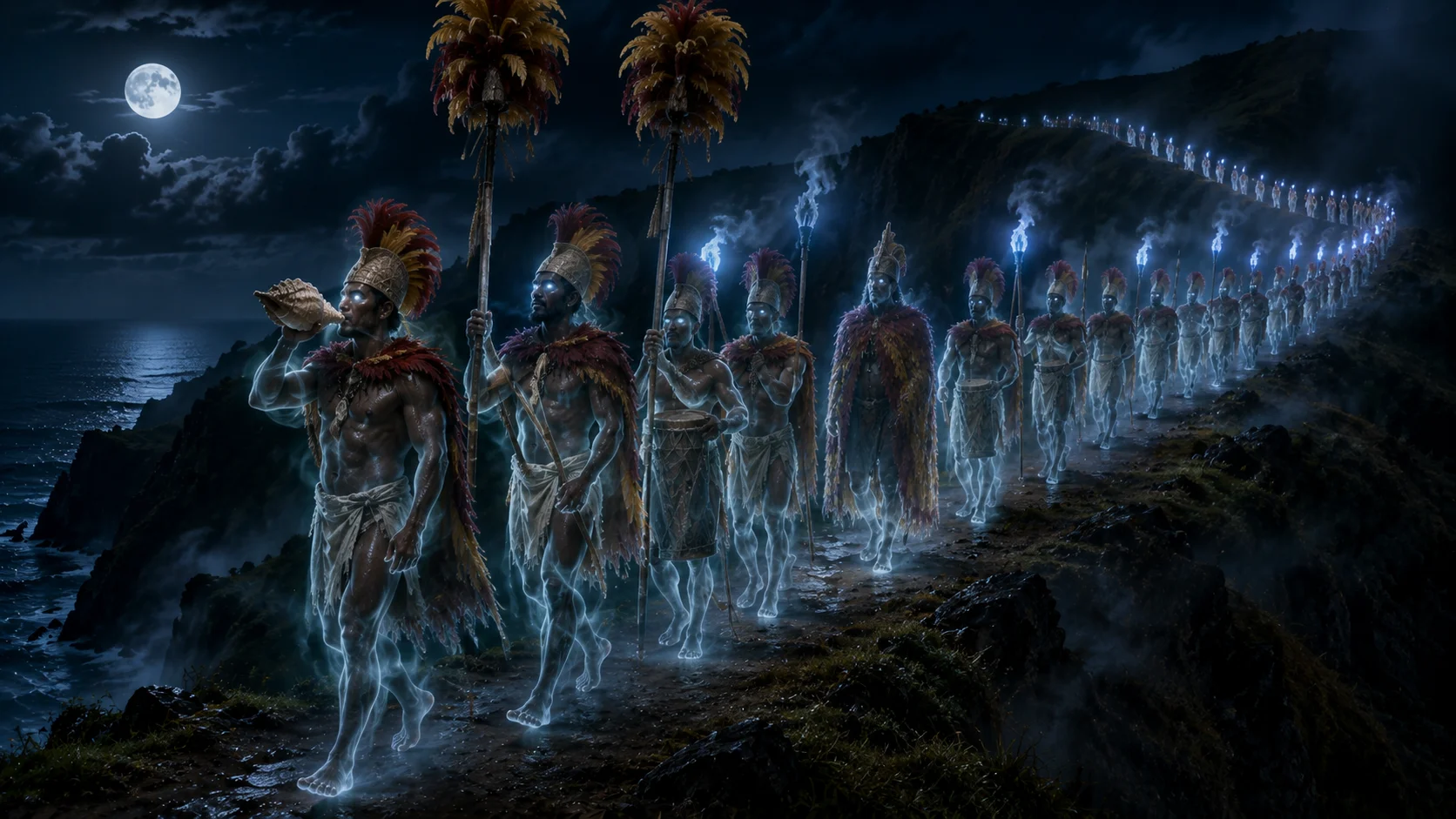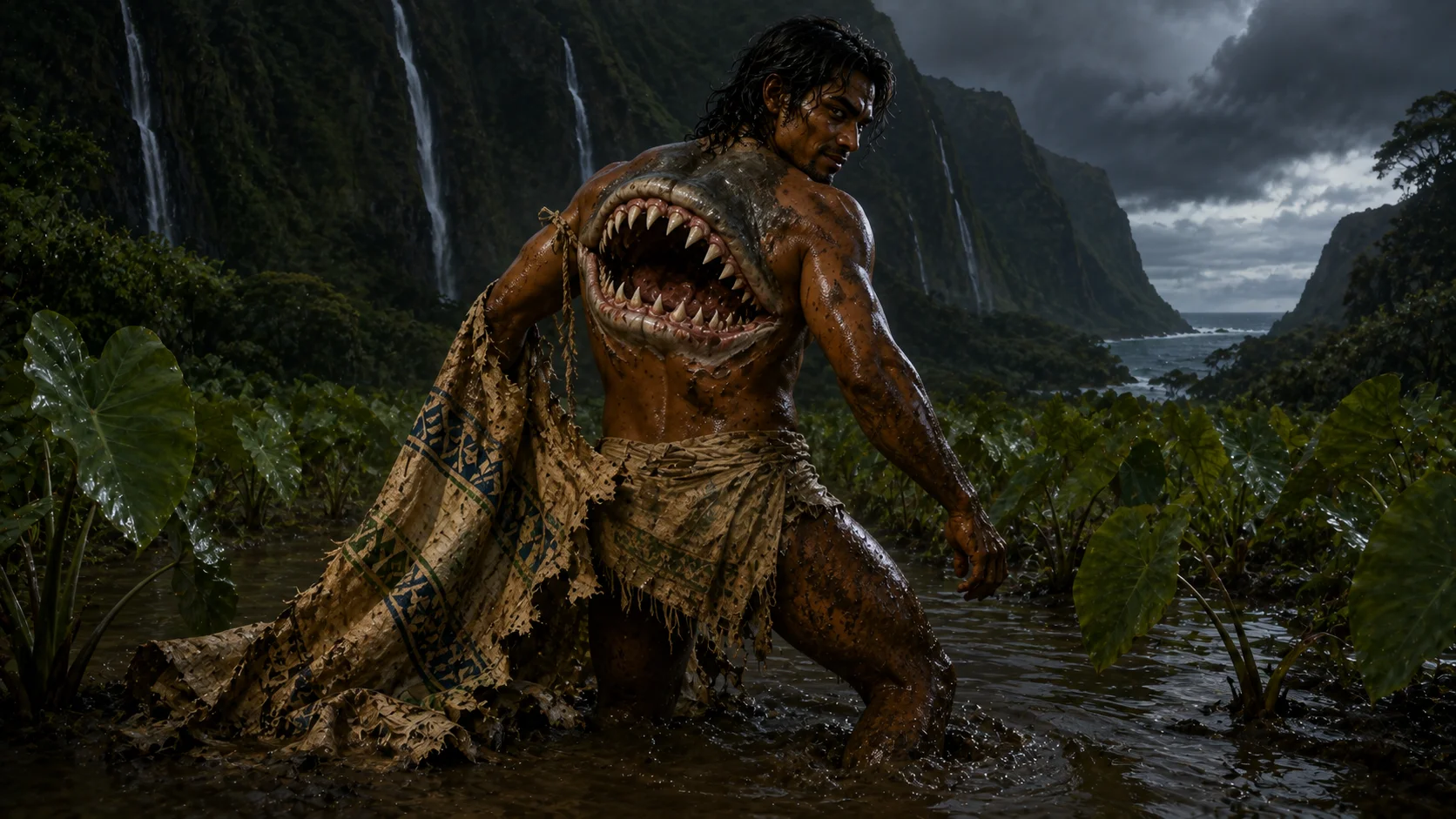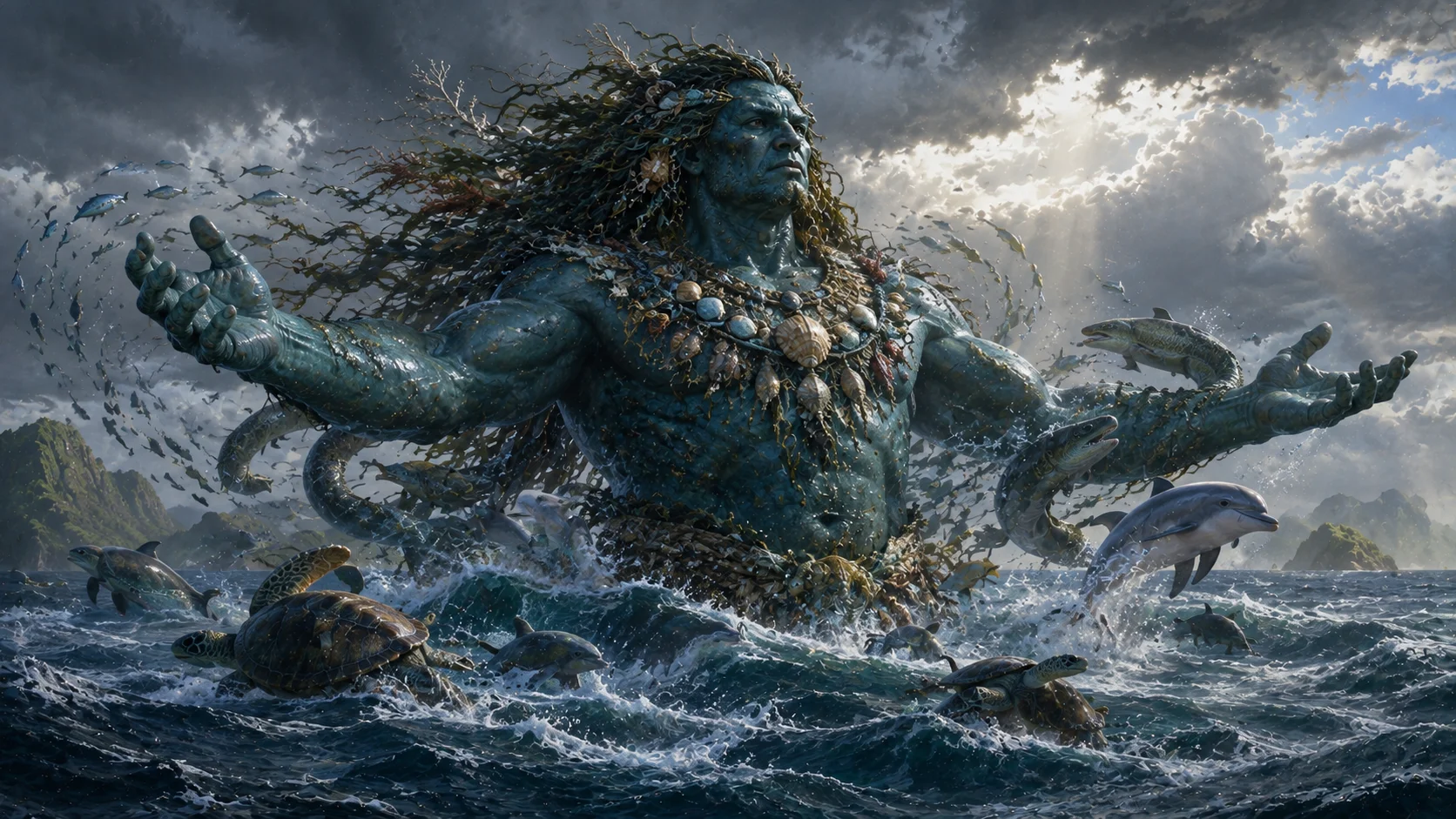
Tangaroa is named among the atua, the great primal gods of Māori tradition, a son of Ranginui the Sky Father and Papatūānuku the Earth Mother. He is atua of the moana, the sea — of fish, of the creatures that move through deep water, and of the tides that a voyaging, fishing people set their lives against. His name is not confined to one shore. Carried across the Pacific by the ancestors of the Polynesian-speaking peoples, it surfaces again and again — as Ta'aroa in Tahiti, as Tagaloa in Samoa, as Tangaloa in Tonga, as Kanaloa in Hawai'i — each telling holding something of a shared root and each shaped, differently, by the island and the iwi that kept it.
Child of Sky and Earth
In the Māori account, Tangaroa belongs to the generation of atua born to Ranginui and Papatūānuku while sky and earth still lay locked together, dark and close. He is counted a brother to Tāne, atua of the forests and of birds; to Tāwhirimātea, atua of wind and storm; to Rongo, atua of cultivated food and of peace; to Haumia-tiketike, atua of the wild-growing food of the fernland; and, in a number of traditions, to Tūmatauenga, atua of war and the ancestor of humankind. The exact ordering of these brothers, and even the full list of who stands among them, is not fixed in a single account. It shifts from iwi to iwi and from the whakapapa carried by one line of tohunga to another — recorded across the nineteenth and twentieth centuries by ethnographers such as George Grey and Elsdon Best, who were themselves working from many separate tellings rather than one master text. Māori tradition was never a single book. It is a family of related oral traditions, each iwi's version a legitimate telling in its own right.
The Sundering of Rangi and Papa
The best-known episode in which Tangaroa appears is the separation of the primal parents. Rangi and Papa lay so close together that their children, crowded in the darkness between them, debated whether to force them apart and let light into the world. Tangaroa is named among the sons who took part in that debate and in the act itself, or who were at least present and affected by it. In most tellings it is Tāne who finally succeeds, bracing himself between earth and sky and pushing his parents apart with his legs, until Rangi was raised high above and Papa left below, and light came into the world for the first time. Some tribal accounts, particularly among coastal iwi whose lives leaned more heavily on the sea than the forest, give Tangaroa a more active role in the separating itself. This is not a contradiction to be resolved by picking a winner — it is exactly the kind of regional variation that runs through the whole tradition, and it should be read as such rather than flattened into one fixed version.
The Quarrel with Tāne
What follows the separation, in a widely recorded strand of the tradition, is conflict between Tāne and Tangaroa. Tāne holds the forest and the birds that live in it; Tangaroa holds the sea and the fish that swim in it. Enmity grew between the two brothers, and it is this quarrel that explains, in the traditional telling, why the creatures of Tangaroa's sea are hunted by the creatures and the people of Tāne's land — why birds take fish from the shallows, why the fisherman comes down from the forest paths to the shore. It also explains something closer to daily life: the great canoes and the carved houses of the people are built from Tāne's trees, yet it is Tangaroa's sea that then carries those very canoes, and Tangaroa's waves that in time claim them back. The rivalry between forest and sea, felled timber and rising tide, is in this way given a mythic origin — two brothers, once close in the darkness beneath their parents, now standing in lasting tension across the shoreline that divides their two worlds.
A House Built From an Old Wound
There is a quiet logic running underneath that old quarrel, one that a fishing and voyaging people would have felt every day rather than merely recited. The waka that carries a fisherman out onto Tangaroa's water is itself a piece of Tāne's forest, shaped and hollowed by human hands out of one brother's domain to be sent into the other's. Every launching, in that light, re-enacts the old debt between them — and every safe return is, in its way, a small reconciliation. It is not hard to see why karakia mattered so much before a canoe touched the water at all.
Brothers of Wind, Field, and War
Tangaroa does not stand alone in the pantheon; he is understood always in relation to his brothers, and the character of the sea he governs is drawn partly by contrast with theirs. Where Tāwhirimātea rules the unstable violence of wind and storm — and in some tellings assails his brothers in anger after the separation of their parents — Tangaroa's sea is a domain that is by turns generous and lethal in its own right, requiring the same wary respect a voyager gives the sky. Where Rongo governs the cultivated crop, planted and tended and predictable in its season, and Haumia-tiketike the wild fernroot that needs no planting at all, Tangaroa's provision is neither planted nor entirely wild in the same sense — it must be sought, read, and, if the tradition is kept, returned to and thanked. Tūmatauenga, ancestor of people and atua of war, stands in some genealogies as a further brother again, a reminder that the whakapapa binding these atua together was never only about nature; it was also about how the descendants of Rangi and Papa were understood to relate to one another, sea to sky to forest to field to human hand.
Sons of the Tide: Ikatere and the Fleeing Reptiles
Tangaroa's own line continues the story of the sea's domain. He is credited across many tellings as the ancestor or origin point of fish and of reptiles alike. In some traditions a son named Ikatere is associated directly with fish, a further working-out of Tangaroa's ocean-nature into a named descendant. In others, a figure called Tū-te-wehiwehi, also known as Tū-te-wanawana, is linked to the reptiles — and it is said that when the quarrel between sea and forest deepened, the reptiles under his care fled the water for the land, taking up residence among the roots and undergrowth that belong to Tāne rather than remaining in Tangaroa's realm. As with so much else in this tradition, exactly which figures are named, and exactly how they are related, varies from iwi to iwi; what stays constant is the pattern — Tangaroa's household reaching out from him into the living world of scale and fin and skin, each creature's place in either sea or land carrying, still, the memory of that old rift between brothers.
Karakia Before the Nets Go Out
None of this stayed confined to story alone. Fishing and the setting out of a voyaging waka were traditionally accompanied by karakia — incantations addressed to Tangaroa, seeking safe passage and a good catch, and acknowledging that the sea was not simply a resource to be taken from but a tapu-laden domain belonging to an atua whose favour could be lost as easily as it was granted. To go out onto Tangaroa's water without observing the proper respect was to invite his displeasure, and the ocean was understood to answer that disrespect in the plainest way it could — with an empty net, a sudden squall, or worse.
Tapu and the First Fish Returned
One custom recorded ethnographically, and still referenced in customary fisheries protocol today, was the practice of returning the very first fish caught to the sea, offered back with karakia in acknowledgement of Tangaroa rather than kept. Fishing grounds themselves carried tapu, and a breach of that tapu — fishing out of season, taking more than was needed, disregarding the restrictions placed on a particular reef or channel — was understood as an offence against Tangaroa personally, not merely a breach of etiquette among people. The sea's abundance was a gift held under obligation, and the obligation ran directly to the god who governed it.
Guardian of the Kaimoana, Then and Now
That same understanding has not stayed locked in the past. Tangaroa remains a living reference point in contemporary Māori environmental and fisheries discourse, invoked in the language of kaitiakitanga — guardianship — that shapes how customary fishing grounds and kaimoana, seafood, are spoken of and managed today. He personifies the ocean in both of its faces at once: the provider whose fish stocks sustain a coastal people, and the dangerous, tapu-laden force that must be approached with care rather than presumption. Resource-management conversations that invoke Tangaroa are not simply reaching for a decorative old name; they are drawing on a continuous line of practice that treats the sea as an entity owed respect and reciprocity, not only extraction.
Ta'aroa Who Broke His Shell
Sail north from Aotearoa into the tradition of Tahiti and the Society Islands, and the same name carries a far larger weight. Here Ta'aroa — Tangaroa under his Tahitian form — is not one sibling-god among several but a primordial, self-created supreme creator. The account, recorded in the nineteenth century by the missionary John Orsmond from Tahitian informants and later published in Teuira Henry's compilation "Ancient Tahiti," tells of Ta'aroa existing alone in darkness within a cosmic shell called Rumia, before anything else existed at all. Cramped within that shell, he broke out of it, and from its very fragments — and from his own body — he shaped the world entire: the dome of the sky, the foundations of the land, and the things that live upon it. Where the Māori Tangaroa is a brother among brothers, contending and quarrelling and taking his place in a family of atua, the Tahitian Ta'aroa stands as the lone origin from which that entire cosmos, gods included, proceeds.
A Theology Recorded, Not a Purer Original
It would be a mistake to read the Tahitian account as simply the "true" or "original" version from which the Māori tradition later diverged and diminished. Scholars examining the Orsmond and Henry material have cautioned that the elevated, highly systematized creator-theology of Ta'aroa may owe something to the process of its own recording — a priestly, consolidated telling gathered and set down by outsiders working with particular informants, at a particular moment, rather than a plain transcription of an unchanging ancient belief. The Māori and Tahitian tellings are better understood as two branches that grew differently from a shared root, each shaped by its own island's needs, its own recorders, and its own generations of tohunga and priests — not as an original and a copy.
One Name, Many Skies: Tagaloa and Tangaloa
The same root name travels further still, and it does not always stay attached to the sea. In Samoan tradition, Tagaloa — often given the fuller title Tagaloa-a-lagi — is a major sky and creator figure rather than strictly a god of the ocean. In Tongan tradition, Tangaloa likewise belongs to the heavens, associated with the origin of chiefly lines rather than with fish and tide as such. This is a genuinely disputed and variable point among those who study Polynesian religion, not a settled detail with one right answer: the same linguistic root, descending from a shared Proto-Polynesian religious vocabulary reconstructed as *Tangaloa, attaches to the sea in one island group and to the sky in another. It is a reminder that a cognate name does not guarantee a cognate domain — the word travelled with the voyaging ancestors of these peoples, but the god it named was reshaped, island by island, into whatever that island's account of the cosmos most needed him to be.
Kanaloa Beside Kāne
In Hawai'i, the cognate takes the form of Kanaloa, associated with the ocean much as Tangaroa is in Aotearoa. Kanaloa is, in a number of Hawaiian accounts, paired or contrasted with Kāne — the Hawaiian cognate of Tāne — and set alongside Kū as well, echoing, at a great distance, the same forest-and-sea, sky-and-land structuring of divine relationships found in the Māori tradition of Tangaroa and Tāne. The pairing is never identical from one archipelago to the next, but the shape recurs: a sea-god and a sky-or-forest-god, bound together as much by old tension as by kinship.
The Sea That Answers to Many Names
Taken together, Tangaroa, Ta'aroa, Tagaloa, Tangaloa, and Kanaloa are not five unrelated gods who happen to share a syllable. They are what one shared name became after generations of voyaging carried it from island to island across the Polynesian Triangle, each community answering the same old questions — where did the world come from, who governs the sea we depend on and fear, how must we behave toward it — in its own voice. In Aotearoa that voice speaks of a son of Sky and Earth, a brother caught in an old quarrel with the forest, a presence to be addressed with karakia before the nets go out and thanked with a fish returned to the water. In Tahiti it speaks of a lone god breaking out of a shell in the darkness to make the world from his own body. Both are Tangaroa. Neither is more Tangaroa than the other.
Sources & traditions
- EncyclopediaWikipedia — Tangaroa
- TraditionPolynesian folk and village traditions
Myths change from area to area and from time to time. This chronicle follows the most widely told versions; tellings in other villages, regions and eras may differ.