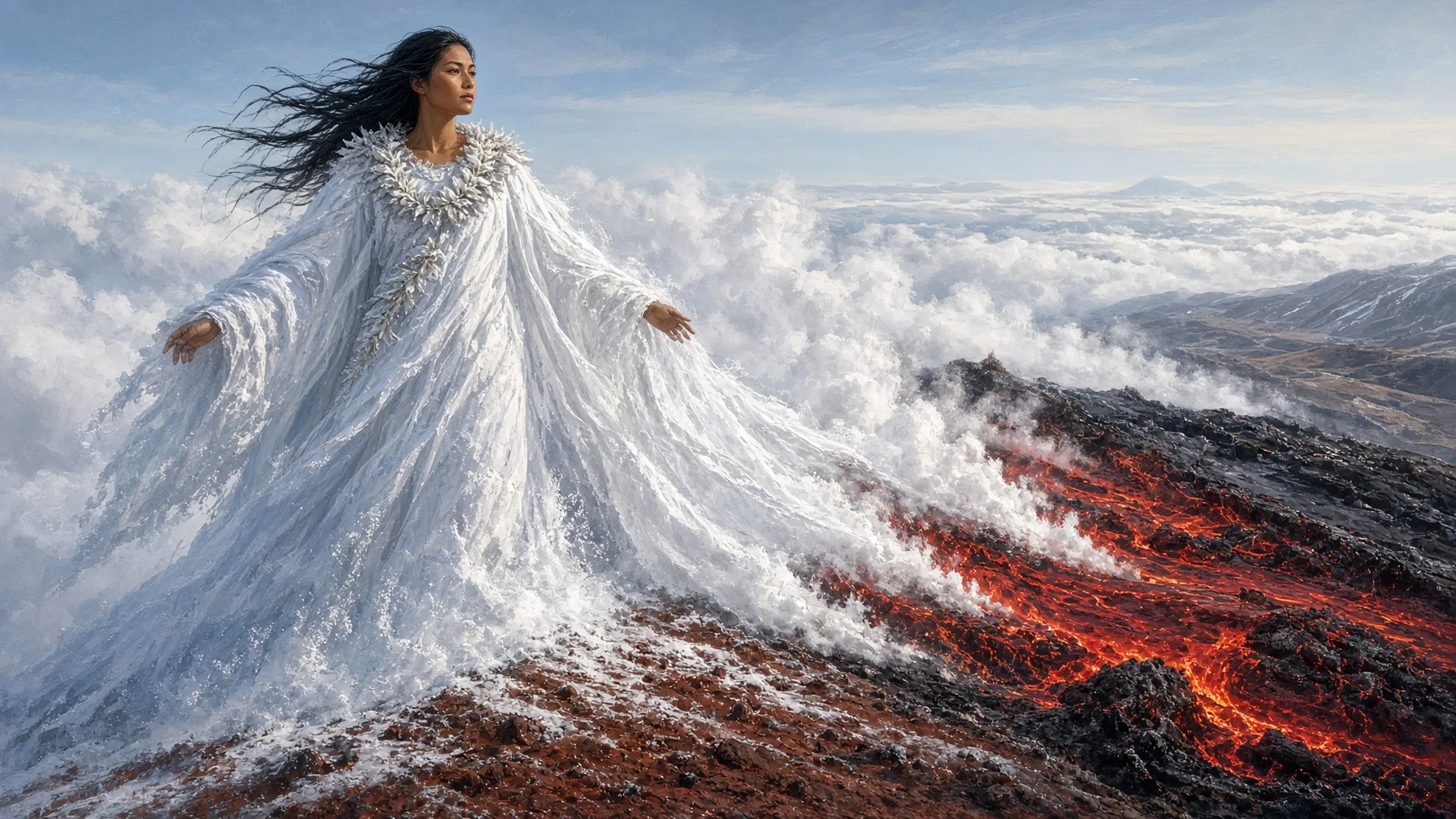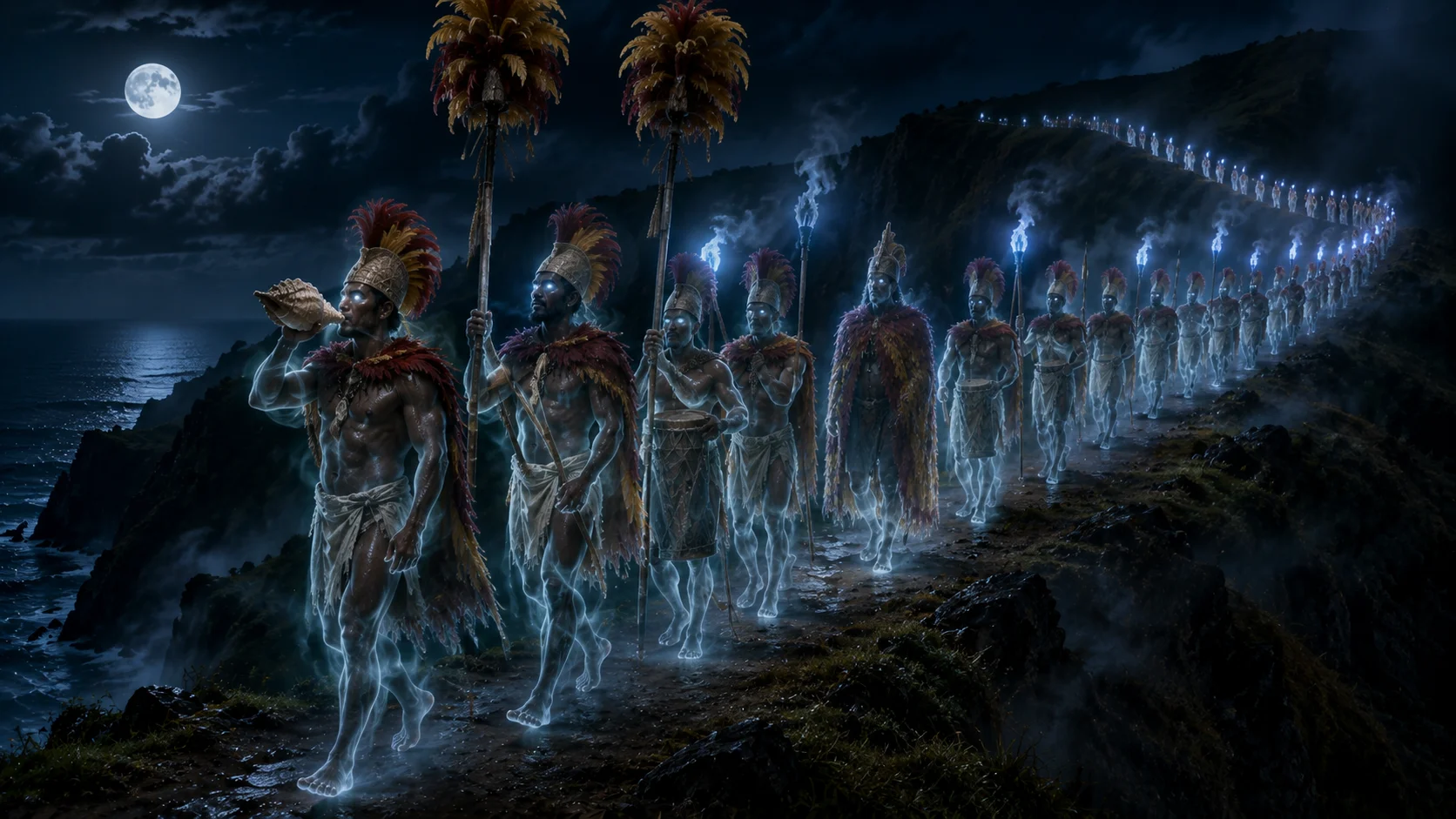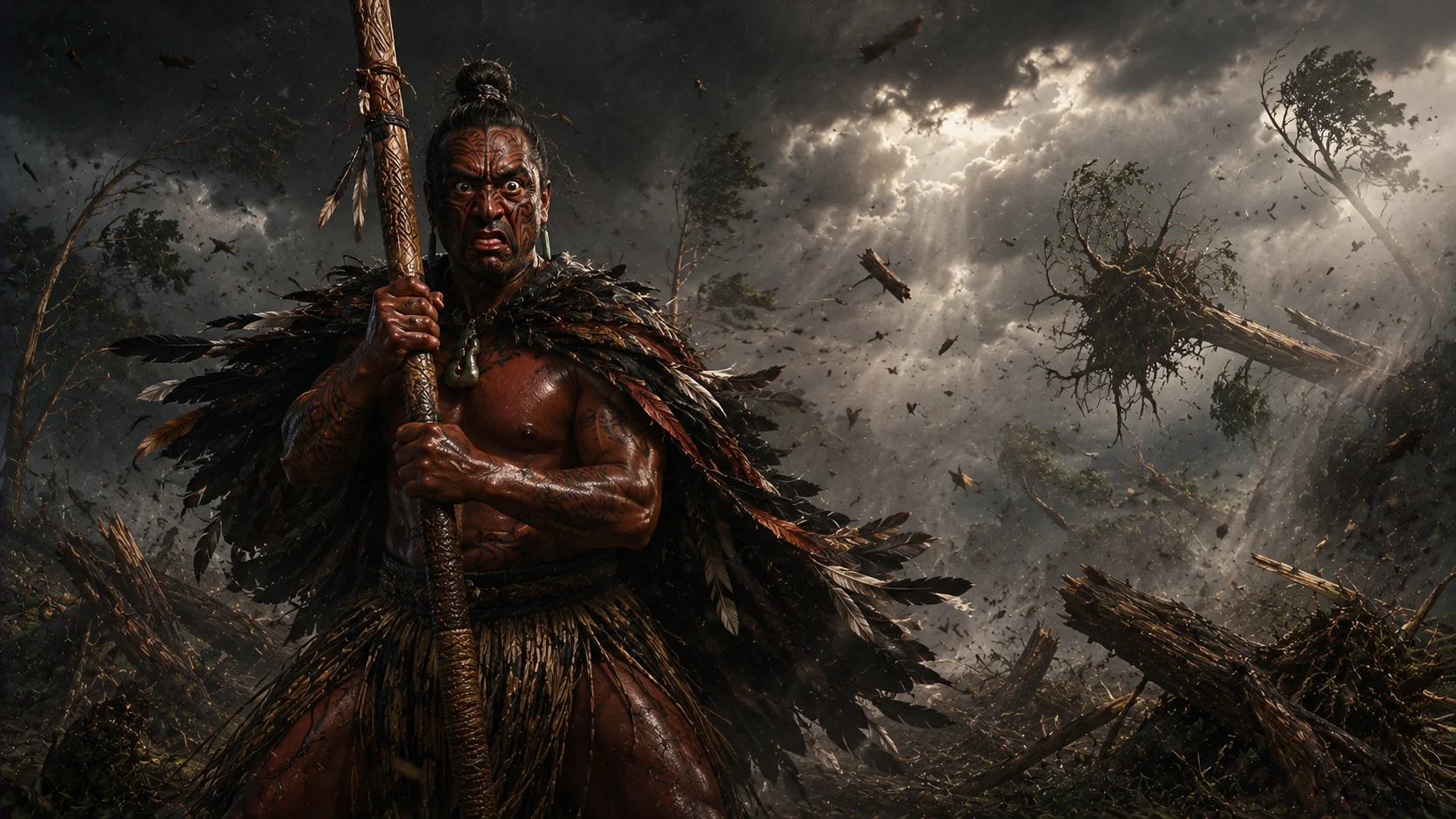
Tumatauenga — Tu, or more fully Tu-matauenga, "Tu of the angry face" — is the Maori atua of war, of human striving, and in many traditions the tutelary god of humankind itself. Among the many sons of Ranginui the sky father and Papatuanuku the earth mother, he is remembered as the one who stood fiercest, argued hardest, and in the end could not be answered even by his own victories. His story is not a tidy one. It is a story about what it costs to win.
Born Into a World Still Closed
Before there was light, there was only the long night of Rangi and Papa locked in their embrace, and their children pressed into the darkness between them. Tumatauenga grew there alongside his brothers — among them Tane, keeper of forests to come, Tangaroa, who would claim the sea, Rongo and Haumia-tiketike, the cultivated and the wild-growing food, and Tawhirimatea, the storm. In most tellings Tu is counted the fiercest-tempered of them from the start, a warrior in nature before there was yet a world to make war in.
The Voice That Counselled Death
When the brothers gathered in the crowded dark to debate what should be done about their parents' unrelenting embrace, it was Tu who spoke the harshest word. Where others weighed separation or endurance, Tumatauenga is recorded in most versions of the tradition as the one who proposed killing Rangi and Papa outright — cutting the bond, not merely opening it. It was a proposal born of the same nature that would later make him war incarnate: decisive, absolute, unwilling to leave an enemy — even a beloved one — half-defeated.
Overruled by the Gentler Plan
The brothers did not follow Tu's counsel. It was Tane who proposed the quieter, and ultimately harder, labour: not to kill their parents but to force them apart, to set Rangi high above and leave Papa lying below, so that light could enter the space where none had been before. That plan prevailed. Tane set his shoulders to the task and pushed the sky upward while the earth remained beneath. Tumatauenga, whose word had been the more violent of the two, watched his gentler brother's plan carried out instead of his own — a small defeat, easily lost among the vastness of what followed, but one worth remembering as the first mark of the pattern that would define him: a god whose instinct is closer to force than to patience, and who is not always the one whose way wins.
Light, and a New Kind of Hunger
With Rangi lifted clear of Papa, light spread across the world for the first time, and with light came the shape of a world that now had to be lived in rather than merely endured. The brothers who had shared the cramped dark now stood apart from one another, each moving toward the domain that would become his own — Tane toward the forming forests, Tangaroa toward the gathering waters, Rongo and Haumia-tiketike toward the ground where food would grow. Tumatauenga's domain was less a place than a disposition. He was not given a forest or a sea. He was given the burden of standing.
Quarrel Among the Newly Freed
Freedom did not bring peace among the brothers. Tradition holds that Tumatauenga, still carrying the temper that had wanted his parents killed, turned that same fierceness on his own siblings. What followed is remembered not as a single battle but as a sequence of confrontations, each one a contest between Tu and one of his brothers' domains — a mythic reckoning that would settle, for all the generations of people to come, what it would mean to draw a living from the natural world.
The Sea Given Over to the Hook
Against Tangaroa, lord of the sea and in most whakapapa another child of Rangi and Papa in his own right, Tumatauenga's weapon was the practice of fishing itself. He is said to have subdued Tangaroa's domain not by a single blow but by the ongoing act of casting lines and nets into the water and drawing its creatures out. In this telling, every catch pulled from the sea afterward is a small repetition of that first conquest — proof, renewed with every voyage, that Tu's dominion over Tangaroa's realm was won and is still being won.
The Forest Brought Low by the Snare
Against Tane, whose forests had spread across the newly lit world and filled with birds, Tumatauenga's conquest took the form of hunting and bird-snaring. Where Tane had laboured to lift the sky and clothe the earth in growth, Tu is remembered as the brother who turned that abundance into food, taking birds from the trees Tane had grown. It is a hard turn in the story — the very brother whose gentler counsel had prevailed over Tu's now finds his creation subdued by the brother he had outvoted — and Maori tradition does not soften it. It is offered instead as the honest shape of how people live: forests are entered, and something is always taken from them.
Cultivated Ground and Wild Root Alike
Rongo, atua of cultivated food, and Haumia-tiketike, atua of the food that grows wild and needs no planting, were subdued in turn by the arts of cultivation and gathering — by the deliberate working of soil on one hand and the deliberate seeking-out of wild growth on the other. Together with the conquests of forest and sea, this completed what tradition frames as Tu's threefold subjugation of his brothers' domains: water, wood, and earth, each yielded up to sustain the people who were still to come. Regional and iwi traditions differ on the exact order of these events, and some describe the conflict less as a single settled contest than as something ongoing and cyclical rather than finished in a single age — a reminder that this corpus was never one fixed text but many related tellings, carried differently from place to place.
The One Brother Who Would Not Yield
Only Tawhirimatea escaped Tu's conquest, and it is this failure, not the three victories, that tradition dwells on longest. When Tawhirimatea turned his storms against his brothers in fury at the separation of their parents, the others fled or were battered into submission — the forests broken, the seas driven into churning refuge, the cultivated fields flattened. Tumatauenga alone stood his ground. He could not defeat the storm, and the storm could not move him. Tawhirimatea's winds have raged against humankind's endeavours ever since, and Tu's answering defiance has never resolved into a victory. Tradition is explicit that this contest was left unfinished, and that its being unfinished is exactly the point.
What the Unfinished Contest Explains
It is this single unresolved war, more than the three that were won, that Maori oral tradition returns to when explaining humanity's condition in the world. A canoe built with the finest skill can still be lost to a storm at sea. A crop tended with every care can still be flattened by wind. A house raised with all the strength people possess can still be torn open by weather no ritual fully commands. Where Tu's conquests of sea, forest, and field explain why people may take from those domains at all, his standoff with Tawhirimatea explains why that taking is never without risk — why every fisher, planter, and voyager since has worked always half in the shadow of a war that was never actually won.
The Warrior Invoked Before Battle
Because of this character — decisive, unyielding, the one brother who stands rather than flees — Tumatauenga became, in pre-colonial and colonial-era practice, the atua most directly invoked in warfare. War parties and warriors performed karakia associated with Tu before entering battle, calling on the same fierce standing that had once held firm against the storm itself. His name, generally read as "Tu of the angry face," names exactly this quality: not cruelty for its own sake, but the fixed, forward-facing readiness of someone who has already decided not to retreat.
A Name Held Differently From Place to Place
The widely published composite versions of this tradition, drawn together in the nineteenth century from many tellings, present Tumatauenga as a single continuous figure. Scholars are careful to note that individual iwi hold their own versions of Tu's role, his exact name-forms, and even distinguish him in places from other war-associated figures who carry regionally specific epithets. What follows here draws on the widely shared shape of the tradition; it does not claim to be the only way Tu's story has ever been told, and it treats that variation as a feature of a living oral tradition rather than an inconsistency to be resolved.
Dominion as Responsibility, Not Only Conquest
The same episodes that cast Tu as conqueror are also, in Maori thought, the foundation of humanity's relationship of use and responsibility toward the sea, the forest, and the cultivated ground. To have won the right to fish, to hunt, and to grow food was never told as a right free of obligation — it was won from brothers, through struggle, and it remains bound to the karakia and practices that acknowledge what was taken and from whom. In more recent generations, Tumatauenga's name has also come to serve as a cultural touchstone for the New Zealand Army, a modern adoption distinct from, and built upon, the older oral tradition rather than a part of it.
The Brother Who Still Stands
Of all Ranginui and Papatuanuku's children, Tumatauenga is the one whose story ends not in a settled domain but in an unfinished posture — feet planted, face turned upward into weather that has never stopped testing him. He conquered the sea, the forest, and the field, and in doing so gave people their means of living. He could not conquer the sky's temper, and in that failure gave people the truer shape of their condition: capable, provided-for, and still, always, standing exposed to something larger than themselves.
Sources & traditions
- EncyclopediaWikipedia — Tūmatauenga
- TraditionMaori texts, oral tradition and village tellings (New Zealand)
Myths change from area to area and from time to time. This chronicle follows the most widely told versions; tellings in other villages, regions and eras may differ.