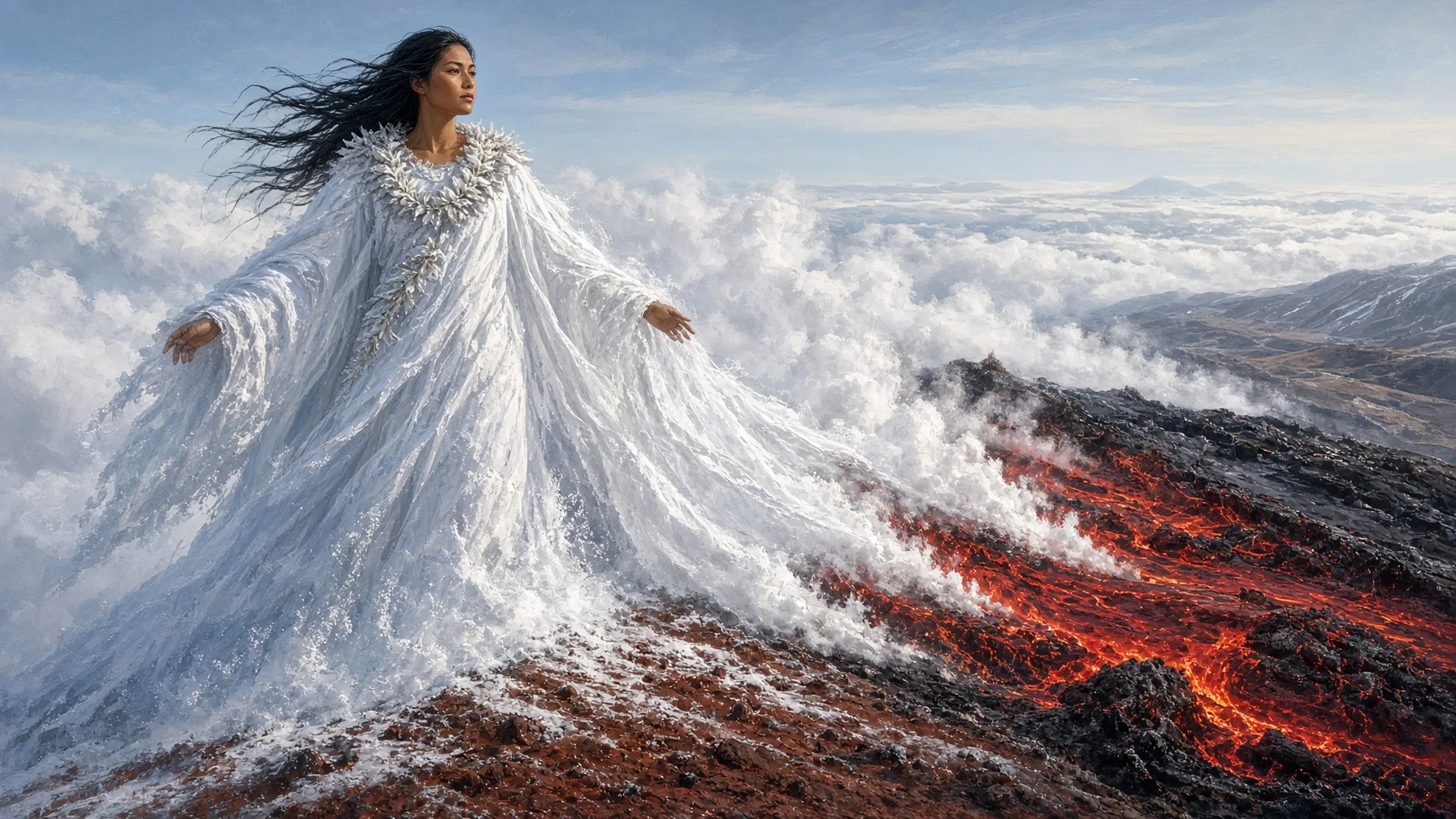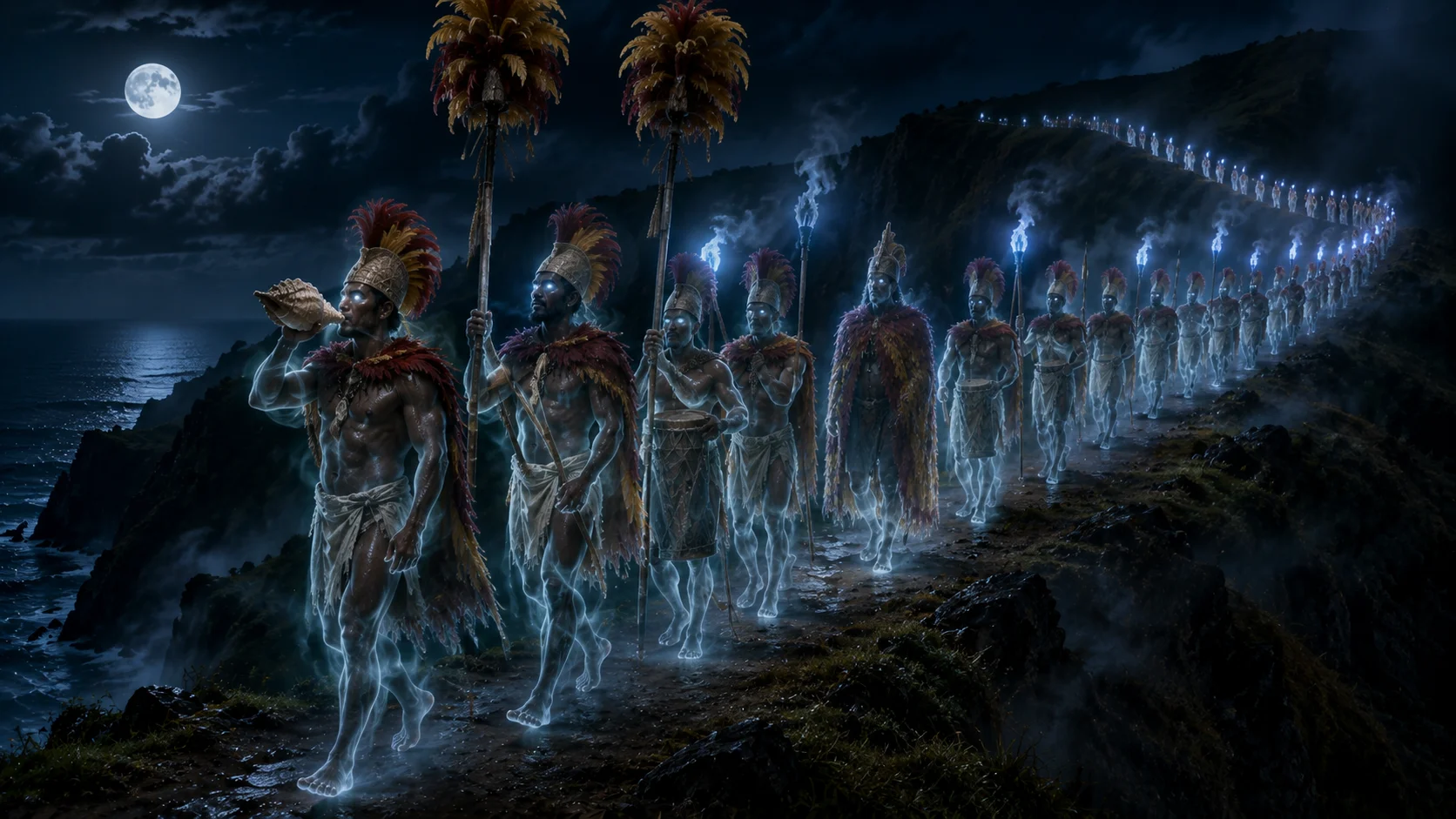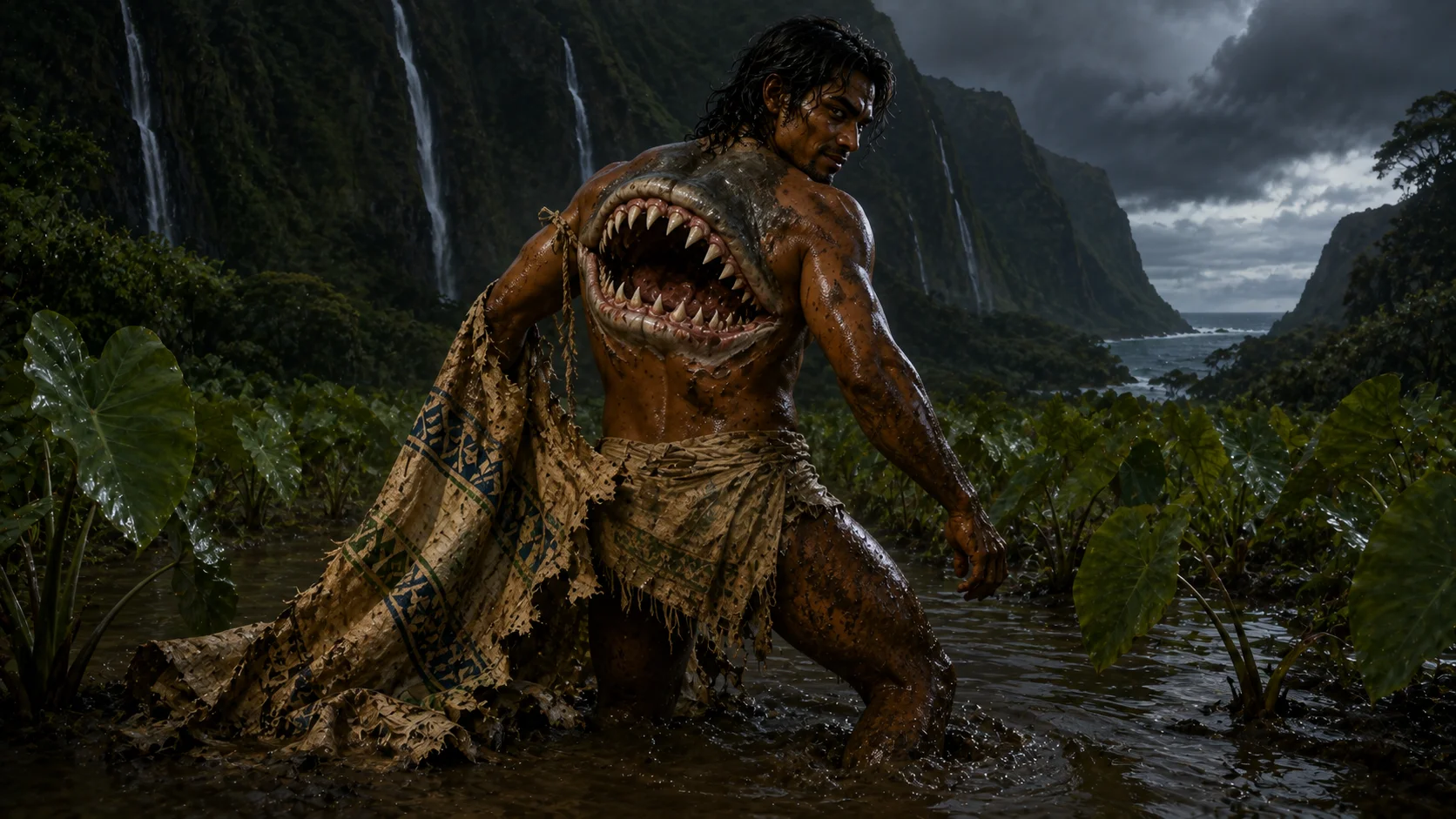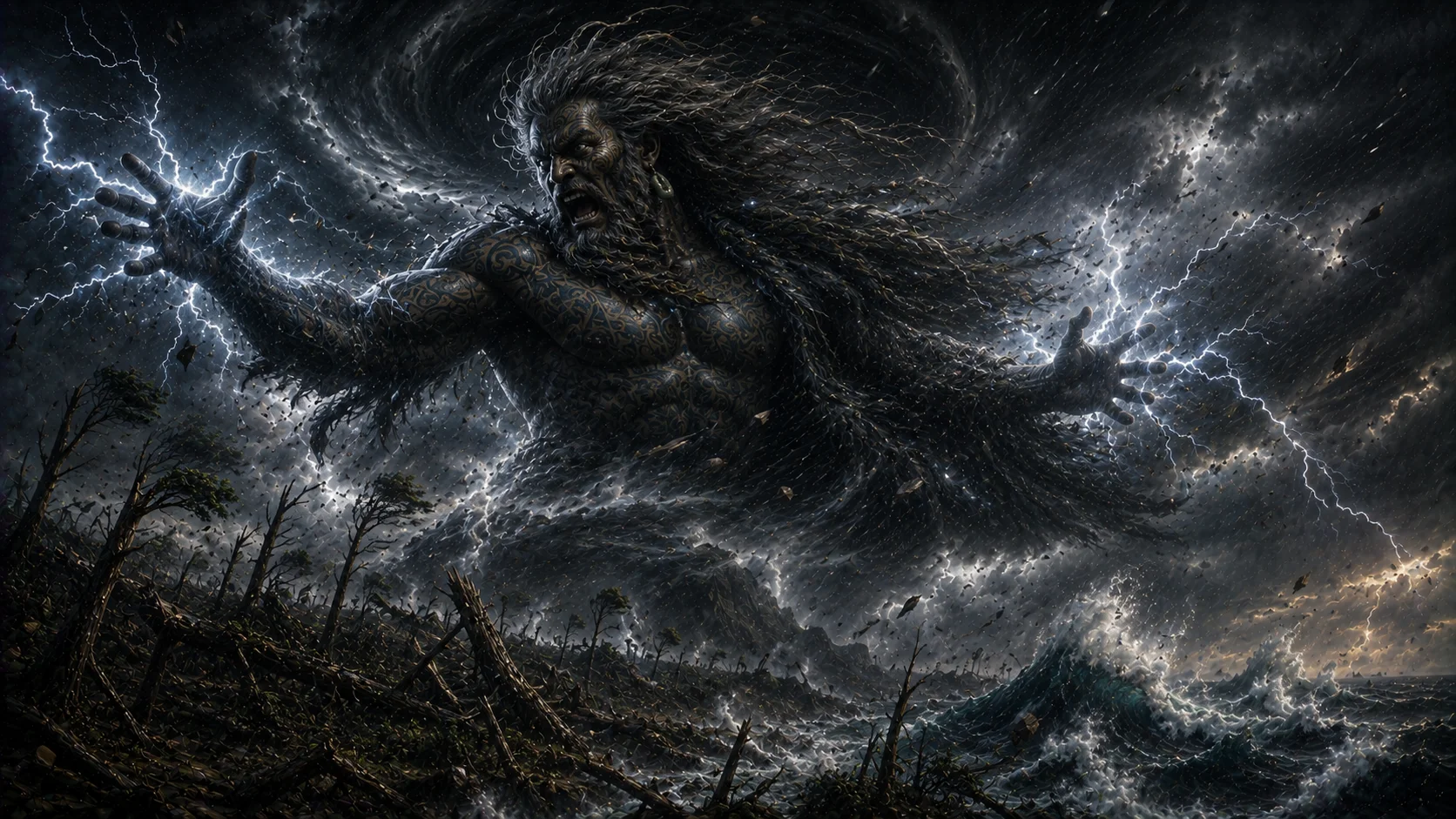
Tawhirimatea (Tawhiri) is the Maori atua of wind, storm, and the restless weather of the sky — a son of Ranginui the sky father and Papatuanuku the earth mother, and the only one of their children who stood against the tearing apart of his parents.
The Voice That Said No
In the long night beneath their parents' embrace, the children of Rangi and Papa debated what to do about the darkness pressed between them. Most of the brothers argued for separation, reasoning that light and space could only come if the primal pair were pushed apart. Tawhirimatea alone spoke against it. He held that the bond between Ranginui and Papatuanuku should not be broken — that the children should endure the crushing dark and cling to one another rather than force their parents into permanent absence from each other. His objection did not carry. In most tellings it is Tane who eventually braces his shoulders against the sky and drives his parents apart, levering Rangi upward with his back and legs until light floods into the world. Tawhirimatea's protest is remembered not as the version that won, but as the dissenting voice within the family — proof that the separation, however necessary it seemed to his brothers, was not unanimous, and that at least one child grieved the parents as a unity rather than celebrating the world that resulted.
Grief Given a Direction
What Tawhirimatea did next distinguishes him from every other child of Rangi and Papa. Where his brothers turned to shape the newly opened world — forests, sea, cultivated ground, the affairs of people — Tawhirimatea turned upward. He followed his father into the sky rather than remain below with the siblings who had, in his eyes, orphaned Ranginui from his wife. It is a striking detail of the tradition: grief, in this telling, is not passive. It becomes wind. Tawhirimatea does not simply mourn the separation; he gathers around himself in the heights an army built from his own sorrow and fury, and turns that army back down toward the brothers he holds responsible.
An Army Bred From the Sky
Tawhirimatea's children are traditionally reckoned as the winds and the weather themselves — distinct winds assigned to each quarter of the compass, banks of cloud of differing character and omen, rain, hail, fog, and mist, each named and each with its own temperament. This is not decoration; it reflects a detailed traditional Maori taxonomy of atmospheric phenomena, in which a squall from one direction and a mist rolling from another are not interchangeable "bad weather" but distinct beings with distinct names and distinct dispositions, all of them Tawhirimatea's own offspring. When the storm god rides out against his brothers, he does not go alone — he goes as a father marshalling a family of winds, exactly as his brothers below have their own descendants and domains.
The Forests of Tane Laid Low
The first target of Tawhirimatea's war is the domain of Tane, the brother most associated with forcing the separation and with clothing the new world in forest and bird. Tawhirimatea sends storm-winds tearing through the canopy, snapping great trees and scattering branches across the forest floor. This is offered in tradition as the plain explanation for wind-fallen timber: a fallen tree, in this account, is not simply weather damage but a mark left by an uncle's enduring anger at a nephew's choice, generations of storms replaying the same grievance against the same domain.
The Sea Driven to Fury
Tawhirimatea's assault reaches next to Tangaroa, atua of the sea, whose waters he churns into violent swell. Some traditions describe Tangaroa's retreat into the deep ocean as a direct response to this assault, the sea god withdrawing from the surface world to escape the storm-god's onslaught. In certain tellings this episode is also connected to a fracturing among Tangaroa's own descendants, who are said to have split — some fleeing to the sea to become fish, others to the land to become reptiles — an act of division echoing, on a smaller scale, the very separation of Rangi and Papa that set the whole conflict in motion. A separate strain of tradition also describes a rift between Tangaroa and Tane, arising when Tane took materials drawn from the sea's domain — flax fibre and shells among them — to bind and adorn the canoes built from his own forests. Storytellers differ on how closely that quarrel is bound to Tawhirimatea's war and on the exact sequence of events; both threads exist in the recorded tradition without a single agreed ordering.
Crops Withered, Cultivators Driven to Earth
The storm god's rage does not spare the cultivated world. He turns against Rongo, atua associated with peace and cultivated food plants, and against Haumia-tiketike, atua of wild-growing fern root and other uncultivated foods. Tawhirimatea withers what grows in the open air, and in response the two brothers are said to take refuge within Papatuanuku herself, retreating into the earth their mother provides rather than facing the storm in the open. Their submission is remembered as an act of shelter rather than defeat — a reminder that cultivated and wild food alike survive not by resisting the storm but by finding cover within the earth, a pattern still visible each time crops are safeguarded from bad weather by being drawn indoors or held in the ground.
The One Who Would Not Bend
Only Tumatauenga, atua of war and the ancestor most closely tied to humankind, stands his ground against Tawhirimatea's fury. Neither brother manages to defeat the other outright. Tumatauenga is buffeted, battered, and made to suffer the full force of the storm-god's winds, yet he does not flee to the sea, retreat into the forest, or hide within the earth as his brothers did. He simply endures, upright, in the open. This standoff — unresolved, ongoing, neither god granted final victory — is widely cited as the mythic explanation for humanity's own relationship with bad weather: people are not spared the storm, and cannot defeat it outright, but they persist through it, generation after generation, exactly as Tumatauenga once did.
A War Without a Treaty
Unlike some sibling conflicts in Maori tradition that resolve into clear alliances or reconciliations, Tawhirimatea's war is generally remembered as ongoing rather than settled. He is not recorded as taking any brother's side; his hostility, in most versions, extends to all of them in turn, driven by the same original grievance over the separation of his parents. Some regional traditions describe a softening over time, or at least a lessening of the most violent mythic warfare, but this varies meaningfully between iwi and between the major published collections of the nineteenth and twentieth centuries. No single account should be taken as the one authoritative sequence — the names of the winds, the precise grievances enacted against each brother, and whether any true reconciliation is ever reached all shift from telling to telling, iwi to iwi, source to source.
Sky Father and Storm Son, Distinguished
It is worth holding apart what belongs to Ranginui and what belongs to Tawhirimatea, since the two are sometimes blurred by those unfamiliar with the tradition. Ranginui is the sky itself in its broadest sense — the vault above, the celestial bodies, the fixed and encompassing father. Tawhirimatea is not that vastness but its motion and its temper: the wind that moves across the vault, the storm that gathers and breaks, the turbulence rather than the sky that contains it. Ranginui is followed, in this tradition, by a son who takes on the sky's more volatile character and makes it his own domain, distinct from his father's, populated by his own children rather than his father's stillness.
Chants for Safe Passage
Because Tawhirimatea governs precisely the conditions that could sink a canoe or drown a fishing party, traditional Maori practice includes karakia — ritual chants — associated with weather, voyaging, and safe passage at sea that invoke him directly. To call on Tawhirimatea before setting out is to address the one being whose favour or restraint determines whether a crossing is calm or lethal. These invocations sit at the practical heart of the tradition: Tawhirimatea is not only a figure from the deep past explaining why storms exist, but an ongoing presence whose temper is still, in living practice, something to be respected and appealed to before entrusting oneself to open water.
Why the Sky Still Rages
Told and retold across generations and across published sources — the collections attributed to Grey, White, and Best among them — the Tawhirimatea narrative endures as the standard explanation within Maori oral tradition for why storms and rough weather exist at all in an otherwise ordered cosmos. It reframes bad weather not as random misfortune but as the visible, ongoing expression of a son's grief and anger at the breaking of his parents' union. Every gale through the forest, every heavy swell at sea, every fern crop laid flat is, in this telling, a fragment of that original argument in the darkness beneath Rangi and Papa — the one dissenting voice, still speaking, long after the debate was supposed to have ended.
A Tradition Held Carefully
As with the wider Rangi and Papa creation cycle, the Tawhirimatea narrative is not a single fixed script but a living body of oral tradition, varying between iwi and between the compiled written sources that recorded different tellings at different times. The broad shape — the lone dissent, the war of winds against each domain, the unyielding stand of Tumatauenga — recurs widely, but the details beneath it, and the question of whether the family's conflict ever truly ends, are left, appropriately, unsettled.
Sources & traditions
- EncyclopediaWikipedia — Tāwhirimātea
- TraditionMaori texts, oral tradition and village tellings (New Zealand)
Myths change from area to area and from time to time. This chronicle follows the most widely told versions; tellings in other villages, regions and eras may differ.