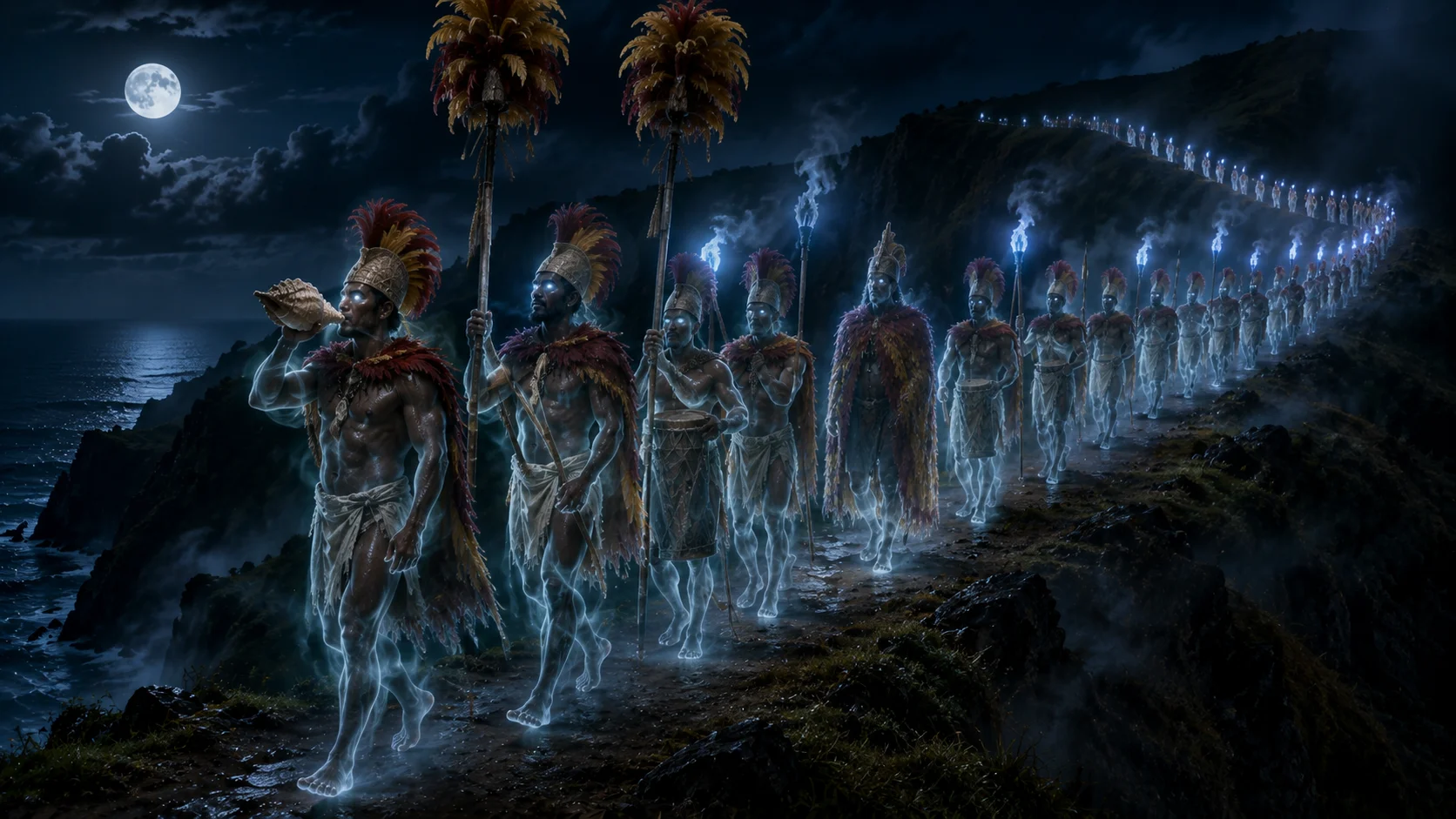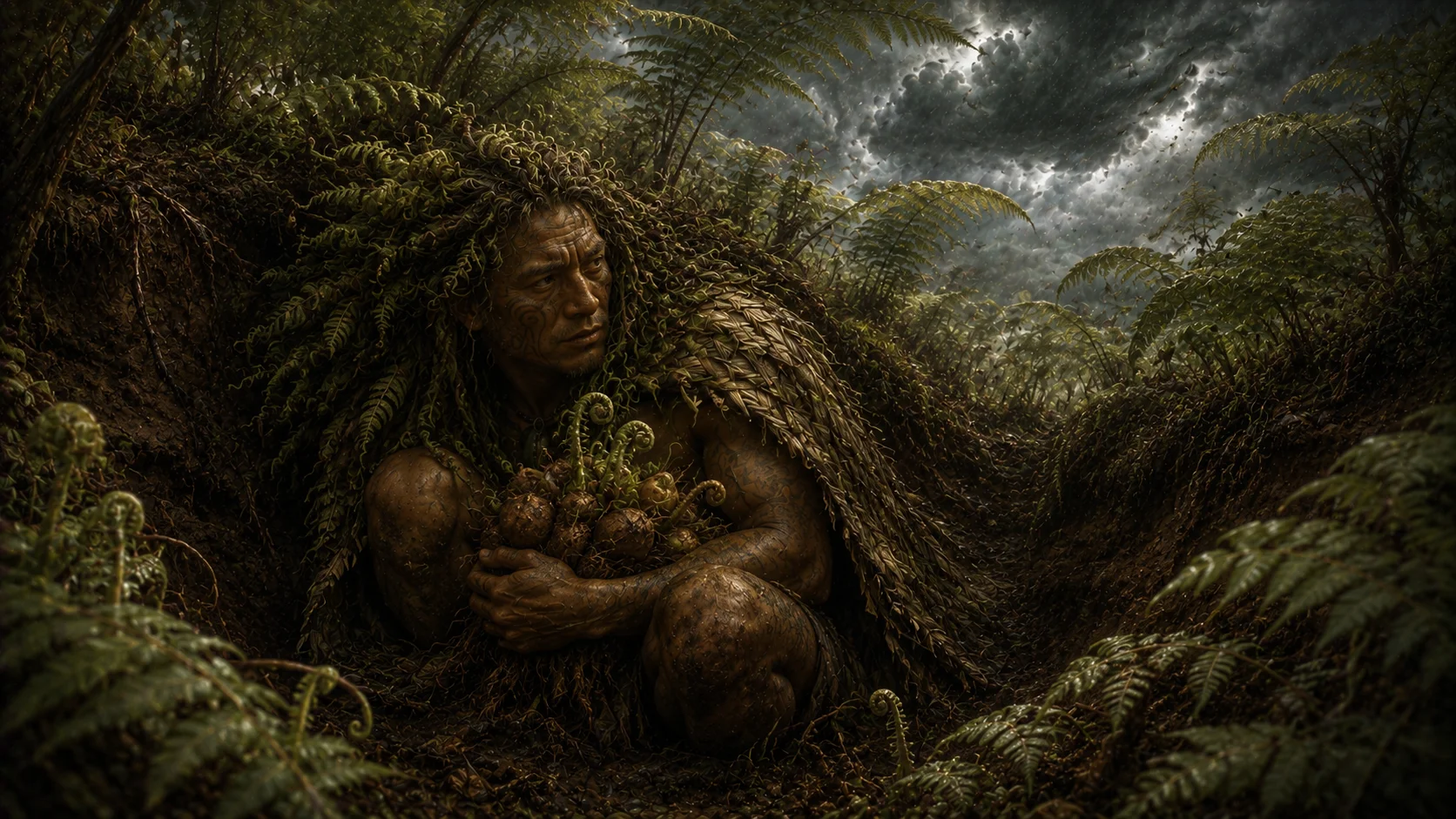
Haumia-tiketike — known also as Haumia, Haumia-tikitiki, or Haumietiketike — is the atua who watches over the food that no hand plants and no hand tends: the fernroot, aruhe, that rises from the bracken across the hills and valleys of Aotearoa without asking anything of the people who depend on it. Where his brother Rongo-ma-Tane presides over the labour of the kumara garden, Haumia presides over abundance that simply is — food offered by the land itself, gathered rather than grown. To speak his name is to speak of one half of the Māori understanding of sustenance, the wild half, the half that answers to no season of planting and no rite of harvest but its own quiet, underground persistence.
A Child of Rangi and Papa
Haumia-tiketike belongs to the great company of atua born from the union of Ranginui, the Sky Father, and Papatuanuku, the Earth Mother — the closely embracing pair whose children numbered, in most tribal recitals, somewhere near seventy. Among that vast whanau he stands as one voice within the smaller, more frequently told circle of siblings: Tane Mahuta, who would become lord of the forests and all who fly within them; Tangaroa, keeper of the sea and its creatures; Tawhirimatea, atua of wind and storm; Tu-matauenga, fierce father of war and of humankind; and Rongo-ma-Tane, guardian of the cultivated kumara. Haumia's place in this roster is not universally fixed — iwi traditions differ, and some tribal recitals name only the other five as the defining pillars of the creation cycle, leaving Haumia a quieter, more peripheral presence. Where he is named, though, he completes something: without him, the account of food itself would be only half told.
The Meaning Folded Into a Name
The second element of his name, tiketike — sometimes rendered tikitiki — carries the sense of loftiness, of a high-standing topknot, an image of something raised up and dignified even while its own habit is to hide low in the earth. Narrators across different iwi have turned this apparent contradiction over in different ways, and no single reading of the name is claimed as final. It is enough to notice the tension it holds: a name suggesting height, worn by an atua whose defining act in the old accounts is to go downward, into the shelter of his mother's body.
Rongo and Haumia: The Two Faces of Food
Haumia is rarely spoken of entirely alone. He is most often set beside Rongo-ma-Tane as one half of a deliberate pairing, and together the two of them map the whole territory of what feeds a people. Rongo governs the kumara — the crop that must be planted, tended through its growing months, and lifted from prepared ground by people who have organised their labour and their seasons around it. Haumia governs the aruhe — the fernroot that asks for none of this, that spreads through the bracken of its own accord and waits beneath the surface for anyone willing to dig. Between them these two atua do not compete so much as complete one another: cultivated and wild, laboured and given, the whole spectrum of how the old world was fed sits in the space between their names. In some tribal accounts the closeness runs deeper still, with Haumia treated less as a fully independent sibling in the same generation as Tane and Tangaroa, and more as a figure paired with or derived from Rongo — a reminder that Māori whakapapa is recited, not fixed, and that its shape shifts a little with every teller and every place.
Reluctant Witnesses to the Separation
The great turning point of the creation narrative comes when the children of Rangi and Papa gather to debate whether their parents, locked in unbroken embrace, should be forced apart to let light fall upon the world for the first time. It is Tane who presses hardest for separation and eventually succeeds in prising sky from earth. But the brothers are not united in this. Accounts recorded by Māori scholars — among them Te Rangi Hiroa, Sir Peter Buck, as well as the traditions gathered by George Grey in his account of Polynesian mythology — differ on exactly where each atua stood, and differ, too, by iwi. In several tellings Haumia stands with Rongo among the more reluctant voices, uneasy with the violence of forcing two loving parents apart, aligned instead with a quieter, more peace-inclined temperament that would come to characterise both of them ever after. It is not the stance of Tane, who acts; nor of Tawhirimatea, who rages. It is the stance of one who would rather the world had found another way.
Flight Into the Body of the Mother
That reluctance carries a cost. When the separation is done and light floods the world, Tawhirimatea — who alone among the brothers had opposed the act outright — turns his fury upon those who tore his parents from each other's arms. He unleashes storm and gale against Tane's forests, drives Tangaroa's creatures into confusion, and moves against every sibling he holds responsible. In the face of that onslaught, Haumia and Rongo do not stand and fight. They flee — and the place they flee to is the last place left that might shelter them: the body of their own mother, Papatuanuku. They dive into the earth itself, taking refuge in the one parent still capable of holding them close, and it is there, hidden inside her, that they wait out the storm-god's rage.
Why the Fernroot Grows Underground
This single act of hiding becomes, in the Māori telling of the world, the origin of a plain physical fact: why aruhe grows the way it does. Because Haumia took shelter within Papatuanuku rather than standing exposed upon her surface, the fernroot he represents grows beneath the soil rather than openly upon it, its rhizome threading through the earth out of sight. Where a cultivated plant like the kumara can at least be seen once it is planted, fernroot must be searched for and dug up, uncovered from the ground the way its own atua once uncovered himself in it. The physical act of harvesting — the digging, the working blind through soil to find what lies hidden — re-enacts, every time it happens, this single moment of flight and concealment from the storm.
Dragged Out by Tu-matauenga
The hiding does not last forever. Tu-matauenga, the atua of war and the ancestor of humankind, had first turned his own violence against Tangaroa and against Tawhirimatea and been defeated by both. Unable to prevail there, he turns instead upon the brothers who had not resisted him — Rongo and Haumia — and where they cannot be met in open contest, he simply seizes them. The old accounts describe him dragging both out from their hiding places by the hair. This, too, becomes an origin story rather than a mere episode: the leaves and fronds of the kumara vine and the fern are the "hair" spoken of, and to this day the harvester pulls at the visible green growth above the ground in order to find, beneath it, the root or tuber that is the true food. Every planting, every fernroot dug from a hillside, repeats the gesture Tu-matauenga first made against his own brothers.
A Staple Where the Kumara Could Not Grow
Beyond the realm of narrative, aruhe held real and considerable weight in Māori life. In regions where the climate made kumara cultivation difficult or impossible — cooler country, land less forgiving of a crop that needs warmth and careful tending — fernroot filled the gap left behind, and did so reliably, season upon season, without the risk that a failed planting could bring. It was not eaten raw: preparation demanded roasting and then pounding, working the tough root down into something a person could actually consume. This labour of processing, though different in kind from the labour of cultivation, was still labour — Haumia's gift arrived freely from the land, but it still asked something of the hands that would turn it into a meal.
A Quiet Atua, Rarely at the Centre
Unlike Tane's long and eventful history of populating the forest, or Tawhirimatea's storming rage, Haumia occupies a modest place in the wider mythological record. He is not given cycles of dramatic deeds; his story is essentially the one already told — the debate over separation, the flight into Papatuanuku, the seizing by Tu-matauenga — and beyond that narrow but significant role, the tradition largely lets him rest. Some tribal tellings, in fact, omit him from the primary list of siblings altogether, keeping their attention on the five more universally recognised atua: Tane, Tangaroa, Tawhirimatea, Tu, and Rongo. Where Haumia does appear, his character is consistent — passive rather than active, associated with peace rather than conflict, defined by what he provides rather than by what he does.
Rongo's Greater Prominence, and Haumia's Narrower Gift
It is worth being honest about where the emphasis in tradition tends to fall. Rongo, elsewhere honoured more broadly as an atua of peace as well as of cultivated food, carries a larger ceremonial presence in many accounts — peacemaking rites in particular are frequently linked to him. Haumia's domain, by comparison, stays close to the one thing he was given: the wild-growing food of the fernroot, and the meaning bound up in how it is found and gathered. He does not claim Rongo's wider ceremonial reach, and the tradition does not ask him to. His significance lies elsewhere — in what his very existence says about the character of provision itself.
Sustenance Without Asking
What Haumia offers, read plainly, is a counterweight to the entire logic of cultivation. Rongo's kumara demands preparation of soil, care through growing months, and a household organised around a planting calendar — an economy of deliberate labour. Haumia's aruhe demands none of that upfront. It is there whether or not anyone has planned for it, spreading through the bracken on hillsides no one seeded, waiting to be found by anyone with the patience to dig. In that sense he stands for a form of resilience distinct from the resilience of good planning: the resilience of a land that continues to give even when human effort has not been invested in it, a subsistence available in hard seasons precisely because it never depended on a good season to begin with.
What Remains in His Name
Haumia-tiketike is remembered, then, not through grand deeds but through a habit of quiet dependability — hidden in the earth from a brother's storm, dragged into visibility by another, and ever since bound to the plant that must be dug rather than picked. He is the reminder, carried in name and in narrative both, that not every gift a people rely on has to be laboured for in the way the garden is laboured for; some of it is simply there, folded into the land itself, waiting under the fern for someone to go looking.
Sources & traditions
- EncyclopediaWikipedia — Haumia-tiketike
- TraditionMaori texts, oral tradition and village tellings (New Zealand)
Myths change from area to area and from time to time. This chronicle follows the most widely told versions; tellings in other villages, regions and eras may differ.