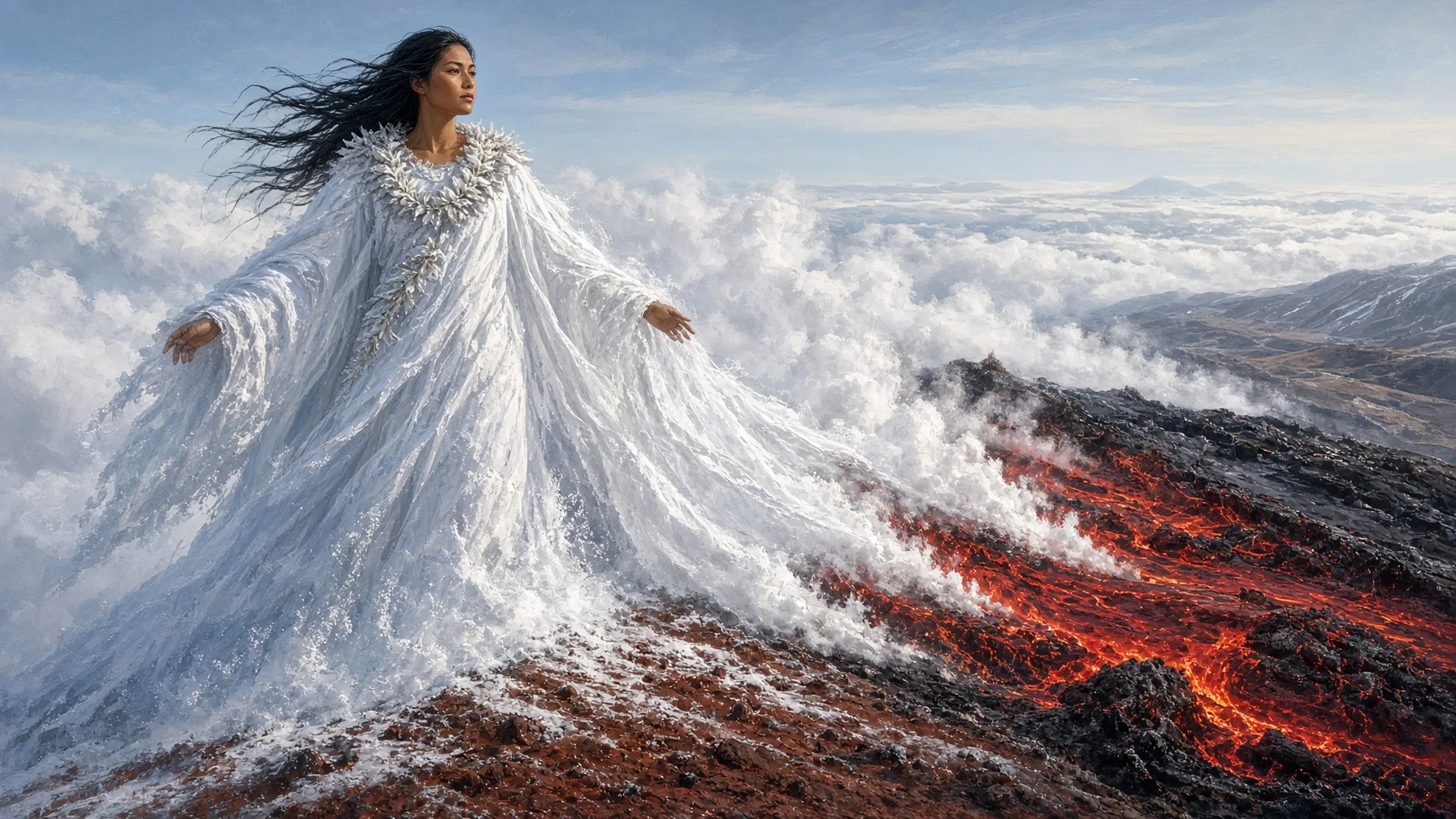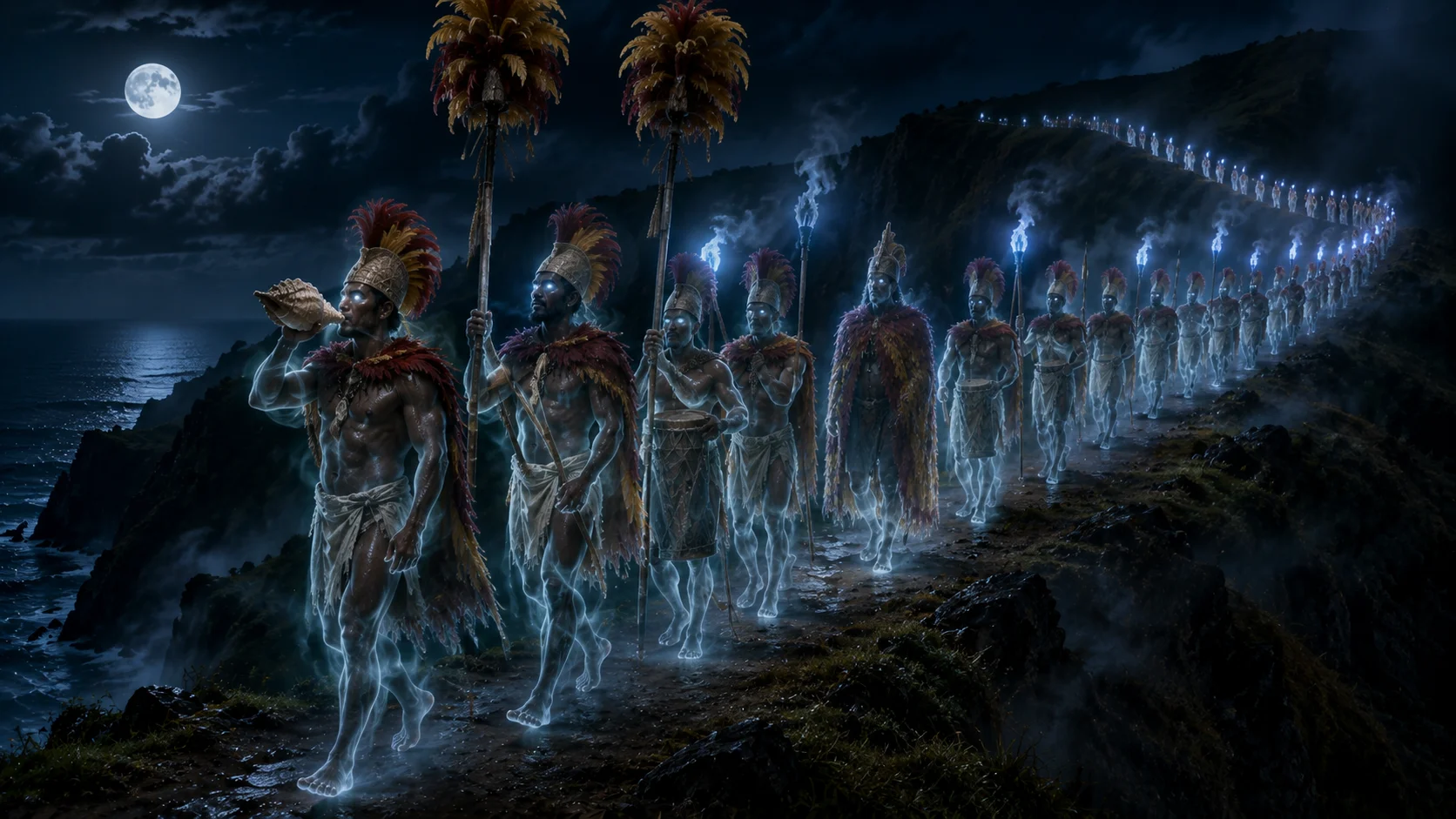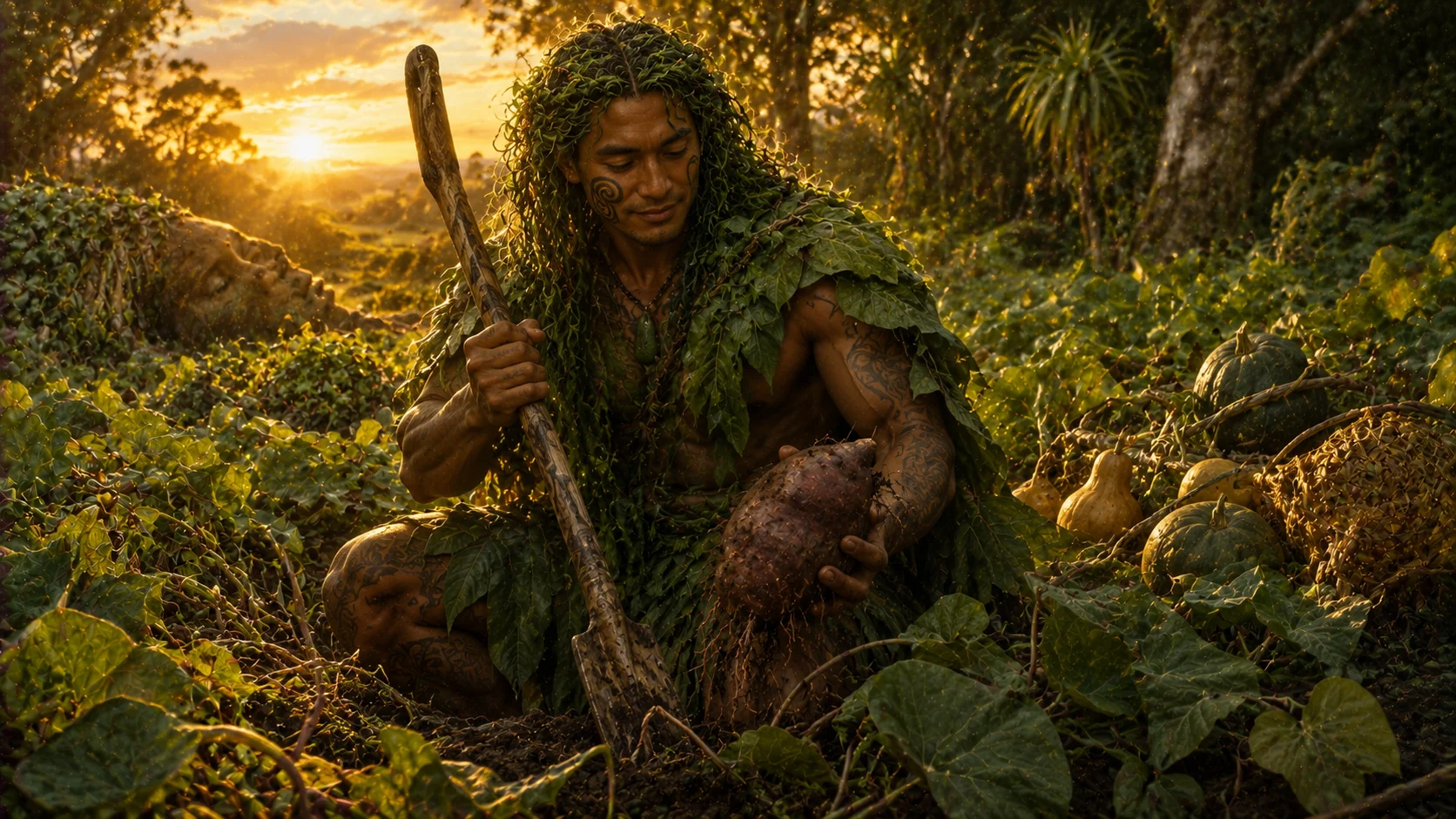
Rongo, known in full as Rongo-mā-Tāne, is one of the great atua of Māori tradition — a child of Ranginui the Sky Father and Papatūānuku the Earth Mother, born into the crushed darkness that held all their children pressed between their parents' bodies before the world had light. Of that whānau of primal children, Rongo carries a domain that touches nearly every meal ever grown from Māori soil: he is the atua of cultivated food plants, above all the kūmara, and by extension the atua of peace, of agriculture, and of the ordered, tended abundance that cultivation makes possible.
A Child Pressed in the Darkness
Before there was light, before Ranginui and Papatūānuku were pulled apart, their children lived crushed together in the cramped dark between their parents' embracing bodies. Rongo was one of these primal offspring, sharing that confinement with siblings whose domains would come to shape the entire visible world: Tāne, who would become guardian of the forests and birds; Tangaroa, lord of the sea; Tāwhirimātea, atua of winds and storms; Tūmatauenga, atua of war and the fierce ancestor of humankind; and Haumia-tiketike, guardian of the wild, uncultivated foods such as fernroot. In some tellings the earthquake-god Rūaumoko is numbered among them as well. It should be said plainly that this roster, and the birth order within it, is not fixed across the country — different iwi hold different genealogies, and Tainui, Te Arawa, and Ngāi Tahu accounts do not always agree on who came first, who did what, or even on the full list of names. No single published version, however often it is repeated, should be mistaken for the definitive one.
The Separation of Sky and Earth
The children eventually could bear the darkness no longer, and moved to separate their parents so that light might enter the world. In the version most widely told, it is Tāne who forces the separation, planting his shoulders against the earth and his feet against the sky and pushing until Ranginui was raised high above and Papatūānuku lay open beneath him. But this is not the only account. In certain tribal traditions, including some held by Tainui, it is Rongo himself who is named as the one who pushed the sky father upward — a different deed than Tāne's, but attributed to Rongo in those tellings all the same.
The War That Followed the Light
Separation did not bring peace. Tūmatauenga, atua of war and the ancestor through whom humankind descends, turned upon his brothers. He attacked Tāne's domain, felling the trees of the forest; he attacked Tangaroa's, dragging fish and sea creatures from the water. Against Rongo and Haumia-tiketike, though, Tūmatauenga's assault found no purchase, because the two food-gods did something the others had not: they hid.
Hidden Within the Body of the Earth Mother
Rongo and Haumia-tiketike took refuge inside the very body of their mother, Papatūānuku, burrowing into the earth itself to escape Tūmatauenga's rage. This act of hiding is given in tradition as the mythological origin of how kūmara and aruhe, the fernroot, come to be found growing within and drawn up out of the ground. Because they escaped Tū's assault where Tāne and Tangaroa did not, Rongo and Haumia are set apart in tradition as the two gods who answered violence with concealment and endurance rather than counter-violence — a distinction that shapes how both are understood ever after.
Guardian of the Kūmara
Of all the cultivated foods under Rongo's care, none is more closely bound to him than the kūmara, the sweet potato that became a cornerstone of Māori horticulture. Kūmara cultivation was never treated as ordinary labour; it was ringed with tapu, with specific rites and karakia addressed to Rongo, performed to secure a successful crop from planting through to harvest. The whare kūmara, the storehouses built to hold the harvested crop, and the māra kūmara, the cultivation grounds themselves, each carried their own ritual protocols, overseen by tohunga whose task was to invoke Rongo's blessing over the fertility of the ground and the safekeeping of what it produced. The kūmara itself was regarded as tapu, treated less as a mere foodstuff than as something touched by the atua whose name it grew under.
Pani and the Origins of the Kūmara
Rongo's role as the great patron of cultivated food does not stand alone in every account of the kūmara's origin. In some tribal narratives, Pani appears as the mother of the kūmara, and Rongo is invoked alongside her in explaining how the crop first came to the Māori people. This layering of figures is characteristic of how Māori oral tradition works — Rongo's domain over cultivated abundance intersects with other ancestral and atua figures depending on which iwi is telling the story, and the presence of Pani in some accounts does not diminish Rongo's guardianship so much as show the range of tradition surrounding a food so central to survival and identity.
Reading the Stars for Planting
Some traditions link Māori horticulture closely with the sky. In these accounts, the rising of the star cluster Whānui, known in the wider world as Vega, or of other stars marking the turning of the seasons, signalled the proper time for planting the kūmara. Ceremonies held at that moment in the maramataka, the lunar and seasonal calendar, were directed toward securing Rongo's blessing over the coming crop. Where this tradition is held, Rongo's domain reaches beyond the soil itself and into the sky that told cultivators when to break the ground.
The Atua of Peace
Rongo's second great domain, closely linked in tradition to his guardianship of cultivated food, is peace itself. Where Tūmatauenga presides over war, conflict, and the violent side of human nature, Rongo presides over its opposite: the laying down of weapons, the making of peace between parties who had been at war, and the return to ordered, cultivated life once conflict has ended. In some traditions, peace ceremonies performed after fighting had ceased were conducted with Rongo specifically invoked, his name called upon to bless a reconciliation much as it was called upon to bless a harvest. The pairing reflects a symbolic opposition running through the tradition: cultivation and peace set against conflict, embodied respectively in Rongo and Tūmatauenga.
What the Name Itself Carries
The word rongo carries meanings in Māori language connected to hearing, to news or report, and to peace itself. Scholars have drawn a thread between this linguistic cluster and the god's peaceful, harmonious character, set against the violent domain of his brother Tūmatauenga.
Rongo Beside Haumia
Throughout tradition, Rongo is most often spoken of in the same breath as Haumia-tiketike, his companion in hiding and his counterpart in provision. Where Rongo governs the cultivated crops — the kūmara chief among them — Haumia governs the wild, uncultivated foods such as aruhe, the fernroot gathered rather than grown. Together they represent the full breadth of Māori food gathering, the tended and the wild held side by side, and together they stand in symbolic opposition to Tūmatauenga: cultivation and peace against war and human violence, two brothers who escaped by hiding set against the brother whose whole nature is to fight.
A Name Carried Across the Pacific
Rongo's presence is not confined to Aotearoa. Across wider Polynesia he has close cognates who carry his character, sometimes under his own name and sometimes transformed. In Hawaiian tradition he corresponds to Lono, a god of fertility, agriculture, and peace whose season is marked by the great Makahiki festival. Related figures appear in Tahitian, Rarotongan, and Mangaian tradition as well, and on some islands — Mangaia among them — Rongo is not a secondary figure at all but one of the major ancestral and creator deities of the whole cosmology. This variation is worth sitting with rather than smoothing over: it shows a god whose importance shifts from island to island, sometimes a beloved patron of the kūmara garden, sometimes standing near the very centre of how a people understand their own origin.
Carved Into the Meeting House
Rongo's presence endures in the wharenui, the carved meeting houses that hold a community's ancestry in wood. Poupou, the carved ancestral figures that line a wharenui's interior, in some houses depict or reference Rongo among the children of Rangi and Papa, placing him within the visual genealogy a community lives alongside. Place names across the country carry his name as well, reflecting his ongoing symbolic presence in Māori art and oral tradition as guardian of cultivated abundance and peace.
Sources & traditions
- EncyclopediaWikipedia — Rongo
- TraditionMaori texts, oral tradition and village tellings (New Zealand)
Myths change from area to area and from time to time. This chronicle follows the most widely told versions; tellings in other villages, regions and eras may differ.