Tāne, known in his forest aspect as Tāne-mahuta, is one of the great atua of Māori tradition — son of Ranginui the sky father and Papatūānuku the earth mother, and the one among their many children who succeeded in parting his parents and letting light into the world. He is atua of the forests and of the birds that fill them, credited in widespread tradition with clothing his naked parents, shaping the first woman from the red earth, and climbing through the heavens to bring the baskets of sacred knowledge down to humankind. As with all Māori atua, the precise names, deeds, and genealogical placement attributed to Tāne differ from iwi to iwi, and these differences are recognised here as genuine variation within a living oral tradition rather than as error to be smoothed away.
Born Into the Long Darkness
In the traditions recorded by nineteenth- and twentieth-century compilers such as George Grey, Elsdon Best and S. Percy Smith, and carried independently within iwi accounts long before any of them wrote a word of it down, Tāne is one of the sons of Ranginui and Papatūānuku, the primal pair who lay locked together in an embrace so close that no light could pass between them. Their children were pressed into the cramped darkness of that embrace, growing there through the long ages of Te Pō, the night, unable to stand upright, unable to see one another, unable to become what they might become. Among those children were Tangaroa, atua of the sea, Tāwhirimātea, atua of storms and weather, Rongo, atua of cultivated food, Haumia-tiketike, atua of food that grows wild, and, in most tribal lists, Tū-matauenga, atua of war. Tāne grew among them in that pressed and lightless space, one voice among several brothers debating what was to be done about the world they had been born into.
The Brother Who Stood Like a Tree
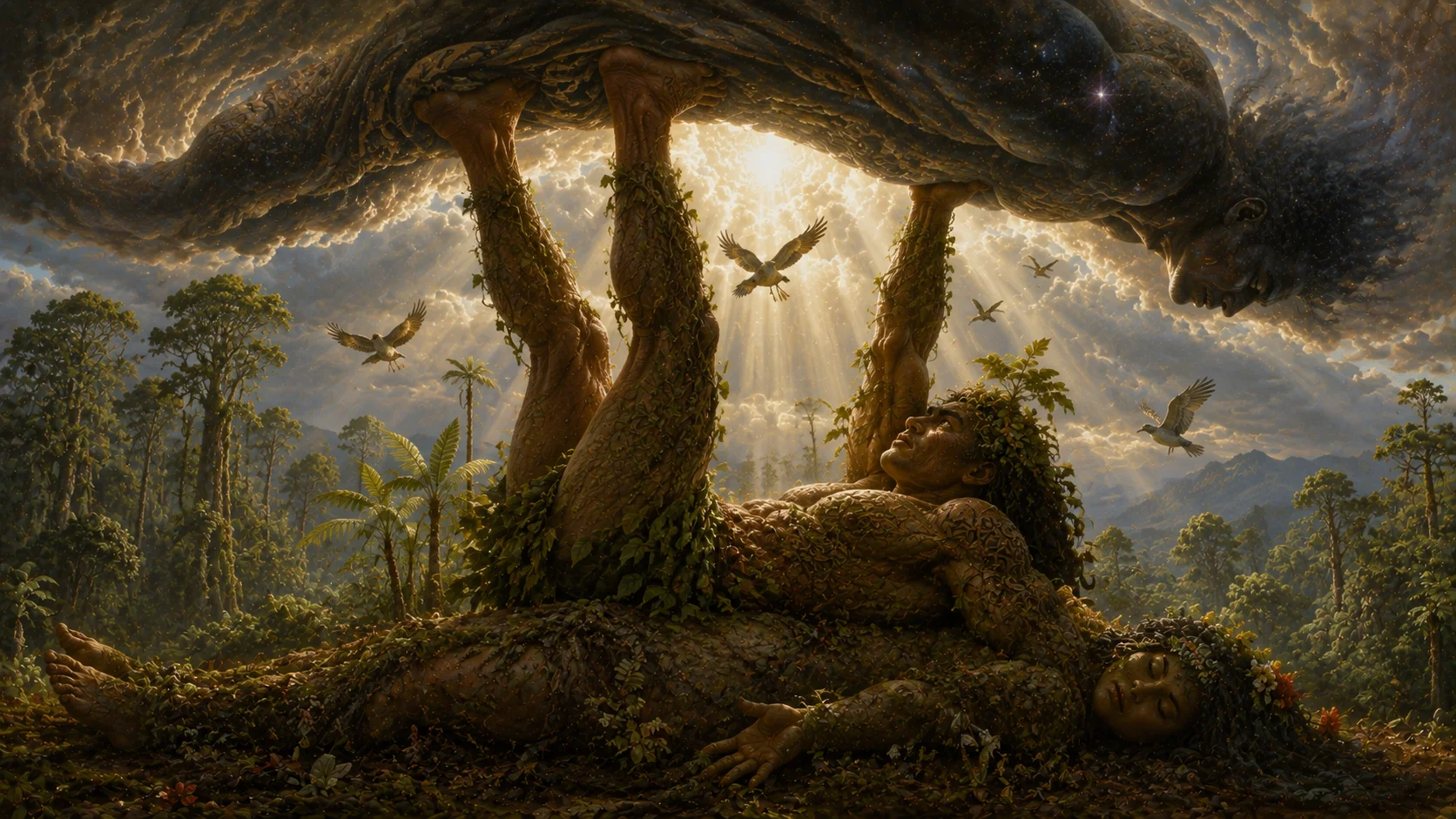
The question the brothers faced was severe: whether to kill their parents outright to end the darkness, or to find some other way to make room for life. Some traditions hold that Tū-matauenga urged the harsher course. It was Tāne who proposed, and then achieved, the separation itself. Rather than tearing his parents apart with violence, he set his legs against Papatūānuku and pressed his shoulders upward against Ranginui — bracing himself, in the phrase that recurs across accounts, like a tree rooted in the earth and reaching for the sky. Slowly, straining against the full weight of the heavens, he forced his father upward and his mother downward, until the space between them opened and light — te ao mārama, the world of light — poured in for the first time. It is this single image, of a god braced between earth and sky and holding, that stands as one of the most famous moments in all of Polynesian cosmology, and it gives Tāne his enduring character: not a warrior god but a grower, one whose strength is the patient strength of something rooted and upright.
Not every iwi tradition assigns this act to Tāne alone. A minority of accounts credit a different brother with the separation, and Māori mythology as a whole should be understood as a family of related, iwi-specific oral traditions rather than a single fixed text with one correct version. That the most widely recorded telling gives the deed to Tāne does not erase the accounts that differ; it simply marks which version has travelled furthest into general memory.
Clothing His Grieving Parents
Separation did not end the sorrow of Ranginui and Papatūānuku. Torn from the embrace they had shared since the beginning, the two continued to grieve for one another, and in many traditions that grief is written directly into the weather: Ranginui's tears fall as rain and settle as dew, and Papatūānuku's sighs rise as the mist that clings to valleys in the early morning. Tāne, credited in numerous accounts with easing this parting as best a child could, clothed his mother's bare form with the forests — every tree, fern and shrub of the Māori world understood as a garment laid over Papatūānuku's skin — and set the stars upon his father's breast to adorn the emptiness of the night sky. In this act the natural world stops being simply scenery and becomes instead the visible relationship between parted parents and the son who tried to comfort both: forest below, stars above, and weather itself as an ongoing expression of love and loss.
Lord of the Standing Forest
Having clothed Papatūānuku, Tāne is honoured above all as the atua of the forest and everything that lives within it, a role carried in the name Tāne-mahuta, lord of the forest. The great trees of the Māori world are reckoned as his children, and the birds that nest and call among their branches belong likewise to his domain. This is not a decorative association but a working one: to fell a tree for a canoe or a meeting house, or to snare a bird for food, was traditionally understood as taking something from Tāne himself, a transaction that called for ritual acknowledgement rather than casual use. That understanding survives today in contemporary kaitiakitanga, the guardianship and stewardship of native forests and birdlife, which draws its deeper meaning from Tāne's ownership of the woodland rather than from resource management alone.
The Enmity of Forest and Storm
Tāne's brothers remain present in his story as ongoing counterparts rather than figures left behind at the separation. Tāwhirimātea, atua of storms, is said in recurring tradition to have opposed the separation of the parents in the first place, and to have gone on afterward to make war on the domains of his brothers by hurling wind and rain against them. The forests that Tāne clothed the earth in bear the brunt of this assault season after season, trees broken and stripped by the very storms Tāwhirimātea commands — a rivalry between forest and weather that is told and retold wherever a storm brings down old trees. A related enmity runs between Tāne and Tangaroa, atua of the sea: canoes hollowed from Tāne's trees carry fishers out onto Tangaroa's waters, and the wooden hooks, weapons and vessels born of the forest are turned against creatures of the sea, an imbalance said to explain why Tangaroa's domain and Tāne's have remained at odds.
Shaping Hine-ahu-one From the Red Earth
A further and widely attested tradition credits Tāne with the making of the first woman. Wishing for a female counterpart, he is said to have gone to Kurawaka, gathered the red earth found there, and shaped it into the form of a woman — Hine-ahu-one, whose name is usually rendered as the earth-formed maid. Having shaped her, Tāne breathed life into her by pressing his breath into her nostrils, and she rose as a living being. He then took Hine-ahu-one as his wife, and in many tribal accounts their union stands at the genealogical root of humankind itself, the whakapapa that links the atua, through this one act of shaping and breath, down to living people. In this telling Tāne is not merely a god who acted upon the world but the ancestor through whom the world's people trace their own beginning.
The Daughter Who Became the Dawn
From the union of Tāne and Hine-ahu-one came a daughter, Hine-tītama, whose name carries the sense of the first light of dawn. She grew and, in due course, became Tāne's wife in turn, in keeping with the way these early genealogies are told. The turn in the story comes when Hine-tītama, in most versions, discovers that her husband is also her father — the exact manner of that discovery differing between tribal tellings, some more explicit than others about how the truth reached her. On learning it, she is overcome with shame and flees the world of light for the underworld, refusing to return despite Tāne's pursuit and pleading. In the depths below she takes a new name and a new nature, becoming Hine-nui-te-pō, the great woman of the night, goddess of death and guardian of the underworld to which all human beings eventually return. This is told across Māori tradition as the origin of human mortality: because of Hine-tītama's flight and transformation, death entered the world of her descendants, and the dawn-maiden who once stood for new light became instead the power that receives the dying at the end of life. It is a story handled with real weight in Māori tradition, its themes of shame, discovery and irreversible transformation treated as foundational rather than incidental.
Climbing to the Twelve Heavens
A further body of tradition credits Tāne with one of the great feats of Māori cosmology: the ascent through the twelve heavens to retrieve ngā kete e toru, the three baskets of knowledge, together with sacred stones, and to carry them back down to the world of light for the benefit of humankind. In these accounts Tāne climbs upward through heaven after heaven, overcoming the trials each level presents, until he reaches the source of wānanga, sacred knowledge, and returns bearing what would become the foundation of learning, ritual and understanding among people. This feat is not attributed to Tāne everywhere; a number of regional traditions instead give the same journey and the same prize to other culture heroes, most notably Tāwhaki, and both versions are correctly understood as authentic branches of the wider tradition rather than one being a mistaken copy of the other. Where the deed is attributed to Tāne, it adds a further dimension to a figure already responsible for light, forest life and the shaping of the first woman: he becomes, in those tellings, the one who brought wisdom itself within reach of human beings.
Many Names for One Great Life-Force
Tradition does not settle on a single fixed title for this atua but knows him under a cluster of names and aspects, each carrying forward a different facet of what he does in the world. Tāne-mahuta names him as lord of the forest; Tāne-nui-a-Rangi is another form recorded in various accounts; other epithets attach to his role as light-bringer or as progenitor of humankind. Which names are used, and exactly what each is understood to mean, varies between iwi sources, and no single list should be read as the complete or final one. Taken together, though, these names describe a figure whose defining quality is not any one deed but a continuous life-force running from the first parting of sky and earth, through the clothing of the forest, to the shaping of the first woman and the bringing of knowledge — light, growth, fertility and wisdom understood as expressions of a single underlying presence rather than separate powers.
One Line of Descent, Many Living Things
What holds these separate episodes together is whakapapa, the genealogical thread that in Māori understanding runs unbroken from the primal parents through the atua to the forests, the birds, and human beings themselves. Tāne stands at several of that thread's key junctures: son of Rangi and Papa, separator of the two, clother of the earth, father in some tellings of birdlife and forest growth, husband of the earth-formed woman, father of the dawn-maiden who became the goddess of death, and in some traditions the one who carried knowledge down from the heavens. To speak of forests, birds, human descent and sacred learning in Māori tradition is, by way of this genealogy, to keep returning to the same figure standing at the hinge between darkness and light.
Kāne of Hawai'i and the Wider Pacific
Tāne is not confined to Aotearoa. Across the wider Pacific he appears under recognisably related names in tradition after tradition, reshaped each time by the particular cosmology that received him. In Hawai'i he is known as Kāne, one of the four major akua, associated there with light, life and procreation and, notably, with fresh water and sunlight rather than specifically with forests — a real shift in emphasis from the Māori forest-god role, not a variant detail. In the Cook Islands and in Tahiti a figure named Tane or Tāne likewise holds major standing; in Tahitian tradition he is sometimes reckoned among the offspring or created beings of Ta'aroa, reflecting that tradition's more creator-centred cosmology, in which Tāne occupies a genuinely different structural position than the simple sibling relationship he holds with Tangaroa in Māori tradition. These are not distortions of a single original story but the visible fingerprints of one shared ancestral tradition, carried by voyaging peoples across the Pacific and reworked, generation after generation, to fit the world each community actually lived in.
A Presence Still Walked Beneath
Tāne's story does not end as a closed sequence of ancient events; it continues wherever people walk beneath standing trees or listen for birdsong in native forest, both understood in tradition as belonging to him still. The god who stood like a tree to force light into the world remains bound to actual trees, actual birds, and to the ongoing responsibility of caring for them — a responsibility carried today under the name of kaitiakitanga. In that sense the account of Tāne is less a finished myth than a living relationship, renewed each time someone enters a forest with the understanding that they are stepping, briefly, into ground that belongs to him.
Sources & traditions
- EncyclopediaWikipedia — Tāne
- TraditionPolynesian folk and village traditions
Myths change from area to area and from time to time. This chronicle follows the most widely told versions; tellings in other villages, regions and eras may differ.