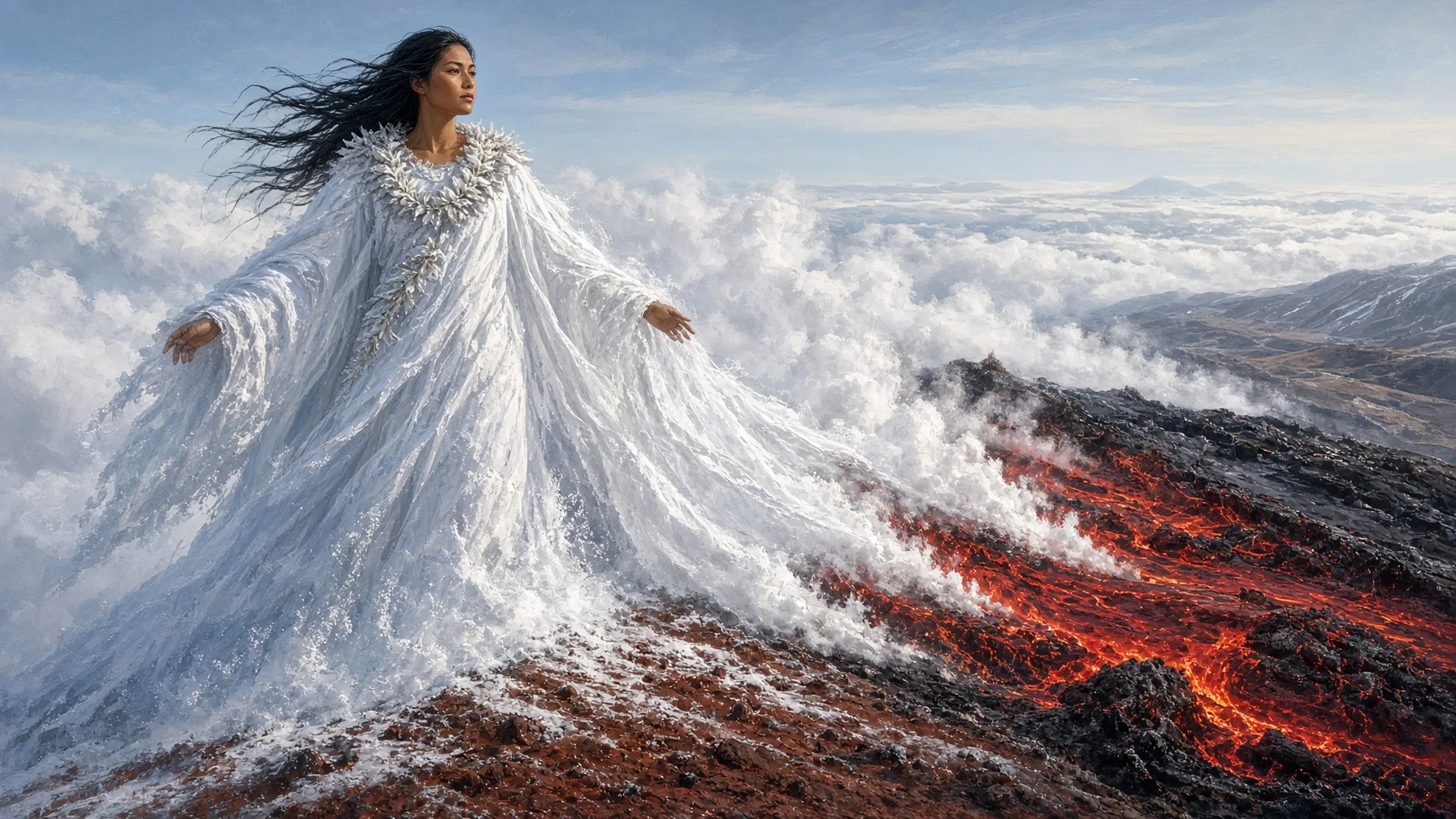
Poliahu is the akua of snow who dwells upon the summit of Mauna Kea, the tallest mountain in the Hawaiian Islands. She is celebrated in moʻolelo (oral tradition and legend) as a being of radiant, cold beauty, wrapped always in a mantle of pure white snow, and as the eternal rival of her fiery sister, the volcano goddess Pele. Where Pele commands the molten rivers of Kīlauea and Mauna Loa, Poliahu commands the frozen heights above them, and the tension between the two — ice against fire, stillness against eruption — is one of the most enduring oppositions in Hawaiian cosmology.
The Goddess Who Wears the Mountain
Poliahu's name itself is often understood to carry this image within it: interpreters trace it to "poli," meaning bosom or breast, and "ahu," a cloak or covering, so that her name evokes the snow lying over the mountain's summit the way a garment lies over a body. Hawaiian oral tradition describes her kapa hau, her cloak of snow, as both an actual mantle she wears and a poetic description of Mauna Kea itself in the months when its peak is white. To speak of Poliahu's cloak is to speak of the mountain's snowline, and the two images were never fully separated by the people who told her stories.
She is not the only spirit said to inhabit those heights. Hawaiian tradition names three companions who share the snow-capped summit region with her: Lilinoe, goddess of the fine, drifting mist that gathers around the peak; Waiau, whose name and presence are tied directly to the small, sacred lake near Mauna Kea's summit; and Kahoupokāne. Together these four are sometimes spoken of as the snow deities of the mountain peaks, each responsible for a different face of the cold, high world above the clouds.
Lake Waiau, the Sacred Water of the Summit
Near the very top of Mauna Kea, at an elevation of roughly 13,020 feet, lies Lake Waiau, a place regarded in Hawaiian tradition as sacred. The lake takes its name from, and is understood to be inhabited by, the goddess Waiau, Poliahu's companion among the summit spirits. In the moʻolelo of this region, the lake is not simply water sitting in volcanic rock; it is a living presence at the roof of the island, tended by the same family of snow deities who watch over the peak below.
The Beauty of Cold Fire
Where Pele is remembered as passionate, quick to anger, and associated with the transformative violence of the volcano, Poliahu is remembered in the old accounts as serene, luminous, and untouchable — a beauty of an entirely different temperature. Storytellers such as those recorded by King Kalākaua in "The Legends and Myths of Hawaii" and by Nathaniel Emerson describe her as extraordinarily lovely, and her rivalry with Pele is remembered as being fought not only over territory but, in at least one well-known telling, over the affections of a chief named Aiwohikupua. In that telling, the two goddesses become rivals in love as much as in landscape, each embodying a different ideal of beauty and power within the same island world.
The Holua Race Against Pele
The most widely told moʻolelo of Poliahu is the account of a sled-racing contest, a holua race, run against Pele down the slopes near Mauna Kea. In this story Pele arrives in disguise, appearing as a beautiful stranger rather than revealing herself as the volcano goddess, and challenges Poliahu to the race. Poliahu wins. Stripped of her disguise and her pride, Pele's fury breaks loose in the form her nature always takes — she erupts, sending rivers of lava racing up the mountain toward Poliahu in an attempt to destroy her.
Poliahu's response is the heart of the story: rather than fleeing or retaliating with a violence of her own kind, she draws her mantle of snow around the summit, cooling and halting the lava with ice, repelling Pele's attack and holding the mountain as her own.
Kūkahauʻula, the Rose of the Summit
Hawaiian tradition also gives Poliahu a lover, or consort, in Kūkahauʻula, a figure who personifies the summit of Mauna Kea itself — and specifically the pink-hued snow of the peak at sunrise. In this pairing, the mountain becomes not only Poliahu's domain but her companion, its rose-tinted dawn light read as a tender counterpart to her white cloak. The legend folds this image of the summit's colored snow into the personal, relational language that Hawaiian moʻolelo so often uses to describe the natural world: not simply phenomena, but beings in relationship with one another.
Snow and Fire as a Map of the Island
The opposition between Poliahu and Pele mirrors something real and visible in the geography of Hawaiʻi Island: a single island holding both an active volcanic domain, hot and building new land, and a summit high enough to hold snow through parts of the year. Hawaiian cosmology treats this contrast as the ongoing relationship between two sisters, each sovereign over her own portion of the same island, their rivalry reflecting the geological contrast between Mauna Kea's snow-capped peak and Pele's volcanic domain on Kīlauea and Mauna Loa. This is characteristic of the broader Hawaiian principle of mana, spiritual power inhabiting the natural world, in which specific deities are bound to specific geographic features, elements, or forces rather than standing apart from them.
A Domain Distinct from the Great Akua
Poliahu belongs to a layer of Hawaiian religious thought that ethnographers such as Martha Beckwith, E. S. Craighill Handy, and Mary Kawena Pukui distinguished from the major akua — Kāne, Kū, Lono, and Kanaloa — who preside over broader cosmological domains. Poliahu, like Pele, is instead tied to a specific place and a specific set of natural forces: the snow of one particular mountain, rather than a general force governing the whole of existence. This does not make her a lesser figure in Hawaiian tradition; it situates her within a cosmology built from many such place-bound powers, each commanding real reverence within its own geography.
A Sacred Summit in the Present Day
Mauna Kea's summit remains one of the most sacred sites in Hawaiian cosmology, and Poliahu's association with it is central to why. In recent decades, proposals to build astronomical observatories atop the mountain have met sustained opposition from Native Hawaiians, who hold the summit as sacred ground — Poliahu's own domain — rather than as available land for development. This is not a historical footnote; it is a living expression of the same reverence recorded in the old moʻolelo, carried forward by people for whom Poliahu's mountain is not a myth of the past but a sacred place still owed care and respect in the present.
The Guardian Spirits Who Watch Over Families
Poliahu's story sits within a wider Hawaiian understanding of spirits bound to the natural world, one that also includes the ʻaumākua, the personal and family ancestral guardian spirits documented by Beckwith and later by Pukui in "Nānā I Ke Kumu." The word ʻaumakua joins "au," a period of time or era, with "akua," a god or spirit — an ancestor god, in effect, watching over the descendants of a particular family line.
Unlike Poliahu, who is tied to a single mountain, each Hawaiian ʻohana traditionally held its own ʻaumakua, passed down through generations, and different branches of the same family could carry different guardian forms. These guardians were believed to take the shape of animals — sharks, owls, lizards, eels — or even plants such as the ti leaf, depending on the lineage. The shark ʻaumakua, sometimes called ʻaumakua manō, held particular importance for fishing families and coastal communities, believed to protect fishermen and guide them safely home through storms. The pueo, the Hawaiian owl, is among the most widely recognized guardian forms, appearing throughout moʻolelo as a protector associated with wisdom and guidance, often credited with rescuing travelers who had lost their way.
Living Reverence for the Guardian Forms
Caring for the physical animal associated with a family's ʻaumakua — feeding it, protecting it — was traditionally understood as an act of reverence toward the ancestor spirit it embodied. The reverse carried real consequence: harming that species, or otherwise failing to honor it, was believed capable of bringing huhū, misfortune or illness, down upon the family responsible. Pukui and Handy's ethnographic work also records that ʻaumākua could reach across that boundary to communicate with the living, appearing in dreams, omens, and visions to offer warning or guidance to their descendants. Some ʻaumākua were understood even more specifically, as the spirits of particular deceased relatives who had undergone a ceremonial transformation, kapu ʻaumakua, into a guardian form after death.
Two Forms of the Same Reverence
Set beside one another, Poliahu's rivalry with Pele and the ʻaumakua tradition of guardian ancestors reveal two different scales of the same underlying belief: that the natural world is inhabited by beings bound in relationship to the people who live alongside them. Poliahu governs a mountain the whole island can see and every family shares; an ʻaumakua governs the fate of a single household, often through a single species of animal known only to that family's line. Both traditions ask the same thing of the living — attentiveness, respect, and the understanding that the mountain, the shark, the owl, and the mist are not simply features of the landscape, but presences owed a relationship that continues, unbroken, into the present day.
Sources & traditions
- EncyclopediaWikipedia — Poliʻahu
- TraditionHawaiian texts, oral tradition and village tellings
Myths change from area to area and from time to time. This chronicle follows the most widely told versions; tellings in other villages, regions and eras may differ.