Kamapua'a is the hog-god and shapeshifting trickster-demigod of Hawaiian tradition — a being who moves between the form of a man and the form of a bristling black boar (pua'a). He belongs to the windward, water-fed side of the islands, where storms roll in heavy and green things grow thick, and his most enduring story is his long, stormy entanglement with the fire goddess Pele.
A Child Almost Destroyed at Birth
Kamapua'a's origins are as unruly as the rest of his story. He was born on O'ahu to the woman Hina and the man Kahikiula, and from his earliest days he showed none of the calm expected of a child. Accounts describe him as monstrously destructive even in infancy — rooting up gardens, trampling what should have been left standing, and behaving with an appetite and a temper that alarmed everyone around him. His own family, unable to control him and fearful of what he might grow into, moved to have him killed. It was his grandmother, Kamaunuaniho, who intervened and spared his life, recognizing in him something that needed shaping rather than ending. That rescue set the pattern for the rest of his myth cycle: a being too large and too wild for ordinary judgment, kept alive by someone willing to see past the destruction to the power underneath it.
The Two Bodies of a Kupua
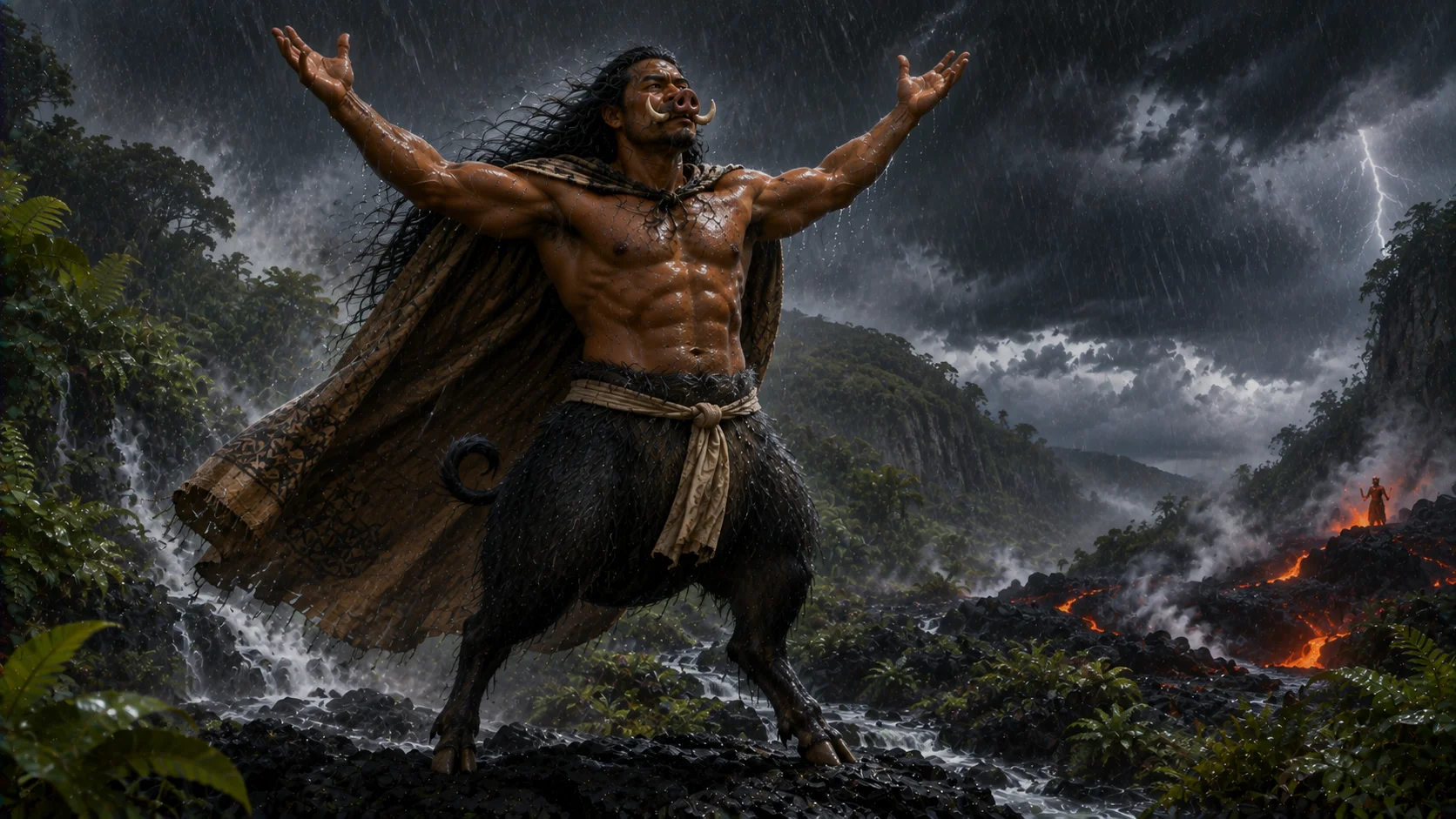
Kamapua'a is properly understood as a kupua — a demigod or nature-spirit capable of shifting between forms. His two known shapes stand in deliberate contrast to one another. As a man he is handsome and persuasive, and in that guise he does much of his courting and his mischief among mortals and gods alike. As a boar he is huge, black, and bristle-backed, a creature whose rooting and trampling can tear open hillsides and whose presence in a story often signals upheaval about to arrive. This fluidity between the two is not incidental decoration; it is the whole point of what kind of god he is. Every story about him plays with the gap between his human charm and his animal violence.
Lord of Rain on the Green Side of the Island
Kamapua'a is tied to fertility, rain, and agriculture on the windward, wetter sides of the islands — the slopes where clouds catch on the mountains and drop their rain, where streams run and taro grows and the ground stays soft and green. In this sense he is less a villain than a force of balance, associated with the growth and cultivation that a wet landscape makes possible. Farmers on the wet windward valleys had reason to honor a being whose rains fed their kalo patches, even as they respected how much damage an unchecked boar-god, or an unchecked rainstorm, could do to the same fields.
The Rivalry That Shaped the Land
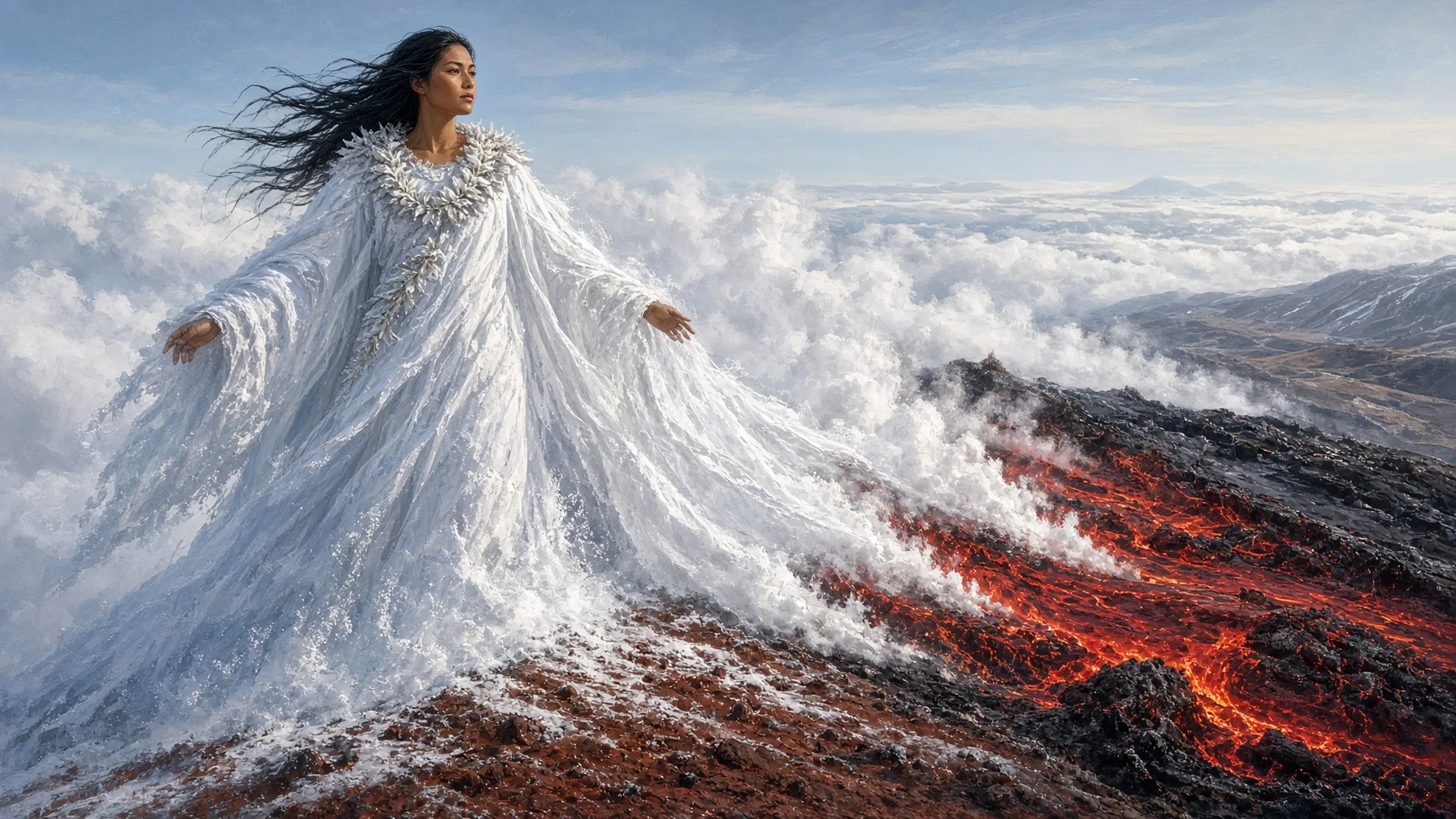
The central drama of Kamapua'a's myth cycle is his long contest with Pele, the fire goddess who commands the volcano and its molten rock. Their relationship moves between open warfare and something closer to a bitter, unstable romance, and Hawaiian tradition preserves both faces of it without insisting that one cancels the other. Their conflict is often read as an allegory — rain and vegetation on one side, volcanic fire on the other, competing over the land — playing out across real geography that anyone standing on a Hawaiian island can still see for themselves, from black lava fields on one side of a ridge to rain-soaked forest on the other.
Courtship, Insult, and War
The stories describing how the rivalry began vary, but many agree that Kamapua'a pursued Pele as a suitor, and that Pele rejected him — sometimes with open scorn for his boar-nature, mocking him as a filthy pig unworthy of her fire and her rank. Wounded pride turned quickly to violence. Kamapua'a attacked her in his boar form, and Pele answered with the only weapon suited to her: she called up her fires against him. Their battles are described as immense and landscape-altering, his rains hissing into steam against her lava, her fire scorching back the growth he sent rooting into her domain. Neither could fully defeat the other, and that unresolved balance is itself part of the meaning of the story — two forces too fundamental to the islands to ever finally cancel one another out.
Kapo's Flying Decoy
Not every episode between Kamapua'a and Pele's family ends in stalemate, and one of the more startling stories involves Pele's kinswoman, the sorcery and healing goddess Kapo. When Kamapua'a pressed his advances on Pele too far, Kapo intervened on her sister's behalf using a power unique to her: a detachable, flying kohe (vagina) that she sent out as a decoy to lure Kamapua'a away and give Pele the chance to escape his pursuit. The trick worked, and the episode is remembered in the place name Kalaeoka'i'lio on O'ahu, tying the story permanently to a specific point on the land. It is a vivid example of how Hawaiian myth treats the body, desire, and cunning as legitimate weapons in a conflict between gods, and it casts Kamapua'a's pursuit of Pele as something that occasionally required the intervention of her wider family to check.
A Trickster's Reputation
Across these stories, Kamapua'a consistently behaves as a trickster: charming when he wants something, capable of persuasive human form, but always liable to revert to destructive, appetite-driven boar behavior when thwarted or provoked. He is neither a purely benevolent agricultural spirit nor a purely destructive monster — he is both, depending on which side of him a given story needs. This duality is part of what makes him such a durable figure in the tradition. A god who only brought rain would be simple; a god who only destroyed would be simple in the other direction. Kamapua'a's staying power comes from holding both possibilities at once, the same way real weather does — the rain that saves a season's taro crop is the same rain that can flood and ruin a village if it does not stop.
Kinship with the Wider Pantheon
Kamapua'a's story does not stand alone; it sits inside the same web of relationships that produced Pele, Kapo, and their siblings. Hawaiian genealogical tradition traces a great many of these figures back to Haumea, the mother goddess and earth-goddess associated with childbirth and fertility, who is said to have given birth to Pele, to Hi'iaka, to Kamohoali'i, to Namaka, and to numerous other deities across her long, renewing life. Kapo herself is counted among Haumea's daughters in some genealogies, a sister to Pele and Hi'iaka. Seen against this backdrop, Kamapua'a's conflict with Pele is not simply a fight between two lone figures — it plays out within a wider family of gods bound by blood and by shared command over volcanic and sorcerous forces.
Fertility and the Meaning of the Pig
Kamapua'a's association with agriculture and rainfall places him alongside other major fertility figures in the tradition, though he occupies a rowdier, less orderly niche than a deity like Lono, whose agricultural blessings arrive through the ordered, peacetime rhythm of the Makahiki season. Where Lono's fertility is seasonal, processional, and tied to tribute and peace, Kamapua'a's is wilder and less predictable — rain that can come as a gift or as a flood, growth that can nourish a valley or overrun it, appetite that can feed a household or destroy its garden in a single night.
A Landscape That Still Tells the Story
What sets Kamapua'a's myth apart from a purely moral fable is how thoroughly it is anchored to real, visible land. The contrast between a windward valley thick with rain-fed green and a nearby stretch of black, dry lava sits at the heart of the story tradition tells about him and Pele — two natures, fire and rain, whose long contest is still legible in the ground itself. Traveling across almost any Hawaiian island still means crossing, sometimes within a short distance, from country that reads as Pele's to country that reads as Kamapua'a's, and the old stories were, among other things, a way of explaining that experience to anyone standing in it. In that sense Kamapua'a is less a settled character than a living explanation — one half of a pairing whose argument with fire is still written into the ground.
Sources & traditions
- EncyclopediaWikipedia — Kamapuaʻa
- TraditionHawaiian texts, oral tradition and village tellings
Myths change from area to area and from time to time. This chronicle follows the most widely told versions; tellings in other villages, regions and eras may differ.