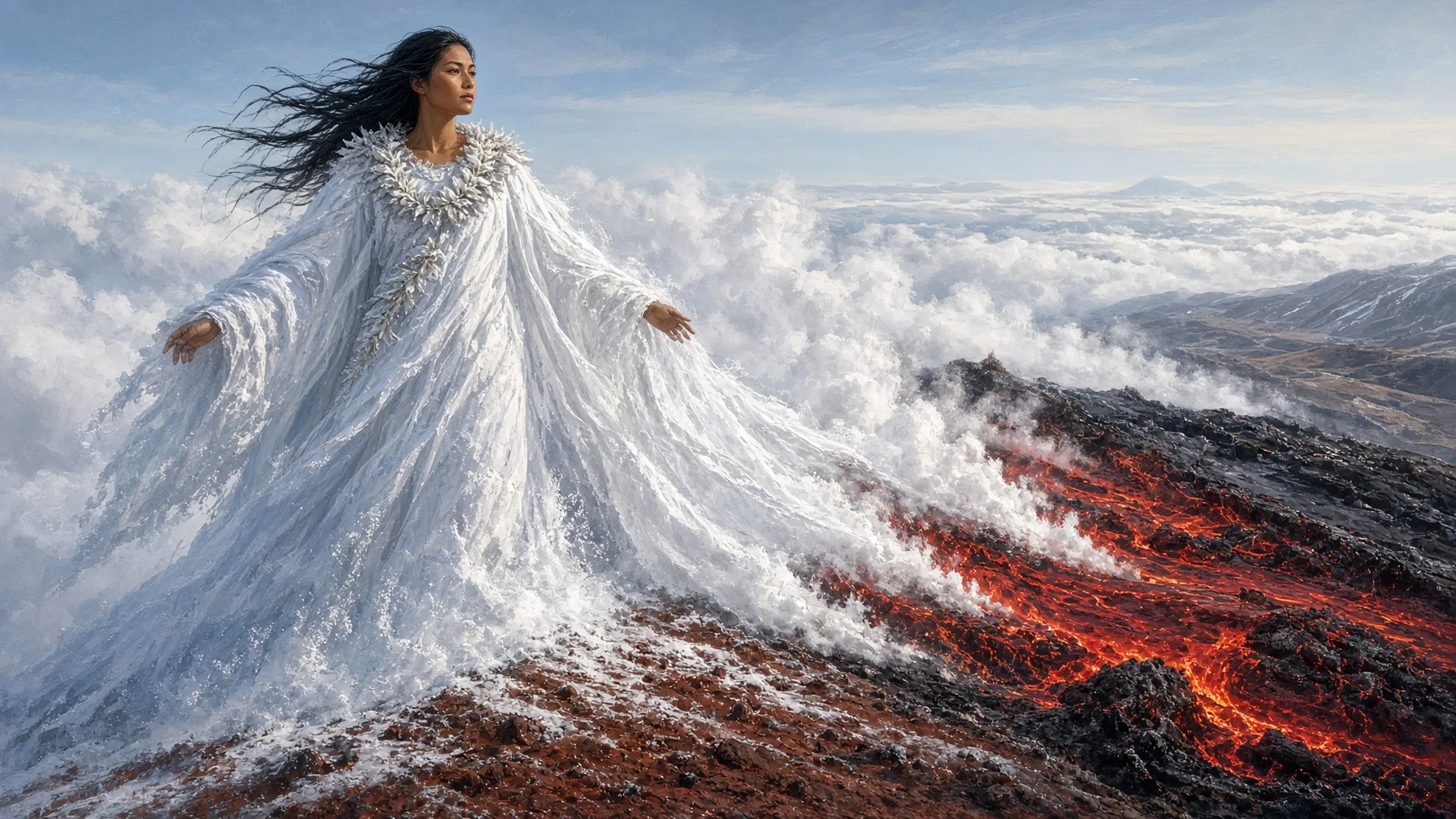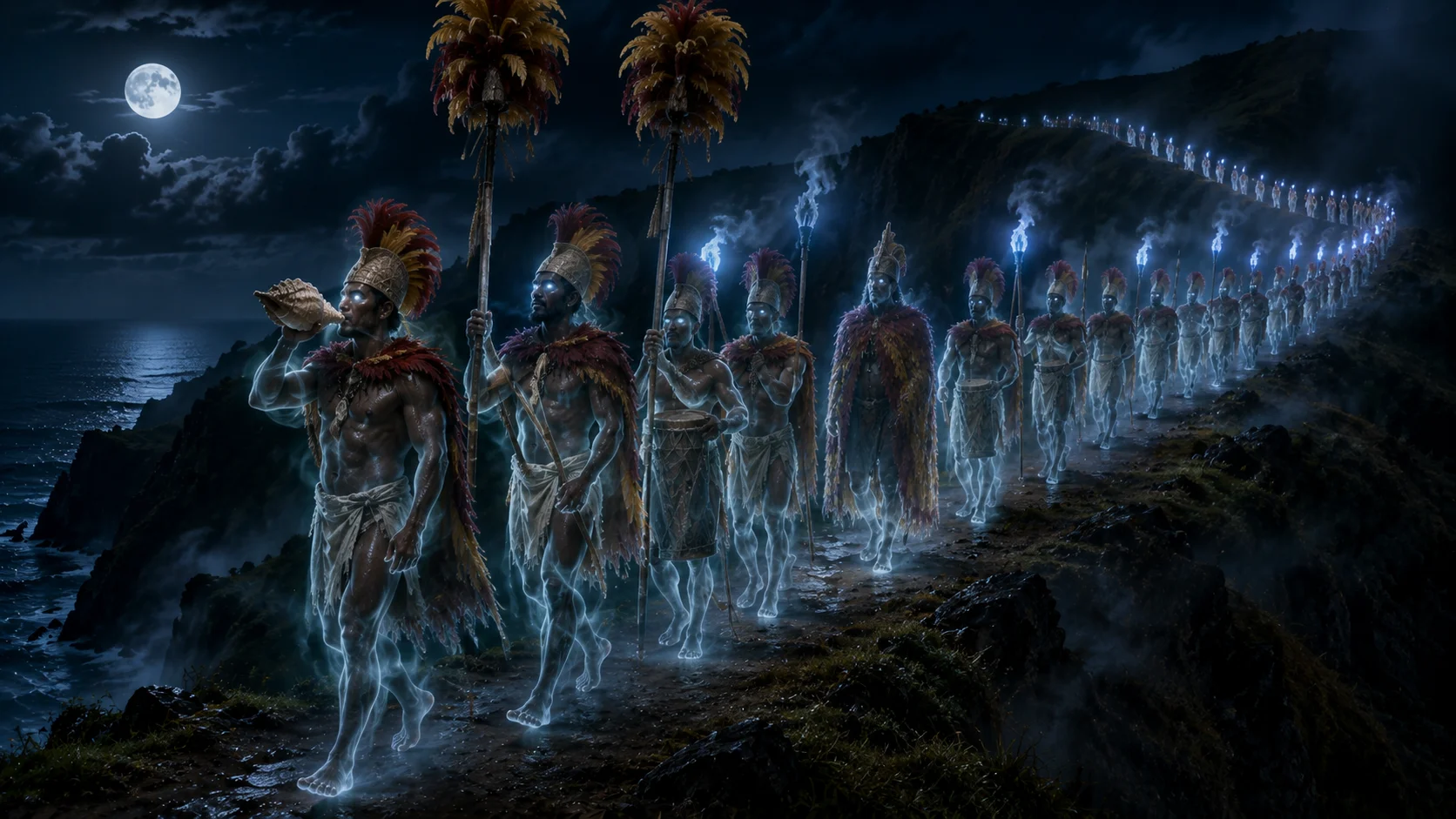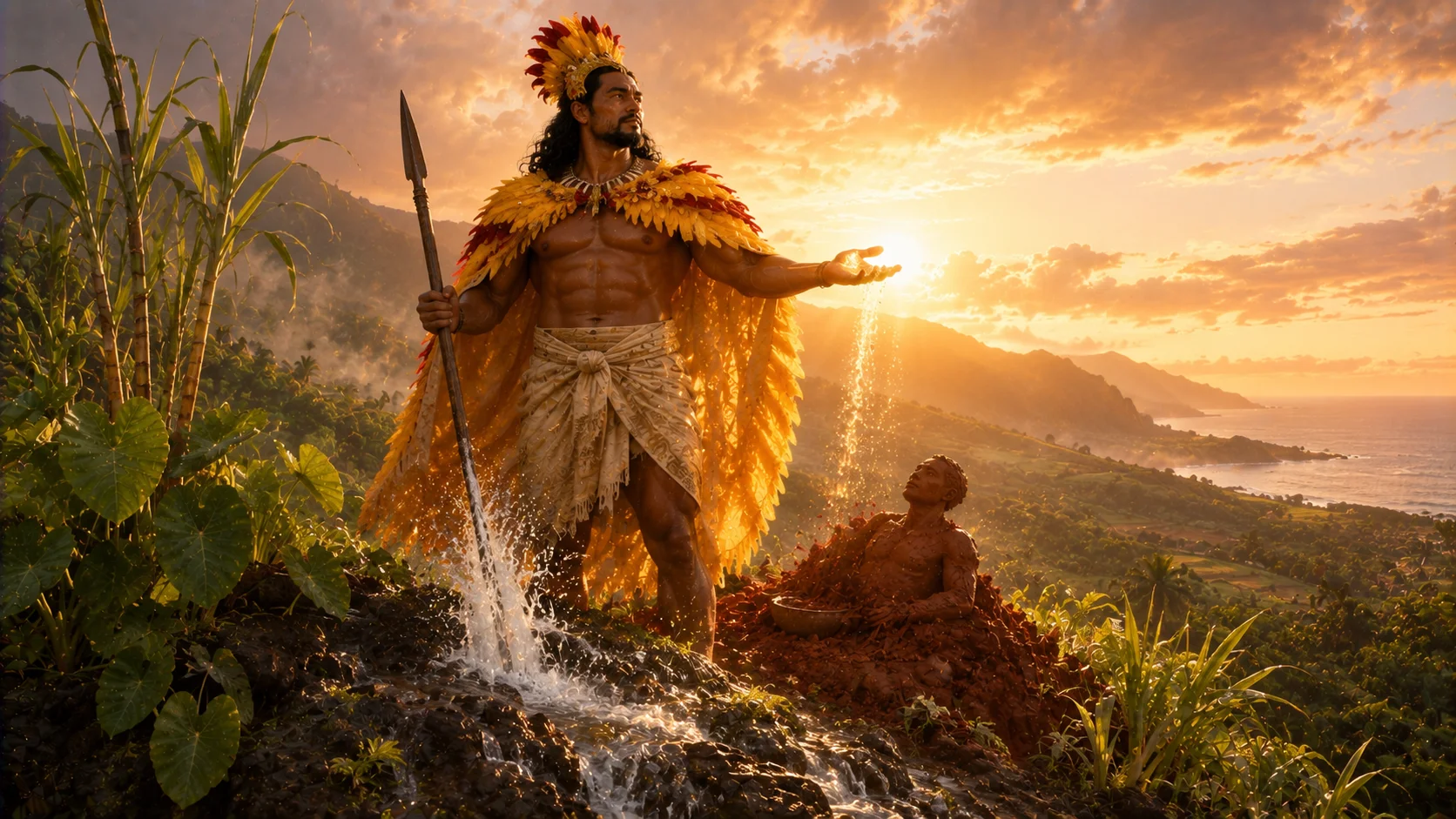
Kane stands as the highest-ranking of the great akua of Hawai'i, foremost among the four principal gods alongside Ku, Lono, and Kanaloa. He is the god of sunlight, fresh water, procreation, and the quiet, sustaining forces of life itself — the breath that animates rather than the spear that conquers. Where other akua are approached through carved images, feathered standards, and elaborate temple ritual, Kane is met most often in the open air: at a spring bubbling from lava rock, in the first light breaking over a ridge, in the simple, daily fact of water flowing downhill to a taro patch. His presence is less an event than a condition of the world continuing to work.
The Highest of the Four
Hawaiian tradition names Kane, Ku, Lono, and Kanaloa as the four great gods, and among them Kane is generally regarded as the highest-ranking. Ku governs the assertive, often martial energies of the world and claims many kino lau, or body forms, from the war god Ku-ka'ili-moku to the peaceable Ku-mauna of the mountains and Ku-ka-ohia-laka of the 'ohia forest. Lono presides over agriculture, rainfall, and the peace of the Makahiki season. Kanaloa is tied to the ocean and its depths. Kane, by contrast, is associated with sunlight, fresh water, procreation, and the creation of the first man. Beyond naming him first in rank, the surviving accounts do not spell out exactly how that precedence was understood or exercised, and this article does not claim more precision than the tradition itself offers.
Breath Given to Red Earth
The most enduring account of Kane's work places him alongside Ku and Lono at the creation of the first human being. In this telling, the three gods shaped a human figure out of 'alaea, the red earth of the islands, and it was Kane who bent to breathe life into the figure's mouth, nose, and ears. Depending on the version of the genealogy being chanted, the resulting man is called Kumuhonua or Wakea. The act is deliberately intimate — not a decree spoken from a distance but breath passed directly into a body, the same gesture a parent might use to revive a child. Life, in this account, is not conjured from nothing; it is given, person to person, and that gift is part of what makes Kane's place among the gods feel less like sovereignty and more like kinship.
Water as the Presence of Kane
Fresh water — wai — is considered a physical manifestation of Kane himself. This is not a metaphor applied loosely; in traditions where Kane has no formal heiau or idol, water, springs, and living things are where he is met and worshipped directly. Rain falling on a ridge, a spring that keeps flowing even in a lean season, the stream threading down toward a lo'i kalo — all of these could be understood as Kane made visible. The specific practices, terms, and land-management systems that different communities built around this belief varied, and the sources drawn on here do not detail a single named chant, phrase, or engineered system for it; what is well attested is the underlying idea itself — that fresh water is Kane's presence in the world, and that a place with reliable water carried a kind of favor.
A God Without a House
One of the most distinctive things about Kane's worship, in contrast to Ku's, is the near absence of formal heiau and carved idols dedicated exclusively to him in many traditions. Ku's war aspect, especially Ku-ka'ili-moku, was housed in feathered images and luakini heiau built for state ritual, including sites associated with human sacrifice such as Pu'ukohola Heiau, built by Kamehameha I in 1791. Kane's worship instead runs through unhewn stone, springs, groves, and the sunrise — nature itself standing in for a temple. This has sometimes been read as evidence of a gentler, less bloodied strand of devotion within Hawaiian religion, focused on nature and the continuity of life rather than conquest, though caution is warranted before flattening a complex tradition into a single moral contrast between the gods, and before assuming every community understood the absence of a heiau the same way.
Kane and the Wider Family of Akua
Kane's story does not stand apart from the rest of the Hawaiian pantheon; it sits alongside the same genealogical tradition that produces the sky father Wakea and the earth mother Papahanaumoku, whose union is remembered in chants such as the Kumulipo as the origin of the islands themselves, of the first taro plant, and of the first human ancestor, Haloa. The mother goddess Haumea, associated with childbirth and fertility and often identified with Papa, extends this same broader current of birth and renewal running through Hawaiian cosmology. Even the trickster boar-god Kamapua'a, whose rain and fertility associations put him in long conflict with the fire goddess Pele, belongs to a current of life-giving, growth-bringing forces often set against fire, war, and destruction in these stories. Kane is not credited as the author of every one of these figures, but his creative act at the beginning of the world places him near the source of that same current.
Light as a Living Force
Sunlight, in the context of Kane's worship, was never treated as mere illumination. Alongside springs and living things, sunrise itself was one of the places in nature where Kane was worshipped directly, without need of a carved image or a built temple. Light warms the soil, ripens the crop, and marks the turning of the day in a way that made it inseparable from the idea of active, benevolent life. This framing helps explain why Kane's worship so rarely needed elaborate apparatus: the sun rises on its own each day, asks nothing of the observer but attention, and needs no priesthood to summon it. Beyond this general association, the specific rituals different communities may have practiced at sunrise are not detailed in the sources this article draws on, and are not asserted here as settled fact.
Procreation and New Life
Kane's domain includes procreation directly, alongside sunlight and fresh water and his role in shaping the first human being. This threefold association — light, water, generation — runs through the same idea: Kane as the ongoing condition that makes new life possible, not only the god credited with a single act of creation long ago. His blessing around birth and fertility follows naturally from this, though the sources here do not go further into how, if at all, this connected to the formal genealogical rank-claims (moʻokūʻauhau) that mattered so much in Hawaiian chiefly society — that is a separate body of practice this article does not attempt to describe.
Guardianship Beyond the Great Gods
Alongside the four major akua, Hawaiian families maintained relationships with 'aumakua, personal or family ancestral guardian spirits who took physical form, or kino lau, as sharks, owls, sea turtles, or eels. These guardians occupied a different register from Kane's cosmic role — more intimate, tied to a specific household's history rather than to the operation of the natural world as a whole — but the underlying logic of the sacred taking recognizable, living form runs through both. A family that honored its shark or owl 'aumakua by observing a kapu against eating that species, and that watched for its guidance in dreams and warnings of danger, was practicing a smaller-scale version of the same attentiveness that treats fresh water as a form of Kane: the conviction that the sacred moves through ordinary living things, and that failing to recognize it carries real consequence.
Reading the Sources with Care
Much of what survives about Kane, as with Hawaiian tradition broadly, comes down through chant, genealogy, and oral memory that was later transcribed under colonial-era pressures, and different island traditions preserve different emphases and even different names for the same figures in the creation account — Kumuhonua in some versions, Wakea in others. Scholars have also long debated how literally to read certain moments of contact between Hawaiian religious life and outside events: the arrival of Captain Cook at Kealakekua Bay in January 1779, during the Makahiki season associated with Lono, is the most famous instance, with scholars such as Marshall Sahlins and Gananath Obeyesekere disagreeing sharply over how literally Cook was taken for the god. The same interpretive caution belongs to claims made about Kane's worship, much of which is preserved less richly in the historical record than the more ceremonially visible cults of Ku and Lono. These are living traditions maintained by Native Hawaiian communities today, not settled museum pieces, and the summaries here should be read as an introduction rather than the final word on beliefs still practiced and still evolving.
A Presence Still Found in Water and Light
What distinguishes Kane across all these threads — creation, water, sunlight, procreation, the quieter kino lau of Ku, the fertility carried by Haumea and Kamapua'a — is his refusal to be confined to a single temple, image, or myth cycle. He is less a character in a sequence of stories than a condition running underneath many of them: the light that lets the taro grow, the water that lets a family survive a dry season, the breath that let the first person open their eyes. To stand at a mountain spring at sunrise, in the framework his worshippers built, was not to visit a shrine to a distant god. It was to stand near evidence of him.
Sources & traditions
- EncyclopediaWikipedia — Kāne
- TraditionHawaiian texts, oral tradition and village tellings
Myths change from area to area and from time to time. This chronicle follows the most widely told versions; tellings in other villages, regions and eras may differ.