Ku stands beside Kane, Kanaloa, and Lono as one of the four great akua of Hawaii, and of the four he is the one whose name carries the most weight in a warrior's mouth. He is a god of war, but that single word flattens a figure who was, in the daily life of old Hawaii, everywhere: in the felled tree that became a canoe, in the fisherman's line, in the mountain forest, in the red-feathered image carried into battle. To understand Ku only as a war god is to see one kino lau — one body form — out of dozens, and to miss why his worship endured through peace as much as through conquest.
A Warrior God Among Equal Powers
In the genealogy of Hawaiian belief, Ku is not a solitary figure but one of a family of cosmic forces. Alongside Kane, the highest-ranking of the akua and the god of sunlight and fresh water, and Kanaloa, his frequent companion, Ku occupies a place that is at once elevated and intimate — he is invoked in chants for canoe-building, in prayers before planting, and in the rites of chiefs preparing for battle. His counterpart in the yearly ritual calendar is Lono, the god of agriculture, rainfall, and peace, whose Makahiki season each year (roughly October through February) suspended warfare entirely. That the islands organized their ritual year around an alternation between Ku's domain and Lono's is itself telling: war and peace were not separate realms so much as two faces of the same sacred order, each with its season, each demanding its own devotion.
Ku-ka'ili-moku, the Snatcher of Land
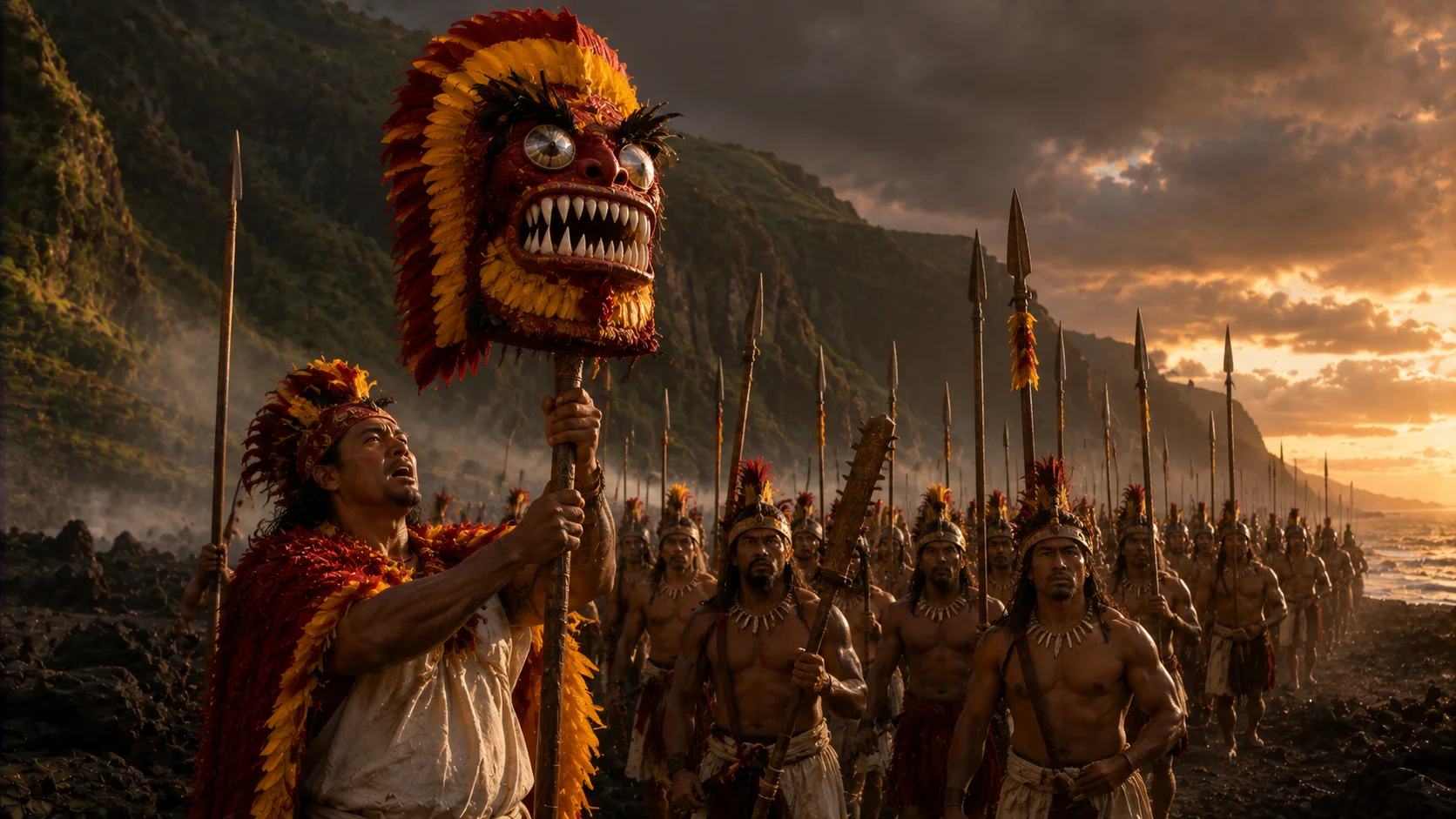
Among Ku's many manifestations, none looms larger in Hawaiian history than Ku-ka'ili-moku — literally, "Ku the land-snatcher." This was the war-god aspect embodied in a feathered image, passed down through chiefly lines as a sacred inheritance rather than a mere religious object. Kamehameha I received the image from his uncle Kalani'opu'u, and it became, by his own account and by the account of those around him, the spiritual force credited with his unification of the Hawaiian Islands by 1810. To carry Ku-ka'ili-moku into battle was to carry the concentrated mana of generations of chiefs before him — a claim to legitimacy as much as a request for supernatural aid.
The Feathered Image and Its Power
The image of Ku-ka'ili-moku was a sacred feathered image, treated as an active vessel of the god's presence rather than a static idol. It traveled with the chief who owned it, was cared for, and consulted before major undertakings. To possess it was to hold a physical, tangible link to divine favor — one passed from chief to chief as among the highest honors a ruler could inherit, and central enough to Kamehameha's own account of his rise that he credited it directly with helping unify the islands.
Pu'ukohola and the Weight of Consecration
Ku's war aspect demanded temples built and consecrated to match the stakes of the conflicts fought in his name. Pu'ukohola Heiau, raised by Kamehameha I in 1791 and dedicated to Ku-ka'ili-moku, stands as the most visible physical testament to this devotion — a luakini heiau, the class of temple associated with the most solemn state rituals, including, in the practice of that era, human sacrifice. These rites were bound closely to Ku worship and to the war temples built in his honor, and they belong to a part of Hawaiian religious history that deserves to be approached with care rather than sensationalism — as a practice embedded in a belief system where the stakes of war were understood in sacred as well as political terms, rather than as a spectacle to be elaborated beyond what is actually recorded.
The Gentler Faces of a War God
What separates Ku from a god of war alone is the sheer range of his peaceful kino lau. As Ku-mauna, he presided over mountains. As Ku-ka-ohia-laka, he was bound to the ohia tree, one of the most important trees in Hawaiian forest life. He governed fishing, forestry, farming, and canoe-building, domains that touched nearly every Hawaiian family regardless of rank or proximity to the chiefly wars fought under his fiercer name. A commoner who never saw a battlefield might still pray to Ku before felling a tree for a canoe hull or setting out to fish, invoking the god in a register entirely unlike the rites surrounding Ku-ka'ili-moku.
Kane, the Elder God of Light and Water
Kane occupies the highest rank among the major akua, associated with sunlight, fresh water, and procreation. Where Ku demanded feathered images and consecrated temples, Kane in many traditions had no formal heiau or carved idol at all — his presence was sought instead in springs, in the light of sunrise, in the quiet persistence of living things. Fresh water, wai, was considered a direct physical manifestation of him, which meant that reverence for Kane was, in a very literal sense, woven into the daily necessity of finding and protecting clean water. This contrast between Ku's monumental, image-centered worship and Kane's diffuse, nature-centered devotion illustrates how varied the textures of belief could be even among the four highest gods.
Shaping the First Human
One creation account brings Kane together with Ku and Lono in a single, foundational act: the three gods are said to have formed the first man from red earth, 'alaea, shaping the figure and breathing life into its mouth, nose, and ears. Depending on the version of the tradition, this first man is named Kumuhonua or Wakea. That Ku stands alongside Kane and Lono at the very moment of human creation is a reminder that his identity in Hawaiian cosmology reaches back before any war was fought — he is present at the beginning of things, not only at their violent turning points.
Wakea, Papa, and the Birth of the Islands
Wakea, the sky father, and Papahanaumoku, known as Papa, the earth mother, form the central pairing in Hawaiian genealogical chants such as the Kumulipo. Their union is credited with birthing the Hawaiian Islands themselves — Hawai'i island first among them — as well as the first taro plant and the first human ancestor. In one widely cited telling, Wakea's daughter Ho'ohokukalani bore a stillborn child who became the first taro plant, named Haloa-naka, and a second child, also named Haloa, who became the first Hawaiian person. This sequence establishes taro as an elder sibling to humanity, owed care and respect rather than mere cultivation — a relationship that still shapes how many Hawaiian families speak of poi and the land that grows it.
Haumea, Mother of Gods and Islands
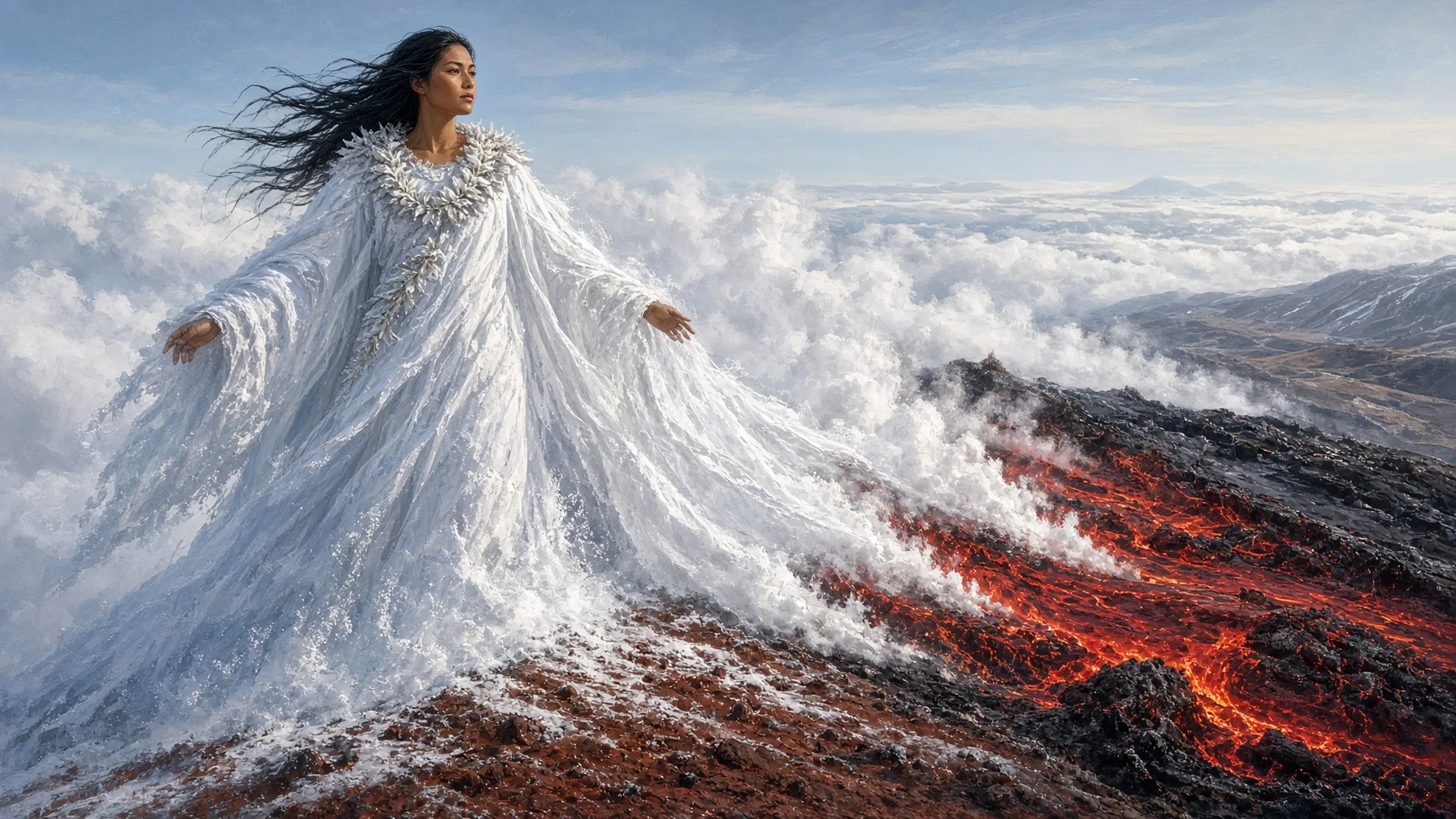
Haumea, goddess of childbirth and fertility, is often identified with Papa herself, the earth-mother figure at the root of the genealogical chants. She is remembered as the mother of an extraordinary lineage of deities, including Pele, Hi'iaka, Kamohoali'i, and Namaka, and her myths return again and again to her capacity for renewal — stories describe her repeatedly restoring her own youth by taking younger husbands. This rejuvenation motif places Haumea at the source of a lineage whose members — Pele among them — are themselves defined by transformation and continual change, each carrying forward, in their own domain, something of their mother's restless, remaking nature.
Kamapua'a, the Boar Who Brings Rain
Kamapua'a, born to Hina and Kahikiula on Oahu, is a trickster demigod able to shift between human form and that of a wild boar, pua'a. Associated with fertility, rain, and agriculture, he belongs especially to the windward, wetter sides of the islands — the natural opposite number to the volcanic fire of Pele. As a boar-child he was so unruly and destructive that his own family moved to kill him, and it was his grandmother, Kamaunuaniho, who intervened to save his life. His most famous myth cycle is his long rivalry and eventual entanglement with Pele, a relationship often read as an allegory: rain and green growth against volcanic fire, each claiming the same land in turn.
Kapo and the Rescue of Pele
Kapo, called Kapo'ulakina'u, is a goddess of sorcery, fertility, and healing, remembered in some genealogies as a sister of Pele and Hi'iaka and a daughter of Haumea. Her most striking myth involves her detachable, flying kohe, which she used as a decoy to distract Kamapua'a and rescue Pele from his advances — a story tied to the place name Kalaeoka'i'lio on Oahu. Kapo is also honored as a patroness of hula and is linked to the sacred maile plant used in its adornment, and she is invoked in kahuna 'ana'ana sorcery practices as a figure capable of both harming enemies and healing the afflicted.
The 'Aumakua: Guardians Within the Family
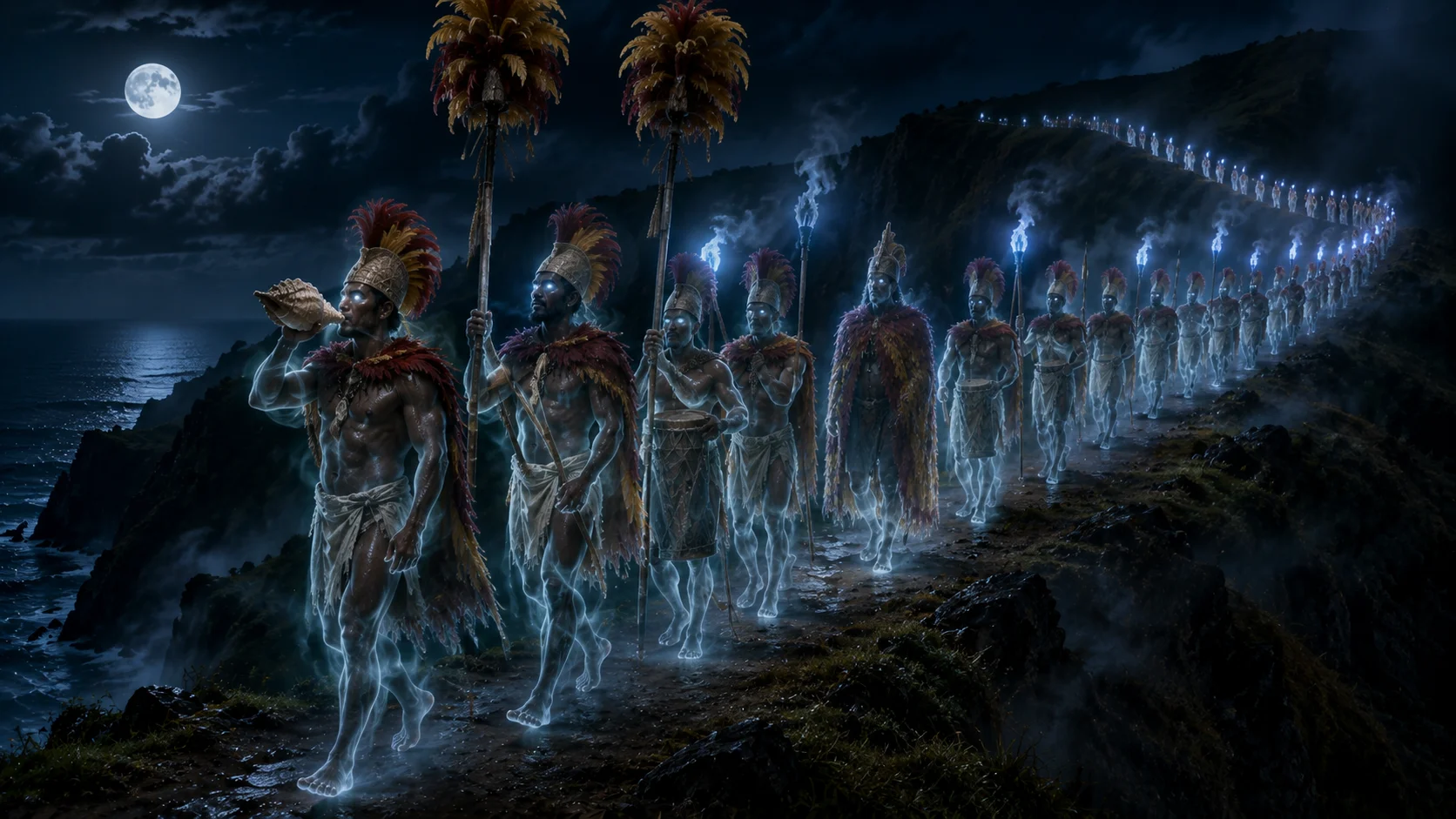
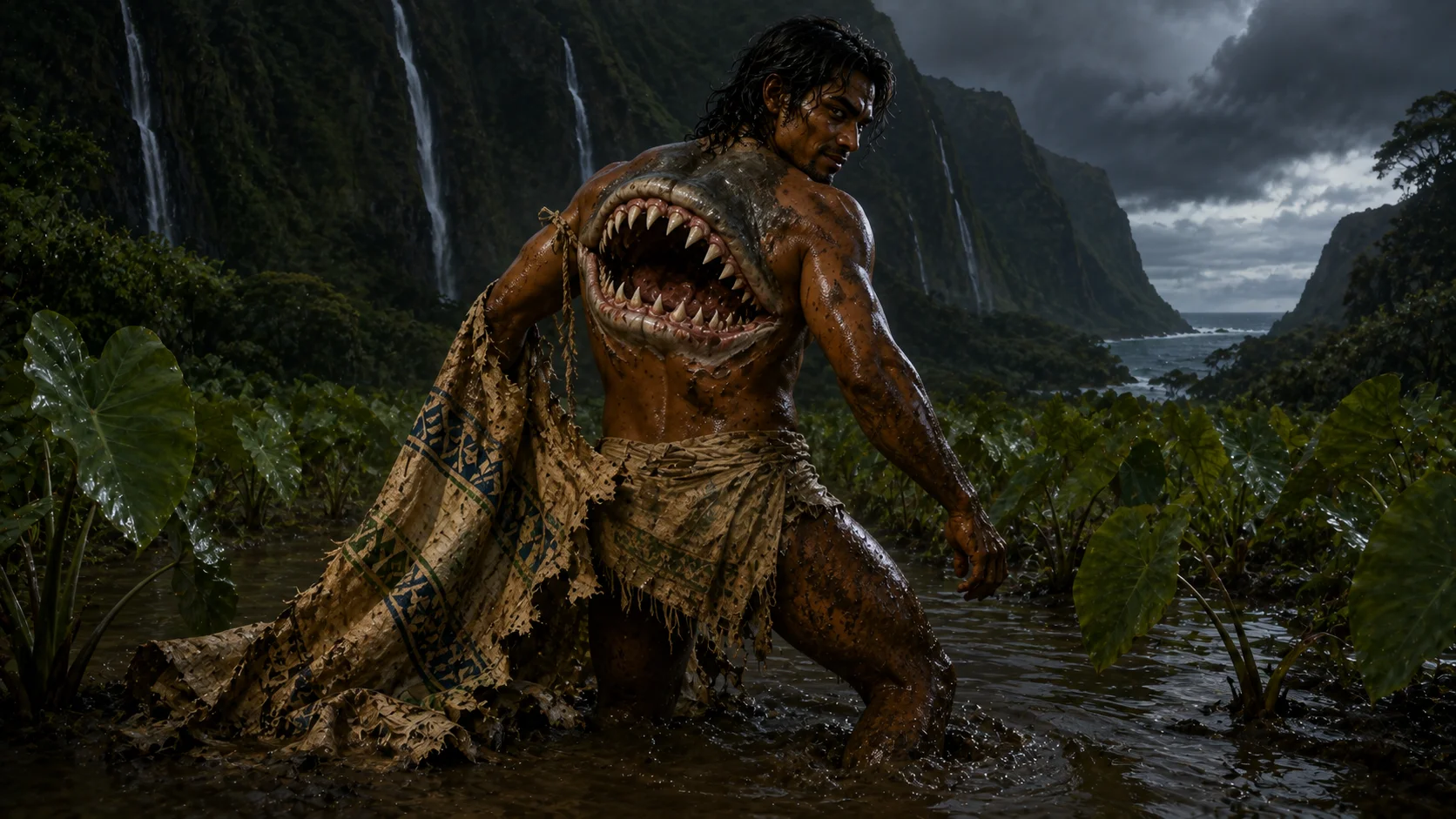
Distinct from the great akua, but woven just as tightly into daily Hawaiian life, are the 'aumakua — personal or family ancestral guardian spirits. These spirits were believed to take physical form, kino lau, as sharks, owls, sea turtles, or eels, among other creatures. A family's bond with its 'aumakua came with specific kapu: never eating the particular species that served as the guardian, since to do so risked offending, or in a real sense consuming, one's own ancestor. In return, the 'aumakua offered guidance, warned of danger, and extended protection to their living descendants, reachable through prayer, offerings, and dreams. This relationship placed the sacred not only in temples and chiefly images but in the ordinary animals moving through reef and forest, watched with a mixture of familiarity and awe.
Cook, Lono, and a Contested Season
Ku's calendar counterpart, Lono, is honored during the Makahiki season with an image called the akua loa — a long pole bearing a carved head and streamers of kapa and feathers — carried clockwise around each island to gather tribute, ho'okupu, from local chiefs. It was into this season that Captain James Cook sailed into Kealakekua Bay in January 1779, and some Hawaiians reportedly associated his ships' sails and the timing of his arrival with Lono. Scholars continue to debate how literally Cook was received as the god — a disagreement most associated with Marshall Sahlins and Gananath Obeyesekere — and the episode is worth holding with that scholarly caution rather than a settled certainty, since it involves the interpretation of a living people's religious response by outside observers.
War and Peace as a Single Order
Seen together, Ku and Lono describe less a rivalry than a rhythm: the Makahiki months of tribute, music, and forbidden warfare under Lono, and the rest of the year in which Ku's authority over war, chiefly power, and the harder labors of forestry and farming could resume. Kamehameha's rise, carried under the sign of Ku-ka'ili-moku, and the peaceful cultivation protected under Lono's Makahiki, were two halves of the same worldview — one in which the sacred touched the felling of a tree, the planting of taro, the building of a canoe, and the consolidation of an island kingdom with the same seriousness. To speak of Ku today is to speak of that entire range, war god and forest god both, and to remember that these traditions remain living ones, carried forward by the descendants of the people who first gave them shape.
Sources & traditions
- EncyclopediaWikipedia — Kū
- TraditionHawaiian texts, oral tradition and village tellings
Myths change from area to area and from time to time. This chronicle follows the most widely told versions; tellings in other villages, regions and eras may differ.