The Nightmarchers, known in Hawaiian as huaka'i pō, are the ghostly processions of ancient Hawaiian warriors and chiefs said to march after dark along old trails. They are among the most enduring and most feared presences in Hawaiian oral tradition, a memory of the islands' past that has never fully receded from local storytelling.
The Procession in the Dark
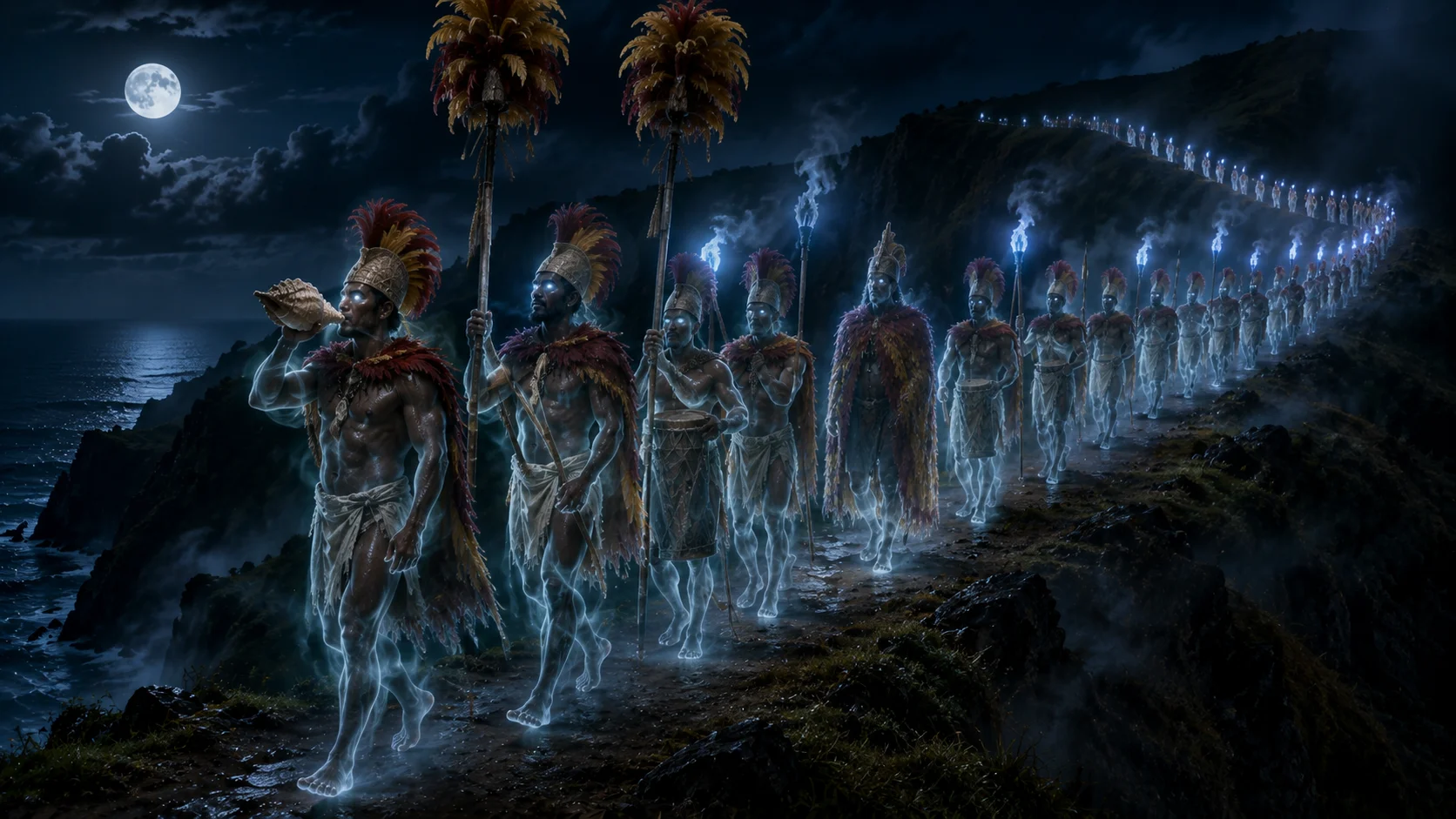
Those who describe an encounter with the huaka'i pō speak of the same signs arriving in sequence, long before any figure is seen: the low pulse of drums carried on still night air, the deep call of a conch shell (pū) sounding across a valley, and finally the flicker of torchlight moving in a disciplined line where no living party should be walking. The marchers themselves are described as warriors and chiefs of old Hawai'i, armed and arrayed as if for procession, moving together in the same formation tradition says they kept in life.
Warriors and Chiefs of the Old Order
Tradition holds that the marchers are the retinues of ali'i — chiefs and warriors, together with their attendants — continuing on in death the processions they made in life. The huaka'i pō are remembered as still walking the routes their earthly bodies once traveled, companies that have simply carried their march forward into the realm of spirits.
The Sacred Nights of the Lunar Calendar
The marchers are not said to walk on any night at random. Hawaiian tradition ties their appearances to specific nights of the traditional lunar calendar — Pō Kāne, Pō Kū, and Pō Lono — and in particular to the nights sacred to the god Kū: Kūkahi, Kūlua, and Kūkolu. These were nights already set apart in the old religious calendar, and the marchers' processions are remembered as belonging to that same sacred rhythm rather than to ordinary darkness.
Trails Associated with Sightings
Certain places on the islands carry a long association with sightings and warnings passed between generations, among them the Nu'uanu Pali on O'ahu, along with other areas near ancient battlefields. Old trails and the sites connected to them are recalled again and again in Hawaiian oral tradition and modern local folklore as places where the drums and torches have been heard and seen after dark.
What the Living Must Never Do
The counsel handed down through Hawaiian oral tradition is consistent and severe: encountering the marching dead directly, or being caught in their path, is said to be fatal. The huaka'i pō are not remembered as wandering apparitions indifferent to the living; a mortal caught upon their road faces real danger unless one of two responses is taken.
Lying Face-Down Before the Dead
Where the marchers cannot be avoided, tradition offers one recourse above all others: to lie face-down upon the ground and remain utterly still and silent, "playing dead," until the procession has passed. This posture of stillness is remembered as the surest way for someone with no other protection to survive an encounter.
An Ancestor Among the Marching Dead
A second possibility offered by tradition is gentler, though it cannot be summoned at will: if one of the marchers is an ancestor of the person who encounters the procession, that ancestral spirit may recognize their descendant and intercede on their behalf, granting safe passage. This belief threads the Nightmarcher tradition into the wider Hawaiian understanding of aumakua, ancestral guardian spirits who watch over their living family lines and may act to protect them from other supernatural danger as well. The shark-god Kamohoali'i, Pele's brother, is remembered in the same aumakua tradition — as the father of the shark-man Nanaue of Waipi'o Valley, and as a protective family guardian to those who honor him, in the broader Hawaiian and Polynesian pattern of shark ancestors watching over their descendants unless a taboo is broken.
A Wider Cosmology of Storied Places
The Nightmarchers belong to a broader Hawaiian understanding in which particular places, called wahi pana, carry lasting significance. The fishing god Ku'ula-kai, said to have lived at Hana on Maui, built the first ko'a there — a stacked-stone fishing shrine, simpler than the larger heiau used for chiefly or war ritual — and taught humans the rites of fishing. His wife Hina-puku-i'a gathered fish, and their son 'Ai'ai traveled the islands establishing further ko'a in his father's honor. Fishermen across Maui, Moloka'i, and Hawai'i Island traditionally left their first catch at a heiau ko'a dedicated to Ku'ula to ensure continued abundance, and stone shrines associated with him are still identified at sites such as Hana today.
Kin to the Guardians of Forest and Hula
The same tradition that produced the Nightmarchers also gave the islands their forest and hula goddess Laka, whose altar (kuahu) in a hula hālau is decorated with maile, 'ie'ie, 'ilima, and other forest plants sacred to her, and before whom practitioners recite the oli kuahu before dancing. Laka is sometimes described as female and sometimes as a male deity, Laka-kāne, associated with the forests used in canoe-building, reflecting regional variation in how the deity was understood. Laka is considered a sister or manifestation of Kapo, goddess of fertility, sorcery, and sexuality, and both are numbered among the daughters of Haumea in some genealogical chants, alongside Pele, Hi'iaka, and Nāmaka — a lineage linking fertility, hula, volcanism, and sorcery across Hawaiian cosmology. Kapo herself is remembered for the legend of her detachable, flying vagina, which she used to lure the pig-god Kamapua'a away from Pele as a decoy hurled at Kalihi, giving rise to place names on O'ahu still associated with the story; she is also associated with medicinal plants such as the 'ohai ali'i, and sorcery priests, the kahuna 'ana'ana, sometimes invoked her in destructive prayer rituals.
A Cosmology Shared with Fire and Snow
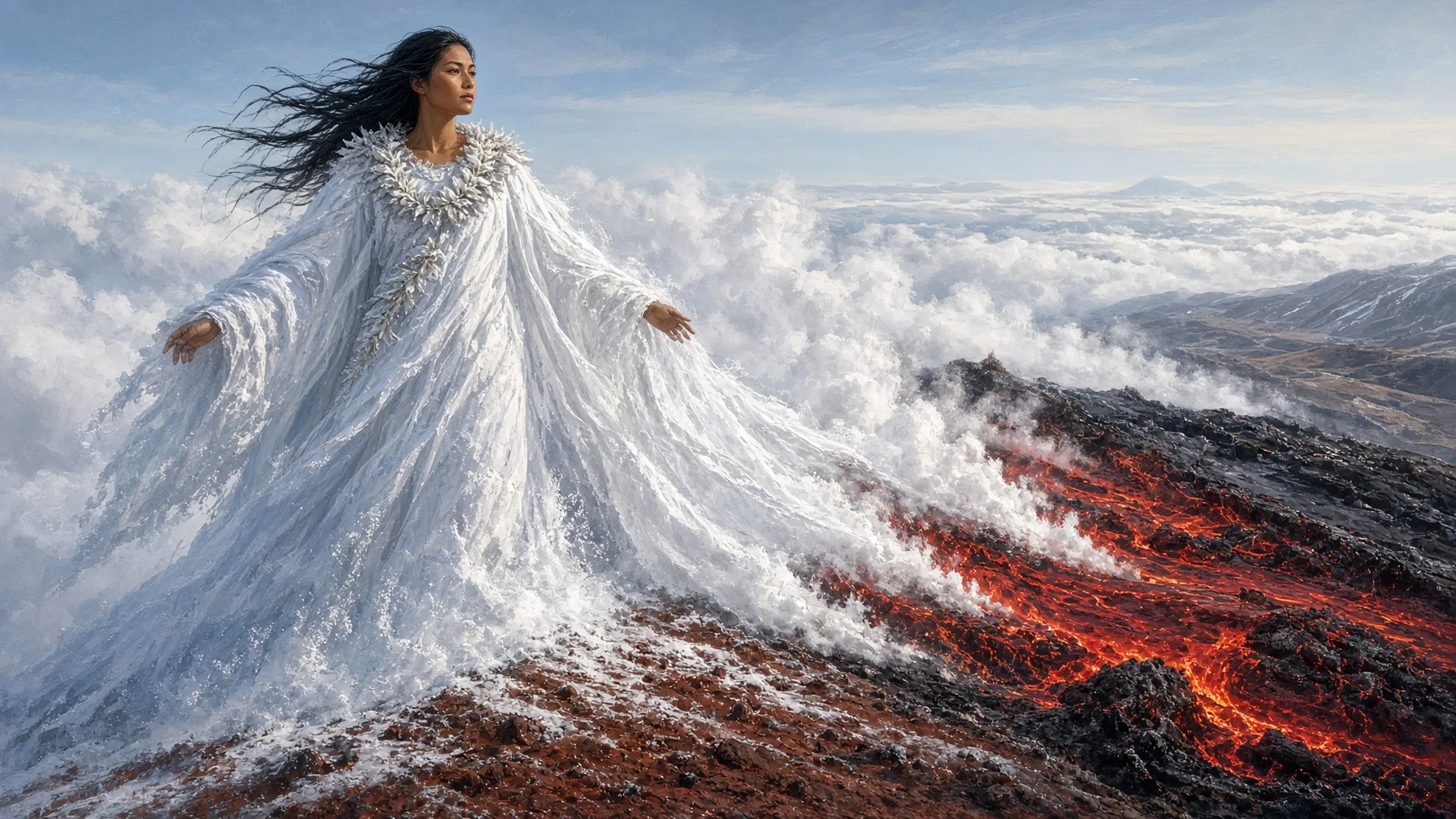
The same body of tradition gives Hawai'i its fire goddess Pele and her rival Poliahu, goddess of the snows crowning the summit of Mauna Kea, one of four snow goddesses alongside Lilinoe, Waiau, and her companions. Poliahu and Pele's most famous conflict involves a sled-racing contest, holua, with the mortal Kahawali: after Pele attacked Poliahu with lava, Poliahu retaliated by covering Mauna Kea with snow and ice to repel her. Poliahu is described as wearing a mantle of pure white snow and is regarded as one of the most beautiful goddesses in Hawaiian mythology, her cold domain set against Pele's fire. Nearby, Lake Waiau, a high-altitude lake near the summit of Mauna Kea, is associated with Poliahu's sister or companion Waiau and is considered a sacred site in its own right.
Other Legendary Beings of the Islands
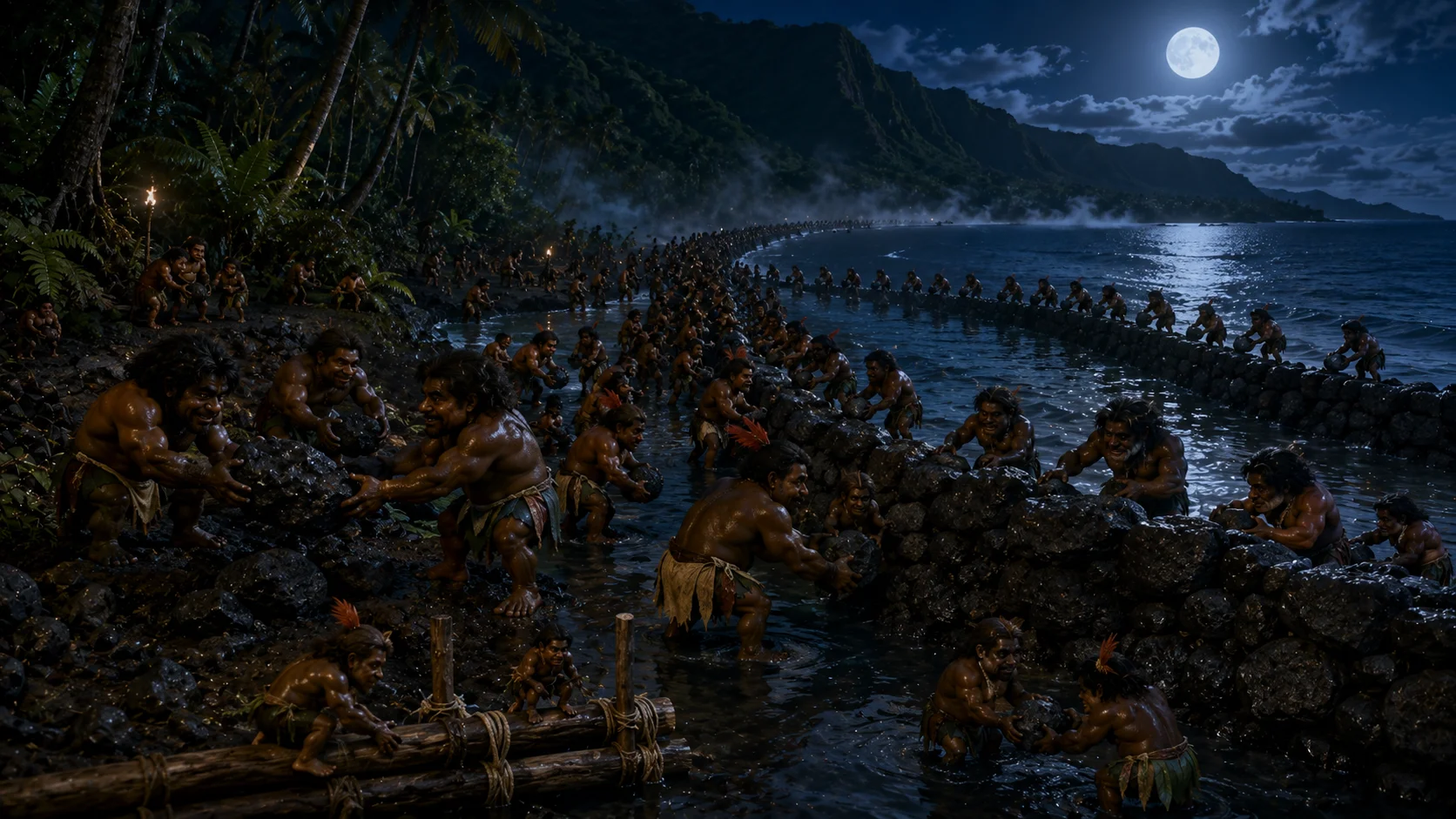
Hawaiian tradition holds a wide range of other legendary beings alongside the Nightmarchers. The Menehune are described as a race of small, secretive people said to inhabit the forests and hidden valleys of Kaua'i, credited with building structures overnight using stone — among them the Alekoko Fishpond and the Menehune Ditch (Kīkīaola) irrigation channel at Waimea. Legend holds that the Menehune worked only at night and would abandon a project unfinished if it was not completed by dawn or if observed by humans during the work; an 1820 census reportedly recorded 65 people in Wainiha Valley who self-identified as Menehune, a claim sometimes used to argue for a historical basis to the tradition. Separately, the shark-man Nanaue of Waipi'o Valley on Hawai'i Island was born to a human mother, Kalei, and the shark-god Kamohoali'i, with a shark's mouth on his back that he concealed beneath a kapa cloak; forbidden by his father from ever eating human flesh, he broke that taboo as an adult man-eating shark and was eventually hunted down and killed by villagers at Kohala, who used pia and awa to intoxicate and trap him.
A Tradition of Consistent Detail
What survives of the Nightmarchers in Hawaiian oral tradition is notably consistent across its retellings: the drums, the conch, the torches, the specific sacred nights tied to the lunar calendar, the danger of being seen, and the two paths to safety — lying face-down or the intercession of an ancestor among the marchers. Alongside the traditions of Ku'ula, Laka, Kapo, Poliahu, the Menehune, and Nanaue, the huaka'i pō form part of a broader Hawaiian mythological landscape in which particular deities, places, and beings are remembered as bound to the sea, the forest, the mountain snows, and the trails the living and the dead alike are said to walk.
Sources & traditions
- EncyclopediaWikipedia — Nightmarchers
- TraditionHawaiian texts, oral tradition and village tellings
Myths change from area to area and from time to time. This chronicle follows the most widely told versions; tellings in other villages, regions and eras may differ.