The ʻAumākua are the deified ancestral guardian spirits of Hawaiʻi — the transformed spirits of departed family members who continue to watch over their living descendants long after death. Where the great akua of the Hawaiian pantheon, figures such as Kāne, Kū, Lono, and Kanaloa, govern the cosmos and the elements at large, the ʻaumākua belong to something far more intimate: the ʻohana, the family itself. They are proof, in Hawaiian cosmology, that death does not sever the bond between a person and their descendants, but transforms it into something quieter, older, and watchful.
An Era Made Into a God
The word ʻaumakua is a compound of striking precision once its roots are unfolded: au, meaning a period of time or an era, and akua, meaning god or spirit. Together they form something close to "god of a time period" or, in the looser but more evocative English rendering favored by later writers, "ancestor god." The ethnographer Martha Beckwith, whose 1940 study Hawaiian Mythology remains a foundational text on the subject, described the ʻaumākua as deified ancestors in the fullest sense: not symbols of the dead, but the dead themselves, elevated into a form capable of continued relationship with the living.
A Different Kind of Divinity
It would be a mistake to fold the ʻaumākua into the same category as Hawaiʻi's major gods. Scholars such as E.S. Craighill Handy and Mary Kawena Pukui, working to document these beliefs before they faded from living memory, drew a careful line between the two. The great akua were cosmic and shared across the islands; the ʻaumākua were personal, familial, and often entirely unknown outside the household that claimed them. Their character reflects a blending of two impulses that anthropologists usually treat separately — ancestor veneration, the honoring of specific named dead, and animism, the belief that spirit inhabits the natural world. In the ʻaumākua, a family's own dead and the living creatures of reef, forest, and sky become the same thing, seen from two directions at once. Both this belief and the wider Hawaiian mythos of gods tied to particular landscapes — such as the snow goddess Poliahu, whose domain is the summit of Mauna Kea — reflect a shared cosmological principle: mana, or spiritual power, inhabiting the natural world and binding specific spirits to specific places, elements, or animal forms.
The Forms They Wear
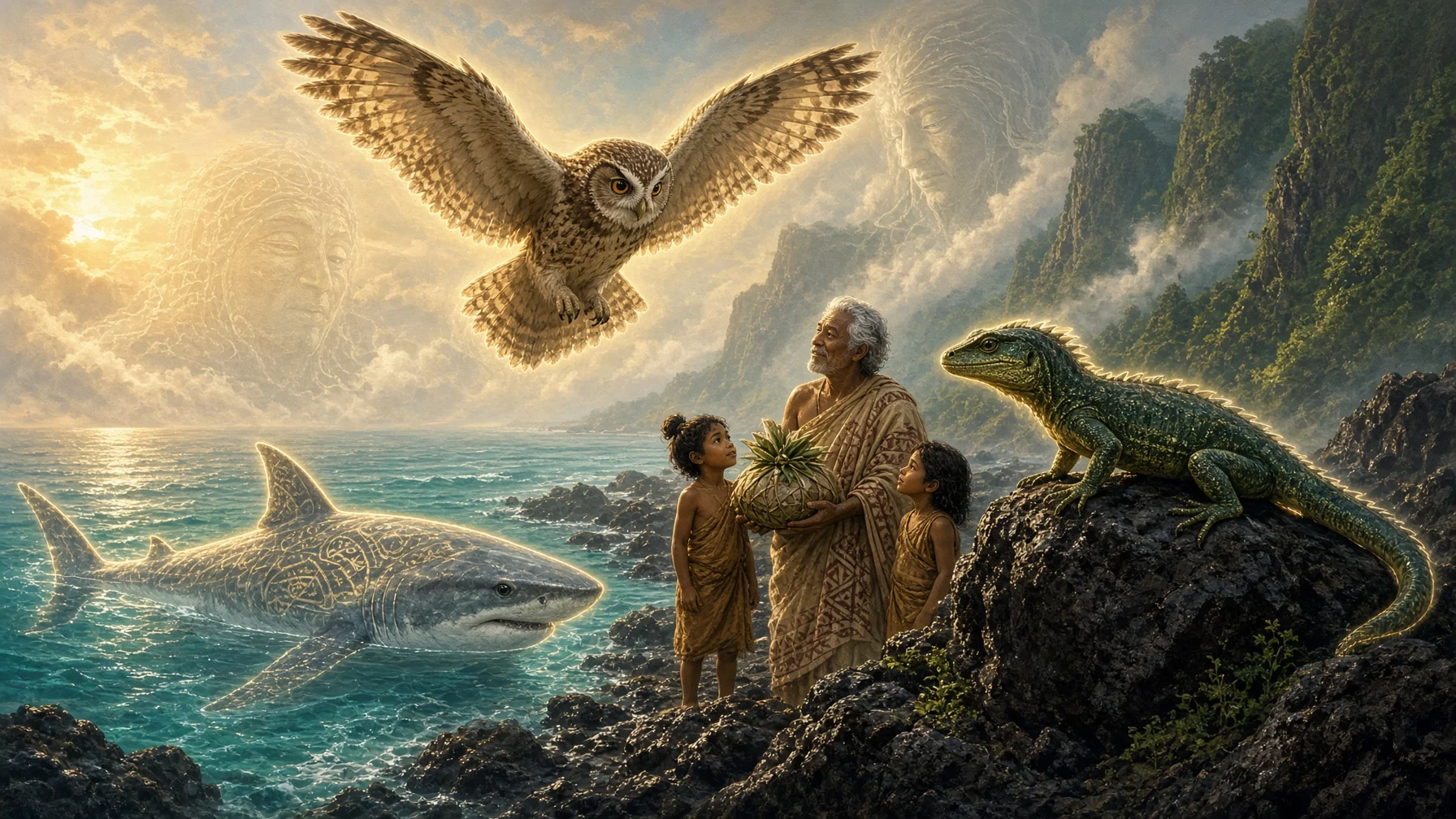
An ʻaumakua does not remain an abstraction. It takes on a physical guise, and which guise depends entirely on the lineage that claims it. Sharks, known as manō, were among the most powerful and feared of these forms. Owls, called pueo, appear again and again in the moʻolelo — the oral legends — as guardians who intervene at the exact moment a descendant is lost or in danger. Lizards, known as moʻo, eels, and even certain plants such as the ti leaf could all serve as the living vessel of a family's ancestral guardian. No single creature was universally sacred in this system; sacredness was distributed according to family history, so that one household's most revered animal might be entirely ordinary, even edible, to its neighbors.
The Shark That Guards the Fleet
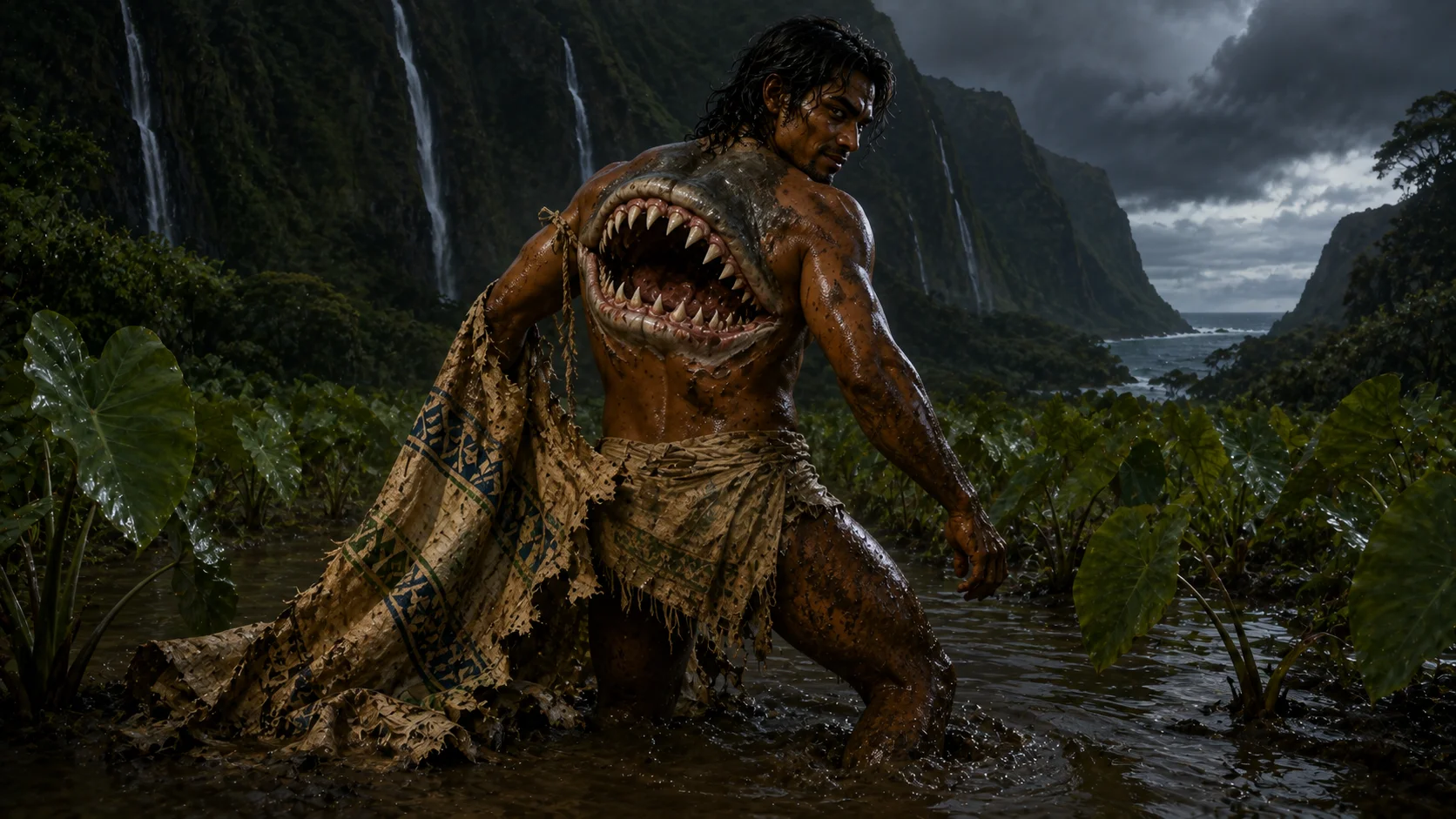
For families whose lives were bound to the sea, the shark ʻaumakua, sometimes called ʻaumakua manō, held a particular weight. Fishing communities along the coasts depended on the ocean for survival, and the belief that an ancestral shark swam among the living sharks, watching for descendants in trouble, gave the relationship between fisherman and ocean an added dimension of trust. A shark ʻaumakua was said to guide canoes to safety through sudden storms and to help fishermen find their way home.
The Owl Who Finds the Lost
Among all the animal forms an ʻaumakua might take, the pueo is one of the most widely remembered today, appearing throughout Hawaiian oral tradition as a figure of protection, wisdom, and guidance. Numerous moʻolelo recount a pueo appearing at the precise moment a traveler has lost the trail, hovering ahead of them in the dark or circling above a person stranded on rough terrain, leading them home. For a family whose ʻaumakua took pueo form, the sight of an owl at an unusual hour was never simply a sighting. It was a visitation.
Kinship Passed Down, Not Chosen
An ʻaumakua was not selected the way a patron saint might be chosen, nor adopted out of personal preference. It was inherited, passed down through generations as a fixed feature of family identity, in much the same way a surname or a genealogical chant might be. Different branches of an extended family could carry different ʻaumākua, reflecting divergent ancestral lines even within what looked, from the outside, like a single household. A person raised in a coastal fishing family might carry the shark; a cousin descended from a different ancestral branch, even within the same generation, might instead carry the pueo or the moʻo. The guardian spirit was, in this sense, a map of lineage as much as a source of protection.
The Ritual of Recognition
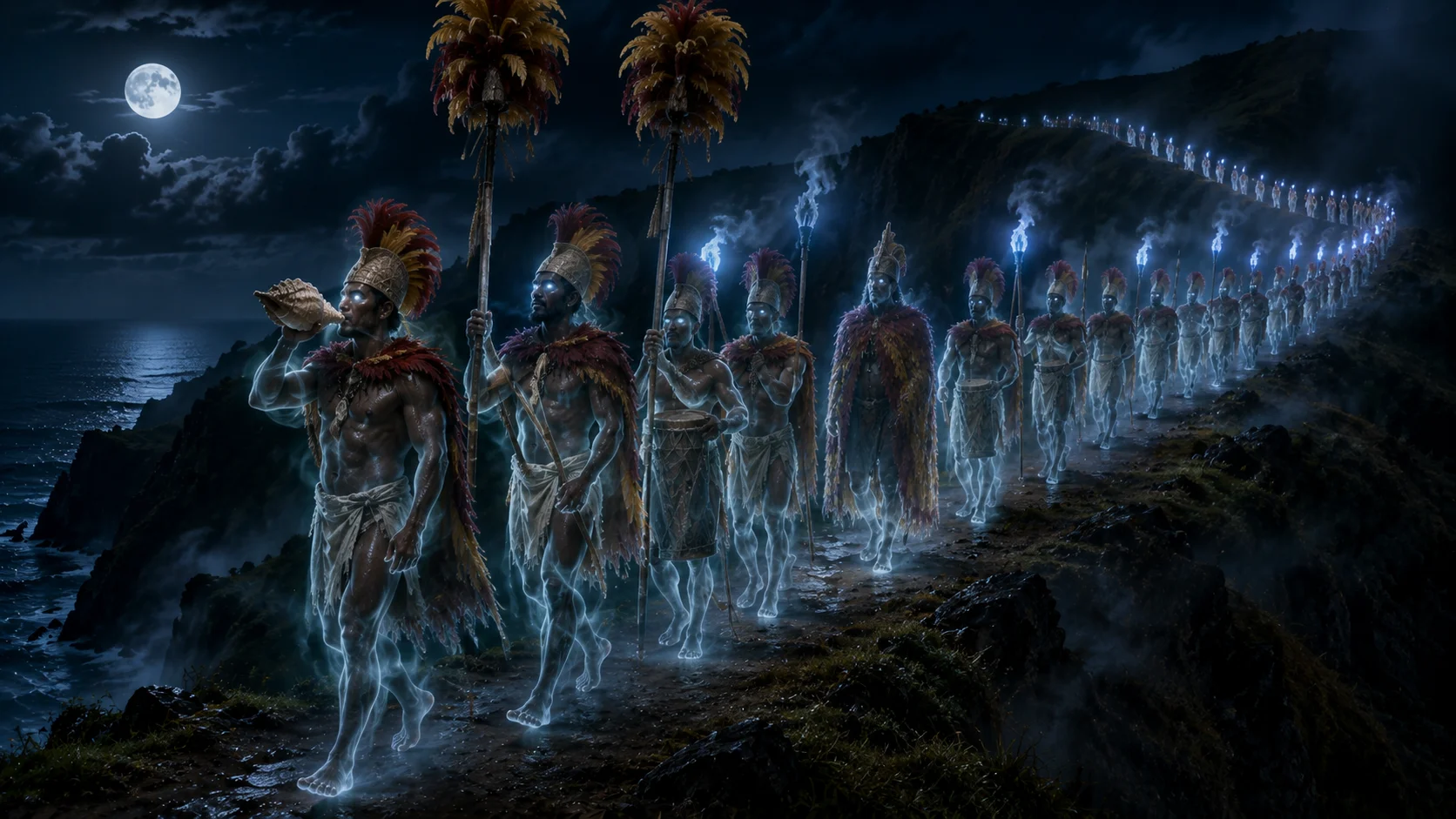
Some ʻaumākua were understood not as generalized ancestral spirits but as the transformed presence of a specific, named relative — a grandmother, an uncle, a particular ancestor whose life was still remembered by name. Hawaiian tradition describes a practice, kapu ʻaumakua, through which a deceased family member could be ceremonially transformed into a guardian spirit after death, formally installing them into this ongoing role within the family's spiritual life. This was not a passive process of forgetting the dead into myth; it was an active, ritualized elevation, one that treated the transition from person to guardian as something requiring deliberate ceremony rather than time alone.
Messages Sent Through Sleep
The relationship between a family and its ʻaumakua was not one-directional reverence flowing only toward the dead. Mary Kawena Pukui, in her 1972 work Nānā I Ke Kumu, documented in detail how ʻaumākua were believed to communicate back to their descendants — through dreams, through omens read in the behavior of animals or the weather, and through visions that arrived unbidden to warn of danger or offer guidance before a decision was made. A dream in which an ancestor appeared, or in which the family's guardian animal behaved strangely, was not dismissed as mere sleep. It was treated as a message requiring interpretation, often by an elder versed in reading such signs, and acted upon accordingly.
The Cost of Neglect
Reverence for one's ʻaumakua was not optional sentiment; it carried real consequence in Hawaiian belief. Caring for the physical animal associated with a family's guardian spirit — feeding it, protecting it, never causing it harm — was considered an active duty. The inverse carried weight as well: harming the species tied to one's own ʻaumakua was believed to invite misfortune down upon the entire family, not merely upon the individual responsible. Handy and Pukui's ethnographic research recorded this dynamic clearly, noting that neglect or disrespect toward an ʻaumakua's animal form was traditionally believed to result in huhū — illness or misfortune that could spread through a household as a kind of spiritual consequence for broken obligation.
Poliahu: A Goddess Bound to the Mountain
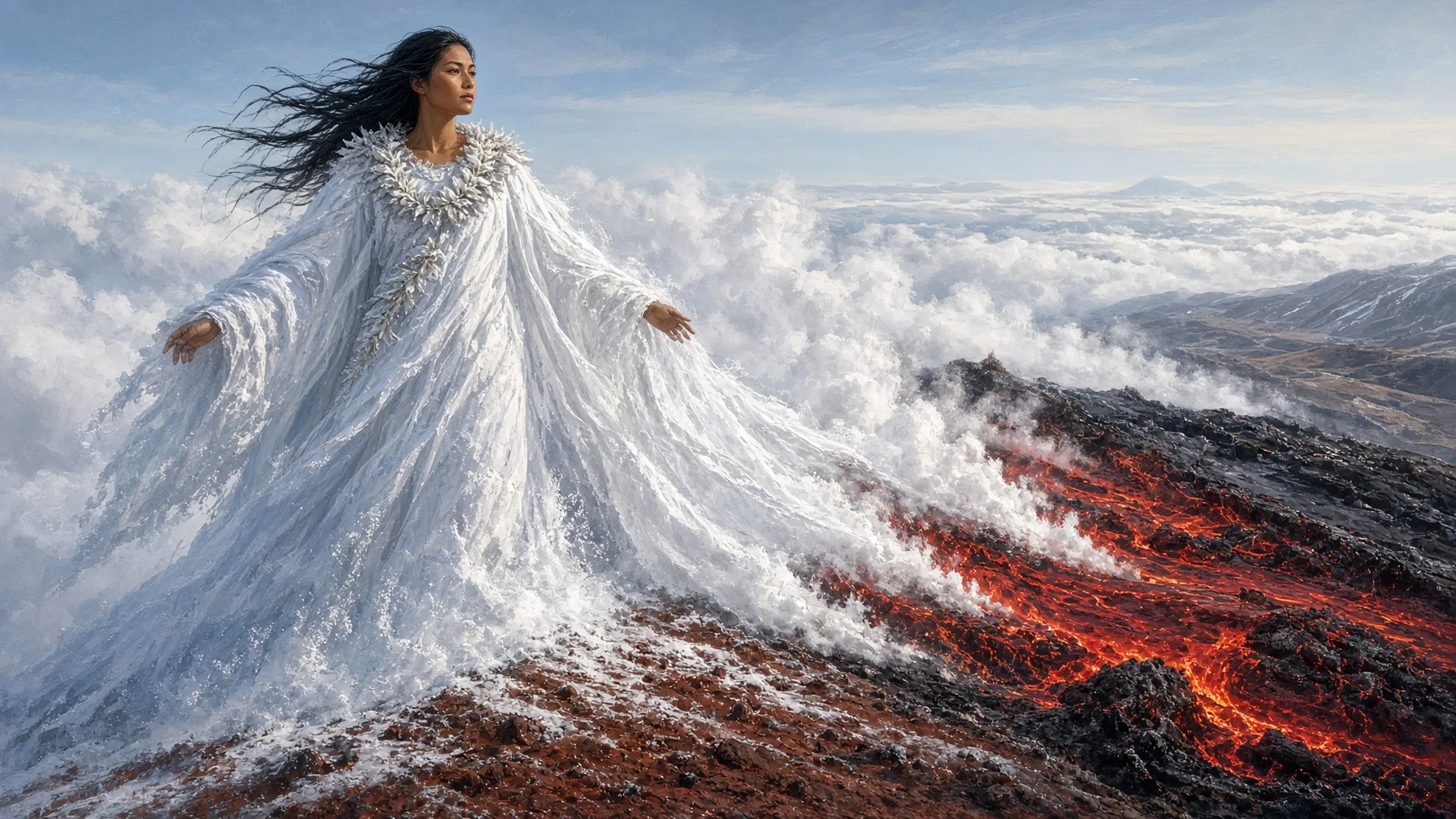
The same Hawaiian worldview that ties a family's dead to a shark or an owl also ties particular deities to particular places on the landscape, and Poliahu is the clearest example on the island of Hawaiʻi. She is the goddess of snow, associated primarily with the summit of Mauna Kea, and is counted as one of four deities of the mountain's peaks, alongside Lilinoe, goddess of fine mist, Waiau, goddess of the sacred lake near the summit, and Kahoupokāne. Lake Waiau itself, sitting at roughly 13,020 feet, is considered sacred ground directly associated with the goddess Waiau.
Poliahu is best remembered for her rivalry with Pele, the volcano goddess, a rivalry that mirrors the geological contrast between Mauna Kea's snow-capped summit and Pele's fiery domain on Kīlauea and Mauna Loa. One well-known legend describes a holua sled-racing contest between the two, in which Pele, disguised as a beautiful woman, competed against Poliahu and lost — provoking Pele to erupt in anger and send lava toward her rival, who repelled it by covering the mountain in snow and ice. Oral tradition describes Poliahu as extraordinarily beautiful, often wearing a mantle of pure white snow, or kapa hau, as a symbolic cloak that sets her radiant, cold beauty apart from Pele's fiery temperament. Her name itself is sometimes read as "the covering, or bosom, of Poli," drawing on poli (bosom) and ahu (cloak), a reference to the snow that blankets the mountain like a garment. In some tellings, the summit peak Kūkahauʻula — the pink-hued snow of sunrise — is personified as Poliahu's lover.
Much of what survives of Poliahu's story was recorded by King Kalākaua, in his 1888 The Legends and Myths of Hawaii, and in Nathaniel Emerson's translations, both of which preserve her romantic rivalry with Pele over the chief Aiwohikupua. The goddess remains culturally significant today: the summit of Mauna Kea is considered her sacred domain, one of the most sacred sites in Hawaiian cosmology, and that status sits at the center of contemporary Native Hawaiian opposition to astronomical observatory development on the mountain.
A World Woven Through With Ancestors
Taken as a whole, the belief in ʻaumākua reflects something central to the wider Hawaiian understanding of the world: that mana, spiritual power, does not sit apart from the physical landscape but inhabits it directly, binding particular spirits to particular animals, plants, and family lines. A shark in the water offshore, an owl seen at dusk, a lizard on a stone wall — none of these were ever purely themselves in this worldview. Each carried the possibility of ancestry looking back. The ʻaumākua tradition turned the everyday, observable world into something inhabited by memory, so that a family's history was not confined to genealogical chant alone but was written, quite literally, into the living creatures around them.
A Guardianship Passed Through the ʻOhana
Across the moʻolelo and the ethnographic record left by Beckwith, Handy, and Pukui, the ʻaumākua concept stands out for how thoroughly it fuses ancestor and animal, obligation and protection. A family's guardian was not a distant myth but a living presence, encountered in a shark that circled a boat, an owl that appeared at dusk, or a warning delivered in a dream — and honoring it, or failing to, was understood to have real consequences for the ʻohana as a whole.
Sources & traditions
- EncyclopediaWikipedia — ʻAumakua
- TraditionHawaiian texts, oral tradition and village tellings
Myths change from area to area and from time to time. This chronicle follows the most widely told versions; tellings in other villages, regions and eras may differ.