The Menehune are the legendary little people of Hawaii: small, powerfully built, secretive folk said to dwell hidden in the deep forests and steep valleys of the islands, emerging only under cover of darkness to accomplish feats of engineering that daylight labor could never match. They are Hawaii's most enduring folk mystery — credited with fishponds, roads, and temple platforms (heiau) that still stand today, built, according to the old stories, between dusk and the first light of dawn.
The Little People of the Forest
In Hawaiian oral tradition, the Menehune are described as short in stature but extraordinarily strong, living in the uplands and forested valleys far from the coastal villages where ordinary people made their homes. They kept to themselves, appearing to human eyes rarely and briefly, and much of what is said about them comes from what was found in the morning rather than what anyone claimed to have witnessed directly. A wall stood that had not stood the evening before. A ditch ran straight and true through solid rock. A pond's embankment, curved and precise, held back a river that had never been tamed. The forest, in these accounts, was not empty — it was populated by an industrious, unseen people who simply chose not to be seen.
The Night-Builders
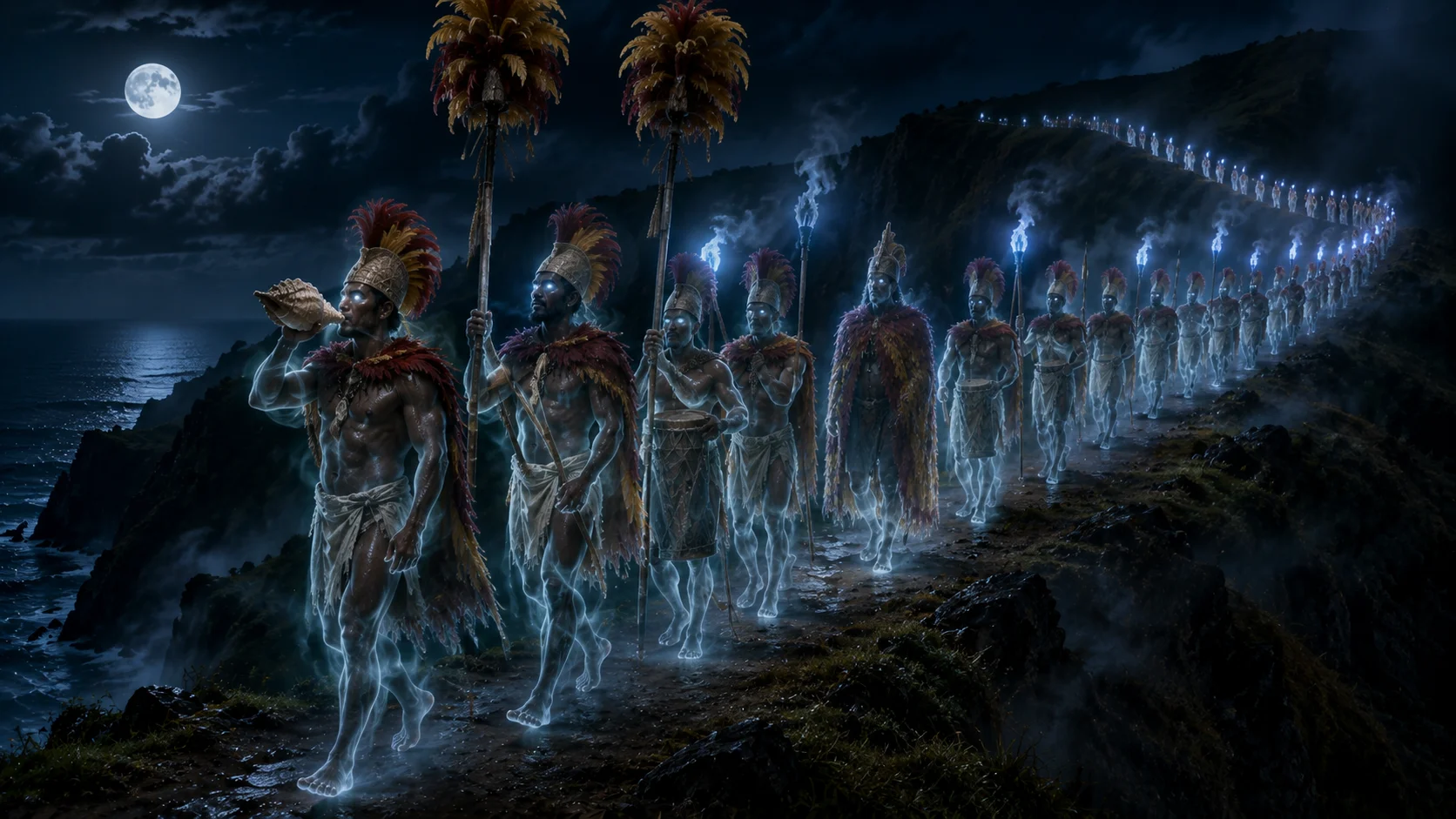
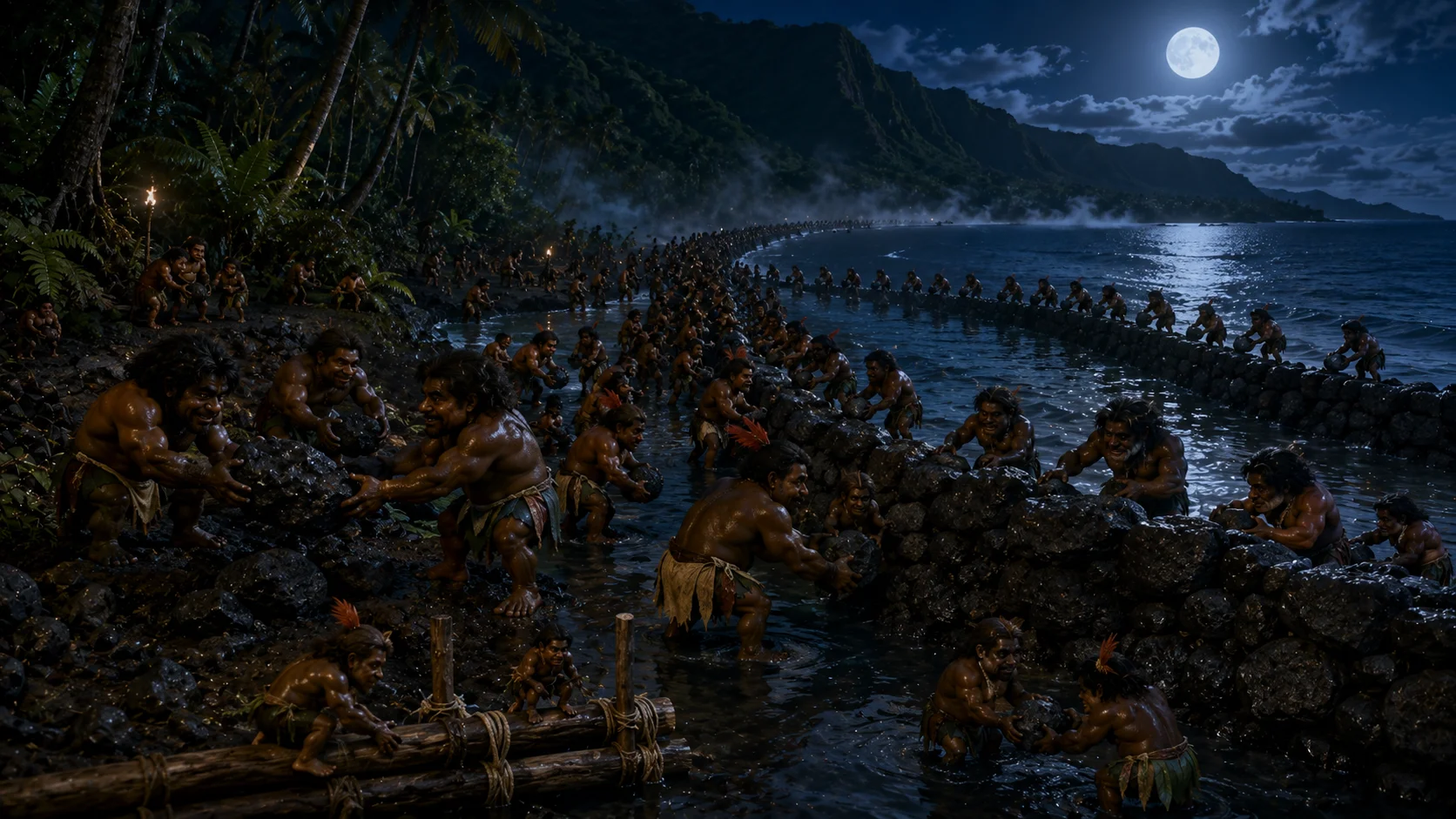
The central and most consistent feature of Menehune lore is the manner of their labor: work performed entirely at night and, by tradition, completed before the sun rose. A task begun after dark had to be finished by dawn or it was abandoned outright, left incomplete rather than carried into a second night. This was not simply a matter of preference but something closer to a rule of their nature — daylight was not their domain, and a job left unfinished stayed unfinished, a detail that later observers pointed to whenever they found structures with an unexplained gap or an oddly truncated wall.
The Human Chain at Alekoko
The best-known feat attributed to the Menehune is the construction of the Alekoko Fishpond, also called the Menehune Fishpond, on the Huleia River on Kauai. Tradition holds that the pond's stone walls were raised in a single night by a human chain that passed stones hand to hand until the enclosure was complete. The claim itself — an entire fishpond built between sunset and sunrise — is part of what has kept the story alive for so long: it describes an amount of coordinated labor that seems to demand an explanation beyond ordinary means, and the Menehune supplied one.
The Precision of Kiki a Ola
A second structure carries the same attribution: the Menehune Ditch, known in Hawaiian as Kiki a Ola, near Waimea on Kauai. What sets this irrigation channel apart from other pre-contact Hawaiian stonework is the precision of its masonry — cut and fitted stones of a regularity that struck early observers as unusual for the tools and techniques otherwise documented in the islands. Where other explanations for that precision have been debated, the traditional account simply credits the same hidden builders: a people whose skill exceeded what was expected, working through the night, leaving behind construction that still puzzles those who examine it.
Seen, and Left Unfinished
Running alongside the building stories is a second rule, just as firm as the first: if the Menehune were seen or interrupted while at work, they would stop and abandon the task, sometimes never returning to complete it. This detail does real narrative work in the tradition — it explains the walls that end abruptly, the terraces that seem to trail off mid-slope, the projects that look for all the world like they were simply dropped. A curious villager who wandered too close at the wrong hour was not rewarded with a glimpse of the builders; the work itself was the price of being noticed.
A Census and a Question of Reality
The Menehune legend intersects with documented history at one striking point: an 1820 census ordered by Kaumuali'i, the last king of Kauai, reportedly recorded sixty-five individuals who identified themselves as Menehune. This is among the earliest written references tying the folklore to an actual claimed population, and it has anchored a long-running question among scholars — whether the Menehune name once referred to a real group of people, perhaps an earlier population on Kauai, before the fully developed "little people" tradition grew up around it.
Luomala's Reassessment
The most influential modern scholarship on the subject comes from Katharine Luomala, a leading twentieth-century researcher of Hawaiian folklore, who argued that the elaborate, widely known image of the Menehune as a distinct race of magical little forest-dwellers was substantially shaped and embellished after Western contact. Her work does not erase the older material — the night-building motif and the association with hidden forest peoples run through pre-contact tradition — but it cautions against reading the modern, fully populated Menehune mythos backward as though it existed in that exact form from the beginning. The legend, in her account, is a living tradition that kept growing.
Forests as Sacred Ground
The Menehune's association with deep forest and valley is not unique to their story; it echoes a broader Hawaiian understanding of the forest as inhabited, watched-over ground rather than empty wilderness. The hula tradition offers a parallel in Laka, the goddess closely tied to hula, chant, and the forest itself, whose altar inside the halau hula is built from native forest plants — maile, ilima, lehua, palapalai fern, and hala — offered in her honor before dancing begins. Where Laka's forest is a place of offering and inspiration, invoked still today through chants like "E Laka e" at the opening of a performance, the Menehune's forest is a place of concealment and labor — two faces of the same conviction that the wooded valleys of Hawaii were never simply unoccupied.
Other Hidden Natures in the Island Tradition
Hawaiian mythology returns often to the idea of a true nature kept carefully hidden from ordinary sight, and the Menehune's daylight invisibility sits within that larger pattern. The story of Nanaue, the shark-man born to a human mother and a shark-god father, turns on exactly this kind of concealment: he wore a cloak over his shoulders to hide the shark's mouth on his back, and the tragedy of his story begins only once that covering slips and his true form is discovered by the community around him. The Menehune are never unmasked in quite that dramatic fashion, but the underlying logic is familiar — a secret self, forest-born or otherwise, that survives only as long as it stays unseen.
Mountains, Snow, and Unseen Domains
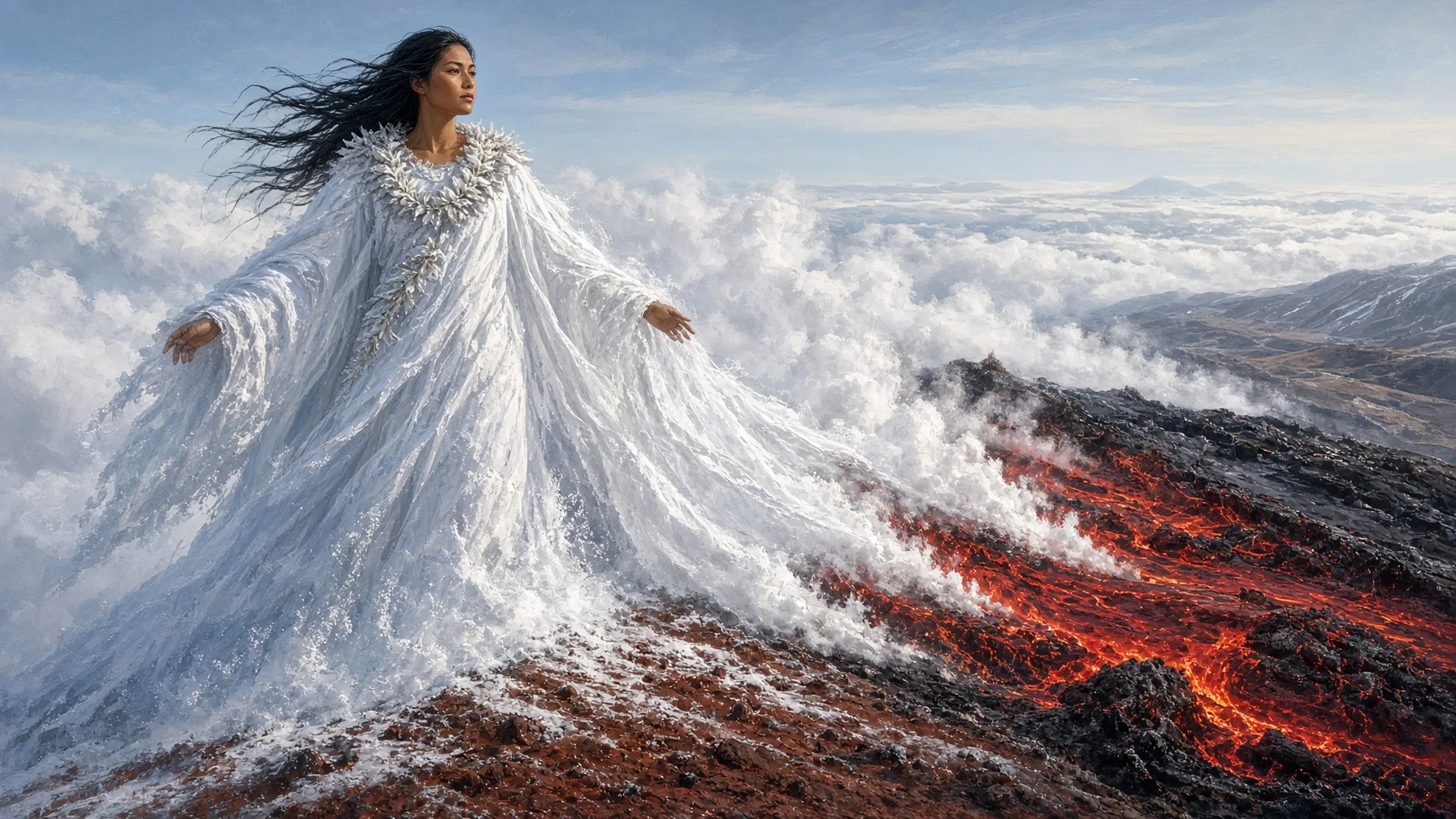
The Menehune's hidden valleys also belong to a wider map of the islands in which certain places are understood to be another people's domain rather than open ground. On Hawaii Island, the snow goddess Poliahu claims the summit of Mauna Kea in much the same spirit — a mantle of white snow over a peak that belongs to her, defended in tradition against Pele's fiery incursions and still honored today by Native Hawaiian practitioners as sacred ground. The Menehune's forests and valleys carry a quieter version of the same principle: land that looks unclaimed to a passing traveler may in fact already belong to someone else, someone who has simply chosen not to be seen.
A Legend That Keeps Building
What makes the Menehune tradition distinct among Hawaii's legendary peoples is how directly it points at the physical world and says, there, look — that fishpond wall, that arrow-straight ditch, that gap in an unfinished terrace. Few Hawaiian legends are so thoroughly anchored to structures a visitor can still walk up to and touch. Whether understood as literal builders, as folk memory of an earlier population, or as a story elaborated over generations the way Luomala described, the Menehune endure because the evidence they are said to have left behind is still standing on Kauai and beyond — stonework built, so the story goes, in the dark, by hands nobody was permitted to watch.
Sources & traditions
- EncyclopediaWikipedia — Menehune
- TraditionHawaiian texts, oral tradition and village tellings
Myths change from area to area and from time to time. This chronicle follows the most widely told versions; tellings in other villages, regions and eras may differ.