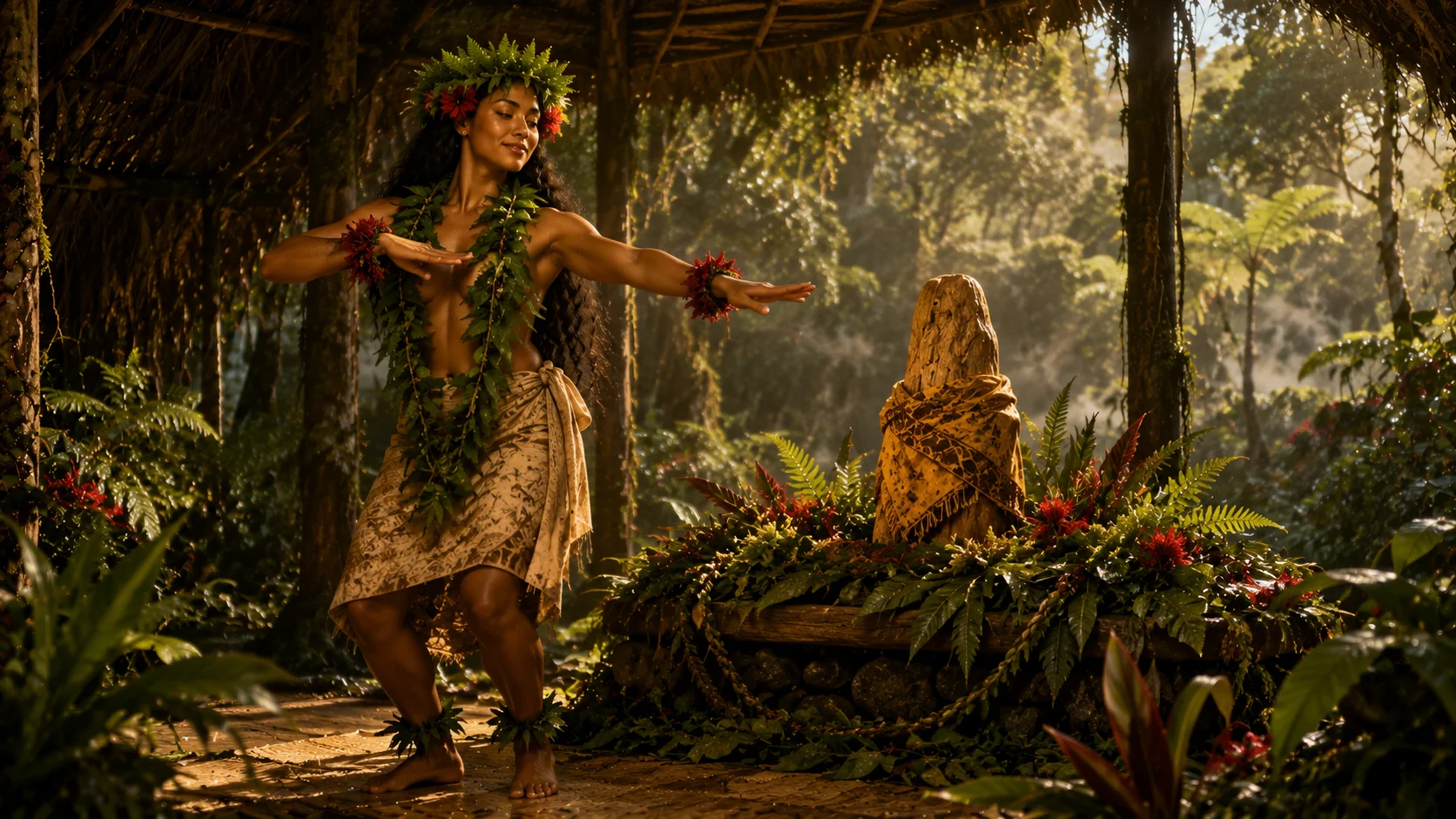
Laka stands among the most beloved figures in Hawaiian tradition, the goddess — and in certain genealogies, the god — of hula, chant, and the living forest. She is the patroness of the halau hula, the schools where dancers train for years to master the sacred art, and her presence is invoked before a single step is danced. To speak of Laka is to speak of the forest itself: the trees, ferns, and flowering vines that clothe Hawaii's uplands are understood as her body and her gift, gathered and worn so that the dance might carry her mana into the performance space.
The Goddess Who Moves Through the Forest
Laka is not pictured as a distant, static deity but as a presence woven into the living plants of the Hawaiian forest. Hula practitioners have long understood that to dance is to borrow something from Laka's forest, and that the plants used in adornment and offering are not mere decoration but extensions of the goddess herself. This is why the relationship between hula and botany in Hawaiian culture is so inseparable — the dance cannot be conceived apart from the forest that clothes and inspires it.
The Kuahu: An Altar Built From the Forest
At the heart of every serious halau hula stands the kuahu, the altar dedicated to Laka. Before dancers may train or perform, the kuahu must be built and honored, typically constructed from native forest plants gathered with care and intention. Maile, prized for its fragrant trailing vines, is among the most sacred of these offerings, often woven into lei and draped across the altar. Ilima, with its delicate golden blossoms, and lehua, the crimson flower of the ohia tree, are likewise placed in tribute. Palapalai fern, valued for its soft fronds and its long association with hula adornment, and hala, whose pandanus leaves have their own deep roots in Hawaiian material culture, complete the customary offerings. Each plant carries its own mana and its own place within the practice, and the assembling of the kuahu is itself an act of reverence, a physical reminder that the hula draws its life from the forest Laka embodies.
Invoking Laka Before the Dance Begins
No performance in the traditional halau hula begins without acknowledging Laka first. The chant "E Laka e" remains a living invocation, recited to ask the goddess to inspire the dancers and grant success to the school. It continues to open hula performances today, just as it has traditionally. The invocation reflects a broader principle in Hawaiian tradition: that skill and artistry are not achievements of the self alone but gifts that flow from a deity who must be honored and asked for her favor before each undertaking.
Sister, Wife, and Forest Companion of Lono
Hawaiian genealogical chants describe Laka in relation to other akua, and in several traditions she appears as a sister or wife of Lono. This connection situates Laka within a family of deities associated with the growing world. Other strands of Hawaiian myth link Laka closely to the Pele mythology cycle, where Laka is treated as a form of, or closely associated with, Hi'iaka's forest patroness role. These variations are not contradictions to be resolved but reflect the reality of Hawaiian oral literature as it was carried across different islands and different chanting traditions, each preserving its own emphasis and lineage.
A Second Laka: Voyager and Son of Wahieloa
Alongside the forest goddess, Hawaiian oral literature preserves an entirely separate mythic figure who also bears the name Laka — in this tradition male, identified as the son of Wahieloa, and associated with wayfinding and the discovery of new lands. This voyaging Laka belongs to a different narrative thread altogether, one concerned with exploration and navigation rather than dance and botany. Scholars who collected and compared Hawaiian oral traditions, including Abraham Fornander and Martha Beckwith, documented both figures, and their coexistence under a single name shows that the name Laka carries at least two distinct mythic identities in Hawaiian oral literature.
The Hidden People of the Forest: Menehune
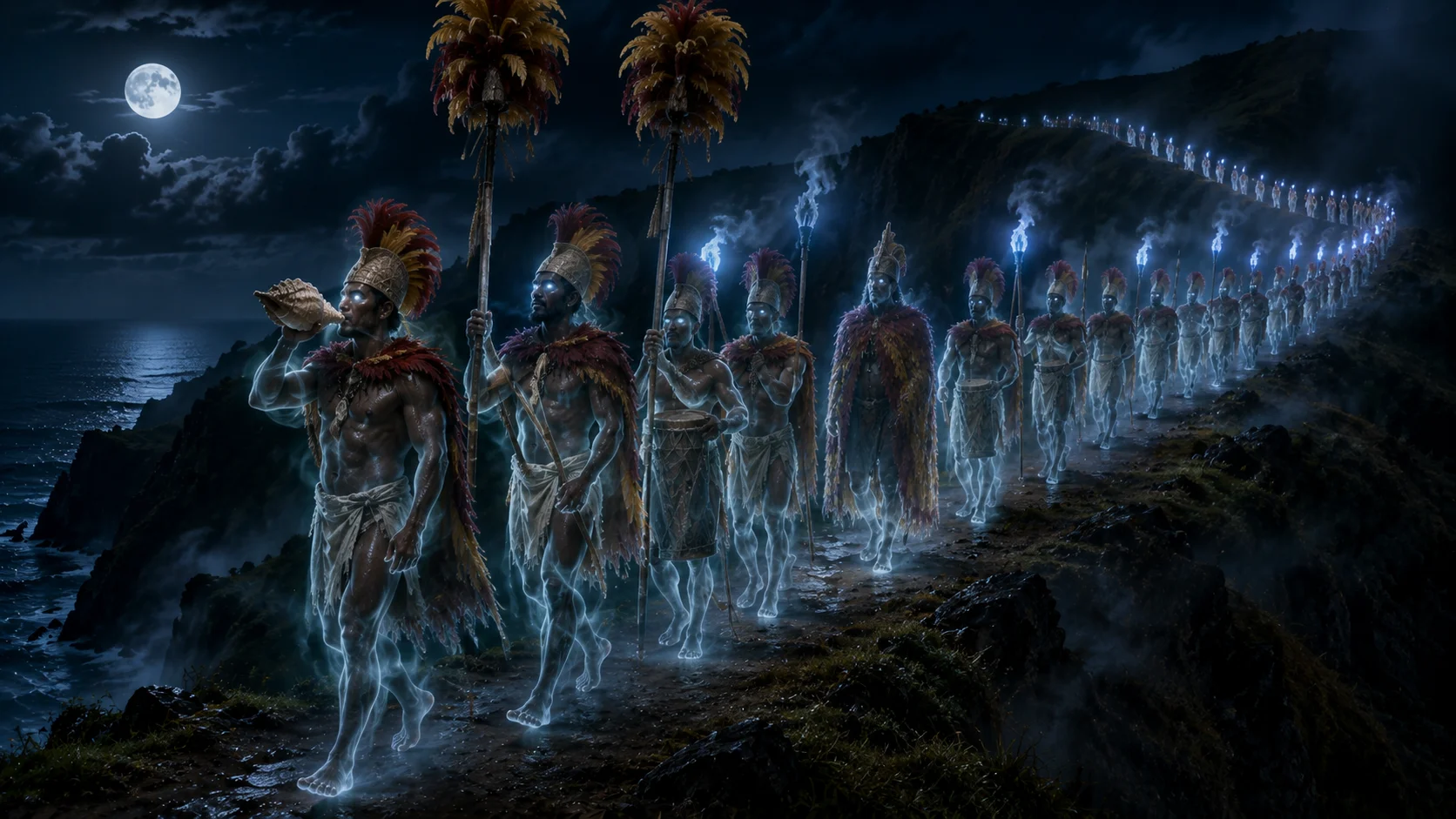
The forests and valleys that Laka inhabits are also, in Hawaiian folklore, home to the Menehune, a legendary race of small, powerful people said to live hidden in forests and valleys. The Menehune are credited with building structures such as fishponds, roads, and heiau in a single night. Their association with the hidden forest world places them within the same broader landscape of unseen, plant-and-mountain-dwelling beings that populate Hawaiian tradition alongside forest deities like Laka.
The Alekoko Fishpond and the Chain of Stone
Among the structures most famously attributed to the Menehune is the Alekoko Fishpond, also known as the Menehune Fishpond, on Kauai's Huleia River. Tradition holds that it was built in a single night, the stones passed hand to hand along a human chain. The legend surrounding its construction reflects the broader Menehune motif of extraordinary labor completed under cover of darkness, beyond the sight of the surrounding community.
Menehune Ditch and the Mystery of Precise Stone
Near Waimea on Kauai stands Menehune Ditch, known in Hawaiian as Kiki a Ola, another structure popularly credited to the Menehune. What sets this site apart is the precision of its stone masonry — cut and fitted in a manner considered unusual for pre-contact Hawaiian construction.
Night Workers Who Vanish at Dawn
Central to nearly every Menehune story is the rule that governs their labor: they work only at night, racing to complete their tasks before the sun rises, and they abandon any project left unfinished if seen or interrupted by human eyes. This narrative device explains both the speed attributed to their constructions and their persistent invisibility to the human communities living alongside them, binding together the practical and the supernatural elements of the legend.
Between Legend and Census: The Question of a Real People
The Menehune legend carries an unusual thread of documentary claim. An 1820 census ordered by Kaumuali'i, the last king of Kauai, reportedly recorded sixty-five people who self-identified as Menehune, one of the earliest documentary references tying the legend to a real population claim, as discussed by scholars including Katharine Luomala. Katharine Luomala, a leading twentieth-century researcher of Menehune lore, argued that the fully developed "little people" version of the Menehune legend familiar today was significantly shaped and embellished after Western contact.
Nanaue, the Shark-Man of Waipio
Hawaiian mythology also preserves the legend of Nanaue, a shark-man born of a human mother named Kalei and a shark-god father, Kamohoali'i, in some versions identified as a form of that god. This dual parentage gave Nanaue the ability to transform between human and shark form. He was said to be born with a shark's mouth on his back, a mark he concealed beneath a cloak or kapa cloth so that others would not discover his true nature.
The Secret Killings and the Cloak's Betrayal
Hidden behind his covering, Nanaue secretly killed and ate villagers while in shark form off the coast of Waipio Valley on Hawaii Island, though some versions of the story place the events on Molokai instead. His concealment held until the day he was seen without his cloak at a community gathering, exposing him as the source of the killings.
The Hunt and the End of Nanaue
Once exposed, Nanaue was hunted down by the villagers, and in most versions of the legend he is caught and killed, bringing the killings to an end. Folklorists such as Martha Beckwith, in her study "Hawaiian Mythology," classify the Nanaue legend as part of a broader Polynesian shark-ancestor motif, in which shark gods known as aumakua father half-human, half-shark offspring.
Poliahu, the Snow Goddess of Mauna Kea
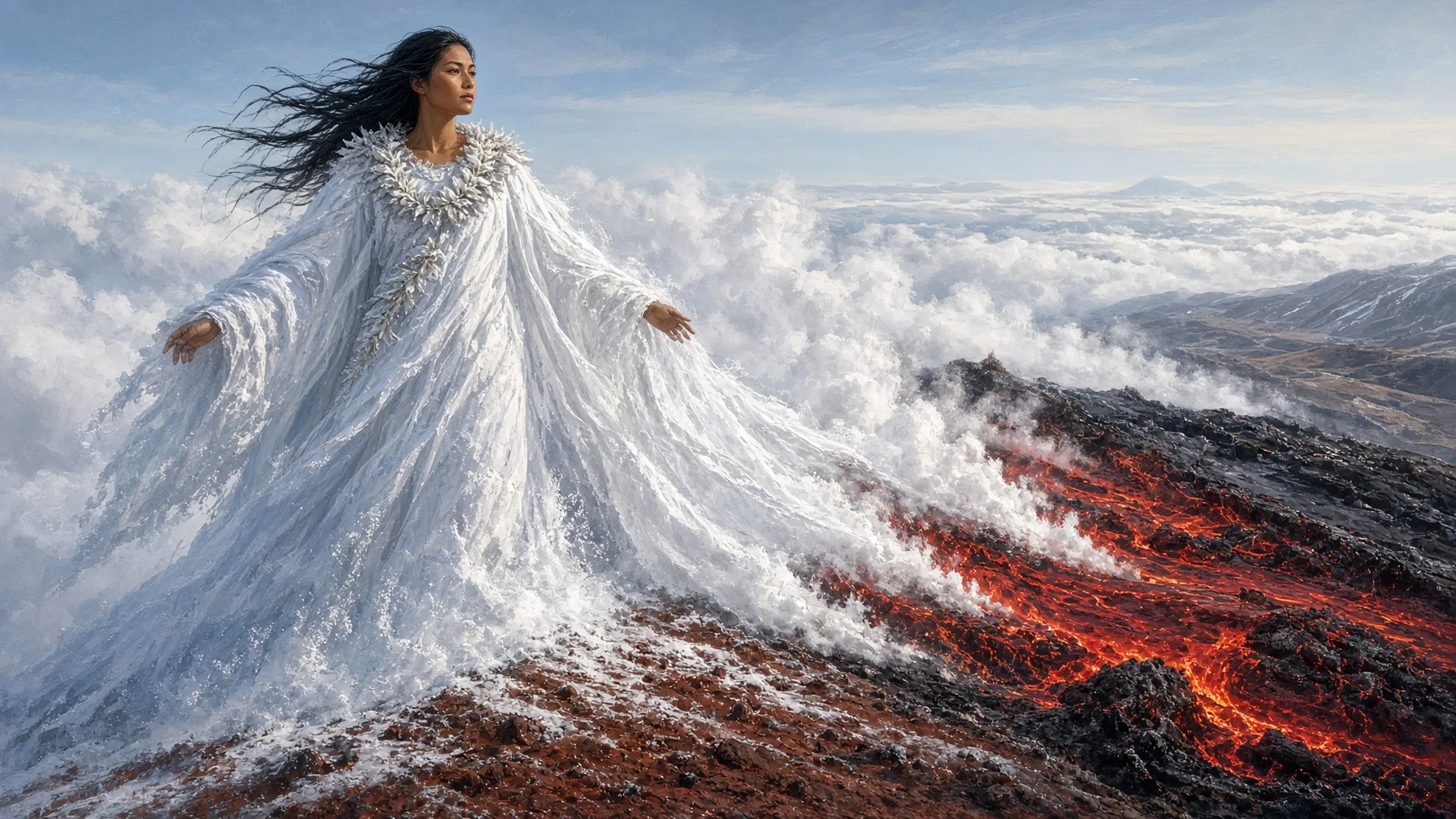
Far from the warm forests of Laka's domain, atop the summit of Mauna Kea on Hawaii Island, dwells Poliahu, goddess of snow and the personification of the mountain itself. She is described as wearing a mantle of pure white snow, called kapa hau. Poliahu is counted among four snow goddess sisters tied to Hawaii Island's mountain heights, alongside Lilinoe, goddess of fine mist, Waiau, goddess of the small lake near the summit, and Kahoupokane.
Fire and Snow: The Rivalry With Pele
The defining myth surrounding Poliahu is her rivalry with Pele, goddess of volcanic fire. In the traditional tale, Pele attempts to invade Poliahu's snowy domain with flowing lava, only to be repelled by Poliahu's snow and ice — a contest that permanently separated their territories between the peaks of Mauna Kea and Mauna Loa and Kilauea. One well-known telling, recorded by Fornander and retold by later folklorists, has Pele disguising herself to compete against Poliahu in holua sled racing on the slopes of Mauna Kea, a contest that escalates into the elemental battle between fire and snow.
Lake Waiau, Poliahu's Bathing Pool
Near the summit of Mauna Kea lies Lake Waiau, a small alpine lake regarded in Hawaiian tradition as Poliahu's bathing pool, associated with her sister goddess Waiau.
Beauty, Suitors, and a Sacred Mountain Today
Poliahu is traditionally described as one of the most beautiful among the Hawaiian akua wahine, and legends recount chiefs climbing Mauna Kea to win her hand. Both Pele and Poliahu are honored today by Native Hawaiian cultural practitioners in the ongoing debate over telescope construction on Mauna Kea, since the mountain summit is considered Poliahu's sacred domain.
A Forest, a Mountain, and a Living Tradition
Laka, the Menehune, Nanaue, and Poliahu together sketch a landscape spanning Hawaii's forests, valleys, coastlines, and mountain summits. The kuahu still rises in halau hula across the islands, the chant "E Laka e" still opens performances, and the summit of Mauna Kea still carries Poliahu's sacred weight in contemporary debate — a living cultural and spiritual practice, not only a set of stories preserved in books.
Sources & traditions
- EncyclopediaWikipedia — Laka
- TraditionHawaiian texts, oral tradition and village tellings
Myths change from area to area and from time to time. This chronicle follows the most widely told versions; tellings in other villages, regions and eras may differ.