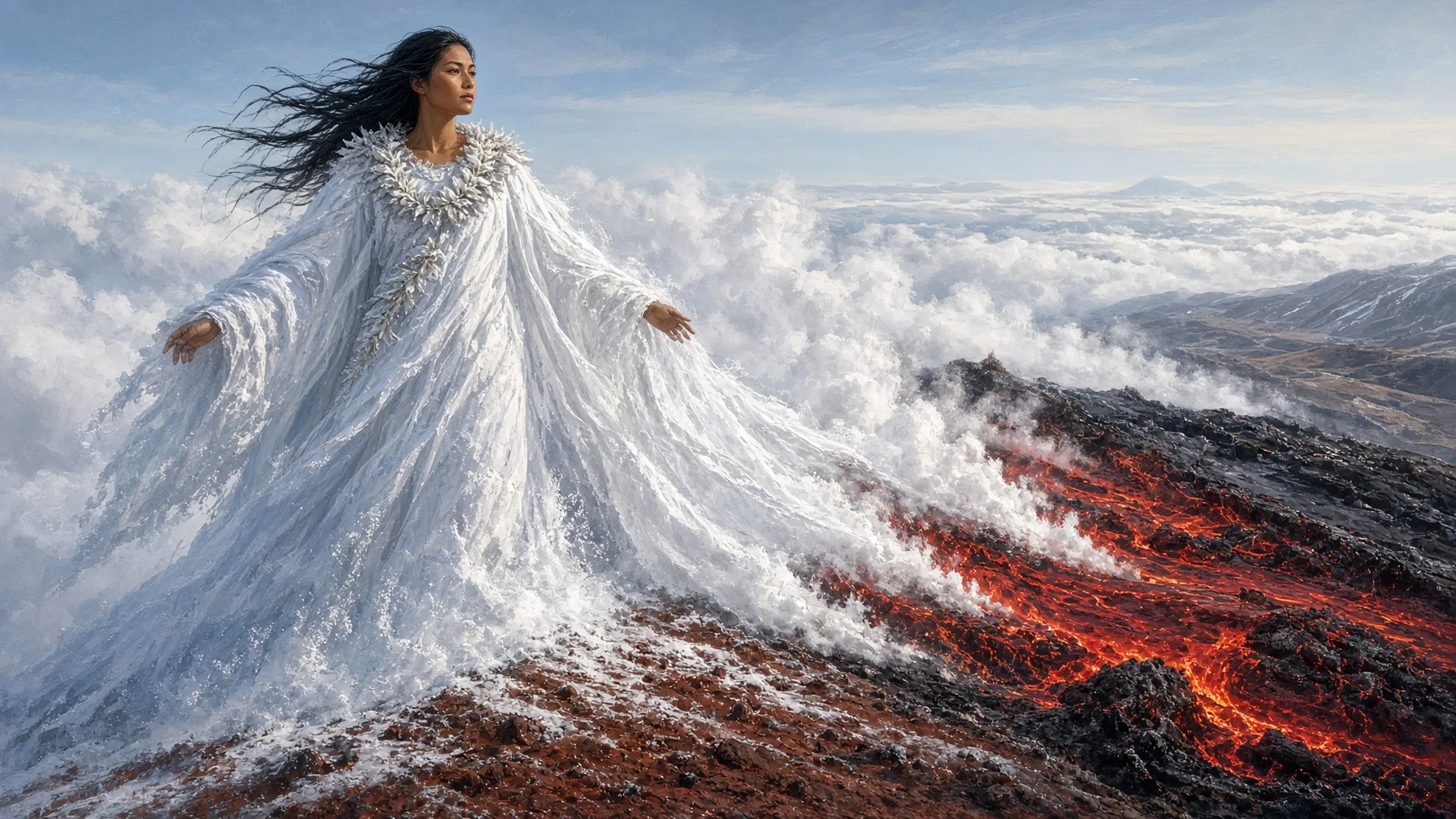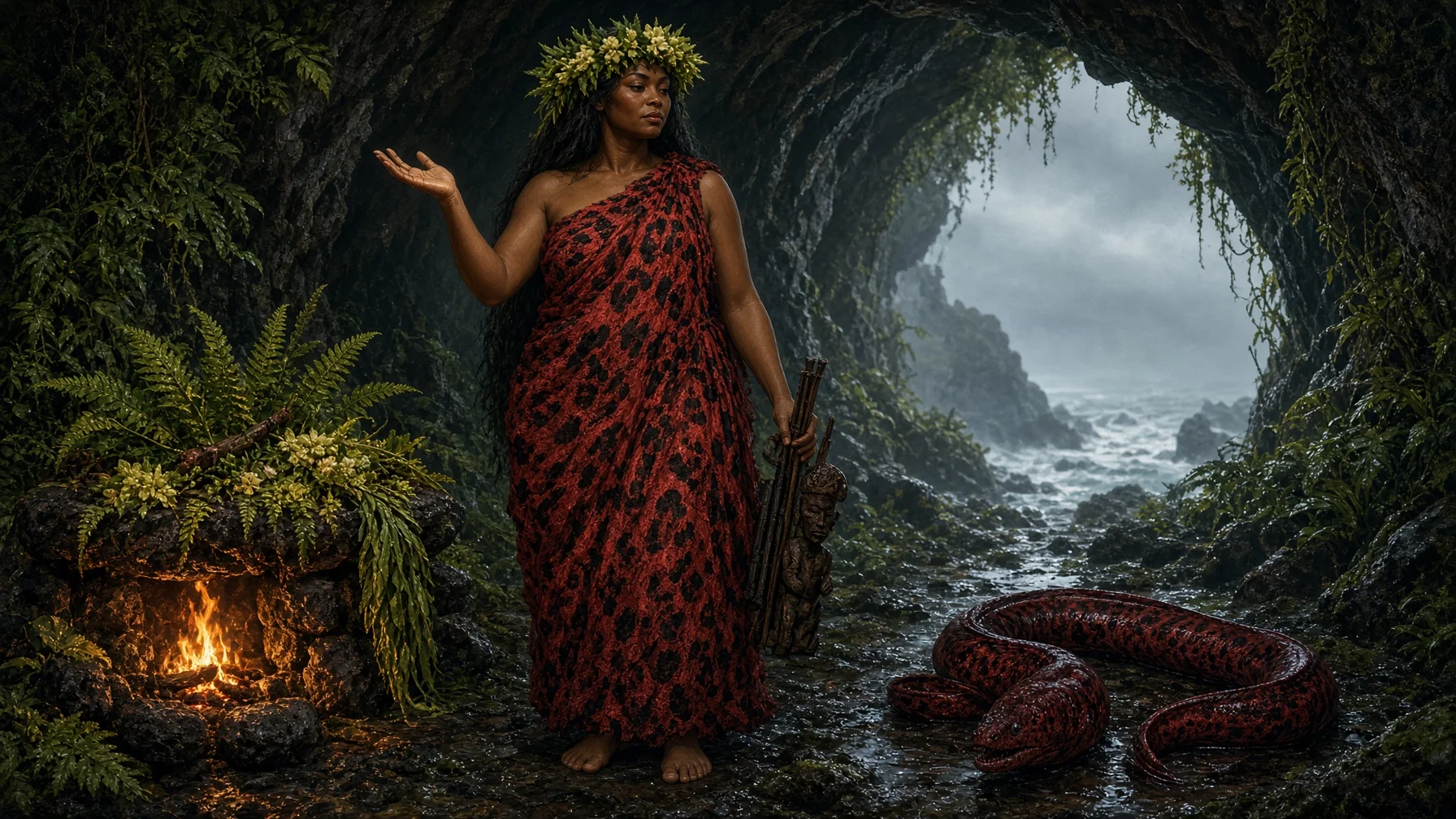
Kapo, sometimes called Kapo'ulakina'u, is one of the most formidable and paradoxical figures in Hawaiian mythology: a goddess who could harm with a curse and heal with the same power, who presided over the sacred art of hula, and whose body itself became a weapon in one of the tradition's strangest and most memorable stories. She belongs to a family of extraordinary women — sister to Pele and Hi'iaka, and in many genealogies a daughter of Haumea, the great mother-goddess of childbirth and fertility. Where her sisters are remembered for fire and for gentleness, Kapo is remembered for mastery over the unseen — the sorcery, the healing arts, and the sacred dance still practiced in Hawai'i today.
A Daughter of Haumea's Restless House
Hawaiian genealogical chant does not describe a single, tidy family tree so much as a braided river of relationships, retold differently from island to island and from one chanting family to the next. In many of these accounts, Kapo is counted among the children of Haumea, the earth-mother figure whose fertility myths describe her repeatedly renewing her own youth by taking younger husbands and bearing children across generations. That same lineage is credited with Pele, the volcano goddess; Hi'iaka, her devoted younger sister; and Kamohoali'i, the shark-god. Being born of Haumea's line placed Kapo among deities of primal creative force — but where Haumea's power flows outward into childbirth and the shaping of the earth, Kapo's power turned inward, toward the hidden mechanisms of the body, the mind, and fate itself.
Goddess of Two Faces
What makes Kapo distinct among Hawaii's akua is that she was never asked to choose a single nature. She is a goddess of fertility and of healing, invoked by families hoping for children or recovery from illness. She is, at the very same time, one of the deities associated with kahuna 'ana'ana — the practice of praying a person to death. A kahuna skilled in this dark art might call on Kapo to curse an enemy, while a healer in the very next village might call on her to lift a sickness. This duality was not seen as contradiction but as completeness: Kapo held both ends of the same power, the capacity to harm and the capacity to mend, and which face she showed depended entirely on who asked, and why, and with what intention behind the prayer.
Patroness of the Sacred Dance
Among ordinary Hawaiians, Kapo was probably best known not as a goddess of curses but as the patroness of hula. Hula was never mere entertainment in old Hawai'i; it was a sacred practice, a form of prayer and historical record carried in the body, and its practitioners trained for years under strict kapu, or sacred restrictions, before ever performing publicly. Kapo watched over this discipline as one of its patron deities. Her association with hula is inseparable from her association with maile, the fragrant, glossy-leaved vine still used today to weave lei for graduation ceremonies, weddings, and hula performances. Maile was considered Kapo's own sacred plant, and its use in ceremony was understood as an offering that carried her blessing into the dance.
The Rescue of Pele
Kapo's most famous story is also her strangest, and it says a great deal about how Hawaiian myth could hold humor, danger, and reverence together without treating any of them as a contradiction. The tale involves Kamapua'a, the shapeshifting boar-demigod whose romantic and adversarial pursuit of Pele forms one of the great myth cycles of the islands. Kamapua'a's advances toward Pele were not gentle courtship; in this telling, he pressed himself upon her with a force that endangered her, and Pele's own considerable powers were, in this moment, not enough to drive him off.
The Detachable Kohe
It was Kapo who intervened. She detached her own kohe — her vagina — and sent it flying off on its own, independent of her body, as a lure. Kamapua'a, distracted and drawn away by this decoy, abandoned his pursuit of Pele to chase it instead, giving Pele the opening she needed to escape. The flying kohe eventually came to rest at a place on O'ahu still remembered in the landscape itself: Kalaeoka'i'lio, a place name that carries the memory of the story within it, the way so much of the Hawaiian landscape holds myth folded into its names. Told properly, within its own tradition, the story is not crude; it is a demonstration of Kapo's command over her own body and its powers, deployed with wit and precision to save her sister when brute strength alone had failed.
A Story About Power, Not Shame
It is worth pausing on why this particular myth mattered enough to survive centuries of oral transmission. Hawaiian storytelling did not treat the body, sexuality, or bodily functions with the same discomfort that later, imported moral frameworks sometimes imposed on them. Kapo's flying kohe is not a joke at her expense; it is proof of her mastery — she could separate a part of herself from herself entirely and send it into the world to do her will. In a mythology built around kino lau, the many body-forms a god or goddess could take, Kapo's myth pushes that concept to a striking extreme: not a transformation into an animal or a plant, but a fragmentation and independent animation of her own body, wielded as a tool of rescue.
Sister to Fire and to Devotion
Kapo's placement within Haumea's family gives her story extra resonance. Pele is remembered for volcanic fire and a fierce, often destructive temperament; Hi'iaka is remembered for gentleness, for her long, dangerous journey to fetch Pele's lover Lohi'au, and for her patience in the face of her sister's jealousy and impatience. Kapo occupies a third position entirely: not fire, not gentleness, but hidden mastery — the sorcerer's and the healer's power, deployed decisively but rarely showily. That the sisters could come to one another's aid, as Kapo did for Pele against Kamapua'a, reflects a broader pattern across Hawaiian myth in which family bonds, however fraught with rivalry or jealousy elsewhere in the stories, held firm against outside threats.
The Kahuna's Two Prayers
In the practice of traditional Hawaiian religion, a kahuna was not one uniform kind of priest but a specialist, trained for years in a particular discipline — canoe-building, navigation, medicine, or the darker art of 'ana'ana, praying someone to death. Kahuna 'ana'ana who called on Kapo did so believing she could bring real harm to an enemy through prayer alone. Yet the very same goddess was petitioned by healers, families, and dancers for entirely opposite purposes — restoring health, protecting a birth, or blessing a hula performance. This was not seen as Kapo being unpredictable or capricious; rather, her worshippers understood that a power capable of harming could, by the same logic, be turned toward healing, and that invoking her correctly meant approaching her with the right intention and the proper offerings for the outcome sought.
Maile and the Living Forest
The maile vine, sacred to Kapo, grows wild in Hawai'i's upland forests, twining fragrantly along other trees and shrubs. Its leaves, when crushed, release a sweet scent that lingers. That this plant belongs to a goddess of sorcery and hula alike underscores how thoroughly Hawaiian religious life wove together plant, place, and deity: to gather maile properly was to enter Kapo's domain, and to wear it was to carry a fragment of her blessing.
Kapo in the Landscape
Hawaiian myth rarely stayed confined to chant and memory alone; it left its mark on the physical world, in place names, in stones said to be transformed ancestors, in caves and cliffs tied to specific gods. Kalaeoka'i'lio, the site associated with the resting place of Kapo's flying kohe, is one such marker, a piece of O'ahu's coastline that carries this story embedded in its very name for anyone who knows to ask what it means. This is characteristic of the tradition as a whole: the land is not simply a backdrop for myth but an active participant in it, holding memory in a way that outlives any single generation of storytellers.
A Goddess of the Dance
Hula has never disappeared from Hawaiian life, and Kapo remains known within that tradition as one of its patron deities, alongside her place in the memory of kahuna 'ana'ana practice. She stands, in the surviving tradition, as a goddess of fertility, healing, sorcery, and dance together — fierce, capable, and utterly her own, a reminder that Hawaiian mythology never asked its most powerful women to be simple.
Sources & traditions
- EncyclopediaWikipedia — Kapo (mythology)
- TraditionHawaiian texts, oral tradition and village tellings
Myths change from area to area and from time to time. This chronicle follows the most widely told versions; tellings in other villages, regions and eras may differ.