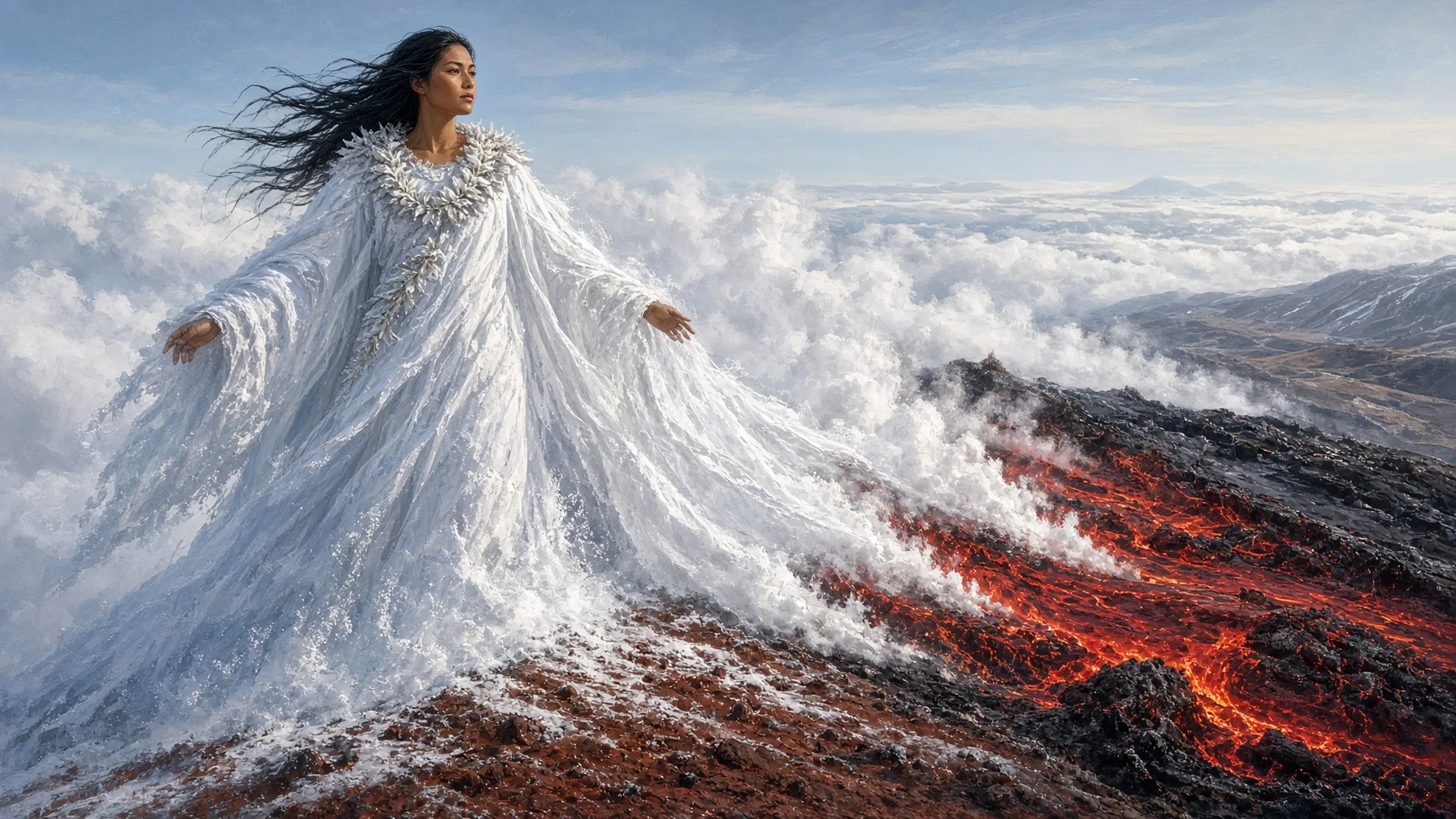
Ranginui (Rangi) is the primordial Sky Father of Maori cosmology, the husband of Papatuanuku, the Earth Mother, and with her the source from which all the atua — and, in time, all humankind — descend. His story is not a tale of adventures in the way of a trickster hero; it is the shape of the world itself, the reason there is sky above and earth below, light where there was once only darkness.
Before the World Had Edges
In the deepest genealogies recited by tohunga, Ranginui and Papatuanuku are not always described as the absolute beginning of things. Some whakapapa traditions — recorded with real variation between Nga Puhi, Tuhoe, and Ngati Porou lines — trace them back further still, as descendants of even earlier states of being: Te Kore, the realm of potential and nothingness, and Te Po, the long night before form. Where one iwi's recitation begins the count of generations differs from another's, and this is not a contradiction to be resolved but a feature of oral tradition itself — cosmogony as living memory, reshaped in each rohe by the voices that carried it.
What is consistent across the versions best known today, particularly as gathered by nineteenth-century ethnographers such as Elsdon Best and George Grey, is the moment the world as it is now recognisable begins: with Rangi and Papa themselves, locked together.
The Long Embrace
Ranginui lay upon Papatuanuku in a union so close that no light could pass between them. Between their bodies their children were born — the atua who would go on to preside over forests, winds, sea, cultivated food, wild food, war, and the beginnings of humankind — and there, in that first generation, they lived pressed together in absolute darkness, unable to stand, unable to stretch, unable to see one another's faces. It was not a punishment. It was simply the shape the world had, before anyone had thought to ask whether it could be otherwise.
Among those children were Tane Mahuta, who would come to hold dominion over the forests and the birds; Tawhirimatea, keeper of wind and storm; Tumatauenga, whose domain is war and human endeavour; and their siblings governing the sea, the wild plants, and the cultivated crops that would one day feed people. Cramped in that endless night between their parents, they began, over what the recitations render as a long and uncertain span, to speak of what might be done.
Council in the Dark
The debate among the children of Rangi and Papa is one of the oldest recorded arguments in Maori oral tradition, and it was not a small one. Some among them proposed that their parents simply be killed outright — better, in that view, a swift and total end to the embrace than any half-measure. Tumatauenga, fierce even then, is remembered as the strongest voice for this path.
Others could not bear the thought of destroying the two beings from whom they had come. It was Tane who proposed the alternative that would prevail in most tellings: not to kill Rangi and Papa, but to separate them — to push the sky father upward and away, leaving the earth mother lying below, so that their children might finally stand upright, stretch their limbs, and let light fall into the space between them for the first time.
The Push That Made Room for Light
One by one, in the widely told version of events, the children attempted the separation and failed. The embrace was too strong, the grief of what was being attempted too heavy. It was Tane who succeeded — not with his hands, as the others had tried, but by turning onto his back, planting his feet against his father, and pushing with his legs. Slowly, and against the felt agony of a bond that had held since before either had children, Rangi was forced upward, further and further, until at last light poured into the space that opened beneath him.
It is worth saying plainly, as tradition itself does, that not every iwi tells this moment identically. Some traditions credit different atua with the act, or describe the mechanics of separation differently. What holds constant across nearly all versions is the outcome: the world of darkness, Te Po, gave way to Te Ao Marama, the World of Light — a concept invoked to this day in whaikorero, in waiata, and in the carved meeting houses where the separation is rendered again and again in wood, the sky father's form arched away from the earth mother beneath him.
The One Who Would Not Let Go
Not all the children agreed to what had been done. Tawhirimatea alone stood against the separation of his parents, unable to accept that harmony had been purchased at the price of tearing Rangi and Papa apart. In his grief and fury he chose to follow his father skyward rather than remain below with his siblings, and from that height he has warred against them ever since — sending storms and hurricanes against the forests of Tane and hurling winds against the crops of his agricultural siblings, an ongoing tumult of weather waged from within the very sky his father occupies. Where Ranginui's presence in the sky is the still, encompassing fact of the atmosphere and the heavens themselves — the origin point of sun, moon, stars, and the great turning weather above — Tawhirimatea's fury within that sky is a distinct and separate portfolio, his own specific domain of wind and storm. The storm is his child's rage, not his own.
A Grief That Falls as Rain
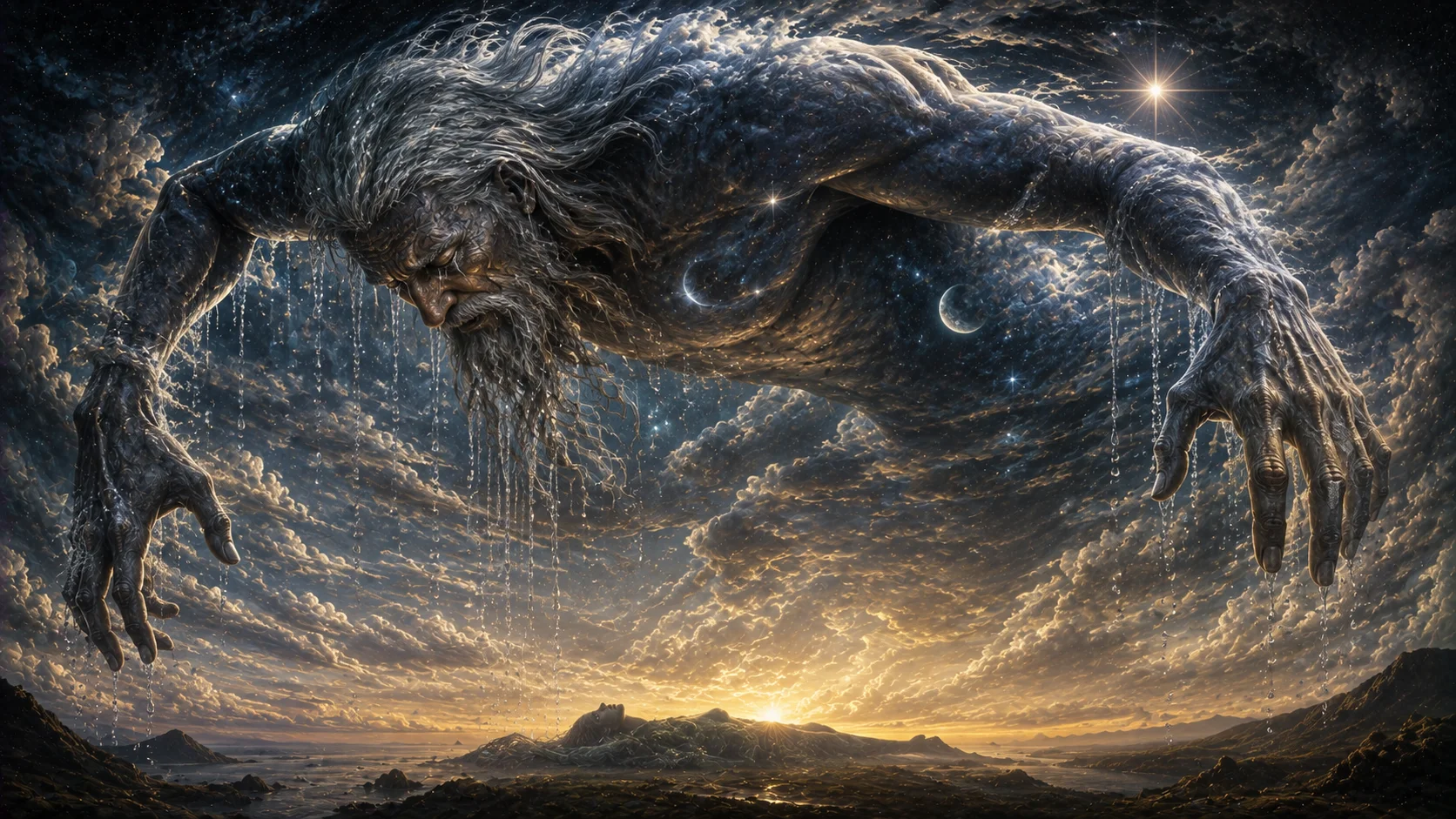
Separation did not end the bond between Rangi and Papa; if anything it revealed how total it had been. From his place high above, Ranginui is said to weep for the wife he can no longer hold, and his tears fall to earth as rain and as dew, morning after morning, an unbroken record of longing carried in the most ordinary of weather. Papatuanuku answers in kind: the mist that rises from her forests at dawn is spoken of as her own sighs, breathed upward toward a husband she can see but never again touch.
This image — sky and earth still reaching for each other across the gap their children opened — is one of the most enduring and most quoted elements of the tradition, cited whenever someone wishes to speak of longing, of separation borne for the sake of others, or simply of why the world is wet with rain and hazed with mist on so many mornings.
Turning Papa's Face Away
In some tellings, the children of Rangi and Papa took a further step once they saw how ceaselessly their mother grieved. Watching her weep for a husband she could no longer reach, and fearing that her sorrow would weigh too heavily upon the people who would one day live upon her, they are said to have turned Papatuanuku over — face down, away from the sky, so that her longing would no longer fall so visibly upon the world she carried. The details of this episode vary considerably between regions and recorded sources, and it is treated with more regional specificity than the separation itself, but the underlying idea recurs: that even after the great parting, the children continued to act to protect the world they had made possible, tending not only to light and space but to their mother's grief within it.
Sky as Origin, Not as Actor
It is a notable feature of Ranginui's place in the tradition that he is rarely the protagonist of subsequent, episodic adventures in the way that Tane or Maui are. Once the separation is accomplished, Rangi's role becomes structural rather than active: he is the sky itself, the point of origin for the sun, the moon, the stars, and the great turning weather of the heavens, understood cosmologically as belonging to his domain even as particular phenomena — wind and storm chief among them — are assigned to specific children such as Tawhirimatea. Ranginui does not go on to have a string of further exploits. His defining act is singular and immense: he was there at the beginning, he was parted from his wife, and in that parting the entire visible world was made possible.
Disputed Threads at the Edges of the Story
As with much oral tradition transmitted across many generations and many rohe, some more localised accounts noted by early ethnographers describe additional unions for Ranginui prior to Papatuanuku. These threads are minority traditions, disputed and far less widely carried than the central narrative of the embrace and separation, and they are not treated as part of the mainstream account of who Ranginui is. They are worth noting honestly rather than smoothing away, precisely because a living tradition is one that holds variation without needing to resolve it into a single official version.
The Argument Carved Into Meeting Houses
The separation of Ranginui and Papatuanuku is not simply an old story recounted for its own sake; it remains a living reference point in Maori oratory and art. Whaikorero draws on the image of light entering the world through that first, difficult act of parting. Waiata carry the grief of sky and earth as an ongoing, present-tense sorrow rather than a closed chapter. And in carved meeting houses across the country, the moment of separation is rendered again and again, Tane's legs braced against his father, the gap between Rangi and Papa filled with the same light that is said to have first entered the world at that instant. To invoke Ranginui, in this sense, is to invoke the very possibility of a world with room enough to stand in.
Sky Father, Enduring
Ranginui's story resists being reduced to a single moral or a single scene, and that resistance is part of its strength. He is at once the origin of the heavens, a husband still weeping for his wife after uncounted generations, and the father whose children chose, at great cost and after real disagreement among themselves, to make a world of light rather than remain forever in a world of night. Rain still falls. Mist still rises from the forests each morning. And in the space between earth and sky that Tane forced open, everything that has lived since has had room to stand.
Sources & traditions
- EncyclopediaWikipedia — Rangi and Papa
- TraditionMaori texts, oral tradition and village tellings (New Zealand)
Myths change from area to area and from time to time. This chronicle follows the most widely told versions; tellings in other villages, regions and eras may differ.