Papatuanuku — often called simply Papa, the Earth Mother — is one of the two primal parents at the root of the Maori cosmogonic narrative. Bound in an embrace with Ranginui, the Sky Father, she is the ground beneath every subsequent event in the tradition: the darkness their children were born into, the body from which forests and food and human life proceed, and the grief that explains mist on the hills to this day. She is not a distant or abstract figure. In te ao Maori she is spoken of as a living ancestor, and the land itself — whenua — is her body still.
The Long Embrace in the Dark
Before there was light, there was Papatuanuku held fast against Ranginui, the two locked together so completely that no space existed between them. Their children were conceived and born into that narrow dark, pressed between the body of their mother and the body of their father, unable to stand, unable to see, unable to stretch a limb without touching one parent or the other. This confinement is the condition the whole tradition begins from — not emptiness, but a fullness with nowhere to go. Different tellings count the children differently: some name only the great atua who would go on to shape the visible world — Tane, Tangaroa, Tawhirimatea, Tumatauenga, Rongo, Haumia-tiketike, and Ruaumoko — while others, depending on iwi, add further names such as Whiro, Ru, or Rehua. What stays constant across the tellings is the image itself: a mother and father so tightly joined that their children knew only twilight, and grew restless in it.
A Council Held in the Dark
It was the children, not the parents, who deliberated over what to do about the darkness. The tradition is not uniform on how that deliberation went — different tellings weigh the brothers' positions differently — but the debate itself belongs to Rangi and Papa's offspring, held in the cramped space between their mother and father. Papatuanuku, in these accounts, is not consulted as an adversary to be defeated; she is the ground of the discussion, present but passive in the decision that would end her long embrace.
Tane's Push and the First Light
Tane is the atua most consistently credited with succeeding where his brothers failed. Where others tried and could not part their parents, Tane is said to have set his shoulders against his mother and his feet against his father, and pushed — not with his hands, in the manner of a child, but braced with his whole body, forcing Ranginui upward and away from Papatuanuku by increments until light broke into the space between them for the first time. That first light falling across Papatuanuku's body is, in the tradition, the beginning of the visible world as it is now known: sky above, earth below, and space enough between them for living things to stand upright.
The Weeping That Never Stopped
The separation that let the world begin also broke apart a marriage, and Maori tradition treats that grief as real and ongoing, not as a mythic footnote. Ranginui's tears for his wife are said to fall as rain. Papatuanuku's answering sighs rise as mist from the forests and hills, and are read as one of the clearest, most everyday proofs that the old stories still describe the world as it actually behaves — the mist does not merely resemble longing, in this telling; it is longing, still being expressed, generations on. This grief is treated in Maori oral literature, in whakatauki and in waiata, as a foundational sorrow underlying the natural order, not as something the world moved past once the separation was complete.
Turned Away From the Sky
In some regional traditions, Papatuanuku's children go a step further than separating their parents: seeing her sorrow continue, unrelieved, and unwilling to let it go on troubling the land and its inhabitants, they turn her over so that her face is set away from the sky. This detail is not universal — it belongs to particular iwi tellings rather than to a single agreed version — but where it appears, it reframes the ongoing separation as something the children actively managed rather than simply caused once and left. It is presented not as a punishment but as a mercy, an attempt by her own children to spare her the sight of the husband she could no longer reach.
Clothed in Forest by Her Son
Papatuanuku's nakedness and grief in the wake of the separation are answered, in the tradition, by Tane, who is credited with clothing her in forests and living things. Tane's association with woodland and birds in Maori tradition is not a separate, unrelated domain from this act — it flows directly from it. In dressing his mother's exposed body with trees, undergrowth, and the creatures that would live among them, Tane is understood to have addressed her sorrow with abundance: where there had been bare earth turned newly to the light, there was now forest, and where there had been silence, birdsong. This act is frequently cited as the origin point of Tane's guardianship over the forest realm, inseparable from his relationship to the mother he clothed.
Unions the Land Itself Remembers
The story of Papatuanuku does not end with Ranginui and the children they made together in the dark. Across many regional traditions she is credited with later unions or associations of her own, distinct from her bond with Rangi, which are said to bring forth further beings and features of the natural world. The details differ markedly from account to account — which figures are involved, and exactly what results, varies by iwi and by teller — and no single version should be read as settled or universal. What the traditions agree on is the underlying idea: Papatuanuku's generative role did not stop at the moment of separation, and her body continued, in various regional tellings, to be the source from which more of the visible world came into being.
The Body That Feeds the World
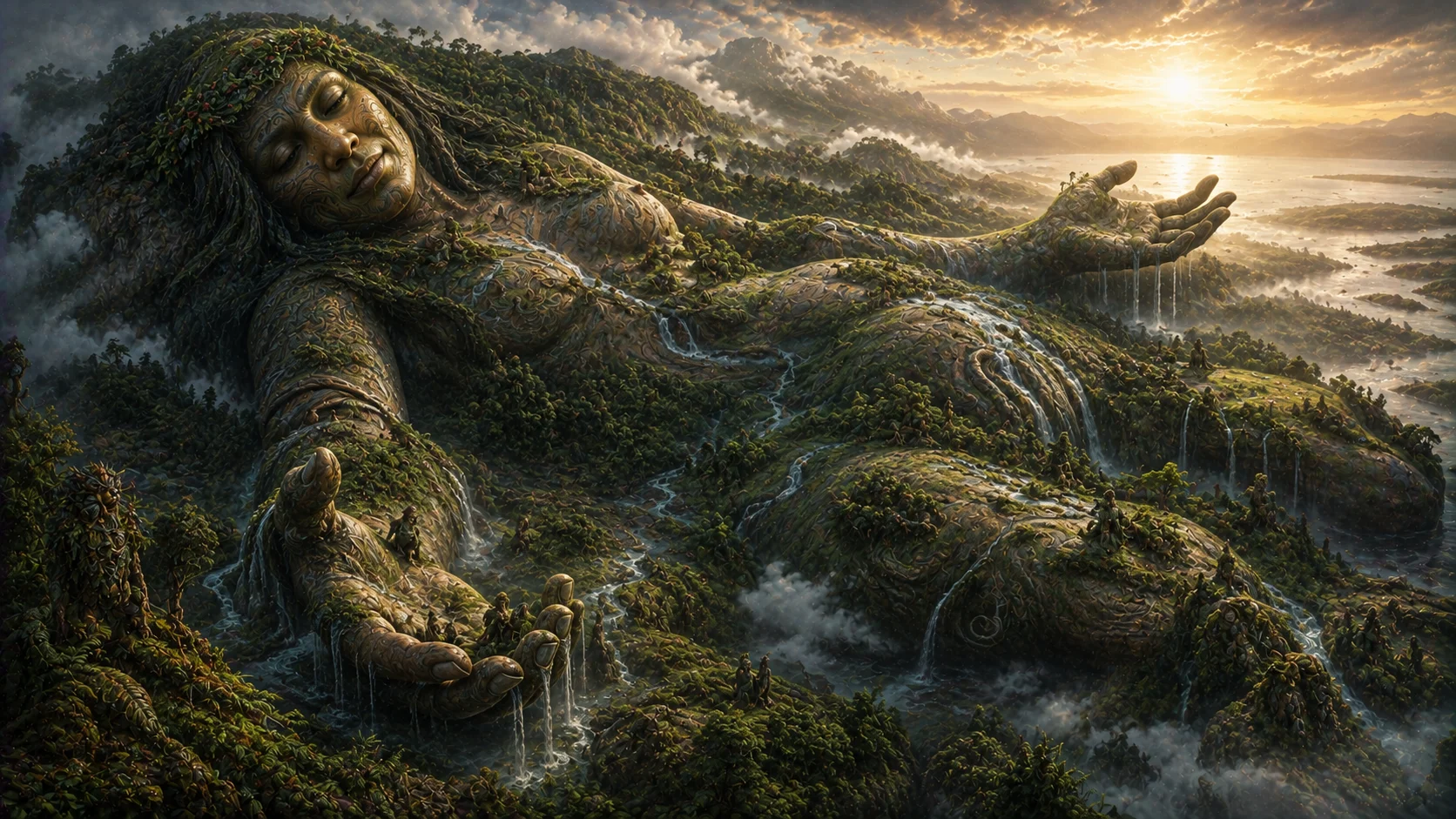
Papatuanuku's most enduring role is as the source of sustenance and physical life. The land is her body in a literal sense within the tradition, not a metaphor laid over an otherwise ordinary landscape — soil, root, and rock are understood as continuous with her, and food that grows from the ground is understood as coming from her directly. This is the belief that underlies kaitiakitanga, the practice and obligation of guardianship over the natural world: land is not property to be used up, but an ancestor to be cared for, because harm done to the whenua is harm done to Papatuanuku herself.
Ruaumoko, Unborn and Restless
Not every child of Rangi and Papa emerged into the light when the separation happened. Ruaumoko, the youngest, is said in most tellings to have remained inside Papatuanuku's womb, unborn at the moment his siblings forced their parents apart. He has stayed there ever since, and his movements beneath the surface — turning, stirring, pressing against the confines of the body that still holds him — are the traditional explanation for earthquakes and volcanic activity. Where Ranginui's grief is expressed outward, as rain falling from above, Ruaumoko's presence is Papatuanuku's own body responding from within: the earth itself shuddering around a child who was never given the chance to stand in the light his brothers won.
Tu Among His Siblings
Tumatauenga, god of war and ancestor of humankind, stood apart from his brothers in the aftermath of the separation, and in some traditions is described as eventually turning on them, overcoming Tangaroa, Tawhirimatea, and the others in turn to secure them as food for the human world Tu represents. Papatuanuku herself is not cast as a participant in this conflict among her children; she is not an antagonist in these episodes, and the struggles that follow the separation play out among her offspring rather than against her. Her role in the tradition remains that of source and ground, even as the children born from her union with Ranginui contend with one another over the world Tane opened up.
A Name Still Spoken Today
Papatuanuku is not treated in Maori tradition as a figure confined to the deep past. She remains a living presence in contemporary Maori cultural, environmental, and political life, invoked directly in land-rights advocacy and in environmental protection movements where the argument is not merely practical but genealogical: the land is an ancestor, and its defence is a family obligation rather than an abstract policy position. This continuity is part of what distinguishes her from a figure known only through recorded myth — she is spoken to, referred to, and drawn upon in present-day contexts in the same terms the old narratives use.
What the Records Preserve, and What They Flatten
Much of what is widely known about Papatuanuku today reaches modern readers through nineteenth- and twentieth-century compilations — notably George Grey's Polynesian Mythology of 1855 and the early twentieth-century ethnographic work of Elsdon Best, both produced by Pakeha writers working with Maori informants. These works preserved a great deal that might otherwise have been lost to the historical record, but scholars caution that composite, published versions of this kind can smooth over the genuine variation that exists between iwi traditions — differences in which children are named, whether Papatuanuku is turned face-down, what later unions are attributed to her, and how the wider narrative is told regionally. No single published account, however influential, should be mistaken for the one true or universal version of her story; the tradition itself has always held more than one telling at once.
Sources & traditions
- EncyclopediaWikipedia — Rangi and Papa
- TraditionMaori texts, oral tradition and village tellings (New Zealand)
Myths change from area to area and from time to time. This chronicle follows the most widely told versions; tellings in other villages, regions and eras may differ.