Beneath the mountains of Aotearoa, beneath the geysers of Rotorua and the trembling plains of Taupō, something ancient still moves. In Māori tradition — though the details shift from iwi to iwi — earthquakes are not spoken of as random violence in dead rock. They are spoken of as Ruaumoko — Rūaumoko, Rūamoko in some dialects — the youngest son of Ranginui the Sky Father and Papatūānuku the Earth Mother, who never left his mother's body and who shakes the world simply by turning over.
The Last Child of Sky and Earth
In the great genealogies, Ranginui and Papatūānuku lay locked together in an embrace so total that no light passed between them. Their children were crushed in the darkness between their parents' bodies — Tāne Mahuta, Tangaroa, Tāwhirimātea, Rongo, Haumia-tiketike, and others, atua who would come to govern forests, seas, storms, cultivated food, and wild food once space was finally made for them. Different iwi tell Ruaumoko's place among them differently: some hold him as the last-born, others dispute the birth order itself rather than simply the question of timing. What most traditions agree on is this — he was still within Papatūānuku, at her breast or in her womb, when his brothers made the decision that would break the world open.
The Separation of the Primal Parents
One by one, the elder brothers tried to force Rangi and Papa apart, so that light and space could exist for their children. Tāne Mahuta is remembered as the one who succeeded where the others failed, thrusting the sky upward into the heavens. Ranginui and Papatūānuku were torn from each other's arms. But in that violent instant of separation, one child was left behind, still bound to his mother's body as she was wrenched downward and away from the sky.
Carried Into the Earth's Body
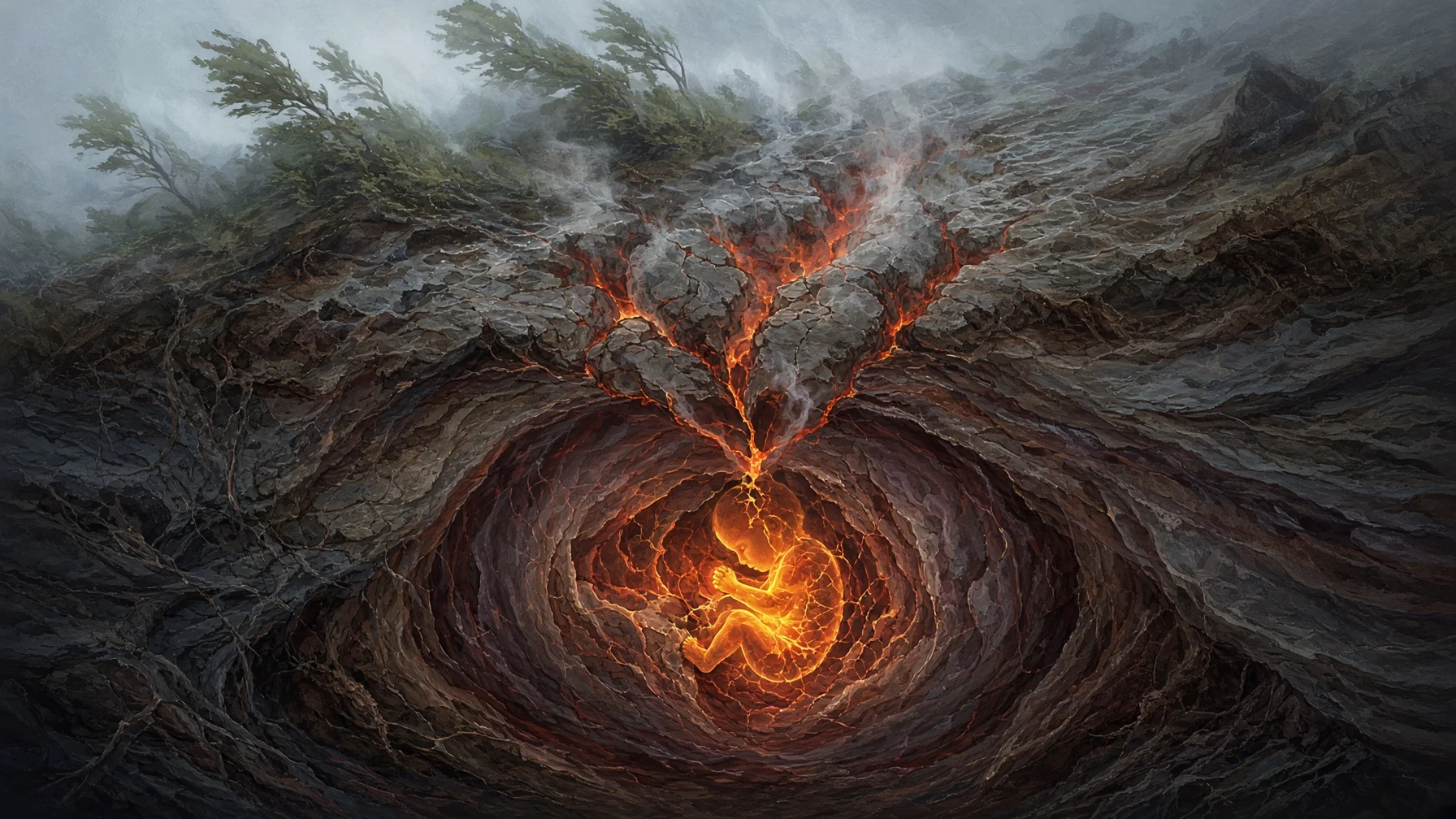
Ruaumoko went with Papatūānuku into the world beneath. In most accounts he never emerged, remaining permanently within her — some genealogies hold that he was never properly born, that he has lived his entire existence inside his mother's womb, beneath the very ground his descendants walk upon. It is this permanence, this unbroken bond, that separates him from every other child of Rangi and Papa. Tāne dwells in the forests above the earth; Tangaroa moves through the sea; Ruaumoko has never left the dark, warm interior of his mother at all.
A Different Grief Than His Brothers'
Tāwhirimātea, god of winds and storms, is generally remembered as the sibling who opposed the separation most violently. Ruaumoko's response to the same event took a different shape entirely — expressed not on the surface of the world but through his permanent bond to Papatūānuku and the rumblings that come from beneath her skin. He did not rage across the surface of the world. He turned inward, staying fused to the mother who bore him, and his grief, his restlessness, his discomfort in the dark, express themselves instead as a slow and continuous stirring beneath the ground.
The Meaning Folded Into His Name
Names in Māori cosmology are rarely decorative; they carry the nature of the being who holds them. Ruaumoko's name is widely connected to ru, to shake or tremble, joined with moko, a word carrying associations of the lizard and of the spiral, coiling patterns associated with tattoo and with taniwha-like beings. Some interpretations read in this a picture of a being who moves the way a lizard moves — low, hidden, sinuous beneath the surface — his presence felt only through the tremor he leaves behind, never through direct sight. This same symbolism is said to be echoed in carved representations found in some wharenui (meeting houses), though accounts vary on exactly what those carvings are understood to depict.
Warmth Sent Down Into the Dark
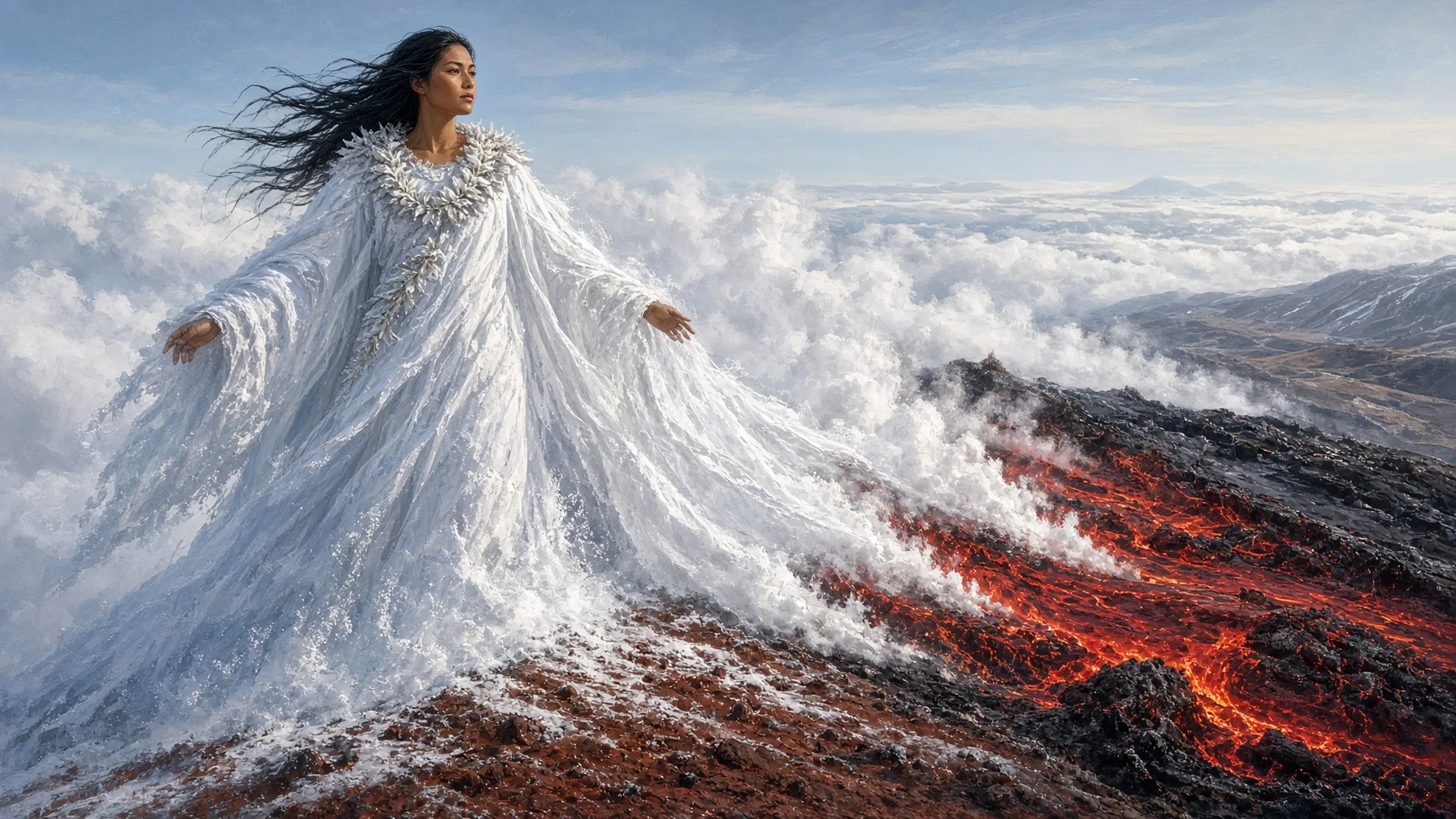
To live forever beneath the earth, cut off from the sun that warms the surface world, is to live in cold. Several traditions hold that Ruaumoko was given fire, ahi, by Mahuika, keeper of the flame, or was otherwise sent down into the underworld with fires to sustain him against the cold of his permanent confinement. Those fires are said to be the origin of the heat that rises through the central North Island to this day — the boiling mud, the geothermal steam fields, the hot springs of the Rotorua and Taupō region, all understood as the warmth of Ruaumoko's hearth reaching up through the skin of Papatūānuku.
Where the Ground Itself Answers
The volcanic zone that runs through the centre of the North Island is not, in this understanding, simply a geological feature. It is where Ruaumoko's presence is closest to the surface, where his fires burn nearest to the world above. Different iwi carry this knowledge according to their own proximity to the land's activity — communities near Rotorua and Taupō, who have lived among geysers and mud pools and volcanic cones for generations, hold particularly strong traditions of Ruaumoko's nearness, shaped by direct, repeated experience of the land moving and steaming beneath their feet.
The Turning That Brings Winter
Some iwi traditions extend Ruaumoko's influence beyond seismic and volcanic activity into the turning of the seasons themselves. When Ruaumoko shifts within his mother's body, Papatūānuku is said to turn her warm side toward him and toward his fires, and her cooler side away, toward the sun — and it is this turning that brings winter to the world above. When he settles again into stillness, she turns back, her warmth returning to the surface, and spring follows. In this reading, every winter is Ruaumoko changing his position in the only home he has ever known, and every spring is his settling back to rest.
Beneath the World of the Living
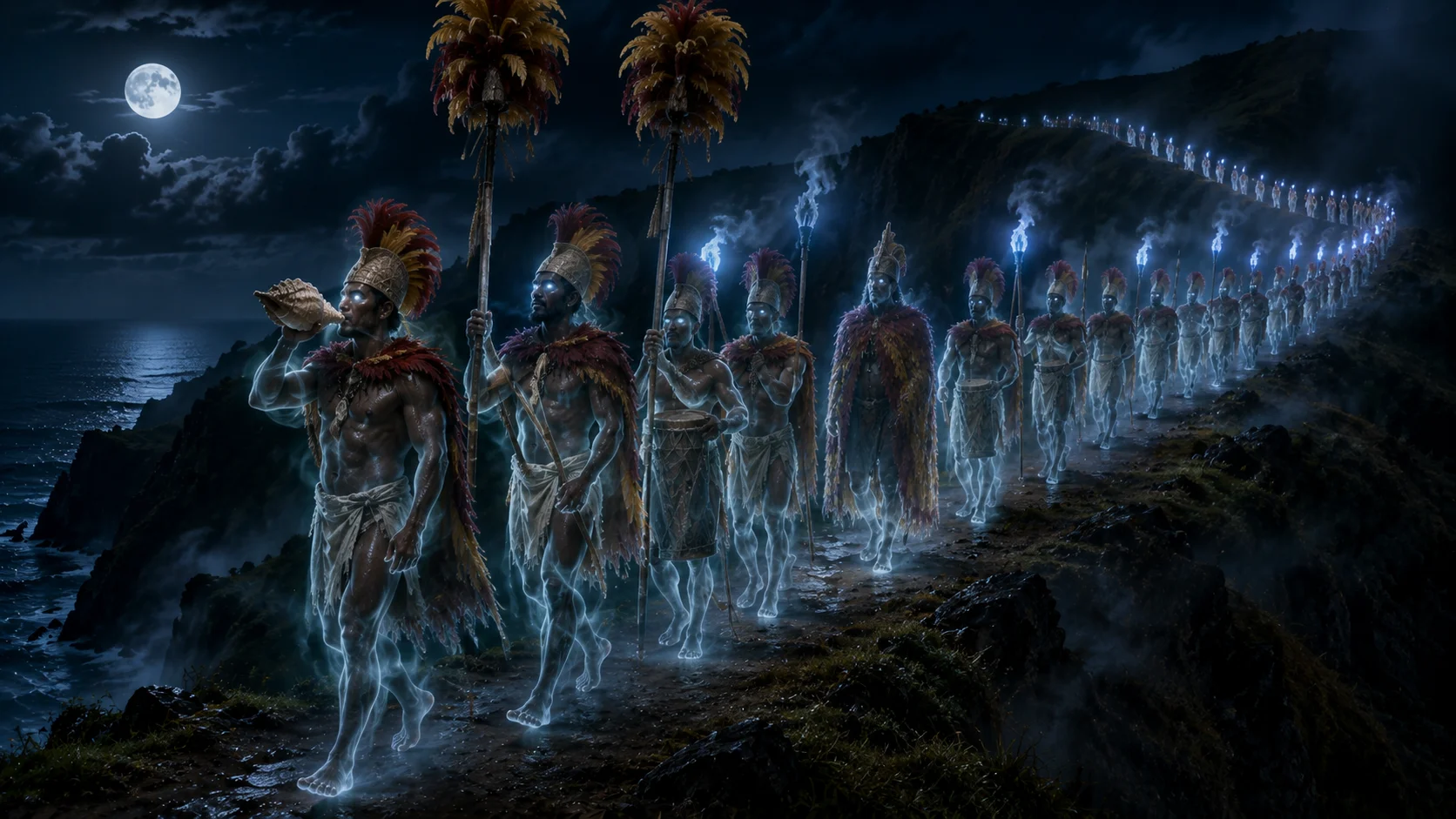
Some traditions carry Ruaumoko's associations further still, connecting the depths where he lives with Rarohenga, the underworld to which the dead travel. Having been taken down into the earth by Papatūānuku at the moment of separation, he is held in some accounts to dwell in company with, or near to, the realm of the departed — binding his domain of shaking ground not only to volcanic fire and seasonal change but to the deep places beneath the world of the living where the ancestors rest.
A Tapu and Feared Presence
Because his movements can bring the ground itself to violence, Ruaumoko is held as deeply tapu, sacred in a way that demands caution and respect rather than casual invocation. An earthquake, in traditional understanding, is not senseless. It is read as Ruaumoko stirring — from discomfort, from restlessness in the confines of his mother's body, from a grief that has never resolved, or simply from the natural, ceaseless movement of a being who has never known stillness for very long. That reading does not diminish the fear such events inspire; if anything it deepens it, because the shaking ground becomes the voice of someone, not merely the failure of something.
Spoken Of When the Earth Moves
In whaikōrero, in oratory delivered when the ground has recently shaken, Ruaumoko's name is invoked as an acknowledgment of what has happened and who is understood to have caused it. Some East Coast and Tūhoe traditions carry particular depth of reference to him in these moments — including in connection with the haka Ka Mate, invoked or referenced in the same cultural context — situating a tremor within a lineage of meaning that stretches back to the separation of Rangi and Papa rather than treating it as an isolated, meaningless event. The land is never simply land in this framing — it is a body, with a history, and a youngest son still living within it.
Ruaumoko in Living Memory
The major earthquakes that Aotearoa has lived through in recent times — the Canterbury and Christchurch earthquakes of 2010 and 2011, the Kaikōura earthquake of 2016 — have been spoken of by some Māori communities within this same cosmology, framed as Ruaumoko stirring rather than as a single fixed myth being replayed. This is not treated as a literal newsreel account so much as a living cultural and spiritual lens through which an unsettling, destructive event is placed in relationship with ancestral understanding, grief, and the deep genealogy connecting every person to Papatūānuku and to the child who has never left her side.
The Child Who Remains
Every other child of Ranginui and Papatūānuku found a place in the world that opened once their parents were pulled apart — the forest, the ocean, the wind, the cultivated and the wild gardens of the earth's surface. Ruaumoko alone stayed behind, bound permanently to the body of the mother he was never fully separated from, carrying warmth and grief and motion into a darkness the rest of his siblings escaped. Traditions differ on the particulars — his exact place in the birth order, whether he was born at all, how strongly he is tied to any one volcanic field or to Rarohenga — and those differences are themselves part of what he means: a god whose story is told a little differently by every iwi who lives closest to where he stirs. Each tremor of the ground, each plume of steam rising from a geothermal field, each mild seasonal turn from warmth to cold, is understood as evidence that he is still there — the youngest son, unborn and undying, restless beneath everything that stands.
Sources & traditions
- EncyclopediaWikipedia — Rūaumoko
- TraditionMaori texts, oral tradition and village tellings (New Zealand)
Myths change from area to area and from time to time. This chronicle follows the most widely told versions; tellings in other villages, regions and eras may differ.