Whiro, also known in some traditions as Whiro-te-tipua, is one of the children of Ranginui (the Sky Father) and Papatuanuku (the Earth Mother). He is generally regarded in Maori cosmology as the personification of darkness, evil, sickness, and death, standing in opposition to Tane-mahuta and the forces of light and life associated with Te Ao Marama, the World of Light.
Birth and Seniority
Whiro is usually numbered among the senior atua born of Rangi and Papa, alongside Tane-mahuta, Tangaroa, Tawhirimatea, Rongo, Haumia-tiketike, and Tumatauenga, though the exact roster and birth order of the children of Rangi and Papa vary between iwi. In several East Coast and Tuhoe traditions, Whiro is named as the eldest of the brothers, a position that in Maori tikanga would ordinarily carry primacy of rank and mana over his younger siblings. This point of seniority is not a minor genealogical footnote in these tellings: tuakana-teina relationships, the ranking of elder over younger siblings, structured much of pre-contact Maori social and ritual life, so an eldest brother denied his expected authority represents a rupture of the natural order itself, not merely a personal grievance. Traditions that place Whiro first among the brothers use that seniority to explain why his anger is remembered as so consequential — a younger sibling's resentment might be treated as a passing slight, but an eldest's is a wound to the whole structure of precedence.
The Contest for Supremacy
Despite this seniority in some accounts, Whiro was passed over or lost a contest for supremacy among the brothers. His resentment over this loss of status and mana is frequently cited in tradition as the origin of his lasting enmity toward Tane and the other atua. Different tribal versions frame the contest itself differently: in some, it is a direct trial of strength or a debate among the brothers over how to treat their parents, Rangi and Papa, following the separation of earth and sky; in others, it is a more abstract judgment of mana and fitness to lead. What the versions agree on is the outcome and its emotional charge — Whiro emerges diminished in standing relative to at least one younger brother, most often Tane, and this diminishment is treated as the psychological hinge on which the rest of his mythology turns. Tradition frequently emphasises that Whiro's grievance is not treated as irrational within the narrative logic of the myth cycle; rather, it is precisely because his claim to primacy had some legitimate basis that his subsequent turn toward darkness carries the moral weight it does, illustrating a broader theme in Maori cosmology that thwarted or humiliated mana can curdle into destructive intent.
Rivalry with Tane
A major mythic cycle recounts a great battle, or an ongoing rivalry, between Whiro and Tane-mahuta for control of Te Ao Marama. Tane, aligned with life, growth, and light, ultimately prevails, and Whiro retreats into darkness. This rivalry is sometimes cited in tradition as an explanation for natural phenomena such as the coming of night after day, decay following growth, and death following life, the Rangi-Papa children's conflicts framed as accounting for the balance between light and life on one hand, and darkness and death on the other. In some tellings the conflict is described less as a single decisive battle than as a continuing, cyclical struggle, mirrored in the daily alternation of day and night and the seasonal alternation of growth and dormancy; Tane's dominance is real but not absolute, since Whiro is never destroyed, only driven back, which is consistent with the broader pattern in Maori tradition of opposed atua existing in permanent tension rather than one eliminating the other outright. This framing allows the myth to do double duty: it accounts cosmologically for the origin of mortality and misfortune while also modelling, at the level of the atua, the same tuakana-teina dynamics of rivalry and rank that structured human whanau and hapu relationships.
Retreat to the Underworld
Following his defeat, Whiro is said to have fled into the underworld, associated in different tellings with Rarohenga or with Po. There he is said to continue ruling over the forces of night, decay, and death, and from there to send sickness and misfortune to afflict humankind. Whiro is closely associated with Po, the realm of darkness and night, and is sometimes considered a chief or lord of Po, in contrast to Tane's association with Te Ao Marama. This underworld sovereignty is significant in how tradition frames the balance of power between the brothers: Whiro's defeat in the upper world does not annihilate him but instead relocates his authority to a parallel domain, so that Te Ao Marama and Po function as two spheres each with its own presiding atua, rather than a single hierarchy with Tane simply on top. Some accounts describe Rarohenga and Po as related but distinct concepts within this underworld geography, with Rarohenga more specifically the realm of the dead reached by spirits after death, while Po carries the broader sense of primordial darkness and night out of which Te Ao Marama itself emerged; Whiro's association with both reflects his standing as a figure of night, death, and the unformed dark alike.
The Baskets of Knowledge
One of the best-known episodes involving Whiro belongs to the story of Tane's ascent to Te Toi-o-nga-rangi, the highest heaven, to retrieve the three baskets of sacred knowledge, along with the sacred stones. In this account, Whiro attempts to thwart or intercept Tane's mission out of jealousy, sending noxious insects, disease, and obstacles against him. Tane is said to have completed the ascent regardless. The episode is often read as a direct continuation of the brothers' earlier rivalry over supremacy: having lost the contest among the atua and been driven into darkness, Whiro cannot prevent Tane's elevation but can still act as an obstacle and a source of affliction along the way, which is consistent with his broader role in tradition as one who disrupts and afflicts rather than one who ultimately overturns outcomes already settled in Tane's favour. The baskets themselves, in traditions that name them, are generally understood to contain different categories of knowledge and ritual, and Tane's successful retrieval of them despite Whiro's interference is presented as securing knowledge and wellbeing for humankind against the deliberate opposition of the atua of darkness.
Agents and Emissaries
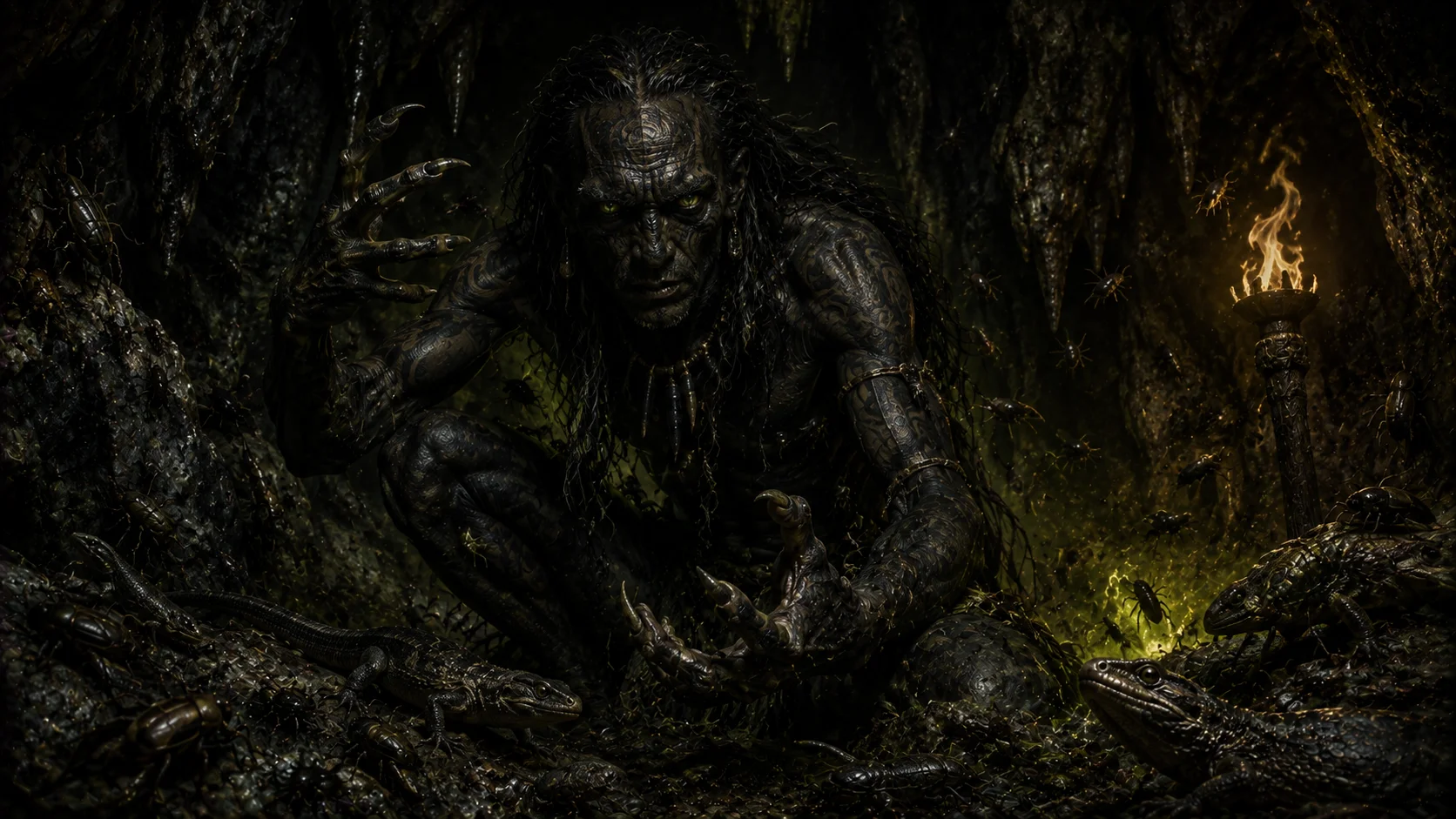
Whiro is frequently linked in tradition with lizards, insects, and other creatures regarded as ill-omened or repulsive. These are considered his tama, his children or emissaries, sent to spread misfortune, sickness, and death among people. This association reflects a broader pattern in Maori tradition of linking particular atua with particular classes of creatures as their earthly agents or representatives, in the same way that Tane is linked with the forests and their birds, and Tangaroa with the creatures of the sea. The specific creatures attributed to Whiro — lizards prominent among them — carried real weight in everyday tikanga, since an encounter with a lizard in certain contexts could itself be treated as an ill omen or a sign of impending misfortune, precisely because of this genealogical and symbolic connection back to Whiro as their originating atua. The insects sent against Tane during his ascent to retrieve the baskets of knowledge are generally understood within this same framework, as an extension of Whiro's use of his lesser creatures as instruments of obstruction rather than confronting his rival directly himself.
Makutu and Moral Failings
Some traditions cast Whiro as the origin of makutu, sorcery or black magic, and of things regarded as noa in a negative or polluting sense, as well as of human moral failings such as theft, jealousy, and treachery. Ngati Porou and other East Coast traditions in particular preserve detailed genealogies and narratives that place Whiro prominently in the whakapapa of darkness, in some accounts identifying him as an ancestor or personification behind the practice of makutu. In these traditions, Whiro's significance extends well beyond a single cosmological episode: he functions as an explanatory figure for the existence of harmful ritual practice and antisocial behaviour within human society itself, providing a mythological account of why such things exist at all rather than describing them as arising from ordinary human failing alone. Jealousy in particular recurs across multiple layers of the Whiro tradition — it is cited as his motive both for opposing Tane's ascent to retrieve the baskets of knowledge and, more fundamentally, for his enmity following the contest for supremacy among the brothers — so that jealousy functions almost as Whiro's defining trait, the emotional thread linking his origin story to his ongoing role as a source of affliction.
Physical Form and Abstract Personification
Not all traditions describe Whiro as a physical being. In some tribal accounts he is depicted not as an anthropomorphic atua with a physical form comparable to Tane or Tangaroa, but as the personification of an abstract force or quality, evil intent, envy, and the impulse toward destruction. This variation matters for how the wider mythology is interpreted: where Whiro is treated as a personified force rather than a being with a body and a residence, episodes such as the sending of insects against Tane or the rulership of Po are more readily read as symbolic descriptions of the workings of darkness, decay, and ill will in the world, rather than as literal acts undertaken by an individual actor. This abstract reading sits alongside, rather than simply replacing, the more personified accounts in which Whiro has siblings, loses a contest, and flees to a specific underworld domain — a duality of the concrete and the abstract that recurs across many atua in Maori tradition and is not unique to Whiro.
Whiro in the Maramataka
The name Whiro is also used for the first night, or phase, of the lunar month in the maramataka, the traditional lunar calendar by which time, tapu, and daily activity were once ordered. It is remembered as a particularly dark, tapu, and inauspicious night, reflecting Whiro's association with darkness and ill omen in everyday ritual practice. Because the maramataka governed practical decisions such as when to plant, fish, or undertake important activities, the naming of this first night after Whiro carried real consequence rather than being merely a symbolic label: a night associated with the atua of darkness, sickness, and misfortune was treated as a poor time for undertakings expected to succeed, and this everyday ritual caution is one of the clearest ways in which Whiro's mythological character persisted as a living element of practice long after the narrative episodes involving Tane and the baskets of knowledge.
Regional Variation
Because Maori oral tradition is iwi-specific and not codified into a single fixed text, the character, deeds, and even the moral valence of Whiro vary regionally. Some traditions present him primarily as a personification of natural darkness and night, with less overtly evil connotation, while others, particularly those built around the Tane-Whiro rivalry, cast him unambiguously as the source of evil, sickness, and death. Researchers and iwi have cautioned against flattening these variations into a single universal Maori mythology narrative, and this article follows tradition-specific attribution where the sources indicate it rather than presenting one version as definitive. The East Coast and Tuhoe traditions that name Whiro as eldest of the brothers, for instance, tend also to be the traditions that most elaborate his connection to makutu and to detailed whakapapa of darkness, while traditions that treat him more as an abstract personification of night tend to place less emphasis on his moral culpability and more on his cosmological function. Readers encountering the name Whiro in different regional contexts should therefore expect the emphasis, and sometimes the moral framing, to shift according to the tribal source rather than assume a single fixed characterisation applies uniformly across Aotearoa.
Comparative Note
Whiro is sometimes distinguished in scholarship from similarly named figures in other Polynesian traditions, such as Hawaiian analogues of a dark or rival sibling deity. This underscores that Whiro's specific characterization as an atua of darkness and death is a distinctly Maori development within the broader Polynesian mythological framework of sibling rivalry among the children of Sky and Earth. The recurrence of a dark or thwarted-sibling figure across related Polynesian traditions suggests a shared ancestral mythological pattern that each tradition subsequently elaborated in its own direction, with the Maori tradition's emphasis on the contest for supremacy, the flight to Po and Rarohenga, and the association with makutu and ill-omened creatures representing the particular form that pattern took in Aotearoa rather than a feature imported wholesale from elsewhere in the Pacific.
Sources & traditions
- EncyclopediaWikipedia — Whiro
- TraditionMaori texts, oral tradition and village tellings (New Zealand)
Myths change from area to area and from time to time. This chronicle follows the most widely told versions; tellings in other villages, regions and eras may differ.