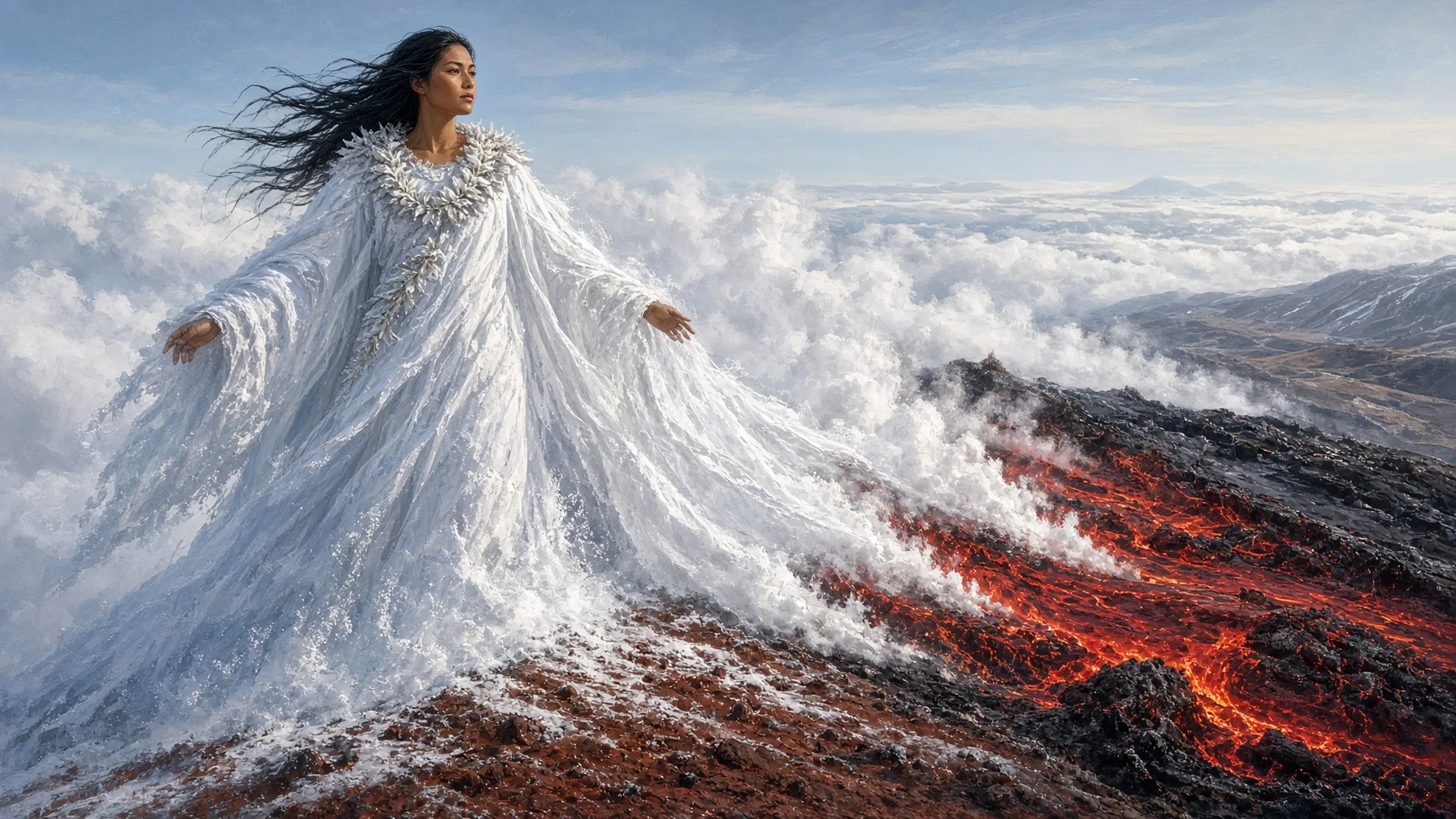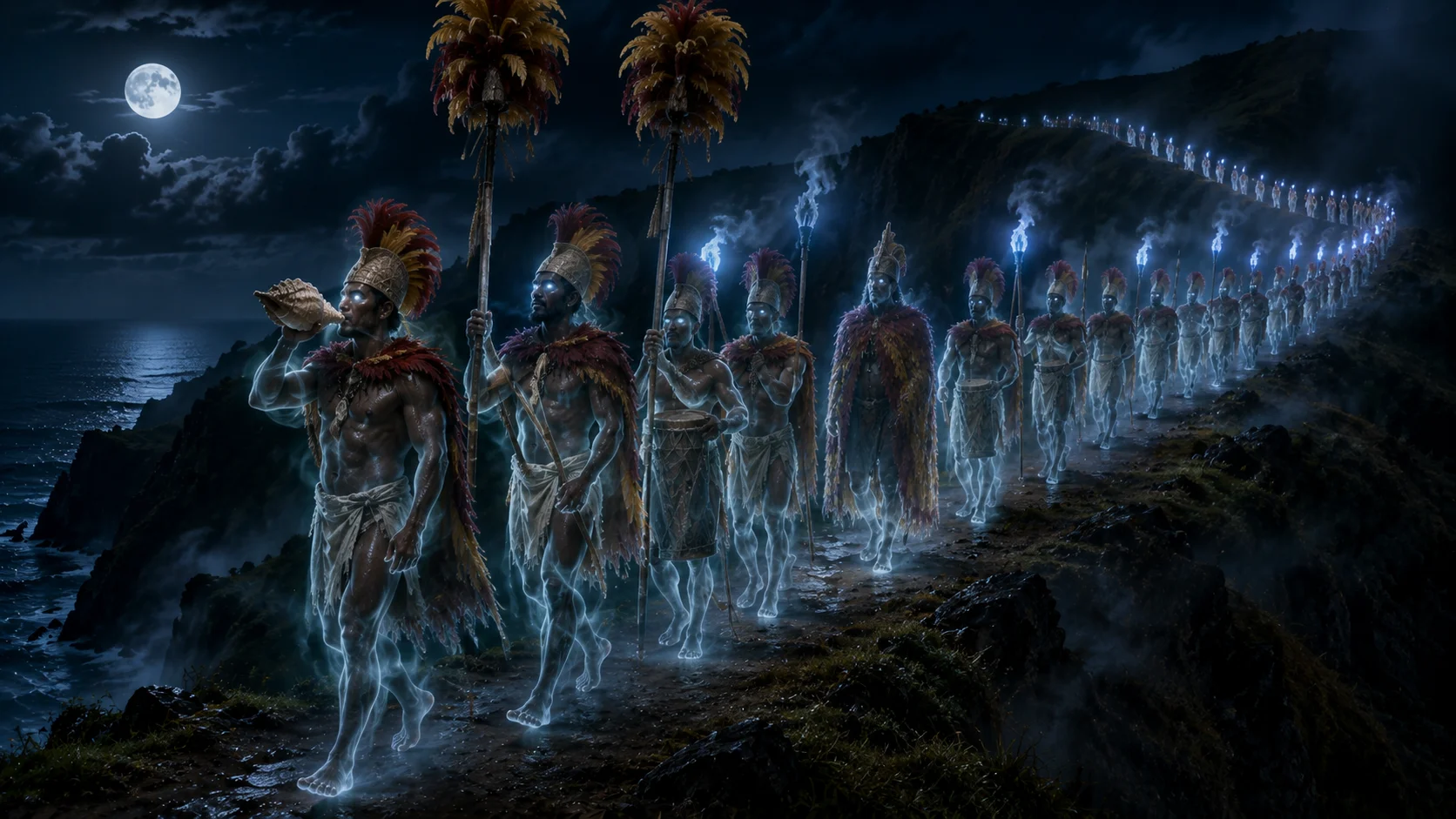
Hine-nui-te-po, the Great Woman of Night, is the Maori goddess of death and the guardian of the underworld realm of Rarohenga. She did not begin her existence in darkness. She was born into the light, and the story of how she came to rule the shadow beneath the earth is, in Maori tradition, the story of how death itself entered the world.
The Dawn Maiden Before the Dark
Before she was Hine-nui-te-po, she was Hine-titama, the Dawn Maiden, daughter of Tane and Hineahuone, the first woman formed from earth by Tane. Hine-titama grew into a woman of the morning light, unaware of the true nature of her own parentage, and in time she became the wife of the very father who had helped bring her into being. This was not deceit on her part; it was a truth withheld from her, and when it surfaced it would break her world in two.
The Question That Undid Everything
The unraveling came, as it so often does in these old stories, through a simple question asked in innocence. Hine-titama wished to know who her father was. When the answer reached her — that the man she called husband and the man who had shaped her mother from earth were one and the same — the shame of it was more than she could carry in the world of light. She could not undo what had happened, and she could not remain among the living carrying that knowledge.
The Flight into Rarohenga
So she fled, in shame, descending into the darkness below the earth. The maiden of dawn was already becoming something else in that descent — something the light could no longer touch, something that no longer belonged to the world she had grown up in.
A Name Taken in the Dark
In the underworld she took a new name and a new nature, becoming Hine-nui-te-po. Where Hine-titama had belonged to morning, Hine-nui-te-po belonged to the long night that follows every dusk. She made a division of labour between herself and the husband-father she left behind, one that Maori tradition holds to explain the shape of every human life since: Tane would remain above, raising their children — meaning all of humankind — into the world of light, while she would remain below, in the dark, gathering those same children back to her when their time in the light was finished.
Guardian of Rarohenga
As ruler of Rarohenga, Hine-nui-te-po does not merely preside over the dead; she receives them. Every person born into the world above is, in this telling, already promised to her — not as a punishment, but as a completion. Life is what happens in her husband's country; death is the return to hers. This is why she is remembered not simply as a figure of fear but as an ancestress waiting at the end of every genealogical line, the final relative every descendant of Tane and Hineahuone will eventually meet.
Maui's Ambition
Into this settled order came Maui, the trickster and culture hero whose exploits run through so much of Maori tradition — the demigod credited with slowing the sun in its course and hauling up the North Island, Te Ika-a-Maui, from the depths of the sea, and with bringing fire to humankind after his dealings with the fire goddess Mahuika. Maui had already tested the boundaries the gods had set for the world more than once, and he set his sights on the greatest boundary of all: the permanence of death itself.
A Plan to Reverse Mortality
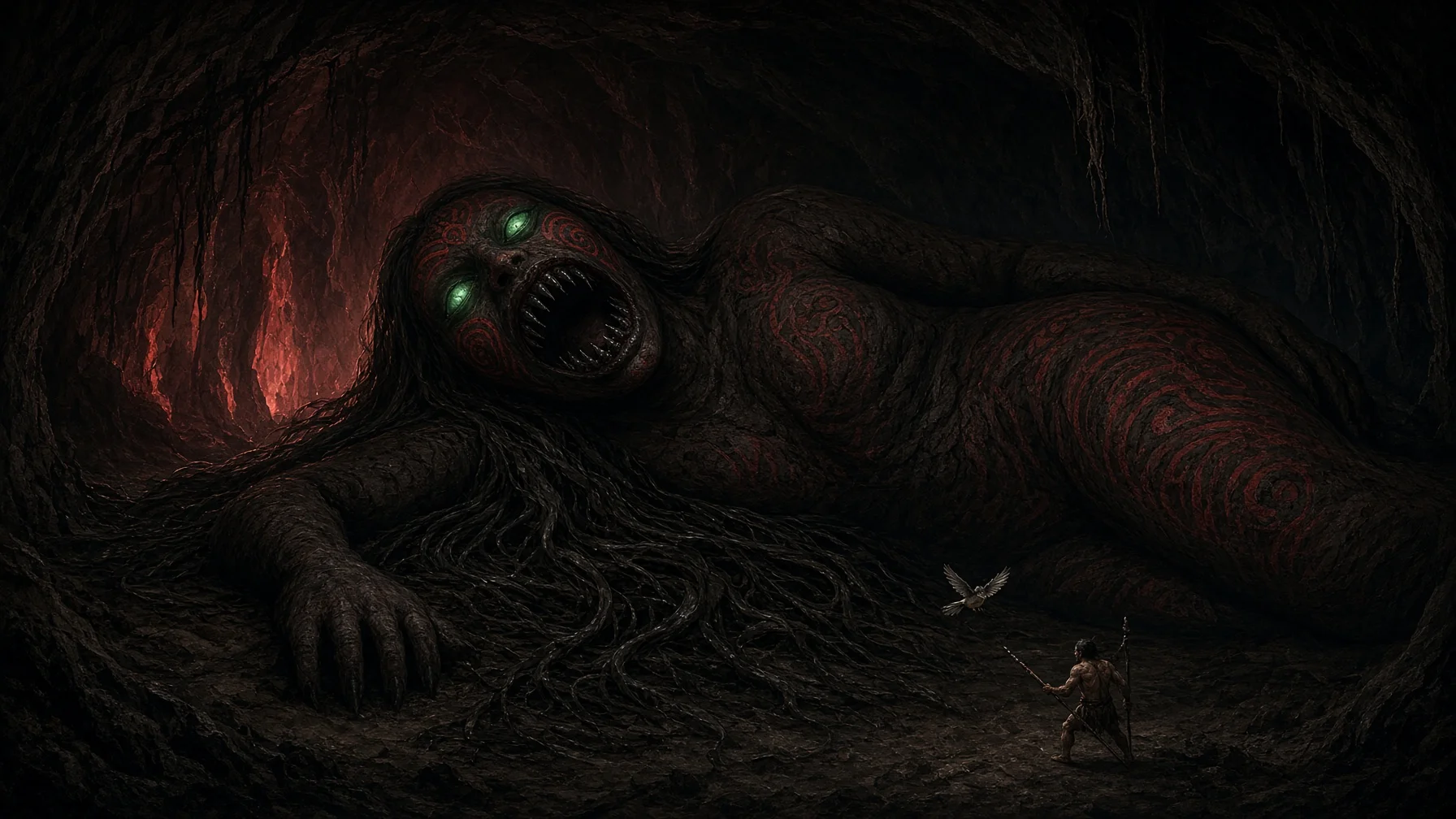
Maui's plan was audacious even by his own standards. He resolved to enter the body of the sleeping Hine-nui-te-po while she rested, intending to pass through her and be born again from her mouth — a reversal of birth itself, and with it, in his reasoning, a reversal of death for all of humankind who would follow his example. If a man could travel backward through the goddess of death and emerge alive, then death might no longer be the end it had always been.
The Laughter of the Fantail
As Maui made his attempt, a small pīwakawaka, the fantail, could not contain itself at the sight of Maui's legs disappearing into the body of the goddess, and its laughter rang out into the stillness. The sound woke Hine-nui-te-po. In Maori tradition it is said that her waking was immediate and absolute in its consequence: she closed around Maui and crushed him, ending the demigod's life in the very place he had hoped to defeat death.
Why Death Remains Permanent
This is remembered as the moment mortality was sealed for humankind. Had Maui succeeded, tradition holds, death might have been something people could pass through and return from, much as he intended to do himself. Because he failed — because a small bird laughed at the wrong instant — death remained what Hine-nui-te-po had already made it in her descent from the light: final, and hers to receive. The small fantail's laughter is remembered not as mischief without consequence, but as the moment on which the mortality of an entire people turned.
A Death Bound to Kinship
What makes this account distinct from a simple tale of a monster and a hero is the kinship running through it. Hine-nui-te-po does not defeat Maui as a stranger defeats an intruder; she receives him the way she receives every descendant of the world above, because in the deeper genealogy of these traditions Maui too belongs to the line that traces back through Tane and Hineahuone to Papatuanuku and Ranginui. Death, in this telling, is a family matter — the dark inheritance owed by every child of the light to the ancestress who once fled into the night rather than remain in a world that had shamed her.
Whakapapa: A Figure Among Many
Hine-nui-te-po does not stand alone in the genealogy of the Maori spirit world. She, Hine-titama before her transformation, and the fire goddess Mahuika are all placed within the broader whakapapa descending from Papatuanuku, the Earth Mother, and Ranginui, the Sky Father — the same primal union from which the whole of Maori cosmology unfolds. Seeing her within this genealogy matters, because it explains why her story is never told as an isolated horror. She is a relative, not an outsider, and the order she enforces below the earth mirrors the order her husband-father enforces above it.
Mahuika and the Fire Maui Carried Away
The same trickster who died attempting to defeat Hine-nui-te-po is remembered elsewhere for a very different confrontation with a very different ancestress. Mahuika, the goddess of fire, was said to keep fire hidden beneath her fingernails — and in some tellings her toenails as well — granting one to each finger as a source of flame for humankind. In the version recorded by Sir George Grey in 1855, Maui repeatedly extinguished the fires she gave him and returned again and again to demand more, until she grew angry and hurled her last fingernail at him, setting the world ablaze in a pursuit that ended only when Maui called on the rain gods to flood the flames. Afterward, Mahuika is said to have flung the last sparks of her fire into trees such as the kaikomako, mahoe, and totara — which is why Maori tradition holds that the dry wood of these trees is used for fire-making by friction to this day. Some tribal traditions further link Mahuika's fire to the volcanic and geothermal forces of the land, tracing her descent from Ruaumoko, the god of earthquakes and volcanoes.
The Wider Company of Maui's Deeds
It is worth pausing on how much of the supernatural landscape Maui touches, because it is his recurring presence that threads Hine-nui-te-po's story into the wider body of Maori tradition rather than leaving it to stand as a single, self-contained myth. The same figure who slowed the sun and fished up an island from the sea is the one who bargained with Mahuika for fire, and the one who finally overreached against Hine-nui-te-po herself. Each exploit ends differently — triumph with the sun, triumph tempered by a scorched world with Mahuika, and outright death at the hands of Hine-nui-te-po — but together they establish Maui as the figure through whom the limits of the world are tested and, in this final case, confirmed.
Other Figures of Rarohenga's Wider World
Hine-nui-te-po's domain sits within a spirit world crowded with other beings, each governing its own portion of Maori cosmology. Taniwha, the water-guardian creatures said to inhabit rivers, lakes, the sea, and dark caves, can act as protective kaitiaki of a hapu or iwi or as dangerous threats depending on their relationship to the people living near them; named taniwha such as Horomatangi in Lake Taupo and Tuhirangi near Cook Strait are tied to specific places on the land in the same way Hine-nui-te-po is tied to Rarohenga itself. Patupaiarehe, the fair-skinned, forest-dwelling people of mist who play the koauau and putorino and retreat before sunlight or fire, occupy the high country rather than the underworld, and some rangatira lines claim descent from unions between patupaiarehe and humans. Beneath the sea live the ponaturi, malevolent beings vulnerable to sunlight, whose conflict with the ancestor Tawhaki's family ended when they were trapped in a house and destroyed by dawn light. None of these figures crosses directly into Hine-nui-te-po's own story, but together they show a cosmology in which every realm — sky, forest, sea, and underworld — has its own guardian, and death is simply the portion Hine-nui-te-po was given to keep.
The Ancestress Who Waits
Hine-nui-te-po endures in tradition as both a fearsome and a necessary figure — not malevolent so much as final, presiding over Rarohenga with the same authority Tane holds over the living world above. Her transformation from the shining Dawn Maiden into the Great Woman of Night is carried in whakapapa as the mythological origin of mortality itself, the reason every life given in the light must eventually be given back into her keeping. In this she stands alongside Mahuika and the other figures descended from Papatuanuku and Ranginui as one of the ancestral forces that gave the Maori world its shape — not an abstraction of dread, but a genealogical relative whose choice, made in shame and sorrow at the edge of the light, became the fixed order the living and the dead still keep between them.
Sources & traditions
- EncyclopediaWikipedia — Hine-nui-te-pō
- TraditionMaori texts, oral tradition and village tellings (New Zealand)
Myths change from area to area and from time to time. This chronicle follows the most widely told versions; tellings in other villages, regions and eras may differ.