Tāwhaki stands among the great culture heroes of Māori tradition, a demigod born into a whakapapa charged with the power of the sky itself. Through his grandmother Whaitiri, the goddess of thunder, Tāwhaki carries storm and lightning in his own body — a birthright that marks him, from his very first appearance in the genealogies, as a being who belongs as much to the heavens as to the earth. His story, preserved across many tribal traditions and gathered by nineteenth- and twentieth-century recorders such as George Grey and Elsdon Best, is one of survival, grief, ascent, and the winning of sacred knowledge on behalf of humankind.
A Grandson of the Thunder Goddess
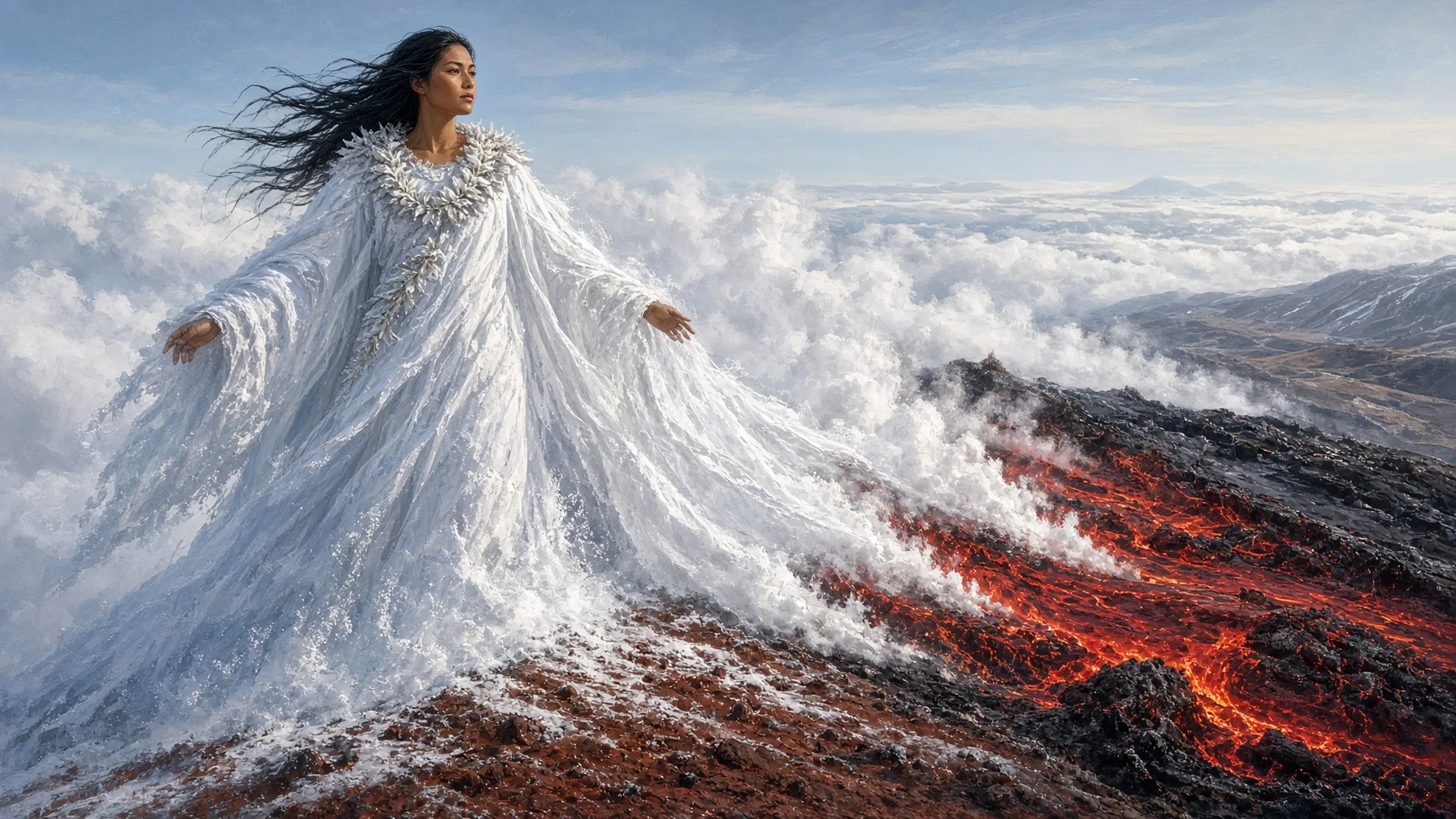
Tāwhaki's mana begins before his own birth, in his descent from Whaitiri. In the East Coast genealogies and in the traditions of several other iwi, Whaitiri is not a distant abstraction but an ancestress whose voice is thunder and whose presence in the family line explains, in the logic of Māori cosmology, why her descendants should be able to command the forces of the sky. This inherited authority over weather is not incidental colour in the Tāwhaki cycle — it is the mechanism by which everything that follows becomes possible. A being born of thunder's line is a being who might, given cause and courage, climb into the realm from which thunder comes.
Beauty, Envy, and the Ambush
The best-known turn in Tāwhaki's story begins not with triumph but with near-destruction. Tāwhaki was renowned for his beauty and for the mana that radiated from him, qualities that in many Māori narratives invite jealousy rather than simple admiration. His own brothers-in-law, resentful of the standing he held, conspired against him. In the accounts recorded by Best and Grey, they set upon Tāwhaki in an ambush, seeking to kill him outright — a betrayal made sharper by the fact that the attackers were his own kin by marriage, bound to him by the very relationships that should have guaranteed his safety.
Tāwhaki survived the attack, though grievously wounded, and it is here that the story turns from violence to devotion. He was found and nursed back to life by his wife — named in some tellings as Hine-piripiri, in others as Tangotango, the variation itself a mark of how many communities carried and reshaped this narrative as their own. Her care restored him, and his survival against kin who wished him dead becomes, in the wider arc of the cycle, the proving ground for the far greater trial still to come: the ascent to the heavens themselves.
The Vine That Held and the Vine That Gave Way
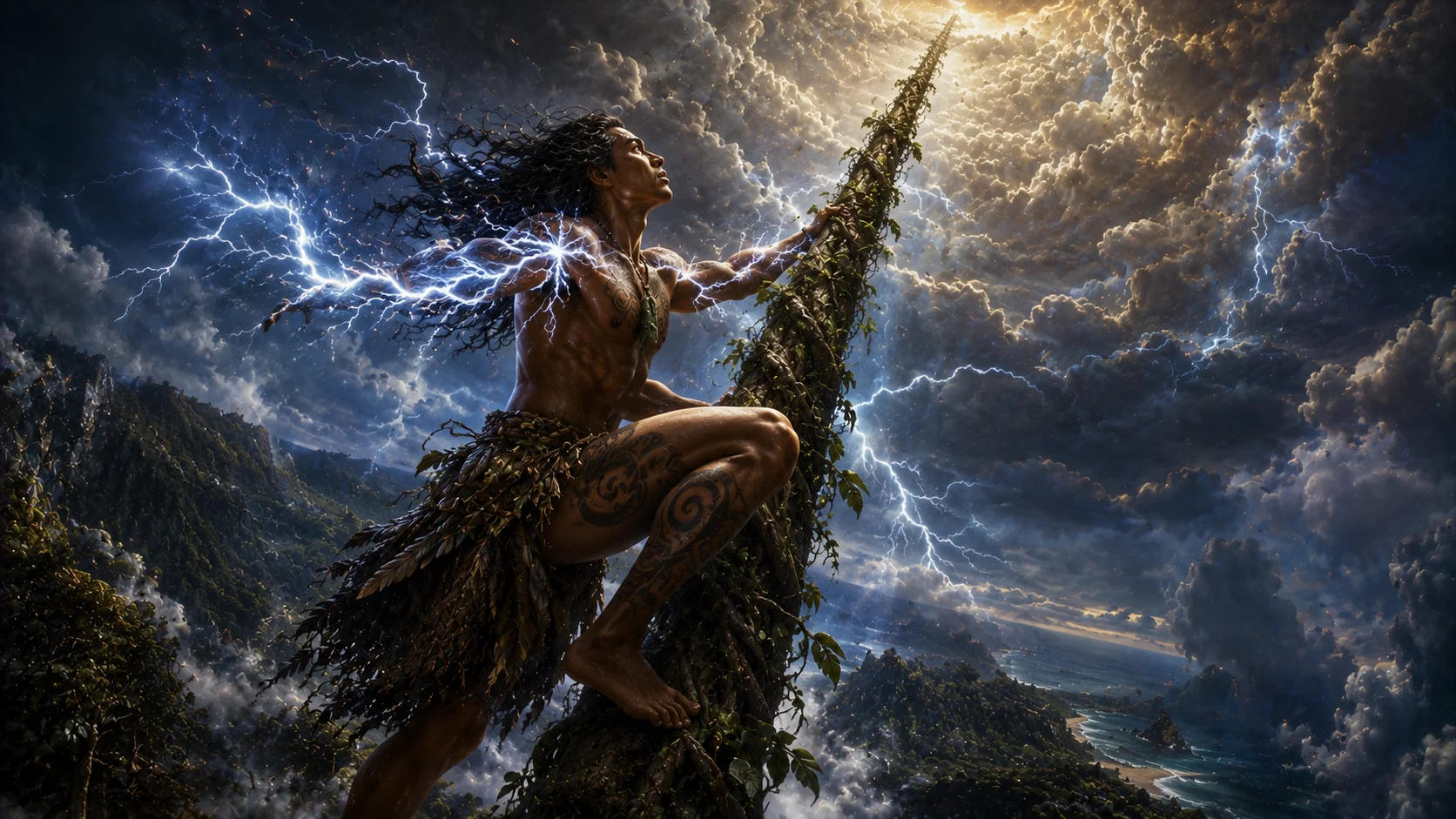
Having endured betrayal and recovered his strength, Tāwhaki resolved to climb into the heavens — not as an act of vanity, but to reach the highest of the many skies said to exist above the world of light, and there to seek out sacred knowledge withheld from ordinary humankind. An ancestress let down a means of ascent for him: in different tellings a vine, a spider's web, or a fine thread, stretching from the heavens down to where Tāwhaki stood.
Several tribal versions of the story sharpen this moment into a lesson rather than a simple feat of climbing. Two aka, or vines, hung before him: the aka matua, the parent vine, fixed firmly at its root, and the aka taepa, a vine that merely hung loose, unanchored, deceptive in its resemblance to the true path. In these versions Tāwhaki at first climbs the wrong vine, the aka taepa, and falls — a failure that is remembered and retold precisely because it teaches something enduring about discernment: that the path which looks sufficient is not always the path that is fixed to anything real, and that choosing rightly between what merely appears secure and what is truly anchored is itself the test. Only by taking hold of the aka matua, the vine rooted firmly to its source, does Tāwhaki complete the ascent.
Climbing into the Twelve Heavens
The heavens of Māori cosmology are not a single realm but a stacked series — traditions differ on the exact number, speaking variously of ten or twelve skies rising one above the other, each with its own character and its own keepers. Tāwhaki's climb was not merely upward but through this whole structure, sky after sky, until he reached the uppermost heaven, the dwelling place of the highest sacred knowledge available to any being who might attempt such a journey.
There he sought and obtained the kete o te wānanga, the baskets of knowledge — a body of sacred learning that, in the framework recorded by Grey, Best, and later synthesised by scholars such as Margaret Orbell, belongs to the same continuous genealogical mythology that runs from Te Kore through Te Pō into Te Ao Mārama, the world of light. Tāwhaki's ascent is thus not an isolated adventure but a thread within that larger fabric: creation, the search for knowledge, and the heroic journeys of demigods are treated as a single unfolding story rather than as separate tales standing alone.
Stamping Thunder into the Floor of the Sky
Tāwhaki's dominion over weather did not end with his climb — if anything, the ascent confirmed it. Several traditions credit him with the power to bring on rain and storm by stamping his foot upon the floor of the heavens, sending thunder rolling down into the world below. This detail draws a direct line back to his descent from Whaitiri: the thunder goddess's grandson, having proven himself worthy of the heavens by right of survival and by right of ascent, exercises in that realm the very power his line was named for. Where his grandmother's voice is thunder, Tāwhaki's footstep becomes it.
A Hero Who Belongs to Both Worlds
What distinguishes Tāwhaki from many other figures in Māori tradition is this doubled belonging: he is wounded and nearly killed among humans, nursed back to health by a human wife, and yet he is equally at home climbing into the highest heaven and commanding the weather from within it. He is neither wholly of the sky nor wholly of the earth, and the narrative draws its power precisely from that tension — from a hero whose triumphs above are always shadowed by the betrayal he survived below, and whose storms remind those on earth of a kinship that reaches upward into the heavens whenever thunder sounds.
A Thread Within a Larger Whakapapa
The Tāwhaki cycle does not stand apart from the rest of Māori cosmogony; it sits within the same genealogical framework that carries the story of Hine-Titama, the earth-formed daughter of Tāne who, on discovering that her husband was also her father, fled into the underworld and became Hine-nui-te-pō, guardian of the dead. Where that narrative explains the origin of human mortality, Tāwhaki's ascent explains the origin of sacred knowledge reaching humankind from the heavens — two movements, one downward into darkness and one upward into light, that together frame the world Māori tradition describes: bounded below by death and above by wānanga, with human life lived in the space between.
Echoes Among the Forest and the Fair Folk
Tāwhaki's story of trial, betrayal, and transcendence belongs to a wider company of Māori narratives that populate the world with beings of extraordinary power just beyond the edge of ordinary human life. The bird-woman Kurangaituku, who held the hunter Hatupatu captive among her tamed birds before he escaped her by outrunning her across a boiling geothermal pool, belongs to this same imaginative landscape, as do the patupaiarehe, the fair-skinned, music-loving beings said to dwell in misted forest hill country and to vanish from sunlight. None of these beings occupy quite the same place as Tāwhaki — he is a demigod of human whakapapa rather than a spirit of the forest or the mist — yet together they describe a Māori world in which the boundary between the human and the more-than-human was never a wall but a series of thresholds, climbed, crossed, or narrowly escaped.
Told and Retold Across Generations
Like much of Māori oral tradition, the Tāwhaki cycle survives not as one fixed text but as a constellation of tribal versions, each shaped by the iwi that carried it — hence a wife named Hine-piripiri in one account and Tangotango in another, hence the varying count of heavens, hence the differing details of exactly how the ambush unfolded and how the vine was let down. Nineteenth- and twentieth-century recorders such as George Grey and Elsdon Best gathered many of these versions into lasting written form, and later scholarship, including Margaret Orbell's synthesis of Māori myth and legend, has traced how these differing threads relate to one another within a shared cosmological structure. The variation itself is part of the tradition's integrity: a living body of narrative, carried by many communities, rather than a single authorised account.
The Lightning That Remains
Long after the ambush has been survived and the highest heaven reached, what endures most vividly of Tāwhaki in memory is the lightning and thunder still attributed to him — a demigod whose presence is renewed every time a storm breaks. In this way the story never fully recedes into the past. Each roll of thunder recalls Whaitiri's line; each flash of lightning recalls the grandson who climbed past treachery and false paths alike to stand in the highest sky and bring its power down into the world of light.
Sources & traditions
- EncyclopediaWikipedia — Tāwhaki
- TraditionMaori texts, oral tradition and village tellings (New Zealand)
Myths change from area to area and from time to time. This chronicle follows the most widely told versions; tellings in other villages, regions and eras may differ.